_Pollux writes_:
I’m feeling under the weather as I write this, and not because I so intensely dislike “John Cuneo’s”:http://www.johncuneo.com/ cover for the October 26, 2009 that it’s produced a negatively physical reaction in me, but because it’s flu season.
Perhaps it was inevitable that I should come across a virus one of these days. It waited for me in some dark alleyway or on some dirty doorknob. It eagerly waited for me with a set of sickness-carrying brass knuckles, and laid me low.
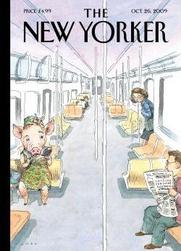
Cuneo’s subway passengers may also soon fall prey to sickness. They look alarmingly upon a very literal depiction of the swine flu. The porcine predator is putting on a disguise, ready to pucker up and deliver its insalubrious smooch upon unsuspecting victims. She wears old-fashioned clothes, but who can deny her present-day power?
The disguise isn’t a very good one. As the saying goes, you can put lipstick on a pig, but it would still be a pig. This was a “saying”:http://www.time.com/time/nation/article/0,8599,1840392,00.html#ixzz0VwUsQZ4c that of course achieved attention during the 2008 election and is the kind of folksy phrasing that politicians love to throw around and against their opponents.
Here Cuneo uses it as a link between the virus’ name and the fears and confusion surrounding it. No matter how many people shrug off the virus or the associated vaccine as a mere scare or scam, it remains among us. Denial is the lipstick that graces the unlovely lips of a pig.
Cuneo’s cover, called “Flu Season,” captures the fear and confusion that surround this flu season in which we have to contend with the ordinary flu and the swine flu. The H1N1 virus goes forth, claiming new victims, and at the same time a debate rages over whether people should take the vaccine or not.
“I am not going to take it,” Rush Limbaugh said, in an “address “:http://latimesblogs.latimes.com/booster_shots/2009/10/the-folks-who-publicly-said-they-would-rather-see-the-us-go-down-the-toilet-in-the-current-recession-rather-than-see-a-demo.html to Health and Human Services Secretary Kathleen Sebelius, “precisely because you are now telling me I must….I don’t want to take your vaccine. I don’t get flu shots.” Glenn Beck and Bill Maher, on opposite sides of the political spectrum, are also vocal in their skepticism of the vaccine.
As an _LA Times_ piece “commented”:http://latimesblogs.latimes.com/booster_shots/2009/10/the-folks-who-publicly-said-they-would-rather-see-the-us-go-down-the-toilet-in-the-current-recession-rather-than-see-a-demo.html, “this is not a liberal versus conservative issue. This is a science versus nonsense issue.”
Cuneo’s style reminds me of Barry Blitt’s in its mixture of inky lines and intentionally messy pools of paint. Cuneo, rendering the subway car in pen, inkwash, and watercolor, renders the subway car as a long, squiggly, scary hallway evocative of a hospital corridor.
The subway car is nearly empty; the cover’s central focus isn’t so much on the porker smeared with Lipfinity as on the desolate subway itself.
A female commuter steps on the subway car, uncertainly. She still has a chance to escape the virus. In the distance, a lone man quakes as he also looks up from a newspaper.
The pig looks seductively upon a man who reads a paper that announces the arrival of the flu vaccine. The pig has a “Come hither” look that would make the cover not out of place in Cuneo’s “_nEuROTIC_”:http://www.fantagraphics.com/index.php?option=com_virtuemart&page=shop.browse&category_id=417&Itemid=62, a recently published collection of erotic and hilariously perverse drawings.
The cover would be humorous if the prospect of getting sick were not so frightening. As another folksy saying goes, “sickness comes in haste and goes at leisure.”
Emdashes
This was a New Yorker fan blog