Emdashes—Modern Times Between the Lines
The Basics:
About Emdashes | Email us
Ask the Librarians
Best of Emdashes: Hit Parade
A Web Comic: The Wavy Rule
Features & Columns:
Headline Shooter
On the Spot
Looked Into
Sempé Fi: Cover Art


Dumb Quotes Are the Cold Tears of a Stick Figure
Filed under: Looked Into Tagged: design, dumb quotes, Jason Santa Maria, John Brownlee, punctuation, smart quotes, typography
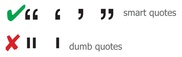 There are smart cookies and dumb bunnies. (The latter term can apply to men and women alike, as far as I’m concerned.) There are smart moves and dumbfounding decisions. And, as every discerning typophile, copy cat, and design devotee knows, there are smart quotes and dumb quotes. The image to the right is a succinct visual summary. The Society of Publication Designers feels so (justly) strongly about it that they made smart versus dumb quotes lesson number one in their essential-vocabulary series.
Most recently, John Brownlee at Fast Company’s Co.Design defines the problem and provides the solution:
(continued)

Dept. of Voice Acting: I Find This Charming
Filed under: Looked Into Tagged: Angela Lansbury, animation, Beauty and the Beast, Disney, film, movies, Mrs. Potts, Pocahontas, voice actors
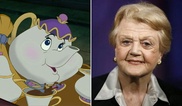 “I get recognized here and there as the voice of Pocahontas. It happened a lot more at the time when it had come out. I couldn’t go grocery shopping without some little kid in the front of the cart going, ‘Mommy—Pocahontas!’”
—Irene Bedard
“[Children] don’t know that I’ve done those other things. They know me by my voice because children hear me in a supermarket; sometimes I’ll be chatting with a friend about lettuce, and suddenly a child will say, ‘Mrs. Potts!’ It’s enchanting.”
—Angela Lansbury
Image from Voice Actors Who Look Like Their Characters
(continued)


Other New York Times Headlines About Snake Handling
Filed under: Looked Into Tagged: hogs, New York Times, Rattlesnake Pete, rattlesnakes, snake handlers, snakes, vipers, zoos
 Bill Haast, 100, Florida Snake Handler, Is Dead
Snake Handler Bitten by One of World’s Most Poisonous Vipers
Snake Handler Hospitalized After Suffering 102d Bite
Snake Handler Dies of Bite, As His Father-in-Law Did
Snake Handler Recuperating
Jolo Journal; When the Faithful Tempt the Serpent
Kentucky Man Killed by Rattler In Rite of Snake-Handling Cult
Defiant Snake Handler Dies
SQUEEZED BY AN ANACONDA; A TRYING MOMENT FOR AN EXPERT SNAKE HANDLER
Drought means booming business for Southern California snake handlers
Handling Hogs
SNAKE BITES A SHOWMAN; “Rattlesnake Pete” Gruber Thought to be Dying at Rochester
Zoo Burglar Tries to Steal Deadly Cobras; Mystery in Raid on the Bronx Reptile House
CHURCHES CHIDED ON MATERIAL AIMS
One African Takes Fangs Over Fido As a Sentry

Who First Said "Print Is Dead," Dr. Venkman?
Filed under: Looked Into Tagged: Bill Murray, comics, Ghostbusters, ghosts, Harold Ramis, magazines, Marshall McLuhan, movies, print is dead
Print is dead? I was watching Ghostbusters (1984) this weekend, and at one point the character Egon Spengler is asked a question, to which he responds: ‘Print is dead.” What is the earliest recorded use of this phrase?Among the satisfying replies:
I found a reference in the Antioch Review (1967) that uses “print is dead” as the characterization for Marshall McLuhan’s scholarship, which make a lot of sense to me in this context. This previously is also pertinent.And:
Someone else in that group also mentions that the “print is dead” line actually gained some popularity in the early 80s in tech circles as the personal computer gained prominence. It likely wasn’t the earliest recorded use, but Egon’s quote may have just been a result of the growing sentiment of the time.Meanwhile, a recent post on Movies.com answers the question I somehow didn’t think to ask, which is what the various Ghostbusters would look like if they were cartoon ghosts. Now you know. (continued)

The Contested Number of Years That Bill Murray Is Stuck in Groundhog Day
Filed under: Looked Into Tagged: Bill Murray, Danny Rubin, film, Groundhog Day, Harold Ramis, math, movies, Punxsutawney Phil
Harold Ramis says ten. (The screenwriter, Danny Rubin, invites you to pony up to find out what he thinks.) These folks say eight years, eight months, and sixteen days. My favorite estimate comes from this brilliant breakdown, which gives it as 12,403 days of Sonny and Cher and sweet vermouth on the rocks with a twist, or almost 34 years. Poor Phil. He really earned that happy ending.
—Emily Gordon
(continued)