Emdashes—Modern Times Between the Lines
The Basics:
About Emdashes | Email us
Ask the Librarians
Best of Emdashes: Hit Parade
A Web Comic: The Wavy Rule
Features & Columns:
Headline Shooter
On the Spot
Looked Into
Sempé Fi: Cover Art


This Just In: E.B. White Was Versatile
Filed under: The Squib Report Tagged: Complete New Yorker, E.B. White, fiction

Absolutely first-rate story by White makes me think I completely misunderstood Stuart Little. A man who works on a Stratovideo plane in the nascent television industry writes the story of the end of the world. This story is so up-to-date you’ll whimper with fear by the end. Highly recommended.Mercy! Well, I couldn’t resist an endorsement like that. I busted out The Complete New Yorker to have a look.
I won’t admit to whimpering, but the story is very well turned indeed. It’s got a few dated bits but not too many; Christensen has a point that it holds up well. (Good writing remains good writing.) It reminded me of nothing so much as 2001: A Space Odyssey, which I suppose is unavoidable. (If you’re wondering, Arthur C. Clarke’s story “The Sentinel” was written a couple of years earlier but seems not to have been published right away.)
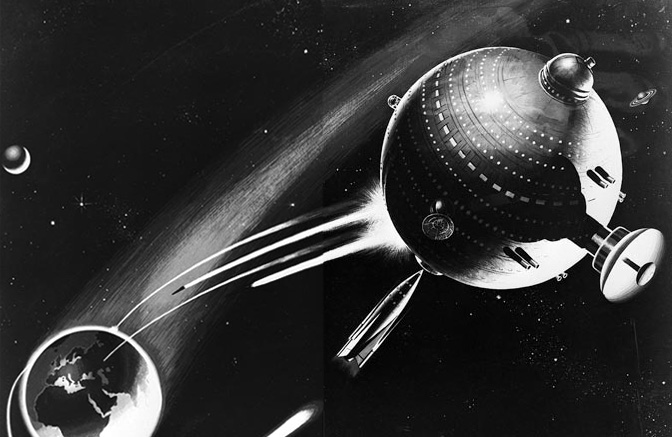
Just to enhance the mood, here’s a 1949 painting of a similar object by legendary fantasist Frank Tinsley:
The story is full of imaginative touches—the Americans invent a pesticide that accidentally kills off all the birds and the bees (except for the whooping crane, for some reason), and all human beings have to get a special injection every three weeks in order to ward off the poisons now in the food. The story features a TV studio in outer space and a character named Major General Artemus T. Recoil.
And the United States does end up destroying the world, but you know what?
We meant well.
—Martin Schneider

Comments
Though White is one of my favorite authors, I always found “The Morning of the Day They Did It” to be overdone. Maybe I need to re-read it.
I suspect you won’t find anything in it that you fail to remember now. It’s not a great story by any means, Christensen does overstate. I’ve been spending the last two weeks looking at short stories from the 1930s and 1950s, and by and large the latter group is far better. This story would be one of the better ones from 1935, but not of 1950, most likely. But in the overall group it stands up pretty well — for someone whose main line was not sci-fi.