Emdashes—Modern Times Between the Lines
The Basics:
About Emdashes | Email us
Ask the Librarians
Best of Emdashes: Hit Parade
A Web Comic: The Wavy Rule
Features & Columns:
Headline Shooter
On the Spot
Looked Into
Sempé Fi: Cover Art


Sempé Fi: Turkey Run
Filed under: Sempé Fi Tagged: art, covers, Emily Coates, George Booth, Michael Quinion, Pollux, Thanksgiving, turkey, words

Pollux writes:
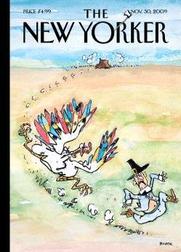
The November 30, 2009 cover of The New Yorker gives us the traditional Thanksgiving images of Pilgrim and Turkey. However, in the hands of an experienced artists like George Booth, the relationship between Pilgrim and Turkey is turned upside-down. Booth gives us a “Thanksgiving Skedaddle.”
Booth’s executioner is not the hale and hearty pilgrim he used to be. He cuts a pathetic figure, his shirt flapping in the wind, his belly button exposed. The old pilgrim is skedaddling and skedaddling as fast as he can.
The angry turkey has overpowered him. It displays its colorful feathers in an angry ruffle that dominates the cover. The bird’s cruel talons cut through the November air like corn threshers. They near their target.
It must have been a sudden coup. Perhaps the turkey remained quiet and cooperative until it rested its head on the chopping block, waited until the pilgrim raised his axe, and then -a sudden explosion of anger and rebellion. The pilgrim’s axe still spins in the air.
George Booth creates the illusion of rapid and sudden movement with his combination of narrow, black brushstrokes and wider, colored ones that capture the chaos of angry bird chasing surprised man. Splashes of imperfect spots and lines add to the chaos in this scene. (The word “skedaddle” may in fact derive, according to this piece by word expert Michael Quinion, from the Scots skiddle, meaning to splash water about or spill.)
Instead of a genteel, calm scene of Thanksgiving splendor, Booth gives us humor in a scene in which the Thanksgiving tables are turned. As Emily Coates points out in her article on New Yorker cartoonists, “chaos typically reigns in a Booth cartoon. Auto body shops, junkyards and shanty interiors establish the ambiance. Cats and dogs hang about. Characters squabble.”
Coates’ article also points out that Booth is part of an older guard of New Yorker cartoonists whose work appears less often in recent years. Nevertheless, Booth’s brush still wields enormous power to amuse and entertain. His work remains funny, effective, and interesting. I give thanks for Booth.