
Monthly Archives: October 2007

“It’s Literary Women That I Drive Hours to See”: Annie Proulx and Junot Diaz

Continuous reports from the 2007 New Yorker Festival.
The audience who gathered for a reading from these two authors was a human Chex mix: bits and pieces of every group were there to listen to Annie Proulx and Junot Diaz, who write in different styles, have different cultural backgrounds and different styles of writing, and clearly respect each other a great deal as friends and as artists.
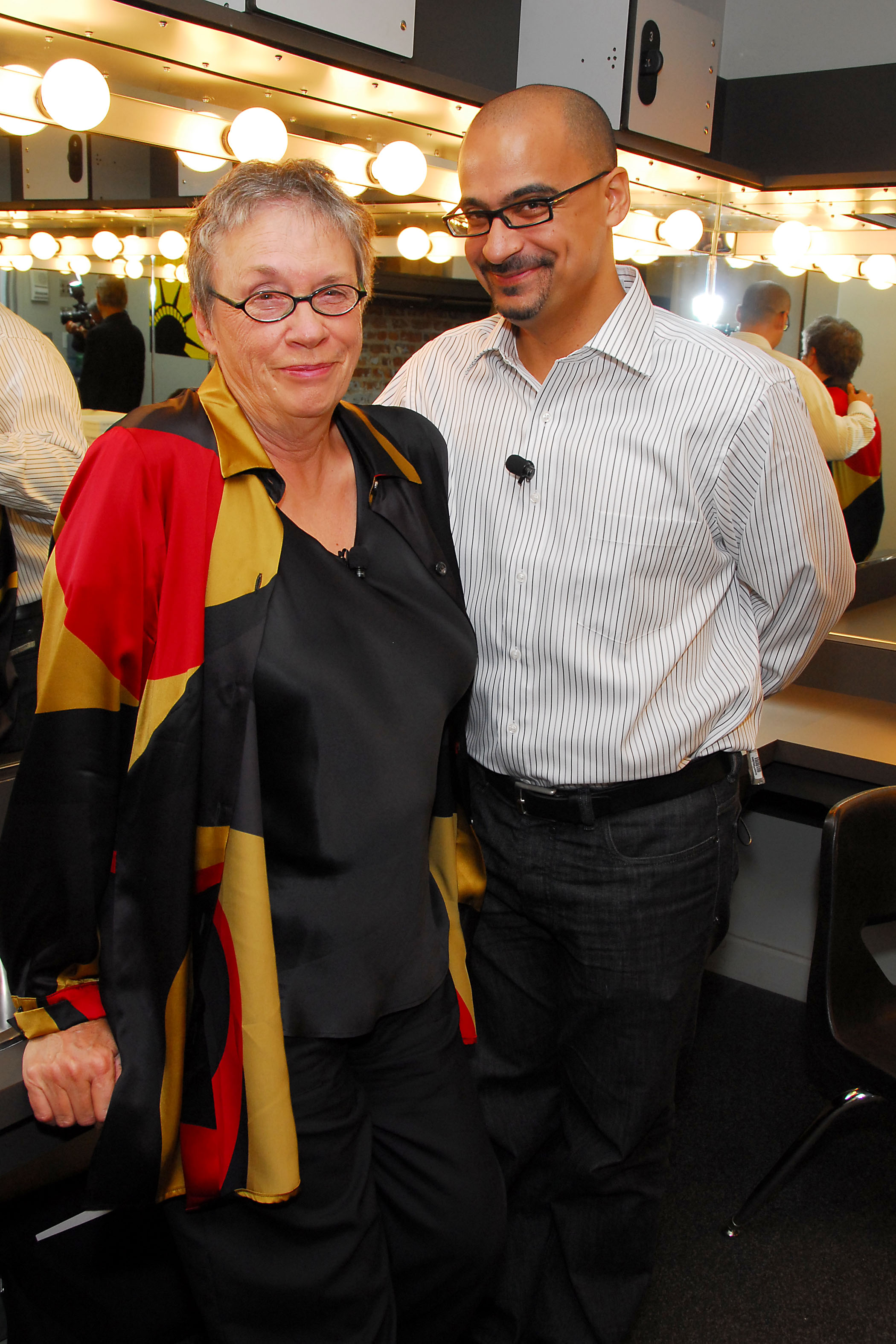
proulx.JPG

High energy abounded. “It used to Mick Jagger that got me excited,” said the woman next to me. “You know, rocker boys. Now it’s literary women that I drive hours to see.” Junot Diaz read a short paragraph from his novel The Brief and Wondrous Life of Oscar Wao—a paragraph in which, once again, his protagonist was being beaten up. He was self-deprecating as he read, apologetic to the audience, as if we wouldn’t enjoy his beautifully constructed sentences and wordplay. He was mistaken.
He talked about the fact that he continues to write short stories about humans and their failings in relationships. “As long as you keep cheating, I’ll keep writing.” he said. To prove this, he read the story of Alma and her lover; Alma has long arms, beautiful legs, and “an ass that exists beyond the 4th dimension.” Alma is all her lover isn’t, but as much as he loves being with her, he cheats on her, writing it all in his journal—which she finds. It’s not the journal that is his downfall, though, but the lie he tells to explain the contents that end it all with the delectable Alma.
Annie Proulx spoke briefly of the book she’d just finished about Wyoming’s Red Desert. When asked by a friend to write the text in his book of photography on that part of the country, she was surprised to find nothing written about it, and it became her next project to produce a book of short stories set there.
As she was researching the book, someone asked her to fill the chasm in sagebrush stories—less than a dearth, there have been none till now—and that brought about the short story she read next. “The Sagebrush Kid” is about the Sandy Skull stagecoach station, run by Mizpah and Bill Furr. Unable to have children, thwarted by eagles and coyotes not understanding that the piglet and dressed-up chicken were substitute children (you had to be there), Mizpah adopted a special sagebrush, and fed it gravy and bones and, well, that sagebrush grew and grew. While it grew, the station gained a reputation of, shall we say, not a place you wanted to spend the night.
Laced with the wonderful richness of language Proulx uses in all her work, we heard sentences that were spectacular in their music and accuracy: “He would buy cattle for a song, fatten them up, then sell them for an opera.” The story ends years later, with the understanding that the Sagebrush Kid has a cousin somewhere, and her name is Audrey.
The Q. & A. that followed was brisk, with both authors advising other writers to remember that fiction has to be disciplined, very structured and organized. Diaz said he felt that Proulx respects humanity, and that he’s a “self-hating boy,” because Proulx treats both sexes equally in her writing and doesn’t allow her subject matter to be defined by her sex. It was obvious that despite their differences, both writers have a great deal of admiration for each other, and that made for a cozy, stimulating evening.
—Quin Browne (Read more about Quin.)


Festival: Matched sets, a Theme?

It’s funny: I assume photographic evidence is forthcoming, but Pamuk and Rushdie were similarly dressed — striped, light blue dress shirts and dark pants.
Saunders and Foer were likewise similarly dressed. Both had lavender- or lilac-dominated tops (in Saunders’s case, a tie) and jeans. Their clothes matched the backdrop.
Are these panels being costume-designed? Is “costume-designed” even a word?

Festival: Saunders and Foer Get Incredible

If the High Line Ballroom is an interesting venue, the Angel Orensanz Foundation is a gorgeous one. Not having ever been there before, I cannot divulge whether the blue and purple rear facade is a permanent feature or a creation of the lighting crew. Either way, the effect was jaw-dropping.
In these stately trappings, Saunders and Foer explored the concept of the Incredible. It was an interesting evening of chat. Unlike the earlier Pamuk/Rushdie event, Foer and Saunders genuinely didn’t see eye to eye on more than a few matters, and therefore something rather unexpected occurred — genuine hortatory verbal sparring, albeit respectful.
Both writers seemed honestly nonplussed to hear their work discussed in such fantastical terms. For Saunders, the emphasis is squarely on keeping the reader diverted; his craft manifests in getting the reader to keep reading — indeed, this is true of all writers in some measure: “Whatever effects you get, you only get them by being Groucho Marx.” Foer’s quick concurrence focused on the need to keep reader #1 entertained: “I have shut my own books, so many times….” Saunders later wished for temporary minor lobotomies, such that the author could approach each day’s work as if for the first time: “Paragraph three sucks. I ain’t readin’ any farther.” What others see as the outlandish in Foer’s work, he sees as a simple testing of the boundaries of the way things are. In his words, “nothing could be more real.”
Saunders is a natural cutup, as seen in his effort to explain the “baseline” narrative mode. If lion eats brother, the next day the discussion’s telling will be grounded in the reality of the lion. Once you’ve established the lion’s reality in story, then you can do something about it: “Let’s go get him; you go first.” On craft, Saunders often seemed the more insightful speaker, but that misses the point. Saunders got where he is through hard work, trial and error, and many false trails down Hemingway Lane. Not to dismiss the role of toil in Foer’s daily lot, but he’s clearly a natural. His description of seeking to induce “rigor mortis” in his readers was indelible, as was his heartfelt avowal of the importance of Kafka to his work. Never did they disagree more than when the subject turned to advertising, a staple of Saunders’s work and a subject he discussed with scarcely disguised glee (Foer’s take verged on horror). It was interesting to hear Saunders conjure a Tolstoy capable of describing both sides of the advertising transaction, the crone that advertising exploits and the advertising executive who exults in the artistry of it.
Foer explained his powerful ability to compartmentalize (when he’s not writing, he doesn’t think about it much) with a wonderful comparison. You may love swimming all the time, but when you’re not in the water, you’re not swimming. —Martin Schneider

Festival: Pamuk and Rushdie Go Home

The High Line Ballroom is a very interesting venue. It’s not very big, yet still a ballroom. All that dancing space taken up by a modest yet dense grid of rectangular tables. I was fortunate to get a table right in the front. I recommending arriving early at High Line Ballroom events; proximity may make the difference.
You will be seated with others; at my table was a young couple discussing Pamuk’s brief contributon to the Food Issue and James Watson’s “ornery” appearance a few days ago. (How often do you hear the phrase “This is the second Nobelist I’m seeing speak this week”?)
Pamuk and Rushdie thankfully ignored the Bushian undertones of the word “homeland,” opting instead to focus on the place of one’s upbringing, the place where one’s mother lives. (Rushdie pointed out that Pamuk’s oft-invoked mother, meant as a symbol for familiar trappings, loomed large over the proceedings.) The two men saw eye to eye on many matters; it was telling where they differed. Rushdie observed that a man who never leaves home is “sad”; Pamuk dissented, preferring to pity the man who is widely traveled and yet finds home in every foreign artifact. Pamuk made a point I found quite penetrating, to the effect that one can be sure one is not at home when one feels no responsibility for the state of affairs where one is. Rushdie impishly said, “I find Orhan’s sense of responsibility comforting; I’m in favor of irresponsibility.”

2E8CA74F00B2E8CA74D237FF.jpg

Pamuk’s English is strongly accented (and largely article-free) and yet, as befits a man of very wide reading, he had an uncanny knack for choosing the correct word. Where Rushdie was delightedly puckish, Pamuk was well-nigh sermonic, and yet charmingly so. Pamuk ventured some wisecracks, none of which went over; yet his “straight” discourse was often more effortlessly amusing, not least when he explained how much it pisses him off when westerners feel compelled to pigeonhole his accessible works as self-evidently limited to “Turkish” love or politics.
Rushdie’s easy whimsy manifested itself in several good anecdotes, such as when he described his mother as a “Garcia Marquez” of local gossip. He also told a wonderful story about the eye-opening feats of New Yorker fact-checkers, who requested that he alter a stray name reference so as not to coincide with the actual contents of the Bradford, UK, telephone directory. Rushdie demurred (in my view rightly).
Perhaps the most startling moment in a very diverting evening was when Rushdie pronounced Updike’s The Coup as “one of the worst novels ever written.” —Martin Schneider

Breaking: Some Events Sold Out at HQ; Many Tickets Still Available

As of 6pm Friday at the New Yorker Festival headquarters (which had closed for the day), the following events were sold out. To the best of my knowledge, tickets to all other events are still quite readily available.
Saturday:
Anthony Lane/Simon Schama
Seymour Hersh/David Remnick
Steve Martin/Susan Morrison
Samantha Power/Darfur
Sigur Ros
“The Kite Runner,” Khaled Hosseini
“Encounters at the End of the World,” Werner Herzog
Sunday:
Bagels with Bob
Behind the Scenes at the Museum
Come Hungry
Inside the Artist’s Studio
The Next Century’s Newsroom
Judd Apatow/Seth Rogen/David Denby
Oliver Sacks
Susan Orlean/Mark Singer
I saw a college-aged woman let out a loud yelp when she noticed that the Fiona Apple event wasn’t sold out yet. And then ran over to the ticket table.
Again, some tickets are also being held at the individual venues for each event. Good luck!

Festival: And They’re Off! (Their Rockers)

I’m actually at Festival HQ before it’s “officially” open. Out front throngs of people are clamoring for the tickets that the Festival has set aside. I noticed that all of the pricey Sunday morning events are now sold out, which is perhaps to be expected, as are the Pamuk/Rushdie event plus Sy Hersh, Simon Schama, Steve Martin and a few others. Plenty of good events, left though, even if they’re vanishing by the half-hour.
The chaos out front is only somewhat mirrored in the headquarters itself. I’m comfortably ensconced in the “Acura Lounge,” where it is posted that complimentary coffees will be made available. Not that I’m partaking—I’m wired enough as it is. According to the Festival Wire cellphone updates, Acura will actually be ferrying people from HQ to events, which I find rather remarkable (I think I’ll take them up on that!).
I’m currently seated amid a welter of controlled hubbub, as motivated young people scurry hither and thither, arranging the Cartoon Bank displays, wiring banks of lights, distributing attractive candles to all tables, and the like. I extend thanks to Josh at Scharf Weisberg and Melissa and Lisa at the New Yorker for helpfully ensuring me WiFi access even though HQ isn’t “officially” open yet. They can all add “liveblogger wrangler” to their resumes.
BoingBoing Gadgets was touting a T-shirt today that actually lights up when you are near a strong WiFi signal.


wifishirt.jpg

What I wouldn’t give for one of those for this weekend! (This assumes that Josh, Melissa, and Lisa won’t be catering to my every whim for the next three days, which admittedly seems like a longshot.)
—Martin Schneider

Joining the Coalition of the Willing: Greetings From Our Roving Correspondents

Martin and I will be reporting from the New Yorker Festival throughout the weekend, so look for our frequent reports! In the meantime, there are a few other people we’d like you to meet. —E.G.
Toby Gardner: With the New Yorker Festival upon us and so many events scattered across the city, the Emdashes Powers That Be (EPTB) saw the need for a new strategy: the Pepper Mill, whereby several correspondents are sprinkled throughout the proceedings like so many flavor-enhancing spices. And I am one of their new recruits. I hope I get called up for tonight’s chat between Miranda July and A.M. Homes on Deviants. There’s also a Town Hall meeting about the war in Iraq, but how relevant is that, really?
Although EPTB offered to pay off my student loans in exchange for my services, I said that really wouldn’t be necessary. [While we’re at it, we really should pay off ours, too. —Ed.] The honor to help cover this exciting festival is payment enough. So if you see a bald guy with a Mac G4 and a winning attitude, say hello. I’ll be working hard to make ensure that Operation Pepper Mill is a success.
Quin Browne will be covering a couple of events for Emdashes this weekend. She was born in New Orleans under one name, and writes in New York under this one. Blatherings about this and that can be found at www.fmdn.blogspot.com; actual shorts are located under her name at www.sixsentences.blogspot.com.
Tiffany De Vos‘s name and musical tastes owe much to the ’80s. She is a poet, pet chinchilla enthusiast, and teacher. Her stories and poems have appeared in Pedestal, The Saint Ann’s Review, Washington Square, Small Spiral Notebook, and the Global City Review. Her hair often falls over her right eye, but she is by no means a hipster.

Ira Glass and the Nonfictioners of Nonfiction

The youngsters of Chicago, city of kickass editors, could probably use a bit of sound instruction on whether the term is properly styled e-mail email e-mail, and we think that 826 Chicago is just the outfit to provide some solid guidance on that subject as well as “their creative and expository writing skills,” as they put it.
Think of it as the New Yorker Festival afterparty. On Monday, October 8, Ira Glass is hosting a benefit for 826Chi at Town Hall. The event is called “The New Kings of Nonfiction,” and showcases such New Yorker-affiliated lights as Malcolm Gladwell and Susan Orlean, not to mention Chuck Klosterman. Ira may be the finest “so wait” clarifier in the history of spoken utterance (listen for it on This American Life), and to see him do it live is surely the equivalent of watching Roger Federer hit a backhand or something.
Be diverted, help Chicago’s youth—not a bad combination. Our only complaint is that Maria Bamford, genius Comedian of Comedy, isn’t part of the lineup; she adds such goofy, nervy pizazz to every stage she’s on. —Martin Schneider

Close But No Cigar: Bethune Bethune Bethune Bethune Bethune…

In this engaging blog interview courtesy of the 92nd St. Y, Judith Thurman discusses good cabbies, bad cabbies, her many New York residences (one was on Bethune St.), Jane Jacobs, the upside of apocalypse, and beastly New York summers. (I disagree on this point—I love NYC when it gets all empty in August.) Thurman is obviously a New Yorker’s New Yorker, a locution that puts me in the mind of “Buffalo buffalo Buffalo buffalo buffalo buffalo Buffalo buffalo,” which I just found out about yesterday and which has been giving me headaches ever since (but the nice kind).
I’m not in town on October 28, but you might be. (I know, you didn’t ask.) Do hasten over to the Upper East Side and have brunch with her at the 92nd St. Y. I’m sure it’ll be a hoot. —Martin Schneider

A Festival to Remember: 2005 Treats From Beatrice

I covered my first New Yorker Festival for the generous and dedicated Ron Hogan (a.k.a. Galleycat) at Beatrice. To get a taste of life back in the fifth year of the new millennium, and the thrills that emanate from the festival generally, take a trip in our Just a Little Bit Back Machine and enjoy!
Festival! Emdashes reporting for duty. Tomorrow I’ll begin what I hope will be fanatically detailed coverage of the New Yorker Festival, because that’s when I’ll know which events I’m definitely going to. Sadly, I must miss Calvin Trillin’s tour of Chinatown…
Ready, set… go forth into the New Yorkerness of it all! Here’s the lineup—the sparkliest bunch of people I’ve ever been around in the course in one weekend, except maybe for the Saturday Night Live cast party my friend Scott, a tall short-filmmaker, took me to a number of years ago…
Chang-Rae Lee is going to have to knock my socks off… to sway my gaze from Lorrie Moore, of whom I have long been an ardent fan. He’s great, don’t get me wrong. But Lorrie Moore: When, like, life makes you wonder who the heck will run the frog hospital…
Live from the 57th St. McDonald’s Jonathan Franzen: “Sometimes we worry that the novel will become like poetry in a few years.” Cressida Leyshon on Zadie Smith…
Themes so far: Birds, Gates Tomorrow morning, more about Chang-Rae Lee, Lorrie “American Idol” Moore, Zadie Smith, Jonathan Franzen, and Star Question Girl of the Night. These themes have emerged: birds…
Hey other journalists covering the New Yorker Festival! Have you been wondering why can’t download any photos of the events on StarTraks? I called them. They checked and found out…
Live from Saturday afternoon! It’s going to be a bit easier to blog many-venued events like this when New York becomes (surely it will?) an all-WiFi-city, like the pleasingly cutting-edge Salem, Mass., or, soon if controversially, Philly. Anyway, I’m in Bryant Park, having just heard an intriguingly academic, consciously nonpolitical, occasionally contentious dialogue between Mikhail Baryshnikov and New Yorker dance critic…
A reader writes: “But today, more to the point of my writing, what is a “fuckable shame cycle”? And how exactly is Franzen in this what-ever-it-is? Read the previous info on your site about Franzen, and the link takes me to a laudatory review of a non-fiction essay of his.” Hello, reader! You mean shame spiral, right? Oh, you know…
The Amazing Adventures of Kavalier and Cujo Gentle giants sign their books as fans go wild. Check out Chabon’s grin…
30% juice in the iBook and there’s still Steve Martin and the cartoonists to go. I want you to know that in the interest of maximum New Yorkerness and blogger/performer ratio, I’m passing up Nancy Franklin interviewing Ricky Gervais—that’s two of the cleverest, bitingest people I know of…
Updike with people: “Was John Updike full of elegant ideas and excellent elocution? Did a nicely suited David Remnick ask respectful questions and gently tease the Rabbit raconteur about his stellar work ethic and multiple writing desks facing the sea?”…
Note: no blinking. [See photo of Malcolm Gladwell and friend.]
On beauty Zadie Smith is seriously talented and she has great clothes…
The curious incident of the quotes in the night-time “Someone once said to me that reading Lorrie Moore is like being tickled to death.” —Deborah Treisman, New Yorker fiction editor…
Not ersatz, RZA! I am really very bummed…
So was it the greatest night of my life? It was pretty damn great. Seeing and hearing Earl Scruggs and Steve Martin (pictured, with Pete Wernick; all the musicians there were fantastic) playing banjo together did indeed turn out to be sublime, as sad as Martin happily advertised the banjo sound to be…
Remnick with clarinetist From “Parting the Waters,” the big Saturday night Katrina relief benefit…
The song is over, but the melody lingers on The festival is done. But I’m not. (Did you think I would be?) For another day or so, or as long as Ron will let me, I’ll post the carefully selected best of my copious notes and a few wrapups of all the events I attended, plus sketches of some of the characters I encountered…
Chast & Nancy I love this photo. I’d been thinking, during the Ricky Gervais talk the previous night, that there’s something Chast-y about the fabulous Franklin—albeit, on the stylish end of Chast dames—and clearly others have had the same thought…
A sleep trance, a dream dance, a shared romance, synchronicity New Yorker Festival wrapup quiz! Match the statement with the speaker…
Last stand I’ll probably post once or twice more before Ron returns. For now, here’s a funny exchange from David Remnick’s talk with John Updike on Saturday…
Alchemy of New Yorker cartoons revealed! All you need to know about this astonishing revelation is…