From the New York Public Library’s website:
A Tribute to NUALA O’FAOLAIN
Tuesday, June 24, 2008
at 7:00 PM
Celeste Bartos Forum
Humanities and Social Sciences Library
5th Avenue and 42nd Street (directions)
THIS EVENT IS FREE but reservations are required. Make reservations.
Friends and fellow Irish writers of Nuala O’Faolain, who died in Dublin on May 9, will gather to pay tribute to one of Ireland’s best-loved writers.
Internationally known for her searing memoir, Are You Somebody, as well as her acclaimed first novel, My Dream of You, O’Faolain was widely respected in Ireland as an award-winning television producer, journalist, and columnist for The Irish Times before her memoir caused a sensation on its publication in 1999. Her unblinking, unsentimental description of an impoverished Irish childhood that struck a chord with readers world-wide became a New York Times bestseller.
Frank McCourt, Paul Muldoon, Fintan O’Toole, Polly Devlin, Julie Grau, Sheridan Hay, John Low-Beer, and others will honor Nuala O’Faolain’s life with reminiscence, traditional music, and readings from her work.
Special live musical performance by vocalist Susan McKeown, guitarist Eamon O’Leary, fiddler Dana Lyn, and piper Ivan Goff. During March 2005, McKeown appeared with O’Faolain at LIVE from the NYPL.
Monthly Archives: June 2008
Flashback: Nancy Pelosi Channels Bob Mankoff
I’m glad to see Nancy Pelosi get her due. Her detractors, who have at times been legion, never seem to notice that the Democrats have had an unusual streak of good fortune since she assumed the leadership of the House. She’s the first woman to reach the second slot in the line of succession; a Wikipedia list of “women who have been in the United States presidential line of succession” makes for interesting and inspiring reading.
The New Republic article I’ve linked to above is a salutary reminder of a seminal moment in Pelosi’s tenure: the brilliant job she and Harry Reid (and Josh Marshall) did fending off George Bush’s attempts to reform/kill off Social Security. Atrios recalls a terrific anecdote, new to me, which occurred at a critical moment in that fight, when the Democrats refused to be bullied into offering up their own plan to reform/kill off Social Security in the name of appearing “reasonable.” Asked when the Democrats “were going to release a rival plan,” Pelosi responded, “Never. Is never good enough for you?”—which will surely remind many New Yorker readers of this Bob Mankoff classic.
“The New Manhattaner,” I Mean “Manhattan,” to Launch
It’s very fancy on old Delancey Street, you know. From the New York Post via I Want Media:
A new battle for New York is underway, as the well-financed Modern Luxury operation invades the city with a new magazine, to be called Manhattan.
Richard Martin, who is currently the editor of Modern Luxury’s recently launched Miami magazine, will be heading to New York to be the editor of Manhattan.
The first issue of the bi-monthly is set to debut in September, around Fashion Week, with free circulation of 65,000 mailed to the most affluent households in New York.
What’s the income cutoff for those 65,000, I wonder? And what shall the households of Brooklyn Heights look forward to?
Study: Listening to the Blues Actually Helps
If you are blue, says a leading study just released by a prominent researcher in this field, letting a gigantic boxed set of John Lee Hooker (a.k.a., on these discs, Texas Slim, Johnny Williams, and John Lee Booker) play through on your iTunes can in fact pick up your spirits to a remarkable degree. Although you very likely aren’t experiencing the very set of root causes that led the form’s originators to construct their melancholy melodies, you may still be surprised by the songs’ effectiveness on your sorry Weltschmertz or just plain old peevishness. The study cites one tune, entitled “Sally May,” that may be about a no-good woman, but could just as easily be about a knee-breaking student-loan collective.
Additional note: The study was conducted on myself, by myself. As everyone secretly knows, this is a rock-solid indication of applicability to all.
Neither a Book Borrower Nor a Book Lender Be?
On the new New Yorker blog The Book Bench, Caleb Crain does a close reading of a Random House/Zogby poll on American reading habits. (I was trying to think of another phrase for “reading habits” so as not to lean on the wording of the benchers, but I’ve got jet lag, and I’m afraid I’m flagging.) I thought this was really funny:
The Zogby poll reflects not only the way that Americans buy books, but what’s socially acceptable to say about buying books. For example, Zogby reports that only thirty-two percent of Americans borrow books, while seventy-one per cent lend them. That might be true; it’s possible to reconcile the disparity by supposing that a small cadre of predatory moochers are taking advantage of a vast cow-like herd of good-hearted people who can’t say no. But the disparity is awfully large. A likelier explanation is that people would rather say that they give books than that they take them.
I Haven’t Slept a Wink! I Win!
I get Details because a friend of mine used to work there, and now it just keeps coming, no matter what I do. I always read Michael Chabon’s column; other than that, I marvel at the masculine anxieties that drip from it like expensive sweat. In the current issue, though, there’s a piece to shout hallelujah for: Greg Williams’ “Being Tired Is Not a Status Symbol.” Why not take the pledge to try not to say you’re exhausted when you’re really more like…well, let’s let the dictionary-and-thesaurus widget provide a few good suggestions (click, if you can, to enlarge):

Note that the Oxford American Dictionary, which kindly provides this widget (one of my favorites), suggests that one might be “exhausted by battling a terminal disease.” I remember the cover of a book I used to have called How to Tell When You’re Tired; it had a photo of, perhaps, a coal miner, covered in grime. He was probably pretty knackered by dinnertime. Delivering a baby can merit “exhausted.” A Details commenter adds:
This is a uniquely American behavior as far as I can tell. I live in Europe and I rarely hear this kind of “bragging†from Europeans, but as soon as I meet an American, all I hear are “I am exhausted, I am sooo busy,†as if this is something to be proud of. It is connected to the Blackberry mentale, and the final-exam-week mentale. All it means is that you are unable to prioritize your life and take care of yourself. To be truly cool, one would make it look effortless.
Next time you revive, try out the phrase, “I’m not sleepy, and there is no place I’m going to.” But I’ll stop wearing you out with this tirade, which may well tax the easily drained.
There’s one more story I’m planning to read in the current Details: something (I can’t find it on the website) by Mac Montandon of Silence in the City fame. It’s nice to see his alliterative byline; in case you were wondering, he is not one of Sean Wilsey’s stepbrothers, just a nice guy who writes.
Special Dispatch From Rome: How to Win the Caption Contest
As I while away the hour or two before flyin’ home, I think I’ll take a moment to note that, in an introspective spirit akin to that of some of our caption contest interviewees, recent winner Patrick House summarizes (for Slate), with a light touch and mighty candor, the mental processes necessary to get a viable caption past the discerning Farley Katz—and, of course, others. Well done, Mr. House, and I hope I can persuade you to chat with one of our talented new interns about your experience. Also, a quick note on your statement here:
To understand what makes the perfect caption, you must start with the readership. Paging through The New Yorker is a lonesome withdrawal, not a group activity. The reader is isolated and introspective, probably on the train commuting to work. He suffers from urban ennui. He does not make eye contact. Laughing out loud is, in this context, an unseemly act sure to draw unwanted attention.
At Emdashes, we try to soothe that periodical loneliness with cheerful camaraderie, meandering reflections, selective spelunking, and, between magazines, digital balm for the paper shakes. Won’t you join us? We can’t promise anything, but you may find yourself laughing a little bit louder.
More Adventures in Advertising
Benjamin Chambers writes:
I love The Complete New Yorker, not least because tracking down one item will inevitably set me off on the trails of six other things. And then there are the unexpected surprises. For example, this ad for a Smith Corona word processor, from the October 9, 1989, issue of The New Yorker (click for a larger version):
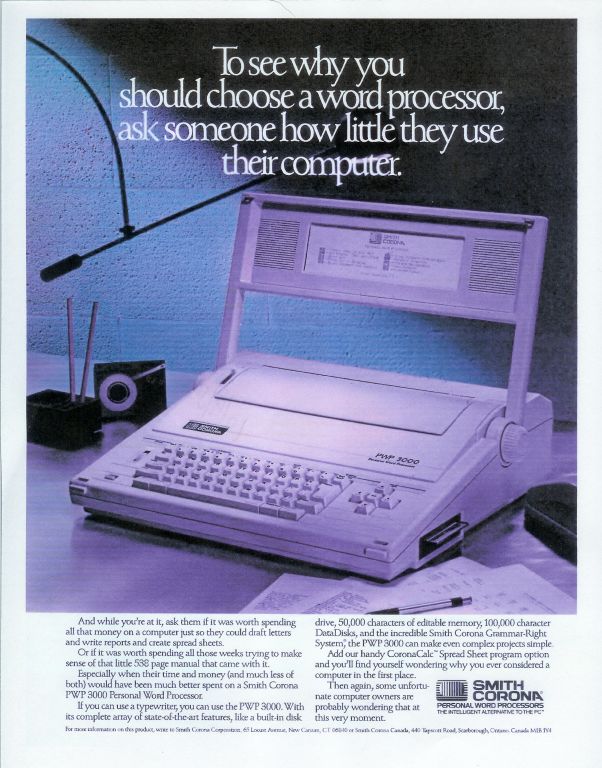
Having just spent 10 hours at my computer, I simply had to laugh. Still, hindsight is always 20/20, though come to think of it, by 1989, I had put a heck of a lot of mileage on my Macintosh. Much harder to comprehend is this bizarre ad from the April 18, 1959, issue of TNY (click for larger version):
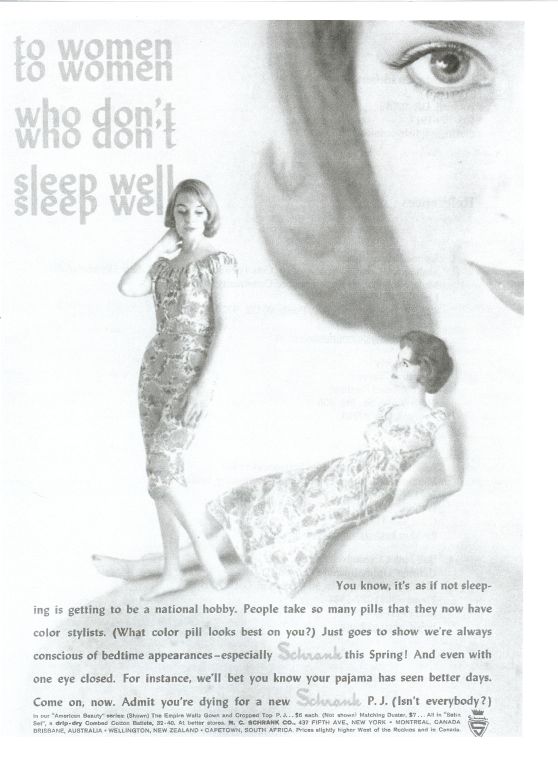
I should have reproduced it in color, but you can still get a sense of how strange a piece of copywriting it is. I’m always skeptical when people complain about things being “written by committee,” but this ad surely was. First, the thinking must have gone, we’ll bewitch bored readers with a headline evoking the double vision of the bleary-eyed sleepless; then we’ll joke about how many barbiturates they’re taking, appeal to their vanity, and then accuse them of wearing shabby PJs. If that won’t hook ’em, nothing will!
And, though it’s not advertising, I was equally entertained by the Leonard Dove cartoon below, from the May 25, 1935, issue. Only one of his many cartoons for TNY is available at The Cartoon Bank, and unfortunately this is not it. To enjoy a larger version, click here: