Author Archives: Emdashes

The Lap of Luxury (Hotels), Circa 1958

Benjamin Chambers writes:
One of the sweeter pleasures of paging through the Complete New Yorker is looking at the dated advertising, especially when a copywriter describes, with a flourish of trumpets, amenities we regard as either standard or puzzling.
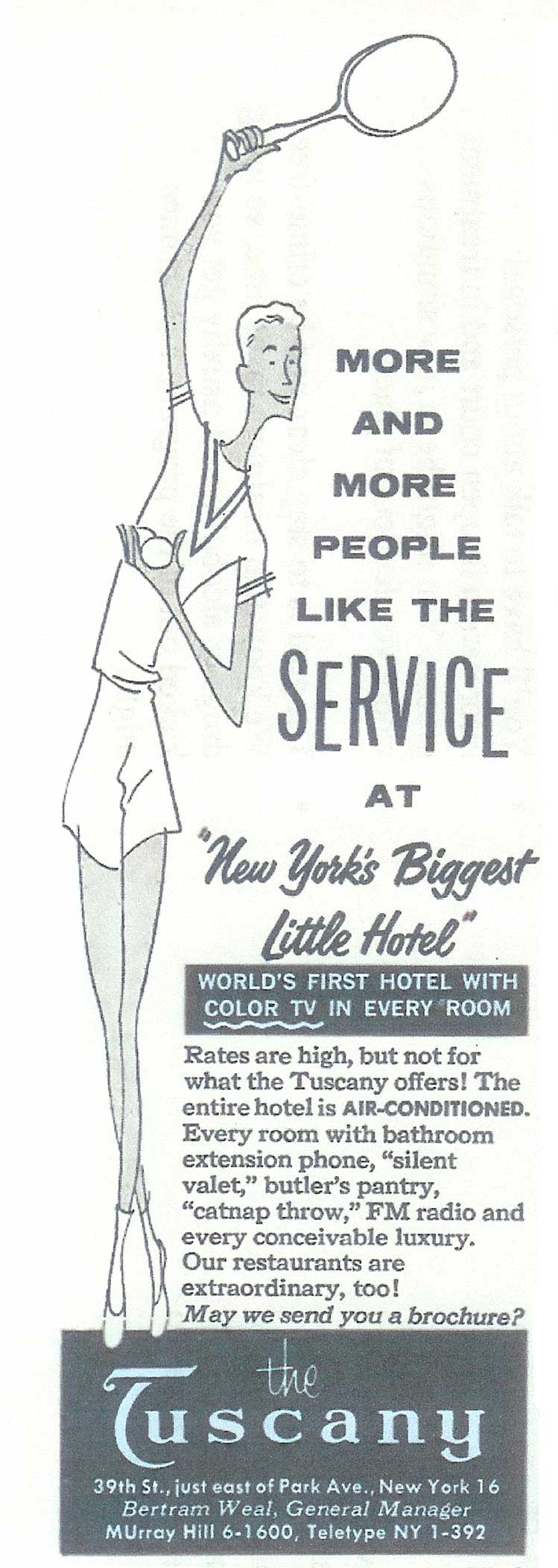
For example, if you’d been looking for a quiet, upscale hotel in 1958, you’d have done well to choose The Tuscany on 39th Street. I know, because I came across an ad for it while reading a sweet-but-forgettable memoir by Grover Amen in the June 14 issue of that year. (I’ve displayed the ad here for your viewing convenience, much as The Tuscany’s staff would have turned down your bed at night.)

TuscanyHotel_1958.jpg

How could you beat a hotel that was the first in the world to have color TVs in every room? Plus, each room had FM and AC, and every guest could count on finding a phone extension in the bathroom: all items at least as breathtaking, apparently, as its rates.

So what else would you get for your money? A “catnap throw” (pillow), butler’s pantry (a small staging area in which to store plates, glassware, and silverware), and a “silent valet” (a rack on which to hang your clothes).

All part of a strategy, it would appear, to net readers of The New Yorker who wanted class, but who were new to travel. These small details imply that prospective guests will be waited on by their own staff of quiet, liveried servants. After all, if one’s room has a “butler’s pantry,” the butler it belongs to has to be there to count the silver, right?

Ah, innocence! Gone now, though I see hotels still advertise silent valets, so maybe we’re still suckers for promises of elegance. But the romance of travel has definitely waned. These days, hotels simply hand over the keys to the mini-bar and don’t even pretend that a genteel staff member will be there to serve you the contents.

Whither The Tuscany? The hotel is still extant, it appears, appropriately upgraded and still advertising a “chenille throw” fifty years later. Imagine all the people who’ve passed through there since (many no doubt loyal readers of The New Yorker).

O, if only those valets could speak!
How Do You Say “Gently Sir” in Japanese?

Martin Schneider writes:
If this video doesn’t make you think of George Price, well, it certainly should.

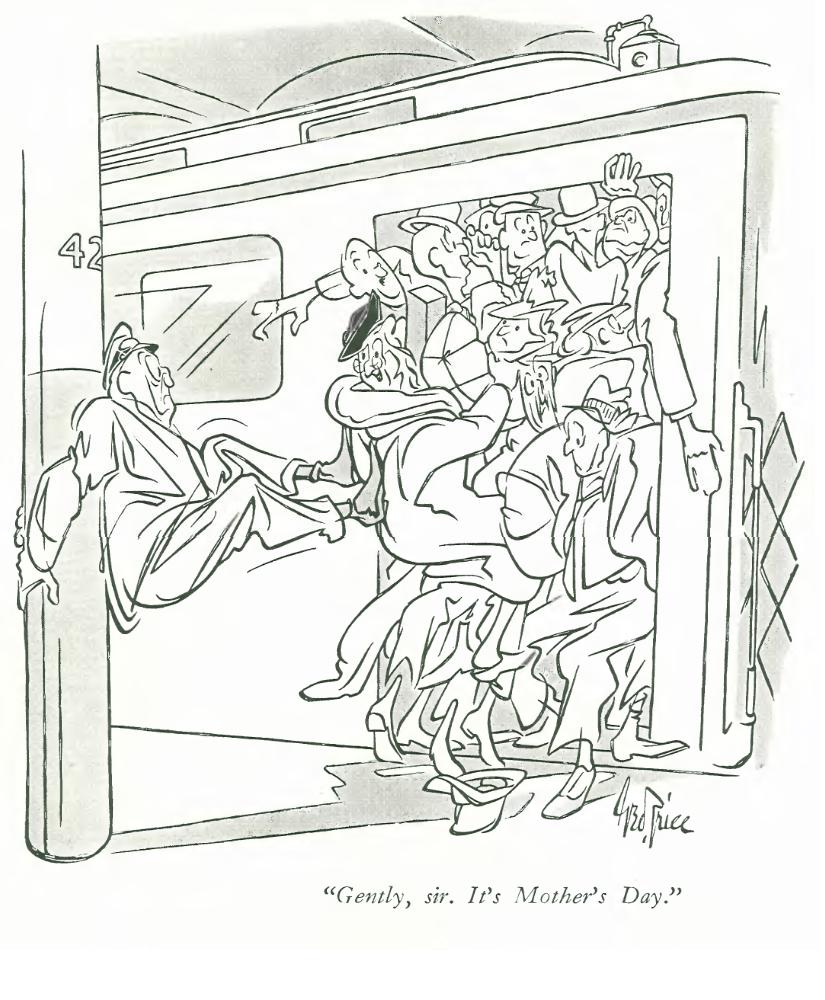
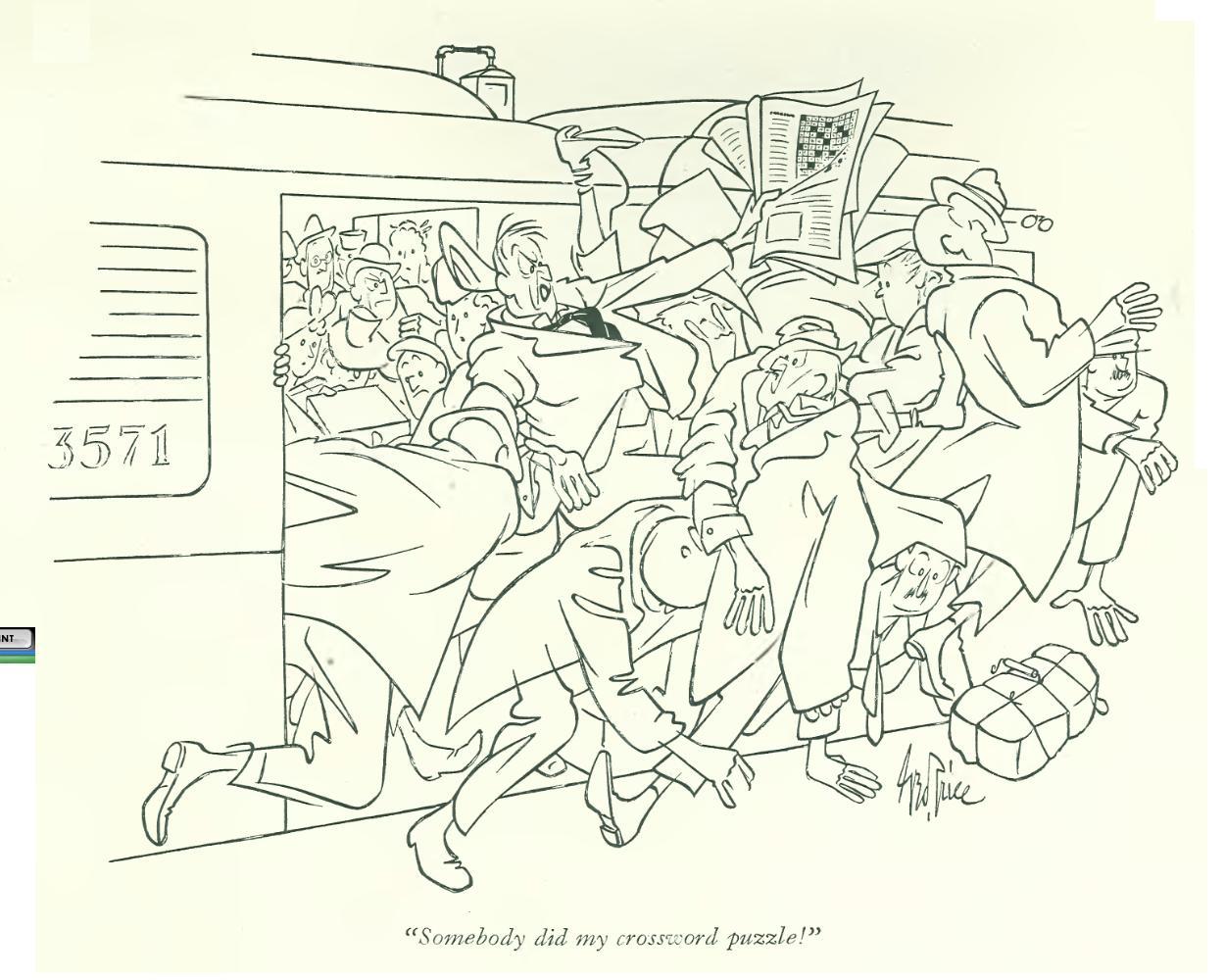
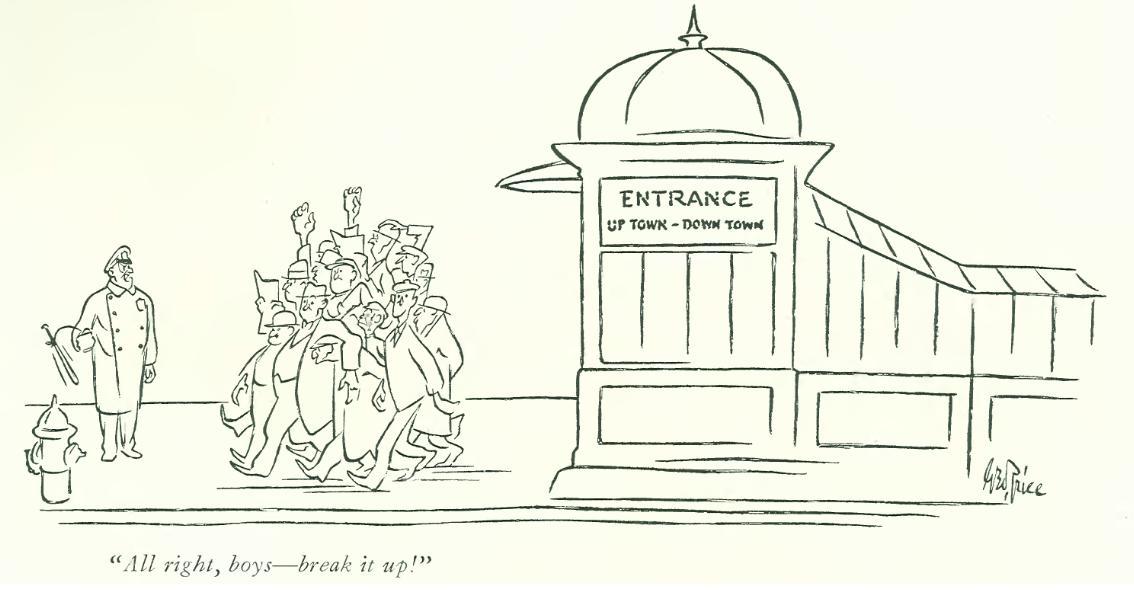
As a reminder, a few classic cartoons from Price’s “crammed subway” period:

break.JPG

“All right, boys — break it up!” (February 25, 1939)
gently.JPG

“Gently, sir. It’s Mother’s Day.” (May 11, 1940)
crossword.JPG

“Somebody did my crossword puzzle!” (December 11, 1943)

That first one is a favorite of Emily’s, the second a particular favorite of mine. (We’ve discussed all of this already, natch.)

I Love New York in June: Ian Frazier and Bill McKibben at the Y

Martin Schneider writes:

I was just riffling through my inbox (such a tactile metaphor), and the following event at the 92nd Street Y jumped out at me. From the Y’s latest press release:
Tuesday, June 10, 8:15 pm, $26
The Lamentations of Ian Frazier
Whether flat-out funny in his Shouts and Murmurs columns in The New Yorker (most recently, the column about the man who bought and is renovating Wyoming), thoughtful and moving in books like On the Rez or far-ranging and perceptive in essay collections like the upcoming Lamentations of the Father, Ian Frazier is an American original. A mix of journalist and comedian, heir to Mark Twain and James Thurber, Frazier brings a sharp but loving eye to the vagaries of American life. He talks with WNYC’s Leonard Lopate.
I’ve never seen Frazier speak, I bet he’s very entertaining. I wish I were in NYC for this but—ain’t.
Plus, don’t overlook this event at the same venue:
Monday, June 2, 8:15 pm, $26
Bill McKibben on the Environment
When, in the 1980s, Bill McKibben started writing about climate change and the environment in The New Yorker, he was one of the first mainstream writers to draw attention to the subject. His writing profoundly affected Al Gore, among others. McKibben’s books include The End of Nature, The Age of Missing Information and Enough; this spring, Times Books has published a collection of his essays, The Bill McKibben Reader, and he is the editor of American Earth: Environmental Writing Since Thoreau (Library of America).

Extra!

General Excellence, over 2,000,000 circulation: The New Yorker, David Remnick, editor, for the February 19 & 26, August 13, October 8 issues. Congratulations to everyone at The New Yorker, including Blake Eskin, who was rightly nominated for leading the extraordinarily dedicated and creative group at newyorker.com.
Three elated cheers, too, for my former colleagues at The Nation—where I first learned about em dashes and a heck of a lot more—and, especially, to our scrappy gang at Print, my friends and role models, who were honored with the General Excellence award for magazines with a circulation under 100,000. Coincidentally, both David Remnick and Print captain Joyce Rutter Kaye are celebrating ten years at their respective magazines. It’s a nice way to cap the decade!

kaye_remnick.jpg
Joyce Rutter Kaye and David Remnick, generally excellent. Click to enlarge.

After You’re Done Reading Everything in Edith Wharton’s Library…

You can move on to the book collections of Carl Sandburg, Susan B. Anthony, and noted fallen rhymester Tupac Shakur. These and other literary libraries are on the Lilbrarything group I See Dead People[‘s Books]. A perfect way to fill in those gaps in your shelves! (Thanks to the indispensable Very Short List for the link.)
On the other hand, space may be tight, and life is certainly short, so you could also get rid of books instead—or at least contemplate the bookshelf with half an eye to getting rid of them, which is what my friends Caleb Crain and Scott McLemee have been doing and debating.
As for Edith Wharton, whose foundation’s house-preserving troubles Rebecca Mead documented in a recent issue, there’s another defender of her home: Kate Bolik in Slate; it looks like Slate readers (and others?) have helped delay the foreclosure of The Mount to May 31. Finally, here’s John Updike’s review in The New Yorker, from 2007, of a recent Edith Wharton biography.
If you’re the good-vibes-sending type, please direct some over to the National Magazine Awards this evening, won’t you?

New Yorker Conference, 2008 Schedule

Martin Schneider writes:
The details for the New Yorker Conference are here—everything that’s scheduled for the two days of events on May 7 and 8. The dedicated website also lists bios of the participants, and more. As always, Emdashes is proud to be able to provide comprehensive coverage of the event, so stay tuned!
Here’s the schedule:
Thursday, May 8
7:30 a.m.-8:55 a.m.
Registration and Breakfast
9:00 a.m.-9:10 a.m.
Welcome by David Remnick
9:10 a.m.-9:40 a.m.
“Reinventing Invention”
Keynote Address by Malcolm Gladwell
9:45 a.m.-10:05 a.m.
“The Green City”
Dana Goodyear talks with Gavin Newsom
10:10 a.m.-10:30 a.m.
“A More Perfect Union”
James Surowiecki talks with Andy Stern
10:35 a.m.-11:00 a.m.
“23 and You”
Michael Specter talks with Linda Avey and Anne Wojicki
11:05 a.m.-11:30 a.m.
BREAK
11:40 a.m.-12:05 p.m.
“Creative Intelligence”
Jane Mayer talks with Eric Haseltine
12:10 p.m.-12:30 p.m.
“Neurobiotics: Where Humans and Robots Connect”
Presentation by Yoky Matsuoka
12:35 p.m.-1:05 p.m.
“Making Musicals Rock”
Susan Morrison talks with Duncan Sheik
1:10 p.m.-2:40 p.m.
LUNCH
2:50 p.m.-3:10 p.m.
“The Centre for Massive Change”
Presentation by Bruce Mau
3:15 p.m.-3:35 p.m.
“Constructing Culture”
Thelma Golden talks with David Adjaye
3:40 p.m.-4:10 p.m.
“Playing with Fire”
Bill Buford talks with David Chang, Daniel Humm, and Marc Taxiera
4:15 p.m.-4:35 p.m.
“How Bad Is It?: A Global View”
Nick Paumgarten talks with Michael Novogratz
4:40 p.m.-5:10 p.m.
BREAK
5:20 p.m.-5:40 p.m.
“Humanitarian Engineering”
Rebecca Mead talks with Amy Smith
5:45 p.m.-6:05 p.m.
“The Politics of Glamour”
Michael Specter talks with Francesco Vezzoli
6:10 p.m.-6:55 p.m.
COCKTAIL RECEPTION
7:15 p.m.-9:15 p.m.
DINNER at Eyebeam
Friday, May 9
7:45 a.m.-8:30 a.m.
BREAKFAST
8:40 a.m.-9:00 a.m.
“The Past, Present, and Future of Humor”
Presentation by Robert Mankoff
9:05 a.m.-9:30 a.m.
“Deconstructing the Airport”
Malcolm Gladwell talks with Paco Underhill
9:35 a.m.-9:55 a.m.
“Saving the World Through Game Design”
Daniel Zalewski talks with Jane McGonigal
10:00 a.m.-10:20 a.m.
“The Forever Campaign”
Ryan Lizza talks with Rahm Emanuel
10:25 a.m.-10:55 a.m.
BREAK
11:05 a.m.-11:25 a.m.
“The Tanning of America”
Kelefa Sanneh talks with Steve Stoute
11:30 a.m.-11:50 a.m.
“Securing the City”
William Finnegan talks with Raymond W. Kelly
11:55 a.m.-12:15 p.m.
“The Knockoff Economy”
James Surowiecki talks with Scott Hemphill and Kal Raustiala
12:20 p.m.-12:40 p.m.
“True Stories”
Jeffrey Toobin talks with Sheila Nevins
12:45 p.m.-2:00 p.m.
LUNCH
2:10 p.m.-2:30 p.m.
“Opera: Coming Soon to a Theatre Near You”
Alex Ross talks with Peter Gelb
2:35 p.m.-2:55 p.m.
“The Post-American World”
David Remnick talks with Fareed Zakaria

It’s Summer Intern Time at Emdashes; Apply Today!

The last time we advertised for an intern, we got the incredibly talented John Bucher, who did his noble service and is now a contributing writer. I have no doubt he’ll go far.
Now, however, we must look to the future. If you’re a serious reader of The New Yorker, have a solid grasp of and appreciation for English syntax and punctuation, know at least enough HTML to get by, and have a bit of experience with blogging (even if you’re just an avid reader of blogs), and would like an unpaid but often entertaining position learning more about all of the above and doing some research and writing, please get in touch with Emily care of emdashes.com. You need not live in New York, but it would be a plus if you did.