
Martin Schneider writes:
I’m living in Cleveland this summer. I spent the weekend in Chicago, and thus it was odd to be not in Cleveland on Thursday night, when LeBron James made his announcement to join the Miami Heat. My friends and compadres in Cleveland had to suffer that one alone—maybe it’s just as well, because my Cleveland identity is a little bit thin for that level of pathos and identification: it’s not my city, in that sense. Anyway, then I return to Cleveland this morning and find out that Harvey Pekar has died. A fun weekend in Chicago bookended by these oddly related events.
So much has been said about LeBron and Dan Gilbert’s angry letter. There were still a few points I thought could add to the discussion.
1. It doesn’t really matter either way. There’s been a lot of commentary about the sheer scale of LeBron’s ESPN announcement, which was, after all, merely an athlete’s announcement of a free agency decision, which happens all the time. It was a very hollow event, inflated by hype and potential and some shrewd PR machinations. I have a friend who is in the business of re-selling Nike sneakers, and he was telling me that LeBron’s decision would be a major deal for Nike, for him personally.
I don’t quite buy this. The NBA has a lot of incredible young players, the number of teams that will win titles in the next five years is still capped at five, and whether it’s LeBron and Wade or Dwight Howard in Orlando or Kevin Durant in Oklahoma City or Derrick Rose in Chicago who becomes the next major NBA star….. is pretty moot. True, LeBron already has a Jordanesque shoe deal and maybe only he could approach the Jordanesque heights of marketing, but I don’t quite buy that this makes any more difference than a butterfly’s fart. Cleveland’s odds of winning a title are down, Miami’s are up, the number of people who like the NBA or Nike sneakers is going to stay about the same.
2. LeBron James isn’t that good. I’ve been hearing about LeBron for years, watching some of the incredible highlights but basically paying no attention. This year, for the playoffs, knowing that I would soon be visiting Cleveland, I started watching the Cavaliers for the first time. I was shocked by what I saw. What I saw was a player who, because he is bad at free throws, declined to drive to the basket. LeBron James is a six-foot-eight shooting guard who is built like a small forward or even a small power forward and who fancies himself a point guard, in the sense that he usually “runs the offense.” LeBron’s is the type of player, against good teams in the playoffs, whose best weapon ended up being a decent, but not great, 18-foot jump shot. I’ll be honest with you, that’s quite a package, but I don’t know what the hell that player is. He’s not a power forward, he’s not a shooting forward, he doesn’t drive to the basket, he’s not a point guard but plays like one………….. I don’t know what that is. No matter how good or talented LeBron is, if he’s at the center of a team’s offense, I can’t see that team winning a title.
Secondarily, I’m not convinced that LeBron values hard work, self-improvement, or, by far most important, winning basketball games more than he values his brand, his popularity, or generally being liked. He’s still young and there’s room for development, but I’m unsure that he will ever get the competitive fire that Kobe Bryant or Michael Jordan have. He may get it once he reaches the age of 29 with no titles (if that happens) and has to retrench and eliminate all distractions.
3. Closely related to his … insufficient game is the fact that his entire profile is built on potential. When the Cavs won the rights to draft him in 2003, that was a huge story that had all of Ohio drooling over all the titles LeBron was going to bring to the area. Those titles never happened. Seven years later, it’s the same thing all over again. It’s all based on a speculative future, and in that sense LeBron is not much different from a speculative bubble in the financial world.
4. I had a realization a few days before the big ESPN announcement on Thursday. The wise move for LeBron would have been to quietly re-sign with the Cavs and go back to work. Given that his Miami announcement has been something of a PR disaster for LeBron (he was actually booed at Carmelo Anthony’s wedding the other day), I think I was right about this. LeBron got his hype, and he got his money, but LeBron isn’t about wisdom, he’s about his brand, so he made what I regard as an unwise choice here. Like a speculative bubble, it’s essential that LeBron cash in as quickly as he can, and that’s what he did. Showing some humility would have been a move nobody could have faulted. As it was, he pleased one city and annoyed everyone else.
5. LeBron is an athlete, and as such has every right to handle his career any way he sees fit and conduct his negotiations as he pleases. In that sense I fully endorse Mark Kleiman’s wise post, “What’s LeBron supposed to have done wrong?” Kleiman is right: People feel a deep need to judge wealthy athletes, and those judgments are inextricable from class and race issues. Read the whole thing.
6. Having said that, there is a difference. LeBron’s announcement circus did not exactly highlight LeBron’s finest features, and if it has put him in a bad light, that’s his own fault. It’s not so much about the size of the contract or that he was driving events that bothers me, but I have no problem with the idea that his treatment of his home region and his hankering for a shortcut to a title reflect poorly on him. It’s not much different from when Roger Clemens signed with the Yankees in 2007. There are valid reasons why sports fans don’t respect “title grabs,” and LeBron is right in line with that.
7. Also, there is the consideration of Cleveland itself. Cleveland is a working-class midwestern city, and the last few decades have not been an easy time in the Midwest. This is where the LeBron argument collides with serious national topics like the economy, urban renewal, retraining of laid-off workers, and so on, topics that LeBron could never solve by himself. But the fact is that Cleveland was perceived as depending on LeBron for economic reasons, in a way that will never be true of Miami. It’s not exactly fair to LeBron, but he contributed to a dynamic in which he was going to help revive Cleveland’s downtown area; now that that downtown area may experience some hard times, it’s not unjust to think poorly of LeBron for “abandoning” it, even if that word is way too strong and melodramatic. In short, the LeBron saga touches on issues of the American City. As a nation, we have to divert emphasis from diversions like sports, with its one-winner or oligopolistic logic (so few haves, so many have-nots), and towards pursuits like urban renewal. It ain’t his fault, but LeBron’s decision is relevant to that story.
8. So, to wrap up, I never found LeBron all that appealing, more Darryl Strawberry than Tony Gwynn, and now that he has chosen to indulge in a bath of hollow PR and scamper towards a “sure-thing” title (even if I think it’s not a sure thing at all), I feel justified in saying, he ain’t all that and he never was all that. I’ve got my doubts about his effectiveness on the basketball court, and I’ll be happy to see those doubts justified in the years to come. And off the court, he’s a big handsome PR creation—who cares?
Author Archives: Emdashes
Harvey Pekar, 1939-2010
_Pollux writes_:
“Some reviewers in Tucson and Kansas City, if they talk about _American Splendor_ at [all,] are gonna say stuff like, ‘This is a comic book? Then why ain’t I laughin’?’ I know that, I’m ready for it.”
These are words spoken by Harvey Pekar in _The New American Splendor Anthology_ (1991), or rather “Harvey Pekar,” the persona who inhabited volumes of comics. As figures and scenes from the Bible were rendered again and again by countless medieval and Renaissance artists, so Pekar was depicted by various comic illustrators, Robert Crumb not the least among them.
From the streets of Cleveland, Pekar gave us a documentary, in comics form, of life as a “flunky file clerk,” a working-class schlub, and self-deprecating visionary. If _American Splendor_ was seen as narcissistic or overly concerned with everyday exertions, it’s because the fact that it was a record of one man’s mind and process was ignored. Pekar wanted to create comics this way. Why leave the reviewers in Tucson and Kansas City laughing when he could give them something new?
Alternative comics allowed for experimentation and collaboration. Comics could become something more than mass-produced, formulaic rags. _American Splendor_, and titles like it, was a comic to keep, shelve, and re-read. Pekar helped us all outgrow simplistic superhero comics.
Pekar was a curmudgeon, yes, but also a diamond in the rough. Pekar helped turn comics into a record of daily life, a collection of little moments that are otherwise forgotten but nonetheless are the stuff of real life.
And real life can be drab, boring, and stressful. Real life is filled with disappointment and solitude. But it can also be filled with laughter, drama, passion, and excitement. Pekar saw that the struggles between caped superheroes paled in comparison to the epic battles of daily life. Who needs Kryptonite when you have bills, loneliness, sickness, and David Letterman? And forget Green Lantern’s ring: what’s better than family or a hard-to-find jazz record?
Daily Comic: The World Cup Final
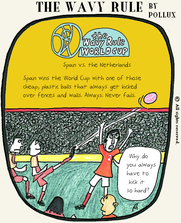
Click on the image for a detailed view!
Daily Comic: Neo-Plasticist Work

Click on the image for a detailed view!
Octoprognostication: Leaking Information
_Pollux writes_:
Just to follow up on the Paul the Octopus story, he has “predicted”:http://www.worldcupblog.org/world-cup-2010/paul-the-octopus-gives-the-final-order-get-ready-for-a-spanish-celebration.html a win for Spain, so let’s see if he turns out to be right. They’ve stopped eating octopus in Spain out of respect to Paul.
As a side note, I can’t help thinking that an intelligent octopus could easily fix the oil leak in the Gulf. All it needs is eight strong hands, sensitivity, and knowledge and respect for the ocean, qualities that no one at BP seems to possess.
Daily Comic: Desert Island Draw
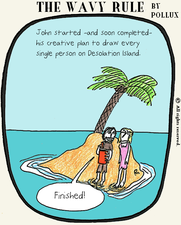
Well, the last game of the World Cup is on Sunday, so back to our regularly scheduled program. I hope you enjoyed the Cup cartoons! Click on the image for a detailed view!
Putting Paul the Octopus to the Test: New Questions

_Click on the image to enlarge_.
_Pollux writes_:
You have to admire “Paul the Octopus'”:http://en.wikipedia.org/wiki/Paul_the_Octopus bravery: predicting Germany’s loss in the World Cup game against Spain while residing in a German aquarium? Gutsy move (do octopuses have guts?).
The Germans and the Argentines (Paul also predicted Argentina’s loss against England) are up in arms, but the eight-armed Paul blithely continues to do his work.
To defer to animals as oracular messengers is as old as civilization itself. Ancient Egyptians consulted divine animals such as “The Bull Who is in Hermonthis, Lord of Medamud, Who is in Tod.”
Octopuses are said to be highly intelligent, and Paul’s prognostication proved correct against the face of popular opinion, namely that the Germans would handily beat Spain and advance to the World Cup Final against the Netherlands.
I’m impressed, and Paul’s predictions make me want to ask _Das Krakenorakel_ questions unrelated to World Cup soccer.
Paul, is the war in Afghanistan a big mistake?
CHOICE #1: Yes
CHOICE #2: Define “mistake.”
Paul, is there life in other parts of the universe?
CHOICE #1: Yes, but you’ll only find it in octopus form.
CHOICE #2: We’re all alone, so exceedingly, extremely alone.
Paul, what is your opinion on Ayn Rand’s criticisms of altruism and her overall philosophy regarding selfishness and its place within a larger societal framework founded on capitalism?
CHOICE #1: Netherlands.
CHOICE #2: Spain.
Daily Comic: The Semifinals: II
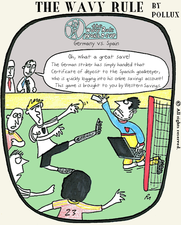
Click on the image for a detailed view!
Daily Comic: The Semifinals
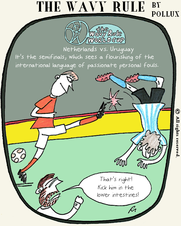
Click on the image for a detailed view!
‘The September Issue’: Ice Queen Reported Missing
Martin Schneider writes:
I just watched The September Issue, the documentary about Vogue and Anna Wintour. I must say it surprised me a lot. It’s very, very enjoyable, and anyone who likes fashion or magazines really ought to see it. (On the subject of magazines, I think I glimpsed an Ivan Brunetti cover from The New Yorker at one point, in the clutches of contributing editor André Leon Talley.)
I hope the movie serves as a corrective to The Devil Wears Prada (the movie anyway, can’t speak for the book). The portrait of imperious “Miranda Priestly” in that movie, ably embodied by Meryl Streep, did much to convince me that Wintour must be (while highly able herself) impossibly demanding, rude, and so on.
If that is true, I didn’t see any evidence of it in The September Issue. In the documentary she seemed extremely busy and capable, certain in her views, decisive (she calls this her most important trait), more than passably considerate. She didn’t seem demanding in petty ways; cheerful enough when engaging with people, quiet and composed when in observation mode (peering at the many catwalks, for instance).
Indeed, “grace under pressure” seems an apter slogan for Wintour than “ice queen.” It really makes you wonder about the way we view successful, nay powerful, women in our culture. I’ll take her over Jack Welch any day.
As far as I can tell, the movie is really about competence. Virtually everyone in the movie is a highly competent professional immersed in his or her work, thoroughly knowledgeable and fulfilled and accustomed to pressure and therefore calm and cheerful.
I appreciate this because it’s important to have on display arenas where excellence and talent and standards are valued—it’s so often not the case. Elsewhere we must put up with compromise and backsliding and shortcuts and limited budgets and on and on. It’s inspiring to see a place where excellence is valued as a matter of course, there’s no doubt that an imperfect photo shoot will be redone.
In the Wikipedia writeup for the movie it says that creative director Grace Coddington (who is awesome and steals the movie) is “the only person who dares to stand up to Anna Wintour.” What nonsense! Wintour is shown dealing with a lot of people, and I didn’t see too many frightened individuals in any of those meetings.
Wintour does make life difficult for Coddington by disagreeing about a couple of Coddington’s photo shoots, but if Wintour made any errors of judgment at any point during the movie, I must have missed them.
Finally, if you want to know what I think of the fashion industry, listen carefully to what Wintour’s daughter Bee Shaffer says about it. I’m with her.