Author Archives: Emdashes

When You Bend It, You Can’t Mend It

Emily Gordon writes:
I should have known Hendrik Hertzberg would be a Kate McGarrigle fan, and here is his heartfelt, ardent tribute to her. I heard about her death on Jonathan Schwartz’s timeless, dreamlike radio show last weekend and have had her songs caught in my head, even more than usual, since then. “And it’s only love, and it’s only love,/That can wreck a human being and turn him inside out.”
Hertzberg wrote this (and more–read all of it) as a Carnegie Hall program note for a McGarrigle Christmas show, and I think it’s just right:

The songs and singing of the McGarrigles have turned out to be a font of consolation: a pool of sweetness, a well of sadness, a geyser of exaltation. They have music to suit every stage of love and life. And they are the muses and matriarchs of an extraordinary family circle–a raffish orchestra of parents, siblings, offspring, exes, friends, and collaborators. We, their fans, are part of this circle, too. There are enough of us to assure our uncompromising heroines of a livelihood, but not so many that we risk the loneliness of a crowd.

Every stage of love and life–including this one, the unreal, suspended sadness of hearing one of your favorite voices on the radio and in your thoughts, and knowing the breath and mind behind that voice are gone.

Sempé Fi: The Life of the World to Come

1-25-10 Frantz Zephirin The Resurrection of the Dead.JPG
_Pollux writes_:
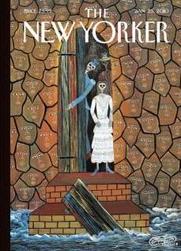
The cover for the January 25, 2010 issue of _The New Yorker_ was created by a Haitian artist, “Frantz Zephirin.”:http://www.haitian-art-co.com/artists/fzephrin.html Zephirin, according to the Contributors page, “lives on a mountain overlooking the village of Mariani, not far from the epicenter of the earthquake that struck the country on January 12th.”
From his mountaintop, Zephirin has a clearer, closer view of the tragedy that manifests itself in an abstract vision of the afterlife. On _The New Yorker_ website, Blake Eskin has written a “Cover Story”:http://www.newyorker.com/online/blogs/newsdesk/2010/01/cover-story-frantz-zephirin.html on Zephirin’s piece. As Eskin points out, Zephirin’s cover was painted in 2007. Nevertheless, its symbolism and its associations with life and death are particularly appropriate for this 2010 cover, in view of the enormous losses and tragedy associated with the recent earthquake.
On _60 Minutes_, we see construction equipment scooping up the dead from the tragic earthquake, and piles of nameless bodies lying in a flattened cityscape. We hear numbers and more numbers: the number of casualties, the earthquake’s magnitude, the amount of monetary aid pouring in, the numbers to call, the number of troops sent by various governments, the number to which we can send text messages in aid of the disaster. We hope it is not so bad as the initial reports say, and realize that it is, in fact, worse.
Zephirin’s cover, called “The Resurrection of the Dead,” is an affirmation of the individuality of those who have perished in the disaster. Instead of numbers or piles of bodies, we see faces, many faces, with eyes and mouth open. According to “one website”:http://www.haitian-art-co.com/artists/fzephrin.html, Zephirin’s work is “characterized by its bright colors, patterns, tightly compacted compositions; and by the human figures with animal heads, which represent his cynicism for the ruling body.”
Instead of mangled bodies, we see beautiful faces, and each face is slightly different from the next. The expressions that we see are neither particularly happy nor sad, nor particularly masculine nor feminine. As androgynous as an angel, each face looks out from variously-shaped, interlocking tiles that hold up the vast vault of the afterlife. As Elizabeth McAlister points out in Eskin’s Cover Story, “the unblinking faces of the spirits of the recently dead. Just crossed over, they still have eyes, which are the blue and red of the Haitian flag.”
Through the open door, we see darkness and cobwebs. At first, I believed this to be a vision of hell, inhabited by grinning skeletal figures, one of whom wears a military uniform, representing military misrule and intervention, both internal and external. The other figures are dressed in clothing of the upper bourgeois. The female skeleton is similar to the figures one sees in a Frida Kahlo painting.
But it not so much hell as a border crossing between life and death. As Eskin’s piece points, gallery-owner Bill Bollendorf identifies the three skeletal figures in the doorway as representing the Guédé, “members of a family of spirits who guard the frontier between life and death. The woman in the wedding dress is Gran’ Brigitte, and the man in the blue uniform is her husband, Baron Samedi.”
Zephirin’s skeletal inhabitants open the wooden door that marks the boundary line. They grin triumphantly. The destructive power of the natural world, worsened by decades of misrule and corruption, has triumphed for the moment.
Debris, in the form of a wooden board, washes against the steps that lead to the this border crossing. The fast currents of this version of the River Styx will no doubt wash the debris away. Time moves the currents. And soon the door will close.
But the faces will remain forever, looking at us, asking us not to forget them.

True Index of Your Mind: Do-It-Yourself Candide

_Pollux writes_:
“In the country of Westphalia… lived a youth whom Nature had endowed with a most sweet disposition. His face was the true index of his mind. He had a solid judgment joined to the most unaffected simplicity; and hence, I presume, he had his name of Candide.”
With these words, Voltaire pays tribute to his creation. The New York Public Library is now featuring an online “exhibition”:http://candide.nypl.org/?hpfeature=3 for Voltaire’s _Candide_ in which you can pay your own tribute to this 18th century work.
It’s not just any online gallery. This exhibition is calling all artists and readers to contribute their own visions, tributes, and adaptations of _Candide_. “Here”:http://candide.nypl.org/content/do-it-yourself-emcandideem is the link for Do-It-Yourself-Candide. Have fun!

Sempé Fi: The Long and Winding Road

1-18-10 Frank Viva Great Expectations.JPG
_Pollux writes_:
A young man glides eagerly through the dark streets of the city. He’s hunched forward for maximum speed. He speeds past an apartment building with largely darkened windows save one, and a closed store named “Minx.” Where will this road lead him?
“Frank Viva’s”:http://www.francisaviva.com cover for the January 18, 2010 issue of _The New Yorker_ strikes me as being a cross between a Valentine’s Day cover and a Christmas cover.
This may or may not have been the illustrator’s intent, but mid-January is when we begin to see Valentine’s Day gifts and paraphernalia in the stores, as well as Christmas trees lying sadly in alleyways and dumpsters. We are like the Roman god Janus, with two heads looking in opposite directions at the past and the future.
Viva’s cover, called “Great Expectations,” depicts a young man on a bicycle bearing gifts in a shoulder bag. There is a tube and a box wrapped in shiny, red wrapping paper. His canine companion, bearing a tag and a bouquet of flowers in its mouth, sits in the bicycle’s basket. The cyclist, depicted in an elongated, paper-cutout style, sits on a delightfully whimsical, mechanically impossible bicycle.
I was curious about how the image was created, so I contacted Mr. Viva directly. The final artwork for “Great Expectations” is digital, but the work began as a pencil sketch. On his blog, Oliver Yaphe “writes”:http://oliveryaphe.com/tag/frank-viva that Viva’s style is “modern and distinct and gaining serious momentum.”
We can see some of Viva’s sketches “here”:http://www.vivaandco.com/TheWork/Illustration/Sketchbooks.aspx, where you’ll find some similarly styled bicycles.
We may be like the two-headed Janus, but Viva’s cyclist looks only forward: perhaps the cyclist is on his way to declare his love to a current or hoped-for girlfriend; the dog itself may be a gift. The young man expects great, crowning success. The night is gloomy, but the young man’s great expectations illuminate his face and create a cheerful scene.
This is Viva’s first cover for _The New Yorker_. According to his website, “when _The New Yorker_ called, Frank jumped up and bumped his head (rather badly) on the desk lamp. It didn’t hurt a bit.”
Viva is an illustrator, writer, graphic designer, and children’s book author. “Great Expectations” is, according to his website, inspired by his forthcoming children’s picture book, “Along a Long Road”:http://www.vivaandco.com/TheWork/Illustration/HarperCollins.aspx, which features a young boy on a cycling adventure through his city.
Viva’s cyclist for this _New Yorker_ cover seeks not only adventure but also romance. The road takes him to someone’s door. Hope propels him forward. We cheer him on.