
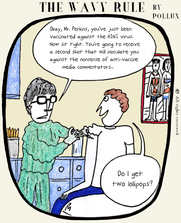
Click on the cartoon to enlarge it!
Author Archives: Emdashes
A Report: Nixon, Oppenheimer, Faust, and John Adams at Yale
In October we were very pleased to present Jenny Blair’s account of Platon’s New Yorker Festival event. Today Blair has volunteered to bring us a detailed report of a fascinating lecture by the composer John Adams in New Haven, which occurred last week.—Martin Schneider
Jenny Blair writes:
The composer John Adams visited Yale University last week to give the prestigious Tanner Lectures on Human Values.*Â This writer attended the second of the two lectures, held at the Whitney Humanities Center on October 29. (In the first, the composer discussed Thomas Mann’s fictional composer in the novel Dr. Faustus.)
A fine-featured and slender man with arching sprouts of white hair and a gracious manner, Adams spoke to a near-capacity crowd about the way that myth informs his operas. Though he is famed in part for having dramatized Nixon’s visit to China and, more recently, for the 2005 opera Doctor Atomic, which dramatizes the hours before the first atomic bomb was detonated, Adams is annoyed when he hears himself referred to as a “political composer” or his operas called “docu-operas.” Such appellations would seem to miss the point, which is that he seeks out universal themes within the famous particular. Events in history, he said, can rise to a mythic level, and these myths are a proper hunting ground for his music. “The themes I choose,” he said, “are not simply mere news, but rather human events that have become mythology. . . . [They are] a symbolic expression of collective experience.”
“Biography, history, and science have come to constitute our own myths,” he said, naming as examples Gandhi, Babe Ruth, 9/11, and the moon landing. “Andy Warhol understood the grip that iconic images have on us, . . . [such as] Elvis with a six-shooter, the electric chair, Marilyn Monroe.”
An indispensable element of myth is the supernatural, Adams said, and there is something about the media’s incessant repetition and manipulation of images and events that supernaturalizes those events. “When they saturate public consciousness, they become totemic. . . . [Some] rise to the status of myth.” Whether we know it or not, he said, we of the electronic age are saturated in myth.
9/11 is a classic case in point. Even with the same number of deaths, he said, “had it been a one-story warehouse somewhere in New Jersey, I don’t think that totemic power would have invaded public consciousness.” The endlessly replayed video clip of the Twin Towers’ collapse, he said, was a ritualistic reenactment.
It was Peter Sellars, director of the first, highly acclaimed production of Doctor Atomic, who suggested that Adams write an opera about Nixon’s iconic visit to China. At the time, Adams had been composing music about Carl Jung, and had even made a pilgrimage to the psychiatrist’s home in Switzerland. But he recognized the story of Nixon’s trip as “full to the brim with myths.” Capitalist meets Communist. Presidential vanitas. The narratives and personae created by people in power—this story had it all. “Both Mao and Nixon had made themselves into grandiose cartoons.”
Adams read aloud a portion of Alice Goodman’s Nixon in China libretto, in which Nixon is speaking. (One suspects he held back a rip-roaring mimicry.) Then he parsed it like a poem, noting references to 1930s ballads, Chekhov, and Apollo 11. A recording of the same passage as sung by original cast member James Maddalena was then played, and Adams, as he listened, made muted conductor-like waves of his bowed head.
To critics who charge that subjects like the atomic bomb or terrorism (a subject he treated in The Death of Klinghoffer, his 1991 opera based on the hijacking of the Achille Lauro) are events too serious to be appropriate for theater, Adams replies that such things are the stuff of myth. Moreover, terrorism, with its suicide bombers and innocent victims, is already a kind of theater. And as for Trinity, “there is no more emphatic image to [sum up] the human predicament than the atomic bomb. . . . That day, science and human invention sprang instantaneously to mythic levels.” Initially, Adams said, he had wanted to draw a parallel between J. Robert Oppenheimer and the soul-selling Faust of Goethe’s drama. But he eventually came to decide that inaction during the war would have required complete pacifism and an acceptance of “a long dark night of the soul,” whereas the Los Alamos scientists were devoted to winning a war against tyranny.
Yet once they built the bomb, said Adams, “the relationship between the human species and the planet irrevocably changed. It was a seismic event in human consciousness. . . . [Humankind now had the ability] to destroy its own nest.” Indeed, the physicist Edward Teller, in a letter Adams read aloud, wrote, “I have no hope of clearing my conscience. . . . No amount of fiddling . . . will save our souls.”
The libretto of Doctor Atomic was greeted by a torrent of criticism in the press for its unusual use of both natural language (as lifted from primary sources, like letters and biographies) and poetry, as well as a perceived lack of “verismo” in some of the arias. But Adams pointed out that not all operas are like Strauss or Wagner. The arias of Monteverdi and Mozart were written purely for poetic effect and stepped out of narrative time—as did Adams’s.
The composer ended his lecture with a few words about the first act’s final aria and a video of its performance by “my wonderful, wonderful” baritone, Gerald Finley. This aria takes place the night before the Trinity test, after an electrical storm has threatened the test. The music before this had flirted with atonality, Adams said, but the aria itself is in D minor, which conveys the “noble gravitas” of the poem. The storm blows over at last, and Oppenheimer is left alone with his thoughts. He sings a lightly adapted Donne sonnet, “Batter my heart, three-person’d God.” The choice of this poem reinforces Adams’s decision not to compare Oppenheimer to Faust, for in it the narrator longs to reunite with God:
Batter my heart, three person’d God; For you
As yet but knock, breathe, knock, breathe, knock, breathe
Shine, and seek to mend;
Batter my heart, three person’d God;
That I may rise, and stand, o’erthrow me, and bend
Your force, to break, blow, break, blow, break, blow
burn and make me new.I, like an usurpt town, to another due,
Labor to admit you, but Oh, to no end,
Reason your viceroy in me, me should defend,
But is captiv’d, and proves weak or untrue,
Yet dearly I love you, and would be lov’d fain,
But am betroth’d unto your enemy,
Divorce me, untie, or break that knot again,
Take me to you, imprison me, for I
Except you enthrall me, never shall be free,
Nor ever chaste, except you ravish me.
After thunderous applause—the kind that tempts you to stand up and start an ovation—audience members stepped up to the microphones to ask questions. Highlights, lightly paraphrased:
Q: “Please give me water—my child is thirsty” were spoken as the last words of the opera. Why?
A: I realized I needed to hear the other side. Those words came from John Hersey’s Hiroshima. The woman who did the recording was a California university student, Japanese, and had a lot of piercings and tattoos.
Q: There are things in your opera that are fictional. For example, Kitty Oppenheimer is portrayed as the embodiment of the feminine principle, but Kitty was not like that at all. She was not a good mother; she left Oppenheimer; she ferociously wanted the project to succeed.
A: The real Nixon is to the operatic Nixon as the real Julius Caesar was to Shakespeare’s version. We’re working in the poetic realm. Moreover, I don’t agree with you about Kitty Oppenheimer. According to American Prometheus [Kai Bird and Martin J. Sherwin’s biography of Robert Oppenheimer], she was incredibly unhappy at Los Alamos. She was a scientist relegated to faculty-wife status. Anyway, I don’t see why a person who has character flaws can’t have profound human and moral feelings about war.
Q: The Kitty material is presented too densely for my taste.
A: I, too, have some difficulties with Muriel Rukeyser [the poet whose words appeared in the libretto during Kitty’s parts]. Poetry is unknowable—each of us brings to it our own personal experience. As for density, check out Othello. Works of art can be dense. It could be that over time people find that density to be something they can really chew on.
Q: Why did you repeat text in the sonnet? It’s not a sonnet anymore.
A: Your ear is tuned to prosody, mine to harmonic necessity. Even the Beatles say “She loves you, yeah, yeah, yeah.” The “yeah, yeah, yeah” there is to confirm the phrase. What I don’t like to do is melisma. It’s a great tradition in opera; it just doesn’t suit me as an American.
Q: Is there any subject you feel is prohibited in opera? What student idea would make you feel compelled to say, “This wouldn’t work”? What would you feel profoundly uncomfortable treating operatically?
A: If I say nothing, I’m immoral. If I say something, then I’m stuck. Next question!
Q: What are your bulwarks?
A: Sterility is the greatest danger. The theme of Mann’s novel Doctor Faustus is sterility. Popular culture is a bulwark against that sterility. Rap. Stravinsky’s imagined primitive dance forms. Bartok’s hummus of Hungarian sounds. . . . There is raw, uncooked life force in popular culture.
* [There doesn’t have to be a connection to The New Yorker for us to run a report of this quality, but for those who crave one, Adams wrote of his early days as a composer in avant-garde Berkeley and San Francisco for the August 28, 2008, issue, and Doctor Atomic was reviewed by Alex Ross on October 27, 2008. —MCS]
Tonight at the Maison Française: More Appetizing Restaurant History, With Fresh Balzac
At least online, there are no longer tickets available to tonight’s New York Public Library discussion of William Grimes’s Appetite City, with Grimes, Ruth Reichl and Dan Barber. But for another, free angle on restaurant history, NYU’s Maison Française is hosting “Balzac, Restaurants, and Gastronomy,” with author Anka Muhlstein and Olivier Muller, chef de cuisine at DB Bistro Moderne (7:00 pm; via the discreetly indispensable Platform for Pedagogy).
Sempé Fi: Pigheaded This Way

_Pollux writes_:
I’m feeling under the weather as I write this, and not because I so intensely dislike “John Cuneo’s”:http://www.johncuneo.com/ cover for the October 26, 2009 that it’s produced a negatively physical reaction in me, but because it’s flu season.
Perhaps it was inevitable that I should come across a virus one of these days. It waited for me in some dark alleyway or on some dirty doorknob. It eagerly waited for me with a set of sickness-carrying brass knuckles, and laid me low.
Cuneo’s subway passengers may also soon fall prey to sickness. They look alarmingly upon a very literal depiction of the swine flu. The porcine predator is putting on a disguise, ready to pucker up and deliver its insalubrious smooch upon unsuspecting victims. She wears old-fashioned clothes, but who can deny her present-day power?
The disguise isn’t a very good one. As the saying goes, you can put lipstick on a pig, but it would still be a pig. This was a “saying”:http://www.time.com/time/nation/article/0,8599,1840392,00.html#ixzz0VwUsQZ4c that of course achieved attention during the 2008 election and is the kind of folksy phrasing that politicians love to throw around and against their opponents.
Here Cuneo uses it as a link between the virus’ name and the fears and confusion surrounding it. No matter how many people shrug off the virus or the associated vaccine as a mere scare or scam, it remains among us. Denial is the lipstick that graces the unlovely lips of a pig.
Cuneo’s cover, called “Flu Season,” captures the fear and confusion that surround this flu season in which we have to contend with the ordinary flu and the swine flu. The H1N1 virus goes forth, claiming new victims, and at the same time a debate rages over whether people should take the vaccine or not.
“I am not going to take it,” Rush Limbaugh said, in an “address “:http://latimesblogs.latimes.com/booster_shots/2009/10/the-folks-who-publicly-said-they-would-rather-see-the-us-go-down-the-toilet-in-the-current-recession-rather-than-see-a-demo.html to Health and Human Services Secretary Kathleen Sebelius, “precisely because you are now telling me I must….I don’t want to take your vaccine. I don’t get flu shots.” Glenn Beck and Bill Maher, on opposite sides of the political spectrum, are also vocal in their skepticism of the vaccine.
As an _LA Times_ piece “commented”:http://latimesblogs.latimes.com/booster_shots/2009/10/the-folks-who-publicly-said-they-would-rather-see-the-us-go-down-the-toilet-in-the-current-recession-rather-than-see-a-demo.html, “this is not a liberal versus conservative issue. This is a science versus nonsense issue.”
Cuneo’s style reminds me of Barry Blitt’s in its mixture of inky lines and intentionally messy pools of paint. Cuneo, rendering the subway car in pen, inkwash, and watercolor, renders the subway car as a long, squiggly, scary hallway evocative of a hospital corridor.
The subway car is nearly empty; the cover’s central focus isn’t so much on the porker smeared with Lipfinity as on the desolate subway itself.
A female commuter steps on the subway car, uncertainly. She still has a chance to escape the virus. In the distance, a lone man quakes as he also looks up from a newspaper.
The pig looks seductively upon a man who reads a paper that announces the arrival of the flu vaccine. The pig has a “Come hither” look that would make the cover not out of place in Cuneo’s “_nEuROTIC_”:http://www.fantagraphics.com/index.php?option=com_virtuemart&page=shop.browse&category_id=417&Itemid=62, a recently published collection of erotic and hilariously perverse drawings.
The cover would be humorous if the prospect of getting sick were not so frightening. As another folksy saying goes, “sickness comes in haste and goes at leisure.”
The Wavy Rule, a Daily Comic by Pollux: dept. of english
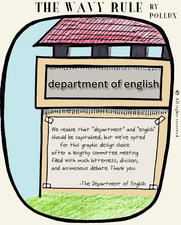
Click on the cartoon to enlarge it!
The Wavy Rule, a Daily Comic by Pollux: Salinger’s New Book
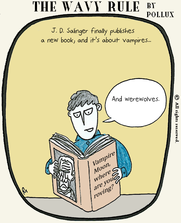
Click on the image for a detailed view!
RIP Claude Lévi-Strauss
Jonathan Taylor writes:
Anthropologist Claude Lévi-Strauss has died at 100.
Updating: John Updike praised The Origin of Table Manners in 1979, though he found missed any sense of “the arthropoid breath” in CLS’s “science of mythology”: “It is beautiful like a clock, and cool like a clock—a strangely elegant heirloom from the torture-prone, fear-ridden jungles and plains. Its orderly revolutions and transpositions have the inverted function of not marking but arresting time, and making a haven, for their passionate analyst, from the torsion and heat of the modern age.”
Against Em Dashes, With Exceptions
“The Em Dash: Friend or Foe?” That’s the title of a blog post by the wonderfully named writer Elizabeth Ditty. She’s doing NaNoWriMo and has some opinions on “that dastardly punctuation mark,” which she also calls “the troublesome turncoat of the punctuation world.” While we cannot agree that our favorite dash is dastardly, we do love rereading the rules (the AP variety, in this case), which provide comfort even in the most turbulent times. And, after all, she adds, “So, as you can see, there really are plenty of instances where the em dash acts as a true friend.” Feeling dashed? Don’t–just read her post. –E.G.
Nibbles From a Bass: More New Yorker Festival Highlights We Dug
Emily Gordon writes:
We (that’s the collective and the particular we) very much enjoyed our friend Ben Bass’s writeup of the recent New Yorker Festival, an event he enjoys even more than we do–that’s a fact, because while it was our fourth Festival, it was his sixth (consecutive). In fact, it was at the Festival two years ago that we first met him, and coaxed him to post about the people he met on line. Not online, but on line! More things should be conducted in person, and his post proved it.
Although Ben teased us that we might get a in-depth Emdashes post to supplement his review, and we hope that’s true, we’re enjoying reading the quickie version. Some highlights from his favorite events (links mine):
• “New Math,” a panel discussion featuring baseball guru Bill James, FiveThirtyEight.com creator Nate Silver, Columbia University economist and Gang Leader for a Day author Sudhir Venkatesh, and University of Missouri statistics professor Nancy Flournoy. Moderator Ben McGrath, whose work I love in the magazine, was quietly hilarious and did a fine job. The discussion was surprisingly funny, occasionally thought-provoking, cordially informative and well worth attending. [For more about “New Math,” read Emdashes editor Martin Schneider’s wonderfully thoughtful and detailed review of the event.]
…
• “Master Class: Cartooning” with cartoon editor Bob Mankoff. I’m no cartoonist, much less one worthy of attending a master class, but I was all over the chance to hear an exemplar talk shop. Mankoff is not just the New Yorker‘s cartoon editor but one of the best cartoonists in the magazine. Those who suspect self-nepotism should know that of his over 900 New Yorker cartoons, many more of them appeared before he was named cartoon editor than since. For that matter, his cartoons are excellent, so who cares? Having seen Bob speak a few times before, I knew him also to be hilarious in person. He did not disappoint, drawing loud laughs from the capacity crowd in the Condé Nast Auditorium.
…
• “Master Class: Copy Editing” with Ann Goldstein, Mary Norris and Elizabeth Pearson-Griffiths, three New Yorker copy editors with nearly a century of experience among them. To the collected authors, editors, reporters, bloggers, English majors, and, yes, New Yorker staff writers in the room, it was pure catnip. Learning from some of the best in the business how they edit copy at the highest level of the publishing industry was a privilege and a joy. On the macro level, they took us through the Byzantine layers of the editing process, still governed by a superannuated, typewritten flowchart. As for the micro, they rattled off examples of New Yorker style, cited umpteen entries from its 2400-entry word list and invited us collectively to take the editing quiz that all prospective new hires must tackle. Undaunted, the audience passed with flying colors.
But you should read it all. Meanwhile, we’re also awed and envious about Ben’s recent and transcendent Steve Martin experience. Thermoses all around, ye enthusiastic and passionate men.
The Wavy Rule, a Daily Comic by Pollux: Two Gladiators

Click on the cartoon to enlarge it!