

Click on the cartoon to enlarge it!
Read “The Wavy Rule” archive, and “order your Wavy Rule 2008 Anthology today!”:http://emdashes.com/2009/03/the-wavy-rule-anthology-now-fo.php
Author Archives: Emdashes
Sempé Fi (On Covers): South of the Highway
_Pollux writes_:
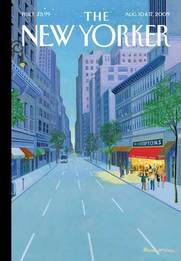
A new themed restaurant has opened in town: _The Hamptons_! Come for the atmosphere without dealing with all the hassles of the real place. When you visit the restaurant, there’s no need to get stuck in traffic on the narrow rural road that materializes after the bridge over the Shinnecock Canal.
There’s also no need to find a place to stay during the crowded summer months. Walk or take a taxi to the restaurant. No muss, no fuss. The scene at the actual place has been “dampened”:http://www.observer.com/2009/daily-transom/checking-georgica-restaurant-and-lounge somewhat by the recession, anyway.
Yes, The Hamptons Restaurant has all the social charms of the real thing and none of the natural charms. There’s no view of Lake Agawam or the hamlets of Water Mill, Sagaponack and Wainscott, but you can settle in for “the season” for just a few pleasant hours. The restaurant has no off-season. Come with friends, come alone. You’re at “The Hamptons,” not The Hamptons.
“Bruce McCall’s”:http://www.brucemccall.com/ restaurant provides access to a social scene–and access to a name. “The Hamptons,” after all, is a name that evokes affluence, expensive zip codes, and plutocratic privilege. To attach the name to a decidedly unspectacular location on an ordinary city street is to attempt to rub a patina of exclusivity on an otherwise ordinary eatery.
McCall thus detaches the name from the place, and challenges us to think of what “The Hamptons” really means. Would the name mean the same to us if it were not associated with the 30-mile string of resorts along the South Fork of Long Island? Does the restaurant retain any of the glamour of the place after which it was named?
As the great American toponymist “George R. Stewart”:http://en.wikipedia.org/wiki/George_R._Stewart writes in his landmark _Names on the Globe_, “Though a place may be conceived as existing in itself or as standing in the consciousness of an animal, a place-name exists only with men, being a part of language…”
Thus, the wide sandy beaches and cornfields and salty air that make up the geographic region of The Hamptons exist in themselves, with or without this famous name. But “The Hamptons” is a name that exists only in the minds of men and women, especially in the minds of the good people of New York.
The people who patronize this restaurant seem happy enough. McCall creates a cheery, convivial atmosphere. The restaurant literally glows with gentle yellow light, casting a beam of happy radiance onto a gray, lonely street. Maybe the customers are happier there than they would have ever been in Long Island, with no traffic, no snobbery, and no distance with which to contend.
As always, McCall creates a quietly detailed scene, making a comment without overstating his point. With McCall’s artwork, one drinks in the scene little by little, as if taking in the layout of a model train set.
Yes, a new themed restaurant has opened in town. The food’s okay. But don’t come for the butter-bathed lobster, stay for the name.
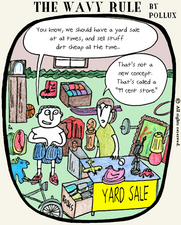
The Wavy Rule, a Daily Comic by Pollux: The Whole Nine Yard Sales
Click on the cartoon to enlarge it!
Read “The Wavy Rule” archive, and “order your Wavy Rule 2008 Anthology today!”:http://emdashes.com/2009/03/the-wavy-rule-anthology-now-fo.php
The Wavy Rule, a Daily Comic by Pollux: Tom Swifty Goes on a Date
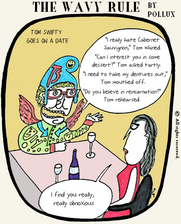
Everyone loves “Tom Swifties.”:http://en.wikipedia.org/wiki/Tom_Swifty Well, maybe not.
Click on the cartoon to enlarge it!
Read “The Wavy Rule” archive, and “order your Wavy Rule 2008 Anthology today!”:http://emdashes.com/2009/03/the-wavy-rule-anthology-now-fo.php
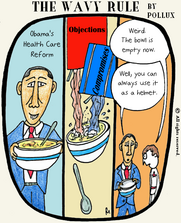
The Wavy Rule, a Daily Comic by Pollux: Condensed Chicken Soup for the Soul
Click on the cartoon to enlarge it!
Read “The Wavy Rule” archive, and “order your Wavy Rule 2008 Anthology today!”:http://emdashes.com/2009/03/the-wavy-rule-anthology-now-fo.php
Meditations in a Newsmergency
Michael Nielsen writes in “Is Scientific Publishing About to Be Disrupted?”, which is worth reading through to the sound advice at the end:
Some people explain the slow death of newspapers by saying that blogs and other online sources [1 (see note)] are news parasites, feeding off the original reporting done by the newspapers. That’s false. While it’s true that many blogs don’t do original reporting, it’s equally true that many of the top blogs do excellent original reporting…. Five years ago, most newspaper editors would have laughed at the idea that blogs might one day offer serious competition. The minicomputer companies laughed at the early personal computers. New technologies often don’t look very good in their early stages, and that means a straightup comparison of new to old is little help in recognizing impending dispruption. That’s a problem, though, because the best time to recognize disruption is in its early stages.
Although much of my own reporting for Emdashes is in the somewhat less world-changing realm of bagel inquiries and Shouts & Murmurs phone number calling, I heartily agree.
Important economic and media-future questions aside, this preoccupation with what a “blogger” does and doesn’t do–and can and can’t do–continues to be fascinating but frustrating to me. (This is why I’m looking forward to reading Say Everything: How Blogging Began, What It’s Becoming, and Why It Matters, by Scott Rosenberg, who, on his book’s site, answers the question “Aren’t there just too many blogs?” with a brief and hilarious “No.”) As Sewell Chan said not long ago: “The whole blogger versus journalist debate that might have existed around 2004 is dead. Over. Stale. Uninteresting. I couldn’t care less — it’s a meaningless debate to have. What’s more interesting to me is what a blog means now.”
Yes indeed, a blog means something–that’s very clear–but what about a “blogger”? If you don’t mind the self-quoting (I so rarely indulge!), I’ll repeat, Pete:
Like “radio host” or “airplane skywriter,” the term “blogger” refers only to a medium of communication, a method of delivery. The first two descriptions might indicate something about a person’s source of income; they say a little more about his or her temperament and skills (the ability to get to a radio studio, win the slot, speak into a microphone, and work the dials, at minimum; the agility and daring to fly a plane in signifying loops).
But “blogger,” like “caller from Schenectady” or “chronicler of skywriting,” reveals next to nothing about that person’s training, philosophy, background, intelligence, education, politics, reporting or research skills, social life, ethics, age, poise, lucidity, conventionality, effectiveness, impulsiveness, discretion, or relationship to (or experience in) traditional media, whether “mainstream” or not. Only watching what the skywriter spells, and listening to what Schenectady has to say, will begin to make them known.
In any case, writers who pride themselves on their sensitivity to language should avoid lumping their fellows into mass categories of either variety, don’t you think?
New ‘n’ related: Scott Rosenberg asks, Time to retire the term “blogger”?
Bird Searcher: The Fluent Troubadour of Tweet Street
Emily Gordon writes:
If there really is a chance of a New Yorker story about the purloined birds at London’s natural history museum, we think Laura Jacobs is just the person to write it.
The Wavy Rule, a Daily Comic by Pollux: Tintin in Iran
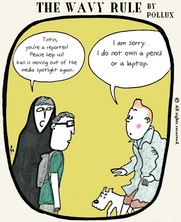
Click on the cartoon to enlarge it!
Read “The Wavy Rule” archive, and “order your Wavy Rule 2008 Anthology today!”:http://emdashes.com/2009/03/the-wavy-rule-anthology-now-fo.php
A Look Back: Pauline Kael, and David Denby’s Snark
Martin Schneider writes:
My Facebook friend Michal Oleszczyk, who once reminded us about Pauline Kael’s former apartment on the Upper West Side, yesterday pointed us in the direction of an unflinching reminiscence written by a fledgling film critic to whom Kael once showed unusual kindness. This is exactly the way I like to think of Kael, imperious but benevolent, possibly eccentric but supremely confident of her abilities and importance (check that closing line).
I really admire Ed Champion’s willingness to grapple with the fundamental questions surrounding writing, and his defense of David Denby’s Snark from several months ago certainly doesn’t detract from that admiration. Back in the day, I was a FameTracker devotee of long standing (username: DerKommissar), so I respect the uses of snark while also harboring concern over its excesses. Either way, Denby’s argument was almost certainly dismissed too quickly, and Champion’s article is a useful corrective. Note that Choire Sicha and Adam Sternbergh took the time to respond to Champion in the comments.
What’s in This Week’s New Yorker: 08.24.09
Martin Schneider writes:
A new issue of The New Yorker comes out tomorrow. A preview of its contents, adapted from the magazine’s press release:
In “The Untouchable,” Ben McGrath examines Michael Bloomberg’s campaign for a third term as Mayor of New York. “After seven and a half years in office, Bloomberg, who is now sixty-seven, has amassed so much power and respect that he seems more a Medici than a mayor,” McGrath writes.
In “Plugged In,” Tad Friend examines the state of the electric-car industry, by profiling Elon Musk, the colorful chairman, C.E.O., and product architect of Tesla Motors.
In Comment, Hendrik Hertzberg takes note of our foundering state governments, and asks if one of our largest states, California, has become ungovernable.
Alec Wilkinson explores the world of competitive free diving.
In Shouts & Murmurs, Amy Ozols offers a cure for hangovers.
David Sedaris reflects on his childhood and a trip to Australia.
Alex Ross examines depictions of fictional composers in literature.
Sasha Frere-Jones looks back at Leonard Cohen’s career in music.
Peter Schjeldahl visits the exhibit “Augustus Saint-Gaudens in the Metropolitan Museum of Art.”
David Denby reviews Inglourious Basterds and Julie & Julia.
There is also an excerpt from The Wild Things, Dave Eggers’s new adult novel based on the storybook by Maurice Sendak.