

Click on the cartoon to enlarge it!
Read “The Wavy Rule” archive.
Author Archives: Emdashes
Essential Comedy Tome to Grill Chast, Sedaris, Clowes, Handey, Others
Martin Schneider writes:
Finally, a post that doesn’t mention Tw****r! I think I’ve discovered the 2009 release I’m looking forward to most. A gentleman named Mike Sacks has compiled a book of interviews with twenty-five of the funniest writers on earth, due for publication in July from F+W Press.
The book will feature interviews with familiar New Yorker contributors Roz Chast, Daniel Clowes, Jack Handey, and David Sedaris, as well as:
Paul Feig (Freaks and Geeks)
Merrill Markoe (Late Night with David Letterman)
Dick Cavett (The Dick Cavett Show)
Larry Wilmore (The Daily Show)
Irving Brecher (Marx Brothers)
Bob Odenkirk (Mr. Show)
Robert Smigel (TV Funhouse)
Dan Mazer (Ali G, Borat)
Harold Ramis (Groundhog Day)
Larry Gelbart (M*A*S*H)
Mitch Hurwitz (Arrested Development)
Dave Barry (syndicated column)
Daniel Handler (Lemony Snicket)
Bruce Jay Friedman (The Heartbreak Kid)
Marshall Brickman (Annie Hall, Manhattan)
George Meyer (The Simpsons)
Al Jaffee (MAD Magazine)
Allison Silverman (The Colbert Report)
Buck Henry (Get Smart, The Graduate)
Stephen Merchant (Extras)
Todd Hanson (The Onion)
(Apparently New Yorker editor Susan Morrison is involved as well.)
I feel confident in guaranteeing that if you collected that group in a room, nobody’d ask, “So when do the funny people show up?”—except in jest.
Best of all, you can read the chapters for Handler, Chast, Friedman, and Clowes in full on the book’s website, which also has generous excerpts of every single other chapter.
As a comedy enthusiast with a serious weakness for artist interviews (Paris Review, Inside the Actor’s Studio, you name it), I’m genuinely excited, as you can well imagine.
Not Just Inane Chatter, Twitter also Brings Facts
Martin Schneider writes:
User @alexbarkett (for that is the convention) tweets: “For everyone who was wondering, the audio prelude to all New Yorker podcasts is a song by Isolée called Schrapnell.” I checked it out: it does sound right! (Compare.) A back and forth with Mr. Barkett confirmed that he knows the full song and that it only applies to the “Out Loud” podcasts.
Note that when I tried to confirm this fact on Google, I came up bupkes.
The Twittersphere Reacts to This Week’s Issue
The Wavy Rule, a Daily Comic by Pollux: The Red-Coats’ Arsenal

Click on the cartoon to enlarge it!
Read “The Wavy Rule” archive.
Best of the 03.02.09 Issue: Hive Mind
Martin Schneider writes:
Ivan Brunetti’s adorable presentation of cubicle life was on the cover. Features included Ryan Lizza’s report on Rahm Emanuel, Rebecca Mead’s Profile on soprano Natalie Dessay, and Steve Koll’s investigation of tensions between Pakistan and India.
Wallace Week at The New Yorker: The Good and the Bad
_Martin Schneider writes:_
Love the prospect of an in-depth “article”:http://www.newyorker.com/reporting/2009/03/09/090309fa_fact_max?currentPage=all about the last days of David Foster Wallace, by D.T. Max. Not so comfortable with the unfinished “work”:http://www.newyorker.com/fiction/features/2009/03/09/090309fi_fiction_wallace?currentPage=all.
You’ve Been Collectively Poked: The Emdashes Facebook Group
“Emdashes has now stormed into the world of Facebook!”:http://www.facebook.com/group.php?gid=132214570367&ref=ts&nectar_impid=7c3d4ab7cba6257d3a737a3312353f34 Yes, we are building champagne pyramids and doing the Charleston on a social connecting website that is known to everyone on and off this planet (the International Space Station also has a Facebook page). Feel free to join and become friends with all of the Emdashes staff.
Sempé Fi (On Covers): The Office
_Pollux writes_:
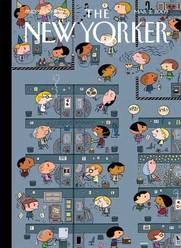
The color gray dominates Ivan Brunetti‘s bird’s-eye-view of a typical American cube farm on the cover of _The New Yorker_ for March 2, 2009. In this corporate necropolis of worthless PCs, dried-out water coolers, filthy coffee pots, and nauseating microwaveable meals, the wheels of American commerce fitfully turn like those on a rusty pump trolley. Even more defective than the machinery are the workers themselves: they weep, sleep, drink coffee, throw around office equipment, argue, and suffer termination, germophobia, and Post-it Note overload. They look for shoes and romance, both of the online and office varieties, and dance fitfully at a potluck. They get caught looking at pornography and lose precious time as the bespectacled Help Desk Guy dismantles their computer with a ruthless drill.
Brunetti’s “Ecosystem” is a corporate world that at first glance seems to be a beehive of industry and activity, but we soon come to an awful conclusion about this American workplace: little work is actually being done. In the sickly gasps of a failing economy, we hear verses, through a defective intercom system, from Alighieri’s _Inferno_: “Here heartsick sighs and groanings and shrill cries / Re-echoed through the air devoid of stars.”
I wish this world were imaginary, for the U.S. economy’s sake, but as a reluctant inhabitant of this type of purgatory myself, I find Brunetti’s vision all too familiar. I have witnessed a Mardi Gras Potluck in which managers and supervisors walked around in feathered carnival masks while workers happily clipped their fingernails, checked Facebook for the umpteenth time, made multiple trips to the break room for bratwurst, Lay’s Potato Chips, and stomach-churning lumps of cheese and steak, and looked forward to a night of office-sponsored glow-in-the-dark miniature golfing.
By a trick of perspective we look at Brunetti’s egg-headed, stick-limbed figures not from above, but follow them on a downward trajectory as if in “an etching by Piranesi.”:http://upload.wikimedia.org/wikipedia/commons/2/29/Piranesi9c.jpg All are locked in their compartments, doomed to scamper endlessly on a hamster wheel they themselves have maintained. The artist’s cartoon figures, normally subjected to the most wicked and outrageous torments (see, for example, his book HAW!: Horrible, Horrible Cartoons), now participate in the most perverse ordeal of all: the daily routine of office life.
Review Roundup: Cheever, Orwell Receive Boost, Yawn
Martin Schneider writes:
In the New York Times Magazine, Charles McGrath (father of Ben) makes the case that John Cheever is sorely due for a revival. Since he’s better than the recently canonized Richard Yates, this does seem both likely and proper. The success of Mad Men, set in Ossining, Cheever’s hometown, should help.
Meanwhile, the otherwise excellent New York Review of Books brings us Julian Barnes’s fatuous review of the new George Packer editions of George Orwell’s essays. I’m an Orwell nut of long standing, dedicated my (poor) senior thesis to his work, have committed the CEJL to memory (true Orwell fanatics instantly recognize that abbreviation), and grow impatient with Barnes’s denigrating tone and determination to ignore the volumes under review. Both Georges deserve better.