
_Pollux writes:_
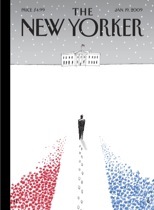
A lone man walks towards a White House constructed from a few thin, sketchy lines in “Guy Billout’s”:http://www.guybillout.com “inauguration cover” for the January 19, 2009 issue of _The New Yorker_. The lone man could be Obama, but is not immediately recognizable as the president-elect. The lone figure, I believe, represents Everyman, unprotected from the snow’s coldness. We are all walking towards the White House, which is set in a wintry landscape unencumbered by distractions, crowds, and TV cameras.
The Everyman walks straight towards his new home, through the fallen red-and-blue leaves of the autumnal election season, which is now over and done with. He walks away from the chaotic noise, a mixture of violence and optimism, of our two warring political parties, whose tendrils nevertheless trail him for as long as possible. He is an Amundsen in search of a new Pole across the Ross Ice Shelf of a new future, away from the simple dichotomy of red and blue.
The cover is more grim than hopeful, I think. What is certain is that the shoeprints in the snow lead towards the future down an unmarked pathway towards the White House door. The loneliness of power is apparent here, and Billout’s stark artistic style lends itself very effectively to this message.
Author Archives: Emdashes
The Wavy Rule, a Daily Comic by Pollux: Look, Teddy!
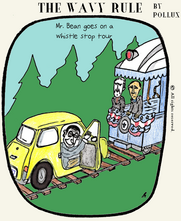
Click on the cartoon to enlarge it!
Read “The Wavy Rule” archive.
Joan Walsh in Salon on Barry Blitt’s Obama Cover
Emily Gordon notes this passage in Salon today:
Still, at times Obama seemed to have the best of both worlds, politically: The self-confidence that comes from being raised (and loved, intimately, from Day One) by the white majority, while also being protected from any perceptible threat of racism by black and white supporters admirably determined to identify and crush it when it surfaced….
Historians may find that this double force field protected Obama; certainly, we saw it in the primaries, when anything that could be remotely perceived as a racial diss to Obama, by the Clintons, their supporters or the media, ignited a firestorm and damaging charges of racism against whomever slurred — or simply slipped — in their treatment of the black Democratic candidate. I enjoyed the anti-racist media strikeforce when it hit Fox News for its idiotic “slips” labeling Barack and Michelle’s affectionate fist-bump a possible “terrorist” gesture, and describing Obama’s wife of 16 years as his “baby mama.” I liked it much less when it was directed at outlets I respect, like the New Yorker (or Salon). I still can’t believe the backlash against the New Yorker’s hilarious (in my opinion) fist-bump cover, sending up all the right wing’s dumbest, least believable slurs against Michelle and Barack Obama. His supporters howled with outrage, and his campaign bit back, too, with even Obama himself lamenting that the cartoon might be misunderstood by confused voters.
The Wavy Rule, a Daily Comic by Pollux: Heloise, Abelard Will Have to Confirm That You Are Friends

Click on the cartoon to enlarge it!
Read “The Wavy Rule” archive.
Friday Steinberg Blogging: California Cheese
Other blogs do “Friday”:http://www.motherjones.com/kevin-drum/2008/12/friday_cat_blogging_-_26_december_2008.html cat “blogging”:http://lefarkins.blogspot.com/2008/05/friday-cat-blogging_30.html; we present the genius of Saul Steinberg! From the December 27, 1982, issue:
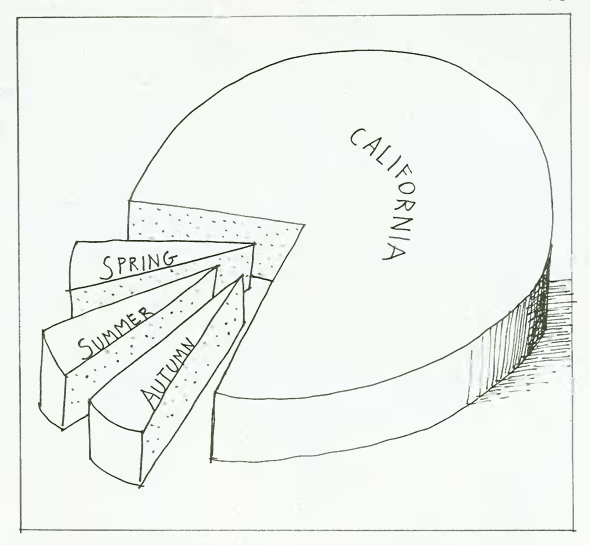
Have a good weekend, everybody! —Martin Schneider
James Wolcott: He Could Type the 1978 Manhattan Phone Book, And I’d Read It
No, I didn’t want to read another review of John Updike’s The Widows of Eastwick, either—until I saw that the London Review of Books‘ critique is by James Wolcott, who’s perennially on fire like one of those burning coal mines (and, thank God, is “working on a memoir about 1970s Manhattan”). Wolcott has a winning way of accentuating the positive by taking for granted the negative, dispensing justice that is elegant in its balance of cheery severity and generosity.—Jonathan Taylor
New Yorker Fiction Podcasts–2008 Highlights
Benjamin Chambers writes:
2008 was the first full year of The New Yorker fiction podcast, and I gotta say, it was a very fine year. Fiction Editor Deborah Treisman’s unhurried confidence sets a nice tone, and the authors nearly always choose interesting work and read it well (not the way actors would, but sensitively nonetheless). They also tend to have interesting things to say about the work, or their reasons for choosing it, that help you see it in new ways. It’s sort of like sitting in on the bull session in the bar after a graduate writing workshop.
Anyway, here are my picks for the best of the bunch:
Best at Getting Me Interested in a Classic Author I’d Never Read: E. L. Doctorow reading and discussing John O’Hara’s 1943 story “Graven Image,” which had the singular effect of making me want to read more O’Hara, whose Appointment in Samarra once failed to entice.
Best Reading of a Classic Short Story First Published in 1948: I can’t decide. I’m sorry; I know you look to Emdashes for firm opinions, but I just can’t do it. It’s a toss-up between Mary Gaitskill tackling Nabokov’s terse story “Symbols and Signs,” and A. M. Homes narrating Shirley Jackson’s creepy chestnut, “The Lottery” (which you can see on film here). What are the odds that two authors featured on the podcast in the same year would both choose stories from 1948? Who cares? Just don’t make me choose.
Best Story by a Contemporary Writer I’d Never Heard of: Stephanie Vaughn’s “Dog Heaven,” read exceedingly well by Tobias Wolff. The upshot? I’ve just picked up a collection of Vaughn’s stories from the library.
Most Interesting Commentary on a Story I Wasn’t Crazy About: Once again, a toss-up. I enjoyed hearing Roddy Doyle talk in his warm Irish accent about having TNY writer Maeve Brennan live with his family in the 1970s; but I also enjoyed hearing Jeffrey Eugenides, after reading Harold Brodkey’s 1994 “Spring Fugue,” chat with Treisman about Brodkey’s lack of appeal to some readers, in spite of his obvious talent.
Podcast I Liked Best In Spite of Myself: T. Coragahessan Boyle reading Tobias Wolff’s 1995 story “Bullet in the Brain.” I admire Wolff’s stories, but this one isn’t his strongest. Nonetheless, it reads well aloud, and it was a smart choice by Boyle, whose discussion of the piece is quite winning, though I’m surprised that he never once mentions the story’s obvious model, Ambrose Bierce’s “An Occurence at Owl Creek Bridge.”
Best Fiction Podcast of the Year: I’ve already talked my fool head off in several posts about how much I liked Louise Erdrich’s reading of Lorrie Moore’s 1993 story “Dance in America.” Surely, ’nuff said. But if you listen to only one fiction podcast from last year…
For Completists: Here’s the entire list of TNY podcasts, going back to 2007. (There’s some good’uns from 2007, too.)
If You’re Eager for More: Go right head and check out the January 2009 podcast, in which Thomas McGuane reads Jame Salter’s kick-ass 2002 story “Last Night.” Not to be missed. Just be sure you’re ready for a fright.
The Wavy Rule, a Daily Comic by Pollux: Senator, I Don’t Recall…Using Iambic Pentameters
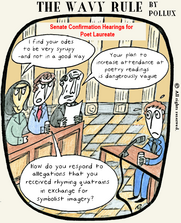
Click on the cartoon to enlarge it!
Read “The Wavy Rule” archive.
The Wavy Rule, a Daily Comic by Pollux: Futility For the Whole Family
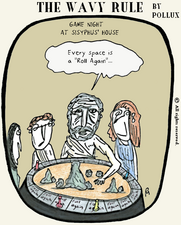
Click on the cartoon to enlarge it!
Read “The Wavy Rule” archive.
The Wavy Rule, a Daily Comic by Pollux: Is Our President Learning?

Here’s the “transcript”:http://www.nytimes.com/2009/01/12/us/politics/12text-bush.html of Bush’s last press conference. Click on the cartoon to enlarge it! Read “The Wavy Rule” archive.