
I noticed that Sports Illustrated recently named 2008 the “best year ever.” (People continue to ignore 538, apparently. A criminally underrated year.) In that spirit, on the heels of yet another strong January issue, I’d like to put in a bid for 2009 as the best year of the post-Bush era. (Which hasn’t even started yet!)
Jeffrey Toobin on the delectable Barney Frank and Jill Lepore on inaugural addresses combine to slake our ever-unsatisfied thirst for politics; Elizabeth Kolbert hits the economics of environmentalism; international affairs is amply covered by Peter Hessler’s newest China report; and there was a story by Joyce Carol Oates to round matters out. I’m curious which one(s) will delight my colleagues! (I’ll weigh in later.)
—Martin Schneider
Benjamin Chambers writes:
I haven’t had a chance to dip into the week’s issue, but I do have a great, can’t-miss recommendation that’s also timely: Thomas McGuane reading and discussing James Salter’s 2002 story, “Last Night,” on this month’s fiction podcast. The story is stripped-down and stark like its subject, without the sensual pleasure usual for Salter’s fiction. The setup: a woman has a terminal illness, and she and her husband go out to dinner one last time before returning home to prepare for her suicide; they have a guest go with them, to blunt the tension. Could be maudlin, but boy, does it pack a punch. (If you like McGuane, you might be interested in this Q&A from 2003 with fiction editor Deborah Treisman.)
Jonathan Taylor writes:
I did pick only one story to read in this issue, Peter Hessler’s “Strange Stones,” a memoir of Peace Corps service in China. Beguiling in structure and emotionally polyvalent, it is my favorite, so far, of Hessler’s many Letters From China. Worthwhile travel writing is a portrait not of a place, but of an apprehending intelligence: one like Hessler’s, that recognizes that in fact, he “hadn’t seen anything stranger in China” than a fellow volunteer’s tale of a Midwestern biker rally.
Stuck in an absurd traffic jam on a remote Inner Mongolian steppe—driving in China is a fruitful theme for Hessler—he invokes “the shadowy line between the Strange and the Stupid,” putting me in mind of a farcical version of Joseph Conrad’s The Shadow Line (in which the narrator’s ship, with a cholera-ridden crew, is inexplicably stranded in windless Oriental waters). At the same time, Hessler’s piece touches on the serious side of Conrad’s “shadow line”—between Youth and Maturity—in sketching, with suggestive anecdotes, the transformations that he and his colleagues underwent through their service.
Author Archives: Emdashes
The Wavy Rule, a Daily Comic by Pollux: My Son is a Condottiero

Click on the cartoon to enlarge it!
Read “The Wavy Rule” archive.
Top Dog of New Yorker Fiction: Morley Callaghan…?
Benjamin Chambers writes:
In an article in the Canadian newspaper The National Post, Philip Marchand writes,
Whatever happened to the reputation of Morley Callaghan, who was once every bit as much an icon of Canadian literature as Margaret Atwood? For a while he practically owned The New Yorker, in the manner of Alice Munro. In 1965 Edmund Wilson—at that time the most prestigious literary critic in the English-speaking world—compared him to Chekhov and Turgenev. Yet today he is rarely taught in Canadian literature courses, and his works seldom opened. Are we so sure what happened to Callaghan won’t happen to Atwood?
If you’re scratching your head and muttering, “Morley Callaghan?”, you’re not alone. A quick check of the Complete New Yorker showed me that Callaghan published 20 stories in TNY between 1928 and 1938. That surprised me, since Wilson lauded him in 1965.
I wondered why Callaghan’s stories stopped appearing in the magazine so suddenly, but Wikipedia says that he wrote almost no fiction between 1937 and 1950, which partially explains why he didn’t show up there again. (Wikipedia also informed me that Callaghan knocked down Hemingway in a boxing match refereed by F. Scott Fitzgerald…)
In any case, it’s obvious Callaghan was both a prolific writer and a well-regarded one, so I look forward to reading his New Yorker stories.
Of course, it’s not always clear, years later, why an author of the past used to take home all the laurels. Taste, like tempus, fugit.
Presenting a Steinberg, to Kick Off a Frigid Weekend

If you’re not in some balmy clime, do stay warm!
New Yorker Fiction By the Numbers, 2003-2008 + Quiz
Benjamin Chambers writes:
The folks over at The Millions have got a great post showing the stats on fiction in The New Yorker for the past six years: male/female ratio, frequency with which authors appear, etc.
While TNY undeniably relies heavily on some of the same authors over and over, I can attest to the fact, after reading every story the magazine published last year, that it often publishes authors of whom I’ve either never heard, or have never read—and many of them are not exactly household names. That got me wondering whether I was just out of the loop, or if others had had the same experience.
So, here’s a quiz. Check out this list of all the stories the magazine published in 2008, and ask yourself how many authors on the list you’d heard of before they appeared in the magazine. I’m reasonably well-read, but of 40 authors, I’d never heard of eight: John Burnside, Rivka Galchen, Yiyun Li, Chimamanda Ngozi Adichie, Daniyal Mueenuddin, Sarah Shun-lien Bynum, J. M. G. Le Clezio, and Wells Tower. That’s not a bad percentage of new-to-me authors.
In the spirit of being ruthlessly honest, I will also add in authors I’ve heard of but have never gotten around to reading (though in some cases I’m embarrassed to admit it), such as Joshua Ferris, Tessa Hadley, Ha Jin, Hari Kunzru, Janet Frame, Ruth Prawer Jhabvala, Roberto Bolaño, Daniel Alarcon, and Edwige Danticat.
That’s another nine authors, which means I’d never read 17 out of 40 authors the magazine published last year. I may be an uncultured boor, but thanks to The New Yorker, I’m significantly more cultured than I was as of 2007.
Write in and tell us how you did on the quiz … and in case you’re curious about the magazine’s editorial policies, check out this recent Q&A with TNY fiction editor, Deborah Treisman.
The Wavy Rule, a Daily Comic by Pollux: After the Binge
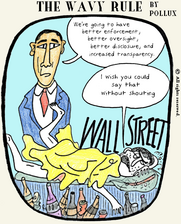
Click on the cartoon to enlarge it!
Read “The Wavy Rule” archive.
The Wavy Rule, a Daily Comic by Pollux: Signs of the Times
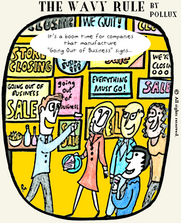
Click on the cartoon to enlarge it!
Read “The Wavy Rule” archive.
Reading (and Watching and Listening to) New Yorker Fiction 2008
Benjamin Chambers writes:
C. Max Magee at The Millions just did my job for me and provided capsule reviews of all the short stories The New Yorker published in 2008, as well as links to others who wrote about them, including Emdashes. My story picks would differ some from his, but who am I to quibble? First one in the pool gets to say how nice the water is.
But I read and posted about a lot of TNY fiction in 2008 that didn’t appear in the magazine last year, so I thought a brief summary of my ’08 posts would be appreciated, especially now that all the old stuff is easily accessible through the TNY Digital Edition.
Read on for my tips on the best TNY story I read all year (from 1959); the funniest (from 1958); the most mysterious (from 1966); and which episode of this year’s fiction podcast was most enjoyable.
Feb 8th—Temporary Outages: Updike, Doctorow, and Boyle—my first post for Emdashes, in which I was disappointed by the first three TNY stories of the year.
Feb 19th—I praised Jean Stafford’s superb 1953 story, “In the Zoo,” and compared it with three other stories of hers that appeared in TNY, including 1948’s “Children are Bored on Sundays.”
Feb 25th—Ever wonder who’s published the most short stories in TNY? Now you can find out the answer.
Feb 28—The great Canadian short story writer, Mavis Gallant (who was Alice Munro before Alice was Munro), is interviewed; and Adam Gopnik, too.
March 11th—Louise Erdrich wins a demolition derby, in which I compare four stories that share the keyword “demolition” in the Complete New Yorker index. Besides a 2006 story by Erdrich, I also covered a 1959 story by Thomas Meehan, a William Gaddis story from 1987, and a Haruki Murakami story from 1991.
March 26th—Certainly the funniest New Yorker story I read all year: Michael J. Arlen’s 1958 casual on losing the novel race to the Soviets.
April 10th—Translations from the British rounds up Britishisms that slipped into the otherwise very American New Yorker in 2008 stories by Ha Jin, Tessa Hadley, John Burnside, Hari Kunzru, and Roddy Doyle.
April 16th—Best TNY podcast of the year? Louise Erdrich reading Lorrie Moore’s 1993 story, “Dance in America.” (Rumor has it that Moore has a new novel coming out in September. Cause for celebration.)
April 21st—“In Praise of Shirley Hazzard” examines stories from 1976, 1977, and 1979 that later appeared in her novel, The Transit of Venus. The title of this post says it all.
May 14th—Hilton Als singles out Jean Stafford’s 1948 “Children Are Bored on Sundays” for reading and discussion on the fiction podcast.
May 30th—Louise Erdrich and Lorrie Moore came out with a novel and a “collected stories,” respectively; here, I rounded up reviews.
June 11th—Muriel Spark got a turn, in this post about two stories of hers from 1960 and 1966, including the ineffable and wonderful “The House of the Famous Poet,” which was one of my top favorites of the year.
June 17th—A few excellent retrospectives on Richard Yates’s life and work before he hit the big time late last year, when the movie Revolutionary Road, based on his novel of the same name, came out.
June 26th—In 1999, Daniel Radosh wrote entertainingly about the difficulty of translating Harry Potter from the British for American readers.
July 8th—A quick post about William Styron’s forthcoming (though posthumous) collection of fiction.
July 9th—Unquestionably the best short story I read all year (and maybe in the past several): Mary Lavin’s “The Wave,” from 1959. They don’t make ’em like that anymore. I wrote about it here.
July 16th—Turns out John Cheever’s 1960 short story, “Some People, Places and Things That Will Not Appear in My Novel” is longer than the final version that appears in his Collected Stories. I had a lot of fun looking closely at this knotty piece of metafiction.
Aug. 7th—C’mon, ‘fess up. You always wanted to hear E.B. White read Charlotte’s Web. You can find a recording here, attached to an appreciation of the book that appeared on NPR.
Aug. 14th—In 2008, Ruth Prawer Jhabvala marked her fifty-first year publishing stories in TNY—an anniversary I celebrated by reading her for the first time, looking closely at the first story she published in the magazine, and her latest.
Aug. 15th—If you ever had doubts about the reading public, a column on the Obama cover quoting Shirley Jackson on public reaction (and failure to comprehend) her infamous story, “The Lottery” won’t help any.
Aug. 26th—In which Emdashes said “So long,” to the great Esquire fiction editor and TNY contributor Rust Hills, and “See you tomorrow,” to TNY fiction editor William Maxwell.
September 9th—Check out Donald Barthelme’s syllabus for students, his 1974 story “The School,” and why reading more fiction is good for you.
September 18th—The late, lamented David Foster Wallace’s not-so-serious reading list.
November 3rd—In case you missed it when it came out in 1969, you can now check out this short film of Shirley Jackson’s 1948 story, “The Lottery” online. Then, you can listen to A.M. Homes read it aloud on the TNY fiction podcast.
Nov. 14th—Obama’s win spurred a look through the archives for stories that had presidents in them. That turned up two of my favorite TNY short stories, by Donald Barthelme and Mark Strand (from 1964 and 1979, respectively): both loopy, poetic pieces having to do with the President as a fictional character.
Nov. 20th—My search for presidential fiction turned up a lot of satire, including a piece by Garrison Keillor, in which he skewers the Other Bush.
Dec 13th—Leaping Lepidopterists! It’s Nabokov on YouTube, along with his 1998 (posthumous, natch) review of his own memoir, Speak, Memory.
Dec 25—I closed out the year with a review of all four stories in the 2008 Winter Fiction issue, by Donald Antrim, Roberto Bolaño, Alice Munro, and Colson Whitehead. Maybe it was the season, but I found a lot to like.
Whew! Stay tuned: next, I’ll cover the year’s fiction podcasts!
Teens Hate Vegetables, Even at 73
The New Yorker‘s Bruce McCall is interviewed about his haunt, Cafe Luxembourg, in this week’s Time Out New York food section. His thoughts on food aren’t too appetizing, but his words about writing are no doubt good for you: “As a writer I find that if I get out of the house, I get a much clearer vision of what I’m writing.”—Jonathan Taylor
The Wavy Rule, a Daily Comic by Pollux: Conscientious Abjecter

Click on the cartoon to enlarge it!
Read “The Wavy Rule” archive.