
At what point can we start calling “Barack Obama”:http://www.newyorker.com/reporting/2008/11/17/081117fa_fact_packer?currentPage=all a “traitor to his class”? I kind of like that idea. FDR attended Harvard and then Columbia Law School; Obama attended Columbia and then Harvard Law School. Hmmm.
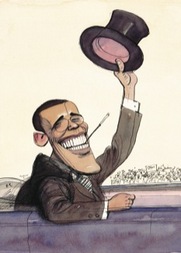
_(Illustration credit: Richard Thompson)_
Author Archives: Emdashes
Campaign-Trail Pain Painful, Though Even More Painful Had Palin Prevailed
Emily takes a break from a long issue close to write:
I was sorry to hear from the latest “Campaign Trail” podcast that most-having host Dorothy Wickenden has busted her ankle. President-elect Obama surmised that Chicago Sun-Times reporter Lynn Sweet’s cracked shoulder was the “only major incident” from the Grant Park party. Could this be the second media-related injury this election season? Either way, I hope both bones heal quickly and well.
Also, I was delighted to learn, at the end of this week’s podcast, that “The Campaign Trail” will continue to continue (as Simon & Garfunkel would say), as “The Transition,” which Wickenden describes as “a program about the new political scene in Washington and around the country as the shift in power gets underway.” I’m so glad: The show is too enlightening, and—particularly last week, when the crew became charmingly manic—too entertaining to end.
“Gladwellian” Outlier Thesis to Apply to Gladwell? Yes/No/Maybe.
Jason Zengerle has a substantial “article”:http://nymag.com/arts/books/features/52014/ in _New York_ magazine on Malcolm Gladwell that’s pretty much a must-read for Gladwell enthusiasts. I very much count myself among that group, and I learned plenty.
In retrospect, the appearance of Gladwell on the national stage, around 2000, when _The Tipping Point_ first came out, had some similarities to the splash occasioned by our new president-elect, back in 2004. Like Obama, Gladwell’s genius is rhetorical in nature, and _The Tipping Point_ got as much attention for what it promised as for what it actually was, I think, and Gladwell became a kind of receptacle for his readers’ hopes in a way that Obama has, albeit on a much larger scale.
I recall attending the Gladwell’s 2004 New Yorker Festival event, held at that Times Square building with the curvy ABC News feeds slithering around it in green and amber; this was a couple of months before _Blink_ came out. Gladwell spoke about the shooting of Diallo and was riveting, I thought. The Q&A portion of the event was dominated by people who had read a galley of _Blink,_ and each questioner started, it seemed, by stating how “beautiful” or “spiritual” or “inspiring” the experience of reading it had been—odd words for a decidedly intellectual book.
That was some serious adulation being expressed there, and it makes for a tough act to live up to. I don’t think I’m speaking out of school when I say that the intervening years have not been a bed of roses for Gladwell, even as his bank account swells (amusingly, he claims not to know much about that). Critics have popped up (maybe they were there all along but feeling outnumbered), and there’s been a feeling that the books were perhaps too slight to warrant all the hoopla—Zengerle and Gladwell seem to adopt this line. _Outliers_ seems to have been written in this spirit; it’s described as more “personal” and “serious.”
Myself, I see the flaws in the first two books, but I also never thought that Gladwell was really setting himself up as the grand theorist everyone took him to be (of course, I was also intoxicated by his narrative voice; still am, I suspect). Once I was able to classify him as a kind of popularizer, a mantle he willingly adopts, then a lot of the criticisms came to seem churlish. Plus I didn’t see anything wrong with his focus on “mere” trends and marketing, as if such phenomena could not be handled with brilliance or insight or ambition. If he seems glib in retrospect, if the days before Iraq and Guantanamo permitted that kind of playful tone, that isn’t really Gladwell’s fault, and judging from Zengerle’s article it sounds like he’s sobered a bit, is after bigger game. I’m glad to see him taking on systems instead of those “mere” trends (even if I don’t share the need to dismiss), and I’m looking forward to the new book.
The Wavy Rule, a Daily Comic by Pollux: Joe the…Democrat? Republican? Independent?
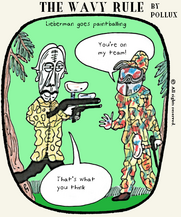
What will happen to Joe Lieberman? Will he be stripped of his chairmanship of the Senate Homeland Security Committee? Click on the cartoon to enlarge it!
Read “The Wavy Rule” archive.
New Yorker Election Special an Issue to Savor
Whether you’re looking at the “Digital Edition”:http://archives.newyorker.com/?i=2008-11-17 or the “dead tree” edition (the very phrase seems to plead for the invention of some sort of Virtual Interweb Way of reading _The New Yorker_), this week’s issue has a lovely cover, a Talk of the Town section crammed with items about Election Night and its aftermath, and four major features by David Remnick, Ryan Lizza, George Packer, and David Grann, about the campaign, the election, the president-elect, and what it all means. I’ll be taking some time out this week to comment on this or that aspect of the issue. It’s great to see _The New Yorker_ rise to the occasion.
Pretty New Yorker Cover Pages Aren’t Just Pretty
I wanted to point out that New Yorker Digital Edition doesn’t always seem to provide the best oversight over the archive, but the “_New Yorker_ website”:http://www.newyorker.com/ has these swell “cover pages”:http://www.newyorker.com/magazine/covers/2008 that permit pretty easy access to the Digital Reader. Even if you forget the distant past, you’ve got 2008 right there on a single page, and that’s nifty.
Obama Is My Flickr Friend
Perhaps even more remarkable than these moving photos of the Obamas and co. on election night is that the future president is now on my Flickr contacts list. He’s male and taken! —E.G.

The Wavy Rule, a Daily Comic by Pollux: Holy Misguided

“The debate over Proposition 8”:http://en.wikipedia.org/wiki/Proposition_8, which passed in California, continues. Click on the cartoon to enlarge it!
Read “The Wavy Rule” archive.
“The Campaign Trail” Is Dead! Long Live “The Transition”!
David Remnick, Hendrik Hertzberg, Ryan Lizza, and host Dorothy Wickenden appear on the very last “Campaign Trail” “podcast,”:http://www.newyorker.com/online/2008/11/10/081110on_audio_campaign which went up yesterday. We know that Remnick was “in Chicago”:http://emdashes.com/2008/11/remnick-the-conservative-era-i.php for the big rally at Grant Park, and in the podcast he describes watching Obama from up close. Wickenden, having injured her ankle, gamely conducted the podcast by phone from her home—we wish her a fast recovery!
But most important of all, we now know the fate of “The Campaign Trail”! It will cease, as the campaign has and all good things inevitably must. The good news is that _The New Yorker_ will continue to provide a political podcast, known as “The Transition” for the next few weeks, until they switch yet again to “Days of Our Obama” or the like after January 20. I’m relieved!
The New Yorker Digital Edition, a Few Early Reactions
I’m looking at the “New Yorker Digital Edition,”:http://archives.newyorker.com/ and I thought I’d get a few initial thoughts down here.
* Is this the most ambitious integration of a magazine on the Internet that we have yet seen? If anybody reading this can think of something comparable, please write in and let us know! To summarize: every subscriber to the magazine now receives, in addition to the physical version in the mailbox, an identical version of the magazine (including layout and ads) in a digital format that can be viewed in any browser wherever there is an Internet connection. Furthermore, every subscriber may now view every single issue the magazine has ever published. The Internet is a palpable problem for magazine publishers, because they are an expensive proposition and the audience is spoiled by widespread free content on the Internet. _The New Yorker_ can use assets that less lofty magazines cannot bring to bear, but this may be an exciting model for other magazine publishers to consider.
* If you attempt to access an archived issue as a non-subscriber, the program inquires whether you would like to purchase the issue for $4.99. In this way the model could potentially increase revenue over and above the subscription revenue. Quoting from the Digital Edition: “For $4.99, you’ll receive access—for one year—to the entire issue in which the article you’re looking for originally ran.” Question: will people confronted with such a demand opt for a subscription instead? How many articles does one have to want to read before a subscription is a better use of one’s money? On “Amazon”:http://www.amazon.com/The-New-Yorker-1-year/dp/B00005N7T5/ref=pd_bbs_sr_1?ie=UTF8&s=magazines&qid=1226059422&sr=8-1 you can get a year’s subscription for $39.95, so that’s about the cost of 8 individual articles. I think this aspect of the model may well lead to an increase in subscriptions.
* The search function within the Digital Edition itself is limited to the issue you are viewing. I noticed something rather tantalizing: I was looking at the “May 31, 2004, issue”:http://archives.newyorker.com/?i=2004-05-31#folio=032 (the one with the “William Finnegan article”:http://emdashes.com/2008/11/prescient-finnegan-gleans-poli.php on “Barack Obama”:http://www.newyorker.com/archive/2004/05/31/040531fa_fact1?currentPage=all), and I did a search on “Bill Clinton.” Two hits came up, _apparently responding to full-text hits_. (The search results seem to reproduce the actual lines of text in which “Bill Clinton” appeared.) Anyone who has used _The Complete New Yorker_ DVD archive knows that this is potentially a big item, because _The Complete New Yorker_ limits the user to a keyword/abstract search (it’s a bit more complicated than that, sometimes searches appear to respond to text that is not limited to the “library card” presented in the “article abstract” section). In any case, anything resembling full-text search capability is pretty awesome. I think we need to hear more about this.
* As Jonathan Taylor was the “first to notice”:http://emdashes.com/2008/11/take-the-new-yorker-digital-ed.php, you can now execute a search at “newyorker.com”:newyorker.com, and if an article is not available on the website, the abstract result now includes a link that brings you to the article in the Digital Edition. That works seamlessly, it’s very impressive.
* Dig the URL format for linking to articles in the Digital Edition, it looks like this:
http://archives.newyorker.com/?i=2004-05-31#folio=032
(That’s the Obama article again.) The “032” is a page number. So if you know the date of the issue and the page number (remember to use a placeholder zero or two to keep it a three-digit number), you can generate a valid URL on the fly. At Emdashes, we will endeavor to include such links to articles as we move forward.
* What about royalties? _The Complete New Yorker_ is the legacy of judicial rulings stating that a magazine publisher has the right to reproduce the full magazine but not in such a way that the individual articles can be copied with impunity. Does the Digital Edition maintain this logic? It probably does—you still can’t grab an ASCII version of any article and put it on your website. (I’ve always felt that this Solomonic judicial ruling struck an ideal middle path between protecting the rights of contributors and the public good of making the magazine available to all at an affordable price.)
* Look and feel: I like the usability but it’s juuuust a bit pinched. I’m not crazy about the dialog boxes that pop up, but that’s a small thing and I expect it to change over time. It’ll be interesting to see how it all evolves. On my MacBook, the bottom toolbar is almost always off the screen, meaning I have to scroll down to access it. The left/right buttons are a little “HTML-y” for my taste, but I do like that the interface responds well to the left and right arrow buttons. Flipping through the magazine is enjoyable, but the experience of dipping in and out of pages might need to improve a little bit. Still: this is a great beginning.
* Hey, recent issues have active links to the web! You can click on any URL in the issue, whether it be in _New Yorker_ content or in advertisements. Pretty sneaky, sis. In addition, the table of contents (for new issues) is hyperlinked to enable you to access every article directly from there, which is a nice touch.