
_In addition to Chirico, this one reminds me of the covers of those old “Choose Your Own Adventure” “books”:http://www.somethingawful.com/d/comedy-goldmine/choose-your-own.php?page=2 (warning, the ones in the link are fake). Click to enlarge!_
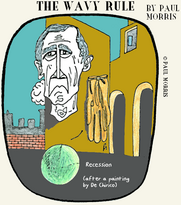
More by Paul Morris: “The Wavy Rule” archive; “Arnjuice,” a wistful, funny webcomic; a smorgasbord at Flickr; and beautifully off-kilter cartoon collections for sale (and free download) at Lulu.
Author Archives: Emdashes
Literary Notes from All Over
Benjamin Chambers writes:
Boy, the literary news has just been piling up. Here’s a quick taste:
* The Nobel prizes were just handed out, and American poets got skunked—as usual, according to David Orr in the Times. According to Orr, New Yorker poets John Ashbery and Adrienne Rich both shoulda been contendas. (Larissa MacFarquhar did a profile on Ashbery in the November 7, 2005 issue, but no one seems to have done the same for Rich, although D.T. Max did a Talk piece on her refusal of the National Medal of the Arts in 1997.)
* Philip Roth was recently interviewed on NPR about his new novel. I’m not a fan of Roth’s work, but I found Robert McCrum’s long interview with him in The Guardian fairly interesting, particularly the section that talks about the hostile reception his story, “Defender of the Faith,” which appeared in the March 14, 1959 issue of TNY: “For much of the Sixties he was declared a traitor to his people, abused and denounced up and down as worse than anti-Semitic.”
* This week, Yale celebrates the 250th birthday of Noah Webster, author of the eponymous dictionary. Webster, I learned, is the person responsible for separating American English from British English in key ways: “The French version of words like ‘centre’ [also used by the Brits] became ‘center’ and he dropped the British ‘u’ in words like colour’ and the redundant ‘k’ in musick and other words.” Jill Lepore, who wrote a November 6, 2006 essay on Webster for TNY, is a fan: “You cannot look up a dictionary definition today and not stumble across many definitions that were written by Noah Webster.” Happy birthday, Noah.
* In this Kansas City Star profile of novelist and poet Jim Harrison, I found a reference to his September 6, 2004 TNY piece, “A Really Big Lunch.” Concerns a 37-course meal he once had, which took 11 hours to eat. Gotta look that one up … feeling a bit peckish.
* May not be as good for sales as the Oprah Book Club, but Melville’s Moby-Dick may soon become the Massachusetts state (er—commonwealth) novel, if its state House of Representatives has anything to say about it, and apparently it does. The bill proposing the honor for Moby-Dick was filed “at the request of fifth-grade pupils at Egremont Elementary School so they could follow the bill through the legislative process.” However, “those pupils are now in the seventh grade, and the bill still isn’t law. It needs to pass the state Senate and get the signature of Governor Deval Patrick.” While you’re waiting for it to become official, check out John Updike’s May 10, 1982 TNY review of Melville’s career after Moby-Dick came out. Updike reverses quite a few myths about Melville, chiefly that Moby-Dick was not, as is popularly supposed, a financial or critical flop.
* Not sure this qualifies as “news,” but I’d never seen these writing commandments from Henry Miller before. Not sure if they’re really his or not, but they might be worth checking out.
Have fun surfing!
Are You Funny? Tag-Team Caption Contest Throws Down the Wit Gauntlet
_Longtime friend of Emdashes “Ben Bass”:http://benbassandbeyond.blogspot.com/ contributed a terrific “report”:http://emdashes.com/2007/10/avenue-queue-a-new-yorker-fest.php from last year’s Festival about waiting on line for tickets; clearly Ben has a talent for making the best of a situation. This year he weighs in on the Cartoon Caption Contest event, held on the Festival’s opening night._
The 2008 New Yorker Festival kicked off Friday evening with a serious town hall meeting on race and class in America at which Thomas Frank, Cornel West, and David Remnick parsed those weighty issues. For those of us in the mood for something lighter, there was the Cartoon Caption Game, a friendly competition hosted by cartoon editor and bon vivant Bob Mankoff.
We entered to find a large open room dotted with nineteen round cocktail tables. At each table, presiding over four empty seats, sat a past New Yorker Cartoon Caption Contest winner or finalist, easily identifiable by a red baseball cap emblazoned with the New Yorker logo and “Team Captain.” Our captain was a friendly New York City psychiatrist named Richard. Displaying the discretion so crucial to his profession, he declined to share his last name upon learning that I would be writing about this evening. He did, however, recite his winning caption, in which a man seated at an office desk in an electric chair says into his telephone, “Cancel my twelve-oh-one.”
If “What’s your line?” was the icebreaker that launched a million midcentury conversations, on this night the de rigueur greeting was “What was your line?” In a room full of strangers, the one fact you knew about these smiling folks was that each had written a good joke and so had a tale to tell. That was all we needed to get things rolling. On the other hand, as attendees (sorry, “contestants”) drifted into the room looking for seats, the captains’ icebreaker was, “Are you funny?” My companion and I answered with a deflective optimism; a bright young couple filled the last two seats with an appealing “We’re kind of funny.”
Of course, most people who attend something called the Cartoon Caption Game think they’re funny, and many of them are right. The trouble is, at least where competitive cartoon captioning is concerned, delight at one’s own witticisms often accompanies a certain solipsism, an unwillingness to acknowledge that others might have thought of the same joke, or even improved upon it. Bob Mankoff calls this malady “idea rapture.”
Mankoff’s introductory remarks included an illustration of this particular type of narcissism. He displayed a recent Caption Contest cartoon of a courtroom scene in which a killer whale is seated at the defense table. Like everyone else in the room, my first reaction was to posit that the whale’s putative killer status was at issue. In fact, I couldn’t think of any other joke. Sure enough, the winning caption was “Objection, Your Honor! Alleged killer whale.”
Mankoff then read an angry letter he received from a contest entrant who had submitted the same joke. The letter writer, convinced that he alone had come up with this line, wrote that he’d scribbled it on a magazine he’d left on an airline flight and bitterly accused the contest winner of finding the magazine and submitting the line as his own work. Mankoff’s elegant response was to send the writer the other fifty or so nearly identical submissions of the same joke.
His amusing spiel (“A lot of you are winners of the contest. The others are losers”) also described the process of administering the caption contest. The New Yorker receives between five and seven thousand contest submissions per week, with over a million to date and counting. As the readership has embraced the contest, it has taken on a momentum of its own, even spawning a new book on the subject, conveniently on sale this very evening.
After Mankoff explained the format, the competition began in earnest. Various gag illustrations from New Yorker cartoonists were projected seriatim for five minutes each, during which time each table huddled and brainstormed its caption ideas. When the time elapsed, each table submitted its best line for consideration by the evening’s panel of judges, New Yorker cartoonists Mankoff, Jack Ziegler, Barbara Smaller, and Matt Diffee, who chose three finalists for each cartoon (sound familiar?).
As in the magazine, where online voting determines the winner, popular acclaim, in this case in the form of applause, awarded the points for first, second, and third place. The evening’s cumulative point leaders would take the first prize, prints of their best-captioned cartoon; the runner-up table would receive signed copies of the new Caption Contest book.
Our group, known for lack of a more creative name as Table 14, came out firing. The first illustration was of a five-story-tall rabbit chasing a throng of business-clad types down a city street, Godzilla-style. A fleeing man in a suit was doing the talking. Table 14’s submission: “I miss the bear market.” Good enough, as it turned out, for second place, but we were aced out by another solid one: “And yet it’s adorable.”
The second cartoon was a Matt Diffee drawing of a domestic scene in a cave that a caveman and cavewoman had improbably furnished with sleek, modern-looking furniture. The club-wielding husband was the speaker. We liked our “There’s a difference between gathering and shopping” but went with “Wait ’til you see the Cadillac I speared”; apparently we liked it more than the judges did.
As the evening wore on, the scarcity of really good jokes became apparent. Over and over, a line we had thought of but rejected as too obvious or hacky would pop up among the finalists as another table’s submission. Did this make us funnier than them, or just worse evaluators of which lines would go over big? We like to think that both are true.
Much like the actual NYer C.C.C., the exercise became a mind game in which we tried not just to think of funny lines but also to predict which of these would please the judges. As a recent Caption Contest winner wrote, “You are not trying to submit the funniest caption; you are trying to win The New Yorker‘s caption contest.”
In the event, the wiseacres at Table 7 ran away with the Cartoon Caption Game. I’m happy to report that they won it not with Table 14’s rejects but with a number of genuinely witty and surprising lines. I hope John McCain, a few weeks hence, will graciously echo our content resignation at having lost to a demonstrably superior opponent.
As for New Yorker Caption Contest idea rapture, not even your correspondent is immune. Last spring I submitted a line my friends and I thought was at least as good as the three somewhat humdrum finalists. After mine wasn’t chosen, I wrote about the small setback, but it was mere whistling in the wind; I still didn’t know whether my joke was considered and rejected, or not even read among the thousands of submissions.
Happily, I got a small measure of satisfaction from Farley Katz, the New Yorker cartoonist, former Mankoff assistant, and Caption Contest first line of defense to whom I’d emailed the above link hours earlier. He told me that he’d checked his records and found that a number of people had submitted the same joke I had and that he had declined to include it among that week’s thirty or so semifinalists. At least now I know I was in the game.
The Wavy Rule, a Daily Comic by Paul Morris: Deep Blue Surge
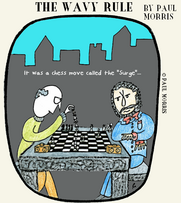
_Paul writes:_ There has been a lot of debate recently about the so-called “Surge”, or to use its working title, “The New Way Forward”. Does it work as a chess strategy? Click on the cartoon to enlarge it!
Somehow I Don’t Think Bill Kristol Will Be Joining Him
_Martin Schneider writes:_
Emdashes extends a hearty congratulations to the new Nobel Laureate in Economics, Paul Krugman! I saw Krugman speak once at the Society for Ethical Culture, at the height of the conservative attempt to privatize/kill Social Security in spring of 2005. It was a debate between Krugman and Cato Institute analyst Michael Tanner, with “Talking Points Memo”:http://www.talkingpointsmemo.com/ head honcho Joshua Micah Marshall supplying blogosphere context but in fact allying with Krugman. Krugman slayed Tanner easily, aided by Marshall’s input and Tanner’s incredibly disingenuous arguments.
Friend of Emdashes Jonathan Taylor caught a “reference”:http://economix.blogs.nytimes.com/2008/10/13/honoring-paul-krugman/ on the Edward L. Glaeser’s entry on today’s “Economix” blog on the _N.Y. Times_ website:
In his public role, Paul Krugman is often a polarizing figure, loved by millions but also intensely disliked by his political opponents. I still chuckle over an old New Yorker cartoon with one plutocrat saying to another that he gets some satisfaction from the fact that his vote will cancel out the vote of Paul Krugman.
Curiously, a search on “Krugman” in the Complete New Yorker archive does not find the hit; it’s a Charles Barsotti cartoon from the March 22, 2004, issue. You can view/purchase it “here”:http://www.cartoonbank.com/product_details.asp?sid=70283.
It’s about time he wrote something for _The New Yorker_!
Irving Berlin Weighs in on the Financial Crisis
Emily copies and pastes:
**When I Leave the World Behind**
I know a millionaire
Who’s burdened down with care
A load is on his mind
He’s thinking of the day
When he must pass away
And leave his wealth behind
I haven’t any gold
To leave when I grow old
Somehow it passed me by
I’m very poor but still
I’ll leave a precious will
When I must say good-bye
I’ll leave the sunshine to the flowers
I’ll leave the springtime to the trees
And to the old folks, I’ll leave the mem’ries
Of a baby upon their knees
I’ll leave the night time to the dreamers
I’ll leave the songbirds to the blind
I’ll leave the moon above
To those in love
When I leave the world behind
To every wrinkled face
I’ll leave a fireplace
To paint their fav’rite scene
Within the golden rays
Scenes of their childhood days
When they were sweet sixteen
I’ll leave them each a song
To sing the whole day long
As toward the end they plod
To ev’ry broken heart
With sorrow torn apart
I’ll leave the love of God
I’ll leave the sunshine to the flowers
I’ll leave the springtime to the trees
And to the old folks, I’ll leave the mem’ries
Of a baby upon their knees
I’ll leave the night time to the dreamers
I’ll leave the songbirds to the blind
I’ll leave the moon above
To those in love
When I leave the world behind
—Irving Berlin, 1915
(Treat: Hear the Singing Miamians do it in four-part barbershop harmony.)
Hey, Someone Left These Big Shoes Behind!
It’s been a couple of days since Emily’s farewell post, and I realized I hadn’t said anything about it yet. Most immediately I want to thank everyone for their words of kindness, interest, and support, they are much appreciated. It is our hope that every single Emdashes reader remains; quixotic perhaps, nevertheless so.
In the four years she has been writing about _The New Yorker,_ first at Blogspot and then at her own URL, Emily communicated enthusiasm and erudition in a way that never seemed hasty or sloppy; years of editorial experience make that possible, and only high standards and interest and passion allow for that sort of experience to accrue. The frame that makes an Emdashes post an Emdashes post is her creation, and that isn’t going anywhere soon.
Luckily, she has somehow assembled a small team of people willing to carry her vision beyond her everyday involvement. With the help of Paul Morris, Benjamin Chambers, and a few others, I am confident that we can continue regular posts much in the same way as you are accustomed. My voice here, while mine, owed more than a tad to Emily’s example, and I hope the experience of reading Emdashes remains much the same.
_The New Yorker_ is such a vast subject that it allows for a good range of interest. I’ve stated before that I’m probably more of a William Shawn person, whereas Emily might lean toward Harold Ross a bit more. I don’t have the fluency in art and design that Emily has, so I focus more on the themes and the ideas and the writing. My nominal lot here was to man the Complete New Yorker DVD archive, so of necessity my posts have been more about the past than Emily’s; to her credit, she consistently encouraged me to stray from that bailiwick, an offer I took up with enthusiasm.
A logistical note: In the last 18 months family concerns have made my life a good deal more nomadic; I am splitting my time between the New York City area and rural Austria, as Emily mentioned. It’s trite to say so, but for people of my age (late 30s) the miracle of the Internet never really loses its power to astonish. Suffice it to say that transit is transit and jet lag is jet lag; beyond that, location is moot, and we’ll try hard to make sure you never notice such disruptions. (To add to the general feeling of instability, I bought my first-ever Mac yesterday, so even a project as prosaic as selecting a word to copy is something of a challenge at the moment. Wish me luck!)
With the help of the rest of the Emdashes team, I will attempt to provide you with something diverting every weekday; most days we will succeed; some days we won’t. But the commitment to covering _The New Yorker_ in all its glory, warts and all, come what may, insert cliche here—that remains intact.
Emily herself won’t ever be very far off; after only two years I count her as a close friend; we are in contact on a daily basis and I know she still thinks a great deal about the site. There will be occasions when she steps in; what is important is that the necessity to do so every day, or even every week, subside. I’m sure everyone connected to Emdashes wishes her great success in her new role at _Print_ (indeed, is sure of it!). In the meantime, we will continue to fulfill the project she started; we hope you stay along for the ride.
The Wavy Rule, a Daily Comic by Paul Morris: George Bailout
_The Depression began in 1929._ It’s a Wonderful Life _came out in 1946. If we get a movie as good as that in 2025, maybe it’ll all be worth it. (Here’s the “bank run”:http://www.youtube.com/watch?v=MJJN9qwhkkE scene.) Click to enlarge._
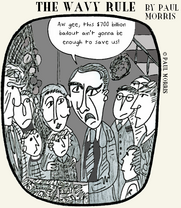
More by Paul Morris: “The Wavy Rule” archive; “Arnjuice,” a wistful, funny webcomic; a smorgasbord at Flickr; and beautifully off-kilter cartoon collections for sale (and free download) at Lulu.
New Yorker Festival Videos Already Online
_The New Yorker_ has put up several videos from the New Yorker Festival:
“Elizabeth Edwards”:http://link.brightcove.com/services/link/bcpid1827871374/bctid1846655477, hosted by Atul Gawande
“Political Humor,”:http://link.brightcove.com/services/link/bcpid1827871374/bctid1845377876 with Samantha Bee, Andy Borowitz, James Downey, John Oliver, and Allison Silverman, hosted by Susan Morrison
“If I Were Running This Campaign,”:http://link.brightcove.com/services/link/bcpid1827871374/bctid1840665660 with Donna Brazile, Alex Castellanos, Edward J. Rollins, and Joe Trippi, hosted by Jeffrey Toobin
“Young Shakespeareans,”:http://link.brightcove.com/services/link/bcpid1827871374/bctid1846620038 with Lauren Ambrose, Ethan Hawke, Kristen Johnson, Martha Plimpton, and Liev Schreiber, moderated by Adam Gopnik
And the Campaign Trail “podcast”:http://www.newyorker.com/online/2008/10/13/081013on_audio_campaign is featuring the audio of the “Campaign Trail” “Festival event”:http://emdashes.com/2008/10/new-yorker-festival-wickenden.php, with Ryan Lizza, George Packer, and Hendrik Hertzberg, moderated by Dorothy Wickenden
Express Your New Yorker Preferences!
In her “Shelf Life” column at the (Syracuse, NY) _Post-Standard,_ Laura T. Ryan wants to “know”:http://blog.syracuse.com/shelflife/2008/10/the_new_yorker_readers_whats_y.html what your favorite section of _The New Yorker_ is. Do indulge her, and tell her we sent you!