
I’m indebted to “Josh Marshall”:http://www.talkingpointsmemo.com/archives/238525.php for explaining the significance of the event. Ken Adelman, lifelong Republican and hawkish former chum of Cheney and Rumsfeld emailed _New Yorker_ staffer George Packer to “explain”:http://www.newyorker.com/online/blogs/georgepacker/2008/10/not-quite-colin.html why he’s “supporting”:http://www.newyorker.com/online/blogs/georgepacker/2008/10/adelman-addendu.html Obama this year. (Hint: _temperament_ is the word of the year.)
Author Archives: Emdashes
Colin Powell Cites Platon Pic in Obama Endorsement
Did you see Colin Powell’s “endorsement”:http://www.msnbc.msn.com/id/21134540/vp/27265490#27265490 on _Meet the Press_ yesterday? I’m excited about it. I think it does a few good things for Obama. Powell is the most famous Republican moderate, by far; he could have an impact with just the kind of right-leaning independents who need one final small nudge to vote Obama. And it may help secure an Obama presidency (knock wood) on the firm bipartisan ground it needs to succeed.
But more directly, it might change the tone of a campaign that is now seeing its fair share of racial and ethnic innuendo. Powell criticized McCain’s unsteadiness on economic matters and his selection of Sarah Palin, but he saved his most powerful words for the subject of American inclusiveness:
I’m also troubled by, not what Senator McCain says, but what members of the party say. And it is permitted to be said such things as, “Well, you know that Mr. Obama is a Muslim.” Well, the correct answer is, he is not a Muslim, he’s a Christian. He’s always been a Christian. But the really right answer is, what if he is? Is there something wrong with being a Muslim in this country? The answer’s no, that’s not America. Is there something wrong with some seven-year-old Muslim-American kid believing that he or she could be president? Yet I have heard senior members of my own party drop the suggestion, he is a Muslim and he might be associated with the terrorists. This is not the way we should be doing it in America.
I feel strongly about this particular point because of a picture I saw in a magazine. It was a photo essay about troops who are serving in Iraq and Afghanistan. And one picture at the tail end of this photo essay was of a mother in Arlington Cemetery, and she had her head on the headstone of her son’s grave. And as the picture focused in, you could see the writing on the headstone. And it gave his awards—Purple Heart, Bronze Star—showed that he died in Iraq, gave his date of birth, date of death. He was 20 years old. And then, at the very top of the headstone, it didn’t have a Christian cross, it didn’t have the Star of David, it had crescent and a star of the Islamic faith. And his name was Kareem Rashad Sultan Khan, and he was an American. He was born in New Jersey. He was 14 years old at the time of 9/11, and he waited until he can go serve his country, and he gave his life.
That picture appeared in _The New Yorker,_ and the “picture”:http://www.newyorker.com/online/2008/09/29/slideshow_080929_platon?slide=16 was taken by Platon. Here it is:
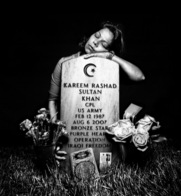
_Elsheba Khan at the grave of her son, Specialist Kareem Rashad Sultan Khan. Photo by Platon._
Platon is a recent _New Yorker_ hire, and he could hardly have had a more auspicious start! The whole “portfolio”:http://www.newyorker.com/online/2008/09/29/slideshow_080929_platon is stunning; you can listen to the photographer “discuss”:http://www.newyorker.com/online/2008/09/29/080929on_audio_platon the series in a podcast on the magazine’s site.
The Wavy Rule, a Daily Comic by Paul Morris: McCain and Spain
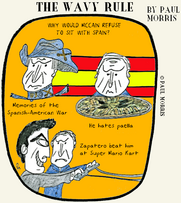
_Paul writes:_ During the VP debate, Joe Biden remarked that “John McCain said as recently as a couple of weeks ago he wouldn’t even sit down with the government of Spain, a NATO ally that has troops in Afghanistan with us now. I find that incredible.” Obama also brought this point up during the debates. Neither Palin nor McCain responded specifically to this point. What did McCain actually say? McCain “stated”:http://www.thenation.com/doc/20081006/spain_video” he would work with leaders in the hemisphere who are friends with us…standing up to those who are not …[based on] the importance of our relationship with Latin America.” Spain is of course not in Latin America and the interviewer clarified this, but McCain simply replied that he would have to “look at the relations, situations, and priorities” first.
“This blog”:http://www.politifact.com/truth-o-meter/statements/768/ suggests that he may have been simply confused by the question regarding Spain. But a statement by the McCain campaign later denied that he had been confused, “as reported”:http://www.thenation.com/doc/20081006/spain_video by _The Nation_. What’s going on here? Is this simply geographic confusion and erratic bumbling or the repeat and possible continuation of the Bush Administration’s attitude towards Spain, which has been frosty since José Luis RodrÃguez Zapatero, the Prime Minster of Spain, pulled out the Spanish troops from Iraq, in response to the Spanish people’s demand. There have been disagreements regarding Cuba and Venezuela as well. I hope that US-Spain relations will improve under Obama.
Click on the cartoon to enlarge it!
I Want My Campaign Trail TV
Emily is moved to return from self-imposed blog retirement to write:
I have spoken of my dependence on “The Campaign Trail,” the magazine’s populous podcast about the presidential election. Now more than ever, I crave daily updates. I checked my iTunes the morning after the third debate, hoping for those familiar voices to engage in gently scorching analysis as I began my day. No such luck! O editors and editorialists, won’t you be my spirit guides through these long, last days of this dreadful campaign? Even a half hour of your sparkling waterfall of talk would ease my thirst.
Surowiecki Blog Debuts; Market Plunges
_Martin Schneider writes:_
You know it’s a good day when James Surowiecki announces he’s starting a “blog”:http://www.newyorker.com/online/blogs/jamessurowiecki/ version of his consistently insightful “Financial Page” column. Only a little more than a day and already there are five meaty posts up there. He wittily “notes”:http://www.newyorker.com/online/blogs/jamessurowiecki/2008/10/welcome-to-the.html that the debut of that column precipitated a reversal in the market in 2000, so we hope for more of that.
The Wavy Rule, a Daily Comic by Paul Morris: Is There an Eco in Here?

_Paul writes:_ Can an Italian semiotician save our crumbling economy? Click on the cartoon to enlarge it!
Fun Charity Event in Washington Heights with Junot DÃaz
_Martin Schneider writes:_
Junot Díaz’s novel only won the most recent Pulitzer Prize for Fiction, and I haven’t heard anyone say a bad word about it. I just got my copy of _The Brief Wondrous Life of Oscar Wao,_ and I can’t wait to read it! Do attend, it looks like a good time and it’s for a good cause! Press release follows:
Junot Díaz, the Pulitzer Prize-winning Dominican-American author of
_The Brief Wondrous Life of Oscar Wao,_ is coming to Washington Heights!
Junot will be joining CoSMO, Columbia’s free student-run primary care
clinic, for a book reading and conversation on Friday, November 7th at
7:30pm. All proceeds go toward prescription medications for CoSMO’s
uninsured patients (“www.cosmoprimarycare.org”:www.cosmoprimarycare.org).
The night will also include free appetizers provided by Mamajuana
restaurant, old school hip-hop sounds by DJ Strike (former tour DJ of
De La Soul), and visual arts by the Sound of Art collective
(“www.soundofart.net”:www.soundofart.net)
Don’t miss this incredible night of literature and conversation
celebrating the communities of Quisqueya Heights!!!!
Junot Díaz: A Reading, a Conversation
Friday, November 7th at 7:30pm
Alumni Auditorium
William Black Research Building
650 W. 168th Street
New York, NY 10032
Tickets sold “online”:https://www.ovationtix.com/trs/pe/769922:
$15 general, $10 with student ID
The Wavy Rule, a Daily Comic by Paul Morris: Raggedy Andy
_I like how Andy Rooney looks like a jack-o-lantern! Hee. Click to enlarge!_
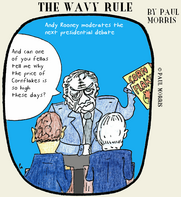
More by Paul Morris: “The Wavy Rule” archive; “Arnjuice,” a wistful, funny webcomic; a smorgasbord at Flickr; and beautifully off-kilter cartoon collections for sale (and free download) at Lulu.
Vile Bodies: David Levine’s Prickly New Yorker Past
Jonathan Taylor, whom we’ve just welcomed to the Emdashes team, writes:
This article in the November Vanity Fair explains the disappearance from The New York Review of Books of the artist who helped define its virtually unchanging look: David Levine, who caricatures the glorious and the notorious of belles lettres and statecraft with huge heads on vestigial bodies (or, sometimes, vice versa). His vision succumbing to macular degeneration, Levine in 2006 for the first time had work rejected by the Review for reasons of execution rather than scurrilousness. The article is a fine sidelong portrait of a publication that’s venerable, yet in fact still young enough to be only now exiting (slowly) the era of its founders.
It also turns out that Levine had several taste tiffs with The New Yorker, for which he has provided 71 illustrations. One reject was this watercolor of Bush in flightsuit atop an array of coffins, which ran in 2005 instead in the Review. It seems practically banal today, but plausibly exceeds the limits of The New Yorker‘s political prudence. (The magazine’s emphatic Barack Obama endorsement is still careful to specify that “There is still disagreement about the wisdom of overthrowing Saddam Hussein and his horrific regime.”)
A little more alarming is the tale of a cartoon of Mahmoud Abbas and Ariel Sharon that the magazine altered unilaterally. It removed some missiles that accompanied Sharon as a counterpart to the machine-gun wielding masked militants looming behind Abbas. David Remnick told Vanity Fair, “David Levine is a great political artist and kept on publishing with us after this, but all I remember about this was thinking that with Sharon being so ominously huge in the drawing, the bombs were too much.” It certainly seems that Levine has a thing about Sharon’s hugeness, if not his enormity (the kaffiyeh on this Sharon I think perfectly typifies Levine’s blunt sharpness, if you will).
Perhaps the context is useful in reading Levine’s rather sweeping take on the state of New Yorker cartooning in an interview with The Nation: “I think they’ve let down the barrier of quality, and it is just terrible.” (Can this be true of every current contributor, including the older cartoonists who continue to draw regularly for the magazine?) But the anger seems rooted in his determination that cartooning have a legible positive purpose: “Caricature is a form of hopeful statement: I’m drawing this critical look at what you’re doing, and I hope that you will learn something from what I’m doing.” Levine compares the cartoonist to the golem created by a rabbi to fend off anti-Semitic attacks: “When things are settled, he’s not needed.”
The New York Review‘s site hosts a complete Levine gallery, searchable by subject name or categories like “Tycoons, Plutocrats, Midases.” The overlap of the two magazines’ preoccupations means there are a lot of images of New Yorker interest over there: David Remnick; William Shawn; a passel of Updikes, from 1971 to 1994; a quorum of Malcolms, including a Gladwell and two contrasting Janets; a Joan Didion or two; a couple of somewhat disturbing Rebecca Wests; even a rather calming Helen Vendler.
New Yorker Festival: Oliver Stone’s Got Guts
“I’m a dramatist, not a journalist.” This is currently Oliver Stone’s favorite mantra, repeated at the Director’s Guild Theater with David Denby and, for instance, on Bill Maher’s HBO show last week. I take it as a sign that his aims have become more modest than in his _JFK_ days, if not an outright shield against the legions of fact-checking critics who, in _W.,_ will doubtless find much fault with Stone’s unique use of composites and rearranged chronology to drive home this or that emotional or political point.
“Nixon’s the grandfather of Bush, in a sense. Reagan’s the father,” said Stone. (I await the Reagan biopic that would complete the trilogy. Actually, that idea’s not half bad.) On the poor box office performance of Nixon, Stone said, “He evokes guilt and paranoia, and those qualities are not much in demand.”
Apparently refusing to absorb that maxim, Stone has produced a movie more than a decade later about George W. Bush. Three lengthy clips were shown, dating from 1978, 1988, and 2002. The first takes place at the barbecue party at which the erstwhile Laura Welch (embodied by Elizabeth Banks) and W. meet. Bush swigs throughout from a beer bottle and appears somewhat cowed by Laura’s identity as a librarian. It’s worth pointing out that Josh Brolin is pretty awesome as W. In the Crawford section his callowness doesn’t quite convince, but as W. ages, Brolin really finds his way to the heart of the character. We’ve all lived with the president for the last eight years, and Brolin’s impersonation won’t distance anyone in the slightest, I think.
The 1988 scene takes place in his father’s vice presidential office, Rove and W., clearly not among the veep’s core advisors, engage in a bit of crosstalk about the rise of the religious right (Poppy is not down with the program). After everyone else is ushered out, W. shows his father the as-yet-unaired Willie Horton ad, and then comes the sort of anachronistic dialogue for which the movie will surely become renowned. W. observes that what with this ad and “that picture of Dukakis in a tank,” Bush’s election is assured, an observation scarcely imaginable without heaps of hindsight, of course.
The 2002 scene demonstrates all of the weaknesses and strengths of Stone’s project. The setting is the Situation Room, and all of the familiar players (Cheney, Rumsfeld, Rice, Powell, Wolfowitz, Rove, Bush) discuss what to do about Iraq. (In person, Stone persistently calls the former secretary of defense “Rumsfield.”) In the scene, several different characters deliver extended speeches explaining this or that point of view. The showdown between Powell (Jeffrey Wright) and Cheney (a marvelously restrained Richard Dreyfuss) is the scene’s climax. As before, statements known to be made in other places and at other times are heard to be uttered here, including the terms slam dunk and misunderestimated.
To Denby, Stone defended these quirks by pointing out the utter opacity of the Bush administration’s decision-making process until quite recently; only in the last two or three years have journalists produced books shedding light on these meetings. (Of course, herein lies the case for waiting until a president is out of office for such attempts at retrospective assessment.)
For all of his excesses, at heart Stone remains almost touching in his idealism. If one asks, “does Stone engage in character studies or works fomenting political change?” The answer I think must be that Stone believes the former to lead to the latter. That is, there is a faith at work here that if audience members can only grasp the “real” person in question (mediated in whatever fashion, using whatever dramatic shortcuts are necessary), then political change will result. And the ascent of Obama is at least a partial proof that the true nature of the Bush administration _has_ penetrated the public at large.
Subtlety was never Stone’s strong suit; he’s the type who underlines words three times. Yet from all appearances this movie is not the hatchet job one might expect. And he’s not exactly fashionable right now, if that’s even the right term for Stone’s status during his peak in the late 1980s and early 1990s. His ability to impose his will on the national discourse is not what it once was. But despite it all, he puts himself on the line as much as in 1988; he has recently produced a documentary about Castro and has another project, since stalled, about My Lai, and mentioned Hugo Chavez and Ahmedinejad as potential future subjects. Somehow you’ve got to admire the old SOB.