
Paul Kocak writes:
His New Yorker covers of the 1970s are quintessential reflections of urban complexity distilled to a serene and sober simplicity. A Zen focus of particularity, here and now. His spot drawings for The New Yorker, signed “R. Davidson,” celebrated Manhattan archways, doorways, a flowerpot on a windowsill, a wrought-iron fence. Raymond Davidson died just after midnight on July 7 at Tara Home, a hospice at Land of Medicine Buddha in Soquel, California. He was creative almost until his very last days, self-publishing poetry and reflections sprinkled with his pen-and-ink line drawings.
We met in the 1980s; he worked at Doubleday, I at Random House. Creativity was, in his view, a spiritual wellspring. He urged me to write haiku poetry as a spiritual exercise. I did.
In those years, fans of the New York Mets often saw a man with a long gray beard and glasses, wearing a seersucker jacket and bow tie, sitting in owner Nelson Doubleday’s box, right next to the Mets’ dugout. He was painting watercolors of the Mets players. These were exquisite depictions of light and shadow and color; balletic celebrations of form and grace and movement. They are gems.
They are New York.
They are Raymond Davidson, Brooklyn-born of Norwegian immigrants more than eighty years ago.
When the woman at the hospice told me of Raymond’s peaceful death, she said he looked like someone in an El Greco painting. Yes, majestic and heavenly.
She said he was “easy to love,” a fitting signature to his life and work. Raymond Davidson easily loved the ordinary right before our eyes.
I easily loved him like a father and a brother.
Paul Kocak
Syracuse, New York
Author Archives: Emdashes
The Wavy Rule, a Daily Comic by Paul Morris: Heaven, I’m in Heaven
I think Paul has outdone himself with this one. He writes: “Yes, that’s God. A collection of blue squiggly lines representing both the eternal aether and my own propensity to use Crayola markers to depict celestial beings.” I love it, and the portrait of Ross is, well, heavenly. Click to enlarge!

Check out the “Wavy Rule” archive! More drawings by Paul Morris: his very funny webcomic “Arnjuice,” his motley Flickr page, and satisfying cartoon collections to download at Lulu.
Emdashes Summer Interns: Warm Greetings to the S.A.T.s
This summer, three interns–Sarah Arkebauer, Taylor House, and Adam Shoemaker (whose smarts and first initials have led me to think of them, collectively, as S.A.T.)–will be contributing to Emdashes in many ways, some of which you’ll see as soon as this Friday. I’m delighted and honored to welcome them to the project. Without further ado, I’ll let them introduce themselves. On Friday, we’ll publish their first reports. They’ll be involved all summer long, and it’s going to be wonderful getting to know them. Note two themes so far: cartoons and the law.
Sarah Arkebauer: I’m a student at the University of Pennsylvania, from Lincoln, Nebraska. I’m tentatively majoring in History, but might switch to English. I enjoy reading (both books and blogs), using retro slang, and StumbleUpon. I also play the violin.
I spent my childhood reading Roz Chast‘s New Yorker cartoons, which helped foster my love of the magazine. Now, I flip to the table of contents and look for any articles by David Sedaris or (perhaps in vain) Jonathan Franzen. I also really enjoy Haruki Murakami’s fiction pieces, and I always check out the cinema reviews and John Updike’s book reviews. I cut out the best articles, pictures, and cartoons and paste them into my commonplace book. Its size is becoming quite unwieldy. I still read all the cartoons.
Taylor House: I recently graduated from the University of Arizona with a B.A. in creative writing. I’m currently in the process of moving to L.A. and becoming “hep” like those hoodlums out in Silverlake. I write, bike, and nap daily. Will one day go to law school and become important. I read The New Yorker on the web or in the bathroom, a page at a time. I like the cartoons, though usually at least one per issue is over my head. I’m working on it.
Adam Shoemaker: I graduated from Harvard Law School in June, where I focused on Legal History and writing about Medieval Iceland. Before that, I studied History and Art at Williams College, with a particular fondness for trumeaus and misericords. I am excited to have the chance to become Emdashes’ first Icelandic corespondent in September, when I head to Reykjavik on a Fulbright. My summer reading includes a biography of Jane Goodall, the novels of Marilynne Robinson and Halldór Laxness, and a box of dog-eared New Yorkers.
It’s Peter J. Boyer Day: Whither Brian Williams?
How extraordinary that Emily chose this evening to post about Peter J. Boyer. I, too, listened to that podcast today, and I, too, enjoyed it.
I found one aspect of the interview puzzling. The subject of the article is the phenomenon of Keith Olbermann as an outlet for liberal rage, and what that phenomenon is doing to MSNBC and, by extension, NBC News. In no way do I mean it as a criticism of Boyer or The New Yorker to wonder how it was that the name “Brian Williams” wasn’t mentioned once in the podcast.
I like Williams–I think he’s my “favorite” anchor–but, as a category, that has about as much meaning these days as a preference for Ann Landers over Dear Abby. But it’s a curious testimony to … the newfound irrelevance of anchors? the ineffectual tenure of Williams himself? I’m not sure.
I went back and looked at the article. Sure enough, there’s plenty of stuff about Brokaw, the “hall monitor” of the sprawl—the entire story is structured as the battle between Olbermann and Brokaw for the very soul of NBC News—but just a few bland references to Williams.
I guess Williams has a tough job; he’s angling for attention smack in the middle of a gaggle of on-air personalities that, on all of those recent primary election nights anyway, included Brokaw, Olbermann, Chris Matthews, Tim Russert, Chuck Todd, and who knows who else. I admire Williams’s stated commitment to making NBC News more “transparent”; perhaps, in the rush for Keith’s ratings, that directive has not gotten the attention it ought; such, anyway, appears to be Boyer’s thesis. Or maybe for all of Williams’s persuasive suavity, he’s not so good at being the center of attention—odd trait, for an anchorman.
Agree? Disagree? Post a comment!
Peter J. Boyer Has an Extraordinarily Soothing Voice
I’m listening to the New Yorker Out Loud podcast in which Matt Dellinger (who has a calming, pleasant voice himself) interviews Boyer about the latter’s recent story about newsman Keith Olbermann, and am struck by how resonant the latter’s speaking voice is. It is a mellow, searchingly thoughtful voice, with a note of the South (Texas, I’m guessing), and the sound of the two of them together makes for a sort of duet for cello and bassoon. It’s a good interview, too.
Matt, bring back Mr. Boyer for another discussion soon, won’t you? In the meantime, he could read a short story for the fiction podcast, perhaps something by John Graves. This makes me think: Paul Muldoon‘s similarly unboastful, shapely voice. A poetry podcast to complement the rest, complete with songs (Muldoon would choose them well), and it would be as lively as can be–something like the Favorite Poem Project, but with a New Yorker-specific tilt. Let’s hope that this is in the works.
Choice Styron Coming Your Way
Tired of new writers? Hungering for more from some of the established greats? Then I’ve got good news for you: William Styron’s got a posthumous “collection of fiction”:http://www.observer.com/2008/media/posthumous-fiction-collection-william-styron-be-published-random-house coming out, which will include a chapter from an unfinished novel. Styron, who died in 2006, is best-known, of course, for “Sophie’s Choice”:http://tinyurl.com/6buy3f and “The Confessions of Nat Turner”:http://en.wikipedia.org/wiki/The_Confessions_of_Nat_Turner_%281967%29 (both controversial when they were published), as well as “Darkness Visible”:http://en.wikipedia.org/wiki/Darkness_Visible:_A_Memoir_of_Madness, his well-known memoir about his first struggle with major depression.
If you’re a fan, or interested in learning more, check out “his daughter’s memoir”:http://www.newyorker.com/reporting/2007/12/10/071210fa_fact_styron from the December 10, 2007 issue of The New Yorker, Styron’s own New Yorker “essay “:http://www.newyorker.com/archive/1995/09/18/1995_09_18_062_TNY_CARDS_000372118about about being misdiagnosed with syphillis when he was 19, “audio interviews”:http://wiredforbooks.org/williamstyron/ with the author from 1981 and 1982, or this hour-long “video appreciation”:http://www.charlierose.com/shows/2006/11/03/2/an-appreciation-of-author-william-styron of the author and his work that appeared on Charlie Rose.
The Wavy Rule, a Daily Comic by Paul Morris: Guzzlers
In honor of the ridiculous SUV that I was forced to drive this weekend, which I nicknamed the Sta-Puft Marshmallow Man (big, fast, friendly, deadly), a Wavy Rule all about our alarming fuel situation and the ways in which our lives are destined to change, any minute now. Click to enlarge!

Check out the “Wavy Rule” archive! More drawings by Paul Morris: his very funny webcomic “Arnjuice,” his motley Flickr page, and satisfying cartoon collections to download at Lulu.
The Times Magazine’s Stunning Covers
Martin Schneider writes:
I just stumbled on this attractive page, which features a handful of thoughtful, arresting New York Times Magazine covers. Beautiful stuff!
Everybody Loves Rea Irvin
That’s the headline for a story by me in the hot-off-the-presses Print magazine, in a special issue on type. Ever wonder who was behind Eustace Tilley–and hundreds more iconic images and visual features (including the famed “Irvin type”)–in the first decades of The New Yorker? There’s so much more to say about this spectacular moment in graphic history, and particularly about what came before it, but this is a start. And it was incredibly fun to write. Since I had limited space to acknowledge the many people who provided documents and contacts for the story, I’ll give three grateful cheers here to cartoonist Liza Donnelly and to Dorothy Parker Society sagamore Kevin Fitzpatrick. They have both been incredibly generous with their resources and thoughts.
Very soon, we’ll run the contest I mentioned the other day. It’s a doozy! And I’ll tell you what our interns will be up to this summer, too. And if you haven’t heard about this, here’s some welcome news about two new Joseph Mitchell reissues, one of which has a new introduction by David Remnick. I can’t agree that Mitchell “is perhaps most remembered not for his writing, but for not writing,” but there’s never anything wrong with new readers for this peerless writer of New York’s proud populations, human, aqueous, and otherwise.
The Wavy Rule, a Daily Comic by Paul Morris: Really, Tilley
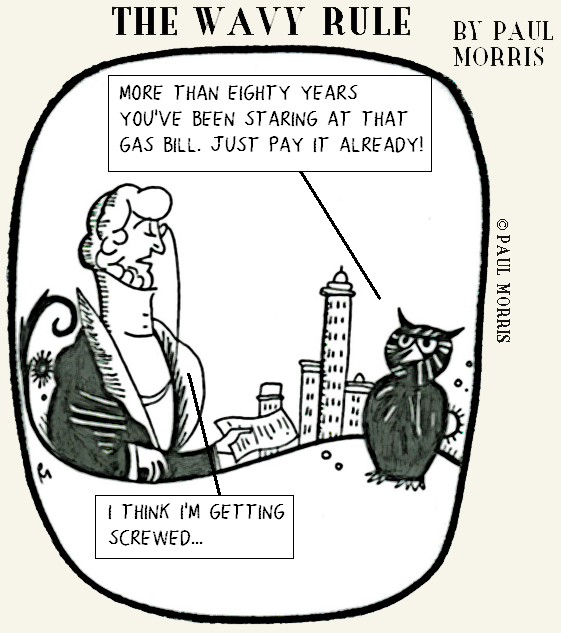
Owls are such know-it-alls, aren’t they? This one has a certain familiar charm, however, and seems to be playing a fiesty Brooklyn to Eustace Tilley’s neurotic Manhattan. Click to enlarge!
Check out the “Wavy Rule” archive! More drawings by Paul Morris: his very funny webcomic “Arnjuice,” a populous Flickr page, and cartoon collections to download at Lulu.