
Author Archives: Emdashes

The Pigeon Files, Part the First

A recurring bulletin from Martin Schneider, Emdashes Squib Report bureau chief, in which urgent matters regarding The Complete New Yorker are speedily and elegantly investigated.
If I were to tell you that pigeons were on the verge of becoming extinct in New York, would that delight or depress you? I’m sure that the range of reactions would include both glee and gloom. Although given their inescapable ubiquity in New York, you might instead question my sanity (or, more prosaically, merely my powers of observation).
Their status as an endangered species is restricted to a very specific domain, and I’ll address what domain that is in just a moment.
Rebecca Mead’s March 5 TOTT about Kader Attia’s “Flying Rats” art exhibit sparked Emily to inquire about prior coverage of pigeons in The New Yorker‘s glorious past. It turns out she’s a pigeon fan! Or more properly, a stalwart defender of the charms of the pigeon (Spec. Columba livia, Latin for “lives near Columbia University”), inexplicably overlooked by so many.
There must be a term for the historiographical practice of using a smaller subject to track the development of an era or empire. As aqueducts work well for the Roman Empire and heresy for the Middle Ages, so do pigeons for The New Yorker. Pigeons appear in many guises and forms, sometimes as the butt of the joke, sometimes held up for contemplation, sometimes exalted (well, not too often). So we’ve decided to launch a limited series of pigeon-related posts from the CNY.
Pigeon fact no. 1: They appear in lots of cartoons; indeed, a survey of pigeons in New Yorker cartoons would tax the resources of this humble venture.
Our first pigeon piece may even fall under “exalted,” a lovely 2/21/01 TOTT called “Some Pigeon!” by Sheridan Prasso that well-nigh claims that a specific pigeon that used to demand (and receive) nocturnal entry to a Burmese restaurant on the Upper West Side (since closed) may have embodied the soul of a former denizen of the premises. It’s just the kind of piece we look to TOTTs for, a charming slice of life nowhere else covered.
Pigeon fact no. 2: Once a staple of New Yorker covers, pigeons have since been almost banished as a cover subject. This is the “extinction” to which I earlier referred. The demise dates approximately from the arrival of Tina Brown; there has been only one pigeon-related cover since 10/5/92—don’t need to tell you what made that issue special, do I? And even that cover, by Peter de Sève for the 9/5/94 issue, seems really to be about the Hamptons and not pigeons per se.
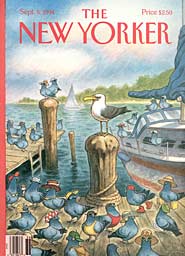
1994_09_05_v256.jpg


And I think therein lies a lesson: If you make a decision to increase topicality, to boost newsstand single-issue sales, to stretch the capacity of The New Yorker to cover the newsworthy and the trendy (as Tina Brown was no doubt right to do, don’t get me wrong), a price is nevertheless paid. New Yorker covers once regularly featured triste still lifes or plangent landscapes, a sometimes haven from the headlines rather than a cheeky “take” on them; they don’t really serve that purpose anymore, and that’s too bad.
But we’ll be visiting some of those in future installments of the Pigeon Files.

PRINT and ID Magazines Nominated for National Magazine Award

Oh yes, and The New Yorker too! All for General Excellence (in different circulation categories). Three cheers for us (plus esteemed previous PRINT men Todd Pruzan and Jeremy Lehrer) and everyone who shares the honor! As ASME notes, “The New Yorker leads the list of 125 finalists, with a total of nine nominations.” Here’s the full list. The sparkling PRINT issues under consideration are March/April, July/August, and September/October 2006; at newyorker.com there’s a list of all the stories and categories they’ve been nominated for. I’m also very happy to see that Stuart Klawans, my old Nation colleague and one of my favorite film critics of all time, is nominated for three of his reviews. He deserves the recognition—truly a gentleman and a scholar.

Betty Hutton, 1921-2007

Unless I’m mistaken, there was no Betty Hutton moment at this year’s Academy Awards. (I was stuck in the Denver airport at the time and watched the awards intermittently at the Mexican restaurant there; afterward, my friend C. texted me each winner as they were announced, so it was an inadequate viewing experience, to say the least.) And now she can’t get a Lifetime Achievement Award, for which there was a movement afoot, because she’s gone. From Playbill News:

Betty Hutton, Vivacious Star of Hollywood Musicals, Dies at 86
By Robert Simonson
Betty Hutton, the high-energy comedic actress who had a brief but memorable career as the star of Hollywood musicals and comedies in the 1940s, died in Palm Springs, CA, it was reported by AP. She was 86 and had lived in virtual isolation for much of the last 40 years…. “Brassy,” “exuberant” and “energetic” were some of the adjectives routinely used to desribe Ms. Hutton’s singular performance style and she brought those qualities to nearly every role she took on. Cont’d.

Damn Academy has no taste. R.I.P. (Here’s the NYT obituary.)

Update: I asked Martin “Squib Report” Schneider to root out any Betty Hutton references in The Complete New Yorker. He notes that the magazine panned The Miracle of Morgan’s Creek (!), and found only a breezy mention of Hutton as patriotic dish in a Talk from January 15, 1944—screen shot after the jump; click to enlarge. Let’s hope Denby, Lane, Lahr, or, say, Richard Brody mentions Hutton in a more nuanced spirit of appreciation (though she was a dish, too) in a column soon, or perhaps a Critic’s Notebook or DVD Note at the front of the book.

Continue reading

If You Think Life Is Sad, This Is the Instant Remedy

You might not have heard of Mike Birbiglia, but you’re in for a huge treat tomorrow night. He’s appearing at Mo Pitkin’s, and that is very lucky for all of us. People, don’t think. Just buy tickets (a mere $10, a small price to pay for the restoration of your faith in the healing power of laughter). If for some reason you need to be convinced further, listen to a few routines on his website or watch some Letterman, Conan, etc. appearances on YouTube. The details:

Mike Birbiglia’s Secret Public Journal Live
Tuesday, Mar 13, 2007 9:00 PM EDT (8:30 PM Doors) at Mo Pitkin’s, 34 Avenue A
Every week comedian Mike Birbiglia writes a new entry in his Secret Public Journal for thousands of subscribers online. Once in a while, he bring them to life with the help of special guests like Andrew Secunda and [completely absurd] Christian Rock duo God’s Pottery. This will be a very special night.

www.birbigs.com

Continue reading

Extra! Existence of Contemporary Poetry Acknowledged!

And it’s not even April yet. Is Ruth Lilly behind even this somehow? Anyway, like most nattering nabobs of negative capability, I could go on about Dana Goodyear v. David Orr for hours (and have been in email exchanges yesterday and today, and in my head as I read blog entries like this, this, this, this, and this), but I think I’ll just ask: Hey, David (I get to call you that because we met at a Gawker party), what did you mean here?

In an especially confusing decision, [Goodyear] includes a cutting remark by the writer Joel Brouwer about the marketing of poetry, and claims the comment was “an obvious … reference” to the Poetry Foundation. But Brouwer, as he confirmed by e-mail, wasn’t talking about the foundation at all. Which makes sense, of course, since Brouwer is a regular contributor to Poetry, a detail Goodyear’s readers wouldn’t know.

We wouldn’t? How can you be so sure, omniscient narrat-Orr? All the people linked to above read Poetry, The New Yorker, and the NYT, and so do I. Sometimes it means tackling some very long articles, certainly, but we seem to be up to it.

Controversies are so often short-lived, but if you’re still following the annals of Essjay, here’s Wikipedia founder Jimmy Wales in PC World on the whole mess Wikipedia’s in; Essjay (Ryan Jordan) has since resigned his position there at Wales’s request.

Seen the New Yorker Website Today?

It’s taken the waters, it’s had an extreme makeover (aided by the wizards of Winterhouse), it’s wired for sound, it’s ready for its closeup, it’s full of poetry, history, and animation, it’s taken some busy Bobolinks under its wing, and, in the words of the old television ad (which would make a great multimedia addition to—to Emdashes, actually!), it’s probably the best New Yorker website that ever was. Hats off to redesign captains Matt Dellinger and Blake Eskin! Not to mention the entire rest of the staff, who’ve been toiling for months and can finally take a fraction of a break.
As you can imagine—since this event blends some of my most beloved preoccupations, magazines, design, the web, and The New Yorker—I’ve been waiting for months for this afternoon. I was out of the office when the redesign sprang to life, and when I returned the always current Jason Kottke had already posted his first impressions, including useful technical notes for the web team. Michael Stillwell weighed in, too; his post links to other reactions. (The site’s archive page addresses some of the concerns listed: “Coming Soon: Most New Yorker articles since 2001 and selected pieces from before; thousands of brief reviews of books, movies, recordings, and restaurants; and a searchable index, with abstracts, of articles since 1925.”) And what do you think, reader?
While you’re touring the new site, by the way, be sure to read this week’s best Talk of the Town—GOAT-herding wunderkind Michael Schulman’s practically McPhee-like journey through all nine hours of the recent Tom Stoppard marathon. It sparkles like a glass of Breaky Bottom à la méthode champenoise. The boy has a bright future, mark my words!

David Remnick, Mandy Moore, and Guy Maddin Share a Surprising Secret

To wit, they’re all in this post. Oh, susceptible feed-readers!
David Remnick makes plenty of good sense in the London Independent, though if you read the fine print it’s actually an excerpt from a Stop Smiling interview. But if you actually visit Stop Smiling, at least if you’re me, you’ll be unable to find the Remnick interview, and will have to content yourself by reading instead about one of your favorite filmmakers, Guy Maddin. And if, after you read the Remnick interview, you’d like to see a photo of him looking rather stern as he interviews Barack Obama, Mediabistro has provided one.
Also, although it’s tempting to view Britney et al. as paragons of grammatical virtue, the quite handy and culturally relevant site Celebrity English will set you straight. Among C.E.’s many practical features:

Grammar Examples
Hone your grammar skills! Janet Jackson and Owen Wilson will teach you about run-on sentences. Madonna and Nicole Kidman will teach you about dangling participles. Which stars would you like to teach you about subject/verb agreement? How about Johnny Depp? Britney Spears? Tom Cruise?

Vocabulary Examples
Have fun while you improve your word power! Angelina Jolie and Brad Pitt will teach you about words that mean “charitable” and “inclination.” Paris Hilton will teach you what “contrition” and “explicate” mean. Orlando Bloom will show you the difference between “avocation” and “vocation.” Learn why Scarlett Johansson is adamant about a decision she made.

Plus, who’s making the most mistakes? Only Celebrity English knows! It’s almost The Chicago Manual of Life & Style, a publication that would suit me to a T.

Grafs and Tidbits: That Origami Guy, Disney Weddings, Specter on Video, &c.

A physicist has more than a quark’s worth of interesting stuff to add to Susan Orlean’s profile of the folding chair.
The Times ran a story in part about Rebecca Mead’s book on the wedding industry; the piece itself is styled just like chick lit, which probably means few men have read it. That’s a shame; this is riveting stuff, especially the Disney wedding business, with which I am fascinated. Fantasy is good. Childlike play is good. But letting Disney define your adult romantic vision, with the same tools it uses to hook five-year-old girls on pink princess culture—that is very strange to me.
A New Republic debate on Giuliani’s chances, begun by Mike Tomasky and Fred Siegel.
Marshall Brickman has a caustic, comic letter to the editor in The San Francisco Chronicle (via Scratchings).
Michael Specter on video!
This guy’s friend is a finalist in the caption contest.
Poets are talkin’ about that provocative Poetry Foundation piece by Dana Goodyear.
From the Voice:

Whitney Balliett’s synesthetic metaphors and similes defied imitation (I learned the hard way), but not parody: In Donald Barthelme’s “The King of Jazz”—a 1977 short story that I doubt I was the only person to read as one New Yorker lifer’s inside joke on another—a character likens a trombone’s roar to “polar bears crossing Arctic ice pans,” “a herd of musk ox in full flight,” “male walruses diving to the bottom of the sea,” and on and on for a few paragraphs. Along with Nat Hentoff and Martin Williams, Balliett—who died from cancer on February 1—reinvented jazz journalism starting in the 1950s. Hentoff introduced a sociopolitical element, whereas Williams brought to the subject an analytical rigor borrowed from Edmund Wilson and the New Critics. Balliett’s contribution was his shapely prose style, his concern for poetic image and cadence. When he and Pauline Kael happened to appear in the same issue of The New Yorker, the magazine’s back pages whistled with tension. In Kael’s case, the tension was between the magazine’s genteel sense of itself and its readership on the one hand, and the unruliness of the movies she championed and her perceptions about them on the other. Balliett on jazz was as perfect a match for the magazine’s sensibility as Herbert Warren Wind on golf—but as with Roger Angellon baseball, the tension resulted from taking such a mannerly (and mannered) approach to a music born on the wrong side of the tracks. Even so, coming out from under the influence of Balliett’s exquisite word-pictures of a typical (or maybe just idealized) Ben Webster or Doc Cheatham solo has been a rite of passage for all of us forced to write about music impressionistically, from a layman’s perspective. And those of us also hoping to detail musicians’ lives have no better model than his flinty profiles. In his own way, he was as imposing and grand as Coleman Hawkins or Art Tatum, as peculiar and sui generis as his beloved Mabel Mercer and Pee Wee Russell.

New Yorker Practically Tops GOOD List of Best Magazines; Also, Deadly Spiders

From the GOOD story (note that #1 is the 1961–1973 Esquire, i.e., not in print; that said, I’m not alone in thinking the current Esquire is damn fine reading):

2. The New Yorker

A rare cultural touchstone both relevant and revered nearly a century after its inception in 1925, The New Yorker has remained a beacon of intellectual clarity and incisive reporting to over-educated bourgeoisie far beyond the borders of Manhattan. With a design that has changed only imperceptibly over the decades (except for earth-shattering changes under mid-1990s editor Tina Brown,who allowed—gasp!—color and—the horror!—photographs), all that’s different at the magazine are the stories it covers. The New Yorker today is just as willing to publish a barely illustrated, three-part, 30,000-word jeremiad on climate change as founding editor Harold Ross was happy to devote an entire issue to one article on the aftermath of the Hiroshima bombing. This is not to mention the fiction, humor, poetry, criticism, and cartoons—all parts of a consistently brilliant editorial vision.

Thanks to Lisa Levy for the link! (By the way, what does “over-educated” mean? The world’s great scientists, leaders, philosophers, &c., and your average cabin boy or housewife of many an era, would surely consider most of us disconcertingly under-educated.)

Also, in case this week’s Burkhard Bilger story about venomous spiders is concerning you for any reason, here is the USA Spider Identification Chart, with suitably frightening illustrations; these are the spiders from which you, Ms. Muffet-like, should definitely run. The page includes an offer for a free spider identification poster of your own, and these good people will email you—as quickly as you may, unfortunately, need it—”Spider Bite FIRST AID information.” Godspeed!

A Reader Asks: Why Leave Out Dawn Powell?

Europhile Bailey Alexander writes:
Cherie Emily,
My name is Bailey Alexander and my husband and I live in Paris with a second home in Malta, but still manage a business in Seattle, albeit long distance. I rarely go back to the States, but I love reading the blogs, like Wolcott’s, your own, Glenn Greenwald, and Daily Kos.
My point? Well, I’ve always been a fan of The New Yorker as well as Dorothy Parker, certo, but why the conspicuous absence of our/America’s greatest comedic writer, Dawn Powell? She was the real deal, where Dorothy was more of an “It” personality. Dorothy could do the quip, the perfect short story every now and then, but Dawn did the novel. The novel.
Gore Vidal and Hemingway always acknowledged her as our finest satire queen and give/gave her the due she deserves, but why don’t you? Your site could prove the perfect position to launch Powell from cult status to religion, n’est pas?
She was not celebrated by the publishers of her time because she didn’t write about the war, but rather chose to focus on women and men on the make in New York, mostly from the Midwest, basically, most of those that made New York happen, culturally. She was the original doyenne of Greenwich Village; her satire is unmatched by or rather only equaled by Evelyn Waugh, etc.
Just curious.
A fan.
Bailey Alexander
Send letters for publication to letters@emdashes.com. If you’d prefer to remain anonymous, please let me know. Emails to my personal account are never published without permission.