
_Pollux writes_:
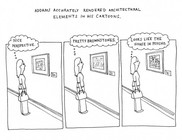
Up-and-coming _New Yorker_ cartoonist “Amy Hwang”:http://www.amyhwang.com/Amy_Hwang.html has created a “review in pictures”:http://urbanomnibus.net/2010/04/addams-big-apple-a-review-in-cartoon/ of an “exhibition”:http://www.mcny.org/exhibitions/current/charles-addams-new-york.html in the Museum of the City of New York that features the work of the legendary Charles Addams.
Hwang’s illustrated “Addams’s Big Apple” reveals not only her fascination with Addams’ genius, artistic methods, and relationship with the urban landscape, but also Hwang’s considerable talents.
Hwang, who is not only a cartoonist but also an architect, transforms her visit into an artistic diary that showcases her own irreverent humor as well as Addams’ use of the city in his cartoons (Addams used accurate architectural elements in his work).
The Addams exhibition will run until June 8, 2010. Click on the image above to enlarge it!
Author Archives: Emdashes
Can Adam Gopnik’s Maturity Countenance Chase Utley’s Glee?
Martin Schneider writes:
There’s been an interesting back and forth on the New Yorker blog pages about Adam Gopnik’s decision to forsake baseball. To recap: Gopnik announced that he no longer much likes baseball, Richard Brody and Ben McGrath responded, then Gopnik wrote again, and so forth. The exchange may not even be over. The best way to follow it all may be to go to the Sporting Scene section and read them in order.
All parties have been intelligent in their advocacy, and I write not so much to correct Brody and McGrath as to supplement them. I find Gopnik’s line of thinking not very convincing and even a bit disingenuous, and since I am a big baseball fan, I thought I would explain why.
Yesterday I attended the home opener for the Cleveland Indians in Progressive Park. The Rangers beat the Indians, 4 to 2, in 10 innings, alas. I was there with three friends, and we had a good time in our outfield seats. Along the way we discussed the unkillable “problem” of baseball losing popularity.
How shall I say this: unlike any endeavor I can think of, baseball is littered with testaments to why baseball is no longer what it once was and also attempts to understand why it will soon not be what it now is. That is to say, baseball fans are constantly telling you that baseball today sucks, and there are two possible offshoots to that premise: first, that the speaker is newly disenchanted (Gopnik); and second, that future generations may not sustain the passion for the sport that we are currently displaying.
I find such worries, to say the least, overdetermined. My position is, to put it bluntly, baseball is still a fine game, its problems are vastly overemphasized, and who really cares if you or some future generations don’t like it so much.
Baseball is incredibly popular. This is a fact. Millions of people attend the games, and millions of people watch the games on television. Millions of people play fantasy baseball (I do), and millions of people pay close attention to the pennant races, playoffs, and World Series. I heard it said on WFAN last week that the revenues for MLB recently passed those for the NFL for the first time in many years.
If this is failure, then I say, Three cheers for failure.
But even if there were serious flaws in the game that were to drastically diminish its popularity short of—I can’t believe I’m writing this phrase—threatening its existence, why should that bother anybody, really? I am not the Treasurer or Accountant for Major League Baseball, and if baseball were to suffer a profound decline in popularity/ratings/revenues of, say, 20 percent, I find it difficult to understand why this would affect me—since I would almost certainly still enjoy the game and derive pleasure from following it.
A hypothetical comes to mind. I am not a serious Star Wars fan. I was seven years old when the first one came out, I had a fairly normal childhood admiration over the first trilogy, and as an adult I’ve come to dislike the whole project quite a bit—yes, the whole thing. Call me the Gopnik of Star Wars, our positions here are probably pretty analogous.
Now, let’s say you, reading this, are a huge Star Wars nerd. What if I were to tell you that, for some imaginary reason, the 1977 gross receipts for Star Wars were, shall we say, 10 percent less impressive than anybody realized at the time? I would essentially be telling you that you have this picture in your mind that Star Wars had Impact X on our culture, and that you, if you were being scrupulous about the truth, would henceforth be forced to downgrade that Impact to something like 90 percent of what you had originally supposed.
Would you find this news distressing? I can certainly imagine that many people would be distressed by that news. The question I have is: Why? If you enjoyed the movie and its sequels as a child, and if you enjoy them today, I don’t really see what difference it makes that a few hundred thousand strangers did not like it as much as you had once thought. The whole concept is alien to me.
Baseball is not your favorite indie band that nobody you know has ever heard of. In that example, it’s sensible to root for the popularity of the project, because its very existence depends entirely on a spike in popularity. Baseball is not in that position.
When we raise the issue of pessimistic prospects for baseball, or investigate one individual’s decision to abandon the sport’s allures, that’s pretty much the situation we’re in. If baseball loses popularity in 2020, 2030, 2040 and there are still strong reasons for my interest to hold steady, I don’t really see what the fact of some unnamed demographic group deciding they like something else better has to do with me. It’s very likely that baseball will still be pretty popular in thirty years, and my desire to watch the World Series, no matter who is playing, will probably also remain. Similarly, I don’t really see why Adam Gopnik’s decision, at the age of 54 or so, to abandon what is after all a child’s game, should interest anybody, in and of itself.
Are we supposed to regard Gopnik’s decision as a canary in the coal mine? I think that is the unmistakable point of Gopnik’s first post, and let’s just say that I disagree with him that the post is actually serving that purpose in any meaningful way.
Having written “around” the problem of Gopnik’s manifesto for several paragraphs, let’s take a closer look at Gopnik’s first post. I don’t want to go through the argument or anything like that, but I did want to hit a couple of quick points.
Start with the opening line: “I am eager to become a baseball fan again.” Frankly, I don’t believe Gopnik when he writes this. The situation that baseball finds itself in is, in my opinion, not so dire that anybody genuinely wanting to love it would truly be barred from doing so. Furthermore, the statement is belied by the rest of what Gopnik writes, which smacks of rationalization, or, as McGrath puts it in the service of a slightly different point, “the use of the statistical record as a kind of moral ballast for what are essentially emotional arguments.”
Be that as it may. Let us now turn to the closing lines of Gopnik’s first post: “The dance of shared purpose and loyalty may be merely a mime—but what else but dancing and miming do we go to games for?”
I understand that it is unpleasantly bracing to realize that athletes are also businessmen, that the teams’ owners are not altruists, that fandom and commerce are intertwined. These are difficult things for an adult to accept about a fondness gained in childhood.
But I must ask: exactly how does Gopnik know that this “mime” is absent, or is being enacted to some insufficient degree? I have an image in my mind, from November of 2008, of a fellow—let us call him a “businessman”—named Chase Utley on a stage in the center of Philadelphia, proclaiming the Phillies the “World Fucking Champions,” to the cheers of many thousands of the city’s citizens.
I must say, his “mime,” which certainly seemed to express a level of jubilation over having won a championship, was a particularly shrewd bit of PR/mime/lying, that would probably have a positive impact on the portfolio of Chase Utley Inc.
But wait—could there be another explanation? Could it be that Utley meant it? Could it be that Utley was sincere in his joy? Is it actually possible that Utley takes pride not so much in his bank account but in his athletic prowess? That the kinship he felt with the other regulars of the “World Fucking Champion” 2008 Phillies was genuine? What if it wasn’t a mime at all?
Gopnik seems to rule out the possibility. Because if he did accept that premise, that Utley is first and foremost an athlete who desperately desires/desired a championship, and not first and foremost a businessman who coolly desires a robust array of assets, then I don’t see how he could have written what he did.
In 2007 I saw Gopnik on stage at the New Yorker Festival, debating with Malcolm Gladwell about the future of the Ivy League. I know from that experience that Gopnik has a subtle mind and can argue creatively and persuasively. For some reason, baseball has a singular tendency to cloud people’s ability to argue cogently. I look forward to a more tough-minded explanation for Gopnik’s new distaste for baseball and its relevance to baseball fans at large.
Although We Are No Longer a Blog Exclusively About The New Yorker
…we continue to be admirers of the magazine and many of its contributors, naturally. We’ll still be posting about New Yorker-related stuff, just alongside a wider range of other subjects. Here’s the transcript of today’s Washington Post live Q&A with David Remnick about his new book, The Bridge: The Life and Rise of Barack Obama. Martin wrote up the recent New York Public Library conversation between Remnick and Ta-Nehisi Coates.
Here’s a snappy answer to a stupid (or maybe just absurdly vague) question:
Johannesburg, South Africa: Shortly after President Obama was inaugurated the U.S. media let slip that directly after law school President Obama encountered a dark cloud. The insinuation was that he had fallen into bad company. And then gone on to a meteorically successful private career in Law. Although I haven’t read your book, I would be interested to hear what you say about this.
David Remnick: It doesn’t sound like reality to me.
And a taste of Remnick’s reading life:
Delaware: Your book, Lenin’s Tomb, is one of my favorite books ever. I initially read it for a Russian history class in college. I’ve read it at least twice since then, each time more impressed with how prescient and cogently organized it is. I’m looking forward to picking up The Bridge this weekend. Wondering, what do you enjoy reading (besides The New Yorker)?
David Remnick: Thanks so much! I really appreciate that. I was delighted to see that my old friend, David Hoffman, at the Post just won a Pulitzer for his extraordinary book on secret Soviet weapons programs. The strangeness, the darkness, and the complexity of the world under Soviet rule remains a subject of great fascination for me, so that is one area where I try to keep up. And I try to read and re-read work by writers like Josef Brodsky, and Nadezhda Mandelstam, and Anna Akhmatova, as much as I can. I read, both for my work and my life (sometimes I wonder about the differene) pretty omnivorously. Not long ago I finished a slender, profound book about Jewish history called “Zakhor” by Yerushalmi and right now I am reading a couple of novels: one by David Grossman, called To the End of the Land, and a book of short stories by Denis Johnson. There is a huge new history of Christianity by MacDiarmid that just landed on my desk with a thud, but I am determined to read it.
–E.G.
The Wavy Rule, a Daily Comic by Pollux: Kingdom of Heaven
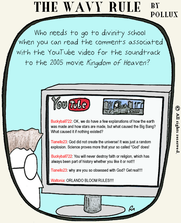
Click on the image for a detailed view!
Thirtysomething: Our Past, Our Future
Emily Gordon transcribes:
From season three, “Legacy,” which aired Oct. 31, 1989:
Lucy, Synergy magazine editor, to Hope, writer: It’s times like this that make me glad I’m in media. This is a remarkable piece, Hope.
**Kit, another editor:** Lucy and I were talking about it all morning.
**Hope:** I’m glad you liked the article.
**Lucy:** With a little work, we think it’ll make a powerful article.
**Hope**: Uh–it already is an article.
**Kit:** We mean an article for us, an article for the NEW Synergy.
**Lucy:** You see, one of the things we’re very anxious to do is to address the problem of–digestibility.
**Kit:** For a consumer magazine to succeed in reaching out to the public, it must be scannable. It has to present itself in a quick, visual, high-impact way that’s readily absorbable and instantly usable.
**Hope:** Are we talking about an article or an antiperspirant?
Later: Here’s a complementary passage from that excellent 2008 Atlantic essay “Is Google Making Us Stupid? What the Internet is doing to our brains.” Nicholas Carr writes:
The Net’s influence doesn’t end at the edges of a computer screen, either. As people’s minds become attuned to the crazy quilt of Internet media, traditional media have to adapt to the audience’s new expectations. Television programs add text crawls and pop-up ads, and magazines and newspapers shorten their articles, introduce capsule summaries, and crowd their pages with easy-to-browse info-snippets. When, in March of this year, The New York Times decided to devote the second and third pages of every edition to
article abstracts, its design director, Tom Bodkin, explained that the “shortcuts” would give harried readers a quick “taste” of the day’s news, sparing them the “less efficient” method of actually turning the pages and reading the articles. Old media have little choice but to play by the new-media rules.
By the way, so that I could reread Carr’s relatively longish piece, I found myself doing the following to keep my brain on track: 1) magnifying the text to a gigantic size so that the ads and sidebars in the margins were forced off the screen; 2) hiding my OS X dock so I wasn’t distracted by the idea of all the other applications I could be jumping to, and 3) turning off NPR. I read in focused peace until…I reached the paragraph I quoted above to switch Safari tabs and amend this post. Curses!
Shivery Books Need New Jackets
 …which is why I like this charming and compassionate Threadless t-shirt that just debuted. It’s by Tenso Graphics and I dig it. God knows the book industry needs some TLC, and weatherproof outerwear (and I’m not talking about Juicy Couture for Kindle) is just the gesture you can make to make it feel better. And keep your bookshelves from a pneumonia outbreak. –E.G.
The Wavy Rule, a Daily Comic by Pollux: To the Lions
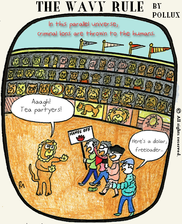
Click on the image for a detailed view!
Sempé Fi: Paw in the Family
_Pollux writes_:
Did you know that there are about a hundred and fifty different rabbit coat colors? The color of rabbit fur can range from orange to opal agouti, from chocolate tortoiseshell to frosted pearl.
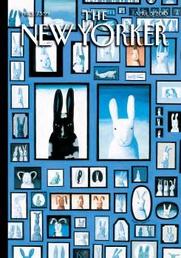
Some of these colors appear in “Kathy Osborn’s”:http://www.kathyosborn.com/ cover for the April 5, 2010 of _The New Yorker_, which is awash with a gouache-based array of various members of an extended rabbit family.
The Easter Bunny always seemed to me a lonely figure, a leporid deity condemned to roam the earth with an incongruous basket of eggs and chocolate. Usually he wears a big bow as well.
But Osborn’s “The Bunny Family” gives us an extensive gallery of countless bunnies in various poses, wearing different expressions. Even bunny families have a hierarchy. In the center of the cover, Osborn gives us a proud black-and-white paterfamilias and the equally important matriarch of this bunny family. Ears twist and swirl; bunnies frown or sleep. Some portraits are group shots.
The web forum known as Pattern Pulp, founded by Shayna Kulik, which is “devoted to tracking ideas and emerging trends that expose, celebrate, share and connect pattern design across all creative platforms,” “sees”:http://www.patternpulp.com/art/follow-up-bunny-portraiture/ a bunny family portrait-themed trend emerging in various forms and formats:
At first glance, last week’s New Yorker cover by Kathy Osborn seems like a cute parody on rabbits, Easter and Grant Wood’s infamous 1930 farmer portrait. The idea of a family tree composed entirely of bunnies, captured in stylistic unison is humorous, charming and rather surreal. A year ago, Bergdorf Goodman’s window display revealed a wall of hand painted bunnies framed against a green backdrop. Fast forward and we now have framed imagery from Hunt Slonem’s Manhattan oasis showcasing his own homage to the bunny world. Joe Zee, Elle’s Creative Director, always says, two times a coincidence, 3 times a trend, so we ask, are other adorable cuddlies going to continue adorning walls around the world or will these visual stories alternate as whims change and moods shift?
But Osborn’s “covers”:http://www.cartoonbank.com/bin/venda?ex=co_wizr-locayta&template=wz_locayta&pageno=1&perpage=20&collate=ivtype%3Apdxtlayout%3Apdxtstyle%3Apdxtdecade%3Apdxtpublicationdate%3Apdxtartist%3Apdxtpublished%3Apdxtperson%3Apdxtdesigner%3Apdxtauthor%3Apdxtlocation%3Apdxtcity%3Apdxtstate%3Apdxtcountry%3Apdxtoriginalartavailable&refine_sort_alph=&fieldrtype=type&termtextrtype=invt&typertype=exact&fieldcatrestrict=xancestorid&termtextcatrestrict=shop&typecatrestrict=exact&typekeywordsearch=keyword&termtextkeywordsearch=Kathy+Osborn for _The New Yorker_ have given us a wide array of original, surreal, and eye-catching imagery.
Osborn’s “Bunny Family” not only can be considered part of a larger trend of rabbit-themed artwork but it also fits as snugly as a bunny in a burrow within Osborn’s colorful, humorous, and off-beat work.
Bluegrass, Matt Diffee, Mark Singer, Zachary Kanin: This Sunday in NYC!
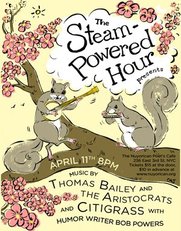
Emily Gordon writes:
The Steam-Powered Hour is one of the best variety shows going in New York. The combination of high-quality bluegrass, New Yorker cartoonists like Drew Dernavich, Carolita Johnson (who drew the merrily sciurine poster above) and Emily Flake drawing live on stage, comedy, storytelling, and spontaneous mass acoustic jams make it a hootenanny-salon you have to experience, trust me.
It’s a monthly party, but it’s taking a break for the summer, so make sure to come to the next two! Especially this one, because Citigrass are some of the rousingest, rollickingest pickers I’ve ever had the pleasure of hearing.
From the Steamers’ latest email:
In April, The Steam Powered Hour welcomes back Citigrass, winners of this year’s Battle of the Hardly Strictly Bluegrass Bands. Also, more bluegrass goodness with Thomas Bailey and the Aristocrats, a story by The New Yorker staff writer Mark Singer and cartoonist Zachary Kanin. Plus, plenty more surprises. Hosted as usual by New Yorker cartoonist Matt Diffee.
April 11th, 8pm
Nuyorican Poet’s Cafe
236 East 3rd Street Between Ave B & C
New York City
Tickets are $15 at the door. Get ’em for $10 in advance at http://www.nuyorican.org.
You can follow The Steam Powered Hour on Twitter and on Facebook.
The Wavy Rule, a Daily Comic by Pollux: The Future of Blogging

Click on the image for a detailed view!