Author Archives: Emdashes

What Gives? Village Voice Poll Cineastes Commit Critical Malpractice

Martin Schneider writes:
The Village Voice has been publishing that year-end film poll combining the assessments of a few dozen critics since 1999. I enjoy it every year, because I’m a dorky cultural maven type, and it pleases me to see these aesthetic preferences totted up in a list for people to argue over. They love Claire Denis, I love Claire Denis, everybody wins.
This year the big winner was The Hurt Locker, which I enjoyed very much but maybe not as much as these critics. That’s fine, The Hurt Locker was terrific.
The list that has me steamed is the list of the best movies of the decade. After I had studied the list for a little bit, I couldn’t decide whether to conclude that cinema had died during the “Noughts” or that movie critics are stupid—or both.
Here is a list of the top ten finishers:

Mulholland Dr. (10)
In the Mood for Love (5)
The 25th Hour (5)
La Commune (Paris, 1871) (4)
Zodiac (4)
Yi Yi (4)
Dogville (3)
The New World (3)
There Will Be Blood (3)
The Death of Mr. Lazarescu (3)

That’s a pretty depressing list, if you ask me, and the other 40 finishers really aren’t any better (which makes sense, if you think about it—they did finish lower). Among those 40 movies are Brian De Palma’s preposterous Femme Fatale and the third Star Wars movie; I’ll let you judge from that how seriously these critics were taking this task.
Let’s go through the top ten, quickly. Mulholland Drive is all kinds of awesome, and it’s not possible to overpraise it; no problem there. Ditto In the Mood for Love, but even there, it may be a bit too “pat” an arthouse fave—it’s great but a little studied. I’ll return to the other second-place winner in a moment. Zodiac was a very impressive movie indeed, and I regard myself as its champion to some degree, but, well, it’s got some problems. Yi Yi was wonderful. There Will Be Blood is a bit like Zodiac, awfully powerful but with serious flaws. The other four movies I haven’t seen, which in itself is fine.
I have to take a moment to address The 25th Hour. That this movie can finish tied for second in a poll of this sort is a terrible condemnation of the current state of film criticism in this country. The 25th Hour came out in 2002, and was directed by Spike Lee. It starred Edward Norton, maybe you remember it. I feel strange directing such ire at the movie, because I really like Spike Lee’s movies, I think he’s a highly underappreciated presence in our film culture, too often damned or derided as “political” or “tendentious” when he’s actually a pretty original and canny director who has few peers.
But The 25th Hour is not very good. It is overlong, overwrought, turgid, and self-important. I’m looking now at Lee’s filmography, and I think I would put it about eighth, of his movies. It’s not a terrible movie, it’s not a mess, it’s an honest attempt to make something powerful. But it doesn’t work, and has little of the panache, lightness, wit, or visual flair that come to mind when you are considering a list of the ten best movies of the past one year or ten years. Having The 25th Man finish second for the 2000-2009 period is quite a bit like stating that Martin Scorsese’s greatest movie is Bringing Out the Dead.
To his credit, J. Hoberman (my favorite film critic of all time), in his introduction to the poll, appears to recognize this ridiculous result when he writes:

The Voice poll, which queries film critics throughout the country, had The Hurt Locker on 54 out of 94 ballots; its margin of victory surpassed the runner-up…by the poll’s largest percentage since David Lynch’s Mulholland Drive swamped Wong Kar-wai’s In the Mood for Love back in 2001. (These two movies get a rematch in our film of the decade category, with Mulholland Drive defeating runner-up In the Mood even more decisively this time around; the big news there is that Spike Lee’s The 25th Hour, a weak 25th in the 2002 poll, ties for second place.)

So that’s just baffling.
But more to the point, the list, the full list, is just a disgrace. There are certainly some splendid movies in there, but the overall package is lacking in zest. It is a list that confirms the wisdom of my decision to decrease my movie intake during the decade, and what kind of message is that to send?
After stewing about the list for a spell, I spent a quarter-hour brainstorming to create a list of fun, inventive, interesting, amusing, worthwhile movies that did not make the Voice‘s list at all, and which might—might—elicit a smile from a movie-lover somewhere. I’m not a film critic, I don’t do this for a living, and it took me the time to make a plate of grits (hat tip to My Cousin Vinny, 1992) to slap it together. It’s amazing to me that the people who do do it for a living, given many weeks to think about their opportunity to spread their delight in the medium they so love, are this unable to produce a list that does anything like that.
What follows is not my top-anything list, it’s more like the larval form of one. It is merely a list of movies that would make me want to safeguard the decade’s cinematic treasures rather than throw them in the Gowanus Canal, as the Voice‘s list does. To repeat: not a single one of the poll’s critics saw fit to mention any of these movies.

A History of Violence
Adaptation
Amelie
American Splendor
Beau Travail
Borat
Brokeback Mountain
Donnie Darko
Eastern Promises
Ghost World
In Bruges
Inglourious Basterds
Lost in Translation
Milk
Monsoon Wedding
Munich
No Man’s Land
O Brother, Where Art Thou?
Primer
Rachel Getting Married
Sideways
Syriana
Talk to Her
The Assassination of Jesse James Etc.
The Departed
The Fantastic Mr. Fox
The International
The Motorcycle Diaries
The Prestige
The Queen
The Savages
The Squid and the Whale
The Three Burials of Melquiades Estrada
The Triplets of Bellville
The Visitor
This is England
Training Day
Watchmen
Y Tu Mama También

Now that I’ve gotten that off my chest, I have something queued up to watch on Netflix. Catch you later!

Holy Last-Minute Gift, Der Fledermausmann!

Benjamin Chambers writes:
What would have been the perfect, last-minute gift for someone on your holiday shopping list in 1966?
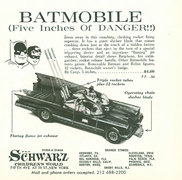
I’m betting it would’ve been the Batmobile seen on p. 185 of the October 1, 1966 issue of The New Yorker. (Click on the image below for a larger view.)

Batmobile.10-1-66-p185.jpg

I was lucky enough to own one of these (though I didn’t get it until 1971 or so), and I can attest that it was the coolest toy car ever made. I quickly lost the “rockets”, but nothing ever dulled the joy of the car’s sleek lines, the futuristic windshield, or the chain-snapping blade that would pop out of the hood.
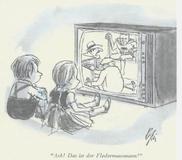
Curious to see if the Batman ever showed up in The Complete New Yorker, I was pleased to see that he did. I’ll have more to say about this at another time, but my favorite find was the Everett Opie cartoon below, from the June 24, 1967 issue. (Again, click on the image for a larger view.)

DerFledermausmann.jpg

Naturally, the cartoon made me want to look into the Strauss operetta, “Die Fledermaus,” which I’d heard of, but never seen. I was amused to learn from Wikipedia that the gist of the finale is, “Oh bat, oh bat, at last let thy victim escape!”
Priceless!

Sempé Fi: Mundus Novus

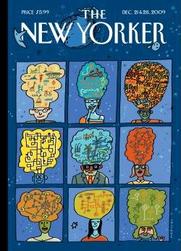
12-21-09 Javier Mariscal New Worlds.JPG
_Pollux writes_:
In order to persuade “Saul Steinberg”:http://www.saulsteinbergfoundation.org/ to draw more covers for _The New Yorker_, art editor Françoise Mouly once showed the legendary artist some of the modern covers she had commissioned.
The only ones Steinberg liked were the covers created by Spanish artist “Javier Mariscal.”:http://www.mariscal.com/ “It gave me goosebumps when I heard that,” Mariscal has commented, in this interesting “piece”:http://www.paulgravett.com/index.php/articles/article/javier_mariscal/ by Paul Gravett.
To describe Mariscal as an artist would be an understatement. Mariscal is a one-man industry, a Renaissance Man of the Digital Age who has emerged from the Spanish _posmodernidad_ to produce underground comics, furniture, paintings, sculptures, posters, sketches, murals, typography, product designs, interior decoration, animation, and audio-visual productions. Mariscal is a polymathic Valencian artist who has built a global empire based on whimsy, joyousness, and free-flowing experimentation.
It was Mariscal who designed “Cobi”:http://en.wikipedia.org/wiki/Cobi, the two-legged doodle of a cat-like Catalan sheepdog for the 1992 Summer Olympics in Barcelona (most of Mariscal’s working life has been spent in Barcelona).
And so Mariscal is the perfect artist to illustrate the cover for the December 21 and 28, 2009 issue of _The New Yorker_. The theme of the issue is “World Changers” and Mariscal is an internationalist artist.
Mariscal’s relationship with _The New Yorker_ is already well-established. Mariscal had contributed to Art Spiegelman’s comics anthology _RAW_ and his previous covers for _The New Yorker_ include, for example, the cover for the August 9, 1993 “issue”:http://archives.newyorker.com/?i=1993-08-09 (*note*: this cover does not appear in the “overhauled”:http://emdashes.com/2009/11/cartoon-bank-overhaul-ben-bass.php Cartoon Bank under the artist’s name or under the date of the issue itself). This 1993 cover depicts a frenetic seaside scene in which a cubist convertible careens along a Mediterranean corniche.
Mariscal’s new cover, called “New Worlds,” is an optimistic depiction of potential “world changers.”
Mariscal was a pioneer of the artistic movement known as Atom Style (also known as _atoomstijl_ or _Style Atome_) that arose in the late 70s and early 80s, which was a throwback to the optimism of the 1950s when it was believed that anything was possible and technology could solve all of mankind’s problems.
In “New Worlds,” ideas burst out of the heads of men and women of all nationalities, ages, and backgrounds. Mariscal creates multi-shaped thought-balloons that fizz with new ideas and innovations. Mariscal’s squiggles, which fill up these multi-colored thought-balloons, create a new symbology that suggest possibilities for innovations in the fields of environmental science, transportation, linguistics, communication, energy, health, and medicine.
We can all be world changers, but no one can do it alone. The 193 nations that attended the United Nations Climate Change Conference in Copenhagen in December 2009 hammered out, with great difficulty, an accord that may lead to positive change. But more conferences, and more cooperation, are needed.
The best ideas emerge from chance, from flights of fancy and castles in the air, and Mariscal, himself an innovator and ideas man, creates doodles that represent the serendipity behind new discoveries.
Mariscal depicts not one struggling single figure in an ivory tower, but multiple figures in closely linked panels set against a universal background. Most of Mariscal’s figures smile. Each of Mariscal’s world changers is a constellation in the galaxy of change, happiness, and hope. Mariscal’s world changers are all “New Worlds.”

I’m Picking Out a Thermos, Filled With Snausages

Martin Schneider writes:
This is great. When our friend Ben Bass was in New York for the most recent New Yorker Festival, he told me about Michelle, this good friend of his who is…pretty much the biggest Steve Martin fan in the world, in the sweetest possible way. Even our own Emily must take a back seat to Michelle when it comes to Steve Martin adulation. And Emily really likes Steve Martin a lot.
So a while back Steve announced a fun little fan contest, to create a video for a jaunty piece of banjo music he had written, “Wally on the Run,” inspired by the frolics of his own dog Wally. The only constraint Steve imposed was that the video ought to involve a dog frolicking in some way. And…well, just go to Ben’s smile-eliciting post at Ben Bass and Beyond for the fuller story (and all relevant videos), and then come back here.
(Back? OK. Two things I feel the need to say. First, I love how Steve—perhaps the most polished TV performer of all time—even he comes off just a little dorky and wooden when he’s just shooting a quick little video for the internet. And second, I think I liked Michelle’s video better than the “Laika” one.)
I love this story. I love the internet. Good day to you.

That Thunderbird Touch

_Benjamin Chambers writes_:
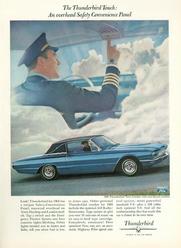
Cruising through The Complete New Yorker (TCNY) the other day—though without a unique Safety-convenience Panel—I ran across a great ad for the Ford Thunderbird on page 5 of the December 25, 1965 issue (click image for larger view):

Thunderbird-12-25-65.JPG

It’s interesting how explicitly the advertisers (Mad Men, anyone?) tried to evoke the romance and cachet of flight: the sheer novelty of having an overhead, “Safety-convenience” instrument panel was used to connote the complexity of the cockpit, and the driver was shown wearing, of all things, a pilot’s uniform. Drive this car, in other words, and you will be captain of your destiny, far from earthly cares … Hard to imagine that idea resonating with anyone today who’s flown coach.
However, I was intrigued by two of the car’s new features: the Stereo-Sonic tape system, and the “automatic Highway Pilot speed control option.” Maybe I’m showing my age, but I had no idea what Stereo-Sonic tapes were, and was surprised to learn they were 8-Track tapes. I hadn’t realized they were introduced so early. (According to Wikipedia, Ford introduced 8-track players in most of its automobile lines in September 1965.)
The mention of the “Highway Pilot speed control option” made me wonder when cruise control was first introduced. Turns out it’s been around since the 1910s (!), though the modern version first appeared in a 1958 Chrysler.
Apparently, the guy who invented the modern version did so after he got tired of the way his employer kept speeding up and slowing down when he was talking as they drove along together. Who knew that highly-useful invention was born of such deep irritation? Maybe that’s why the driver shown in the ad has no passengers. Wouldn’t want to spoil the illusion of peaceful command by including insubordinates just itching to fix your wagon …