
_Martin Schneider writes_:

Emdashes is delighted to be giving away a copy of _I’m Not Hanging Noodles On Your Ears_, a book on idioms by “Jag Bhalla”:http://www.hangingnoodles.com/, illustrated by _New Yorker_ cartoonist Julia Suits (who drew the funny picture above).
We recently “reviewed”:http://emdashes.com/2009/08/hanging-noodles.php Bhalla’s delightful book, which amuses and educates. The book is a great addition to lovers of both language and cartoons, and we guarantee that you’ll love _Hanging Noodles_. We know that you crave this book, or as the Chinese say, have _spittle that’s three feet long_ for this book.
Here are the rules: There are two ways you can enter. One is to drop us an “e-mail”:mailto:martin@emdashes.com, with the subject line “**My favorite idiom**”; include your favorite idiom, your full name, and your mailing address in the body of the e-mail.
The other way is to retweet our message about this contest on Twitter; our username is @emdashes, if you’re not already following us.
Please mention your favorite idiom in the tweet, too.
We’ll accept all entries until 8:00 p.m., Eastern Standard Time, on Friday, **September 30**, and then the Random Number Generator will deliver its negative verdict to every entrant save one.
Good luck to all of you! As the Russians say, _each vegetable has its own time_ (“every dog has its day”).
Author Archives: Emdashes
The Wavy Rule, a Daily Comic by Pollux: Mom’s Flyers
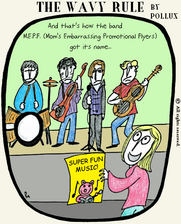
Click on the cartoon to enlarge it!
Read “The Wavy Rule” archive.
More New Yorker Festival Gets Announced Quizzically
Martin Schneider writes:
The New Yorker Festival blog has lately been teasing its readers with blind previews of the Festival, which takes place October 16-18. Yesterday came the third installment:
Which indie-film actor once played a monarch in a movie directed by his cousin?
The New York Times called which political guru “perhaps the most unlikely media star to emerge” in the 2008 election season?
Which single-named poet studied under Allen Ginsberg at Brooklyn College?
In previous editions we learned of the likely appearance of Rufus Wainwright, E. Annie Proulx, Matthew Weiner, James Franco, Wallace Shawn, and Rachel Maddow. Who are the mystery guests this week?
Why Keep Blogging? With Your Help, We’ll Have the Answer in March!
Emily Gordon writes:
This is the panel proposal I submitted for potential inclusion in next March’s South by Southwest Interactive festival. If you click on the PanelPicker, sign up in a flash, and click on the little thumbs-up button, you’ll be helping me get there! Voting ends Friday, so if you do it now while you’re thinking about it, you’ll be helping out a lot. Thanks so much!
Here are all the details:
**Why Keep Blogging? Real Answers for Smart Tweeple**
**Organizer:**
Emily Gordon, Founder, Emdashes.com; Editor-in-Chief, Print magazine
**Description:**
Now that we think in 140-character strings and live through Facebook, it’s tempting to throw out the blog baby with the bathwater. These seasoned bloggers explain the vitality of this still-revolutionary medium–the resources, community, continuity, and space for real ideas that only blogs can provide–and its infinite future potential.
**Questions Answered:**
1. Why blog when there are newer, shorter, quicker mediums to express myself in?
2. If there’s no barrier to blogging, what makes any blog special?
3. Which blogs are going to be worth reading in 2, 5, 10, and 50 years?
4. What can blogging do for my life–creatively, socially, professionally, and intellectually?
5. What techniques do the bloggers with the most staying power use to keep their readers–and themselves–informed and inspired?
6. Why blogging during a recession is the smartest thing you can be doing with your time
7. What works as a blog post and what works better as a tweet or status update, and why?
8. How do veteran bloggers avoid the 10 blog traps that rookies always fall into?
9. Why is it so important to keep commenters happy and engaged–and how do I do it?
10. Is it worth it to revive a dead blog–and should I kill the one I don’t love anymore?
So far, the people I’ve asked to be on the panel if we make it to the show are:
• Daniel Radosh, blogger, radosh.net; contributing editor, The Week; author, Rapture Ready! Adventures In The Parallel Universe of Christian Pop Culture
• Book-writer and blog-writer Lizzie Skurnick, who writes the blockbuster Fine Lines column at Jezebel, which turned into her new book, Shelf Discovery: The Teen Classics We Never Stopped Reading; her book blog, The Old Hag; and, of course, www.lizzieskurnick.com.
• Scott Rosenberg, author, Say Everything: How Blogging Began, What It’s Becoming, and Why It Matters; blogger, www.wordyard.com
• Heather Cocks and Jessica Morgan; bloggers, Go Fug Yourself; authors, Go Fug Yourself: The Fug Awards
• Ron Hogan, blogger, Beatrice and GalleyCat; book critic; author, The Stewardess Is Flying the Plane! American Films of the 1970s
• Paddy Johnson, blogger, Art Fag City
• Josh Fruhlinger, blogger, The Comics Curmudgeon
And if we do make it–and you’ll be in Austin for the festival–come on by and I’ll thank you in person!
The Wavy Rule, a Daily Comic by Pollux: The Afghanistan Open
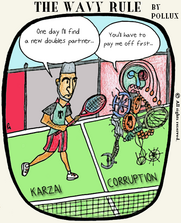
Click on the cartoon to enlarge it!
Read “The Wavy Rule” archive.
Also read Burkhard Bilger’s tennis-related “article”:http://www.newyorker.com/reporting/2009/08/31/090831fa_fact_bilger on doubles team Bob and Mike Bryan in the August 31, 2009 issue of _The New Yorker_.
The Wavy Rule, a Daily Comic by Pollux: NRA Distortion Service
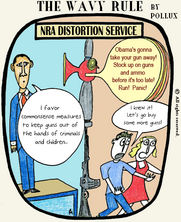
Click on the cartoon to enlarge it!
Read “The Wavy Rule” archive.
Sempé Fi (On Covers): Bridge to Nowhere
_Pollux writes_:
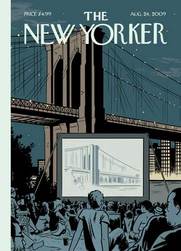
There is a feature playing in an outdoor theatre alongside the Brooklyn Bridge. Tickets are free. All are welcome to come. Flickering on the screen is a shot of the Brooklyn Bridge itself. The audience is entranced. It is a diverse crowd. No one looks at the actual bridge looming behind the improvised cinema.
A movie under the stars makes for a decent Saturday night, maybe a good “second date” or “third date” sort of outing.
Why look up at a marvel of engineering when you can see it on a much smaller screen? No craning of the neck is required; you can see it as you see most of the world: through streaming videos on the CNN website, through newly uploaded Snapfish albums, through the muted flash of Kindle screens.
For the August 24, 2009 cover of _The New Yorker_, “Adrian Tomine”:http://www.adrian-tomine.com/ makes a statement about our world. It is a world in which life and culture seem to be permanently plugged into any device that has a screen: films, iPods, television, and computers. We could spend our whole day viewing, viewing, and viewing some more, and this has become the stuff of life itself. It is life not led but LED, a light-emitting diode existence.
René Magritte created the same sort of imagery and made the same sort of comment in the two paintings called “_The Human Condition_.”:http://www.uh.edu/~englmi/BorgesBaroqueIllusionism/index.html These paintings depicted paintings: in them an easel stands before an open window. The painting on the easel depicts the very same landscape it is concealing. It depicts and conceals it at the same time. Magritte thus toys with reality and our conceptions of it. The painting on the easel is no more and no less real than the landscape behind it.
Tomine’s Magritte-like cover is appropriate to our times. His Brooklyn Bridge is not real; it is simply a depiction of it. Is it any less real than the film that portrays it? Is the film a documentary or a feature film starring the It Girl of the moment?
Our world is a world in which Facebook friendships seem more vigorous and more affectionate than the flesh-and-blood variety. As the ever-waggish Andy Borowitz once “joked”:http://www.youtube.com/watch?v=4cRCHNmoOws, he loves his Facebook friends because they would never betray him as his real friends would.
Are we becoming a world in which reality on the screen is becoming more real than flesh, blood, stone, and brick?
Will battles between nations become transformed into cyber-attacks, in which the websites of embassies are hacked and cities themselves are left untouched and un-bombed? No, that is wishful thinking. It seems that only the good things in life are being transferred to the world of small screens: friendship, architectural works, and concerts.
Tomine’s “last cover”:http://emdashes.com/2009/01/sempe-fi-winter-keeps-us-warm.php for _The New Yorker_, for the January 31, 2009 issue, depicted a different night scene: an ice-cream salesman braving the cold to sell his product, in which light and warmth emanate from the truck that serves as a refuge from the screaming winds.
Tomine’s new cover is equally incongruous, but not obviously so. Tomine makes his point gently and subtly, much like Bruce McCall. Tomine and McCall are the diametric opposites of artists like Blitt, who make their point with hammer blows. _The New Yorker_ needs both types of artists.
We don’t live in an entirely virtual world. The shock of reality always intrudes upon our iWorld of little screens and _Next_ buttons. Perhaps that is just as well. We are alive; what we see on the screen is not.
What’s in This Week’s New Yorker: 09.07.09
Martin Schneider writes:
A new issue of The New Yorker comes out tomorrow. A preview of its contents, adapted from the magazine’s press release:
In “Trial by Fire,” David Grann offers a pathbreaking report, presenting overwhelming evidence that an innocent man was executed by the modern American judicial system—something that has never been proven beyond doubt. Cameron Todd Willingham was put to death by lethal injection on February 17th, 2004, for the murder of his three children by arson, in 1991. But Grann, drawing on court records, government documents, interviews, and even Willingham’s own diaries, shows that the prosecution’s case was flawed in every respect, from the eyewitness testimony to the evidence presented for arson.
In Comment, Nicholas Lemann looks at Senator Ted Kennedy’s legacy of support for universal health care.
Adam Gopnik writes about Michael Ignatieff, the intellectual who may become Canada’s next Prime Minister.
In Shouts & Murmurs, Bruce McCall imagines a health-care newsletter from an unconcerned insurance company.
Jane Kramer looks at Michel de Montaigne’s legacy as the “first truly modern man.”
Hendrik Hertzberg remembers Senator Kennedy, accompanied by a photo of Kennedy from 1962 by John Loengard.
Caleb Crain asks what the pirates of yore can tell us about their modern counterparts.
Joyce Carol Oates reads E. L. Doctorow’s Homer and Langley.
Hilton Als watches the Public Theatre’s production of The Bacchae in Central Park.
David Denby reviews American Casino and The Most Dangerous Man in America.
There is a short story by Orhan Pamuk.
Edward Kennedy, 1932-2009
Martin Schneider writes:
I was hours away from an airplane voyage when news came though of Senator Kennedy’s death. Now, at my destination, I can take the time to accomplish the minimum a post like this should do: direct you to the useful post on The New Yorker‘s website listing the many fine articles that covered Kennedy over the years.
I know I’ll be using it.
The Wavy Rule, a Daily Comic by Pollux: “Rodulodeceditis”
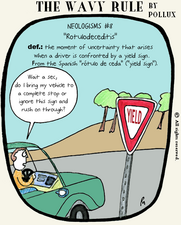
Click on the cartoon to enlarge it!
Read “The Wavy Rule” archive.