_Pollux writes_:
I drew a “joke”:http://emdashes.com/2009/07/the-wavy-rule-a-daily-comic-by-251.php about desert island jokes a few weeks ago. It struck me, as I’m sure it has struck many observers, that the desert island features often as a comic device, especially “within the pages of _The New Yorker_.”:http://www.cartoonbank.com/directory/deserted-cartoons.html
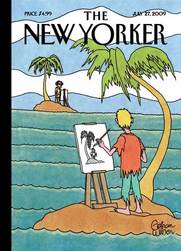
And now it appears on the cover of the July 27, 2009 issue. “Gahan Wilson’s”:http://en.wikipedia.org/wiki/Gahan_Wilson cover is of course a comment also on the desert island as a frequent location in one panel gags and cartoons. Last year, Mike Lynch’s cartoon blog “voted”:http://mikelynchcartoons.blogspot.com/2008/05/favorite-gag-cartoon-cliche.html for the desert island number one for gag cartoon clichés (second place was the Psychiatrist’s Couch, while third was The Grim Reaper).
Wilson’s cover, called “Cartoon Island,” of course features two cartoon islands, occupied by two artists drawing inspiration from one another across the treacherous-looking channel that separates them. The canvas we are allowed to see features a third island, occupied by a smiling castaway.
The castaway featured in the canvas is not a portrait of the bespectacled artist farthest away from us. The bespectacled artist simply provided the initial inspiration. The blond artist whose back is to us sees inspiration across the channel but not an opportunity for exact portraiture.
He is of course a castaway himself, but neither artist may realize this. So they paint and draw, sustaining themselves on Art and the off-chance that 7.5 oz cans of beans and franks and some desalinization equipment will wash up on their picayune shores.
Wilson has thus turned the desert island device on its own head. As Wilson has “remarked”:http://www.lowbrowartworld.com/gahan_wilson.html, “the creative artist is automatically an outsider, because he sees through the world that everybody else takes as the final reality, and he’s a very scary kind of guy.” Instead of a subject of art the island has become a place for producing art. The cartoon desert island is producing art about cartoon desert islands.
These cartoon desert islands usually look the same: they’re about the size of a Smart Car, usually sustaining a single palm tree and a single inhabitant, who is usually male. He wears the costume of a comic castaway: frayed slacks and shirt. He is sometimes unshaven, and always uninjured, and mysteriously does not look very undernourished. This is a humorous cartoon after all.
These desert islands are usually covered by a soft carpet of sand instead of unfriendly coral as sharp as an X-acto knife. Their very stripped-down quality makes desert islands a good location for humor. All you have is a man, an island, and the possiblity of a punchline. The cartoonist introduces some element that disrupts this minimalist world, and makes a comment on the world at large. The island is a laboratory for exploring ourselves.
The islands are ridiculously small, but their size allows us to see an entire world at once, a society in miniature, and of course, a small island is better than the dangers of the sea. As Gonzalo, the honest old counselor in Shakespeare’s “The Tempest,” declares, “Now would I give a thousand furlongs of sea for an acre / of barren ground–long heath, brown furze, anything.”
Wilson’s art, produced over the course of half a century, is sometimes described as scary or creepy, but here acquires a certain satirical tinge that is not particularly disturbing or sinister. His “Cartoon Island” is considerably less sinister than “another”:http://www.gahanwilson.com/orginalart.htm of his cartoon islands, which is not an island at all but a large sea monster -which is itself an old literary theme.
Wilson’s Cartoon Archipelago, composed of ink and watercolors, is a place of industry and stimulation. “I began to conclude in my mind,” Robinson Crusoe realizes on his deserted island, “that it was possible for me to be more happy in this forsaken, solitary condition than it was probable I should ever have been in any other particular state in the world.”
On Wilson’s “Cartoon Island,” we find two artists finding inspiration in the bleakest of circumstances, and thus finding a form of happiness through their art despite the fact that only the smallest of patches of earth separates them from a deep and hazardous ocean. The ocean is Neptune’s domain; skillful cartooning is Wilson’s.
Author Archives: Emdashes
The Wavy Rule, a Daily Comic by Pollux: Historically Accurate Tattoos

Click on the cartoon to enlarge it!
Read “The Wavy Rule” archive, and “order your Wavy Rule 2008 Anthology today!”:http://emdashes.com/2009/03/the-wavy-rule-anthology-now-fo.php
We’re Liberal and We Drink Vinegar
Jonathan Taylor writes:
Michael Savage is right. Vinegar is “like wine.” (It’s a trick!) I recently received, as a thoughtful gift, a “drinking vinegar” from Gegenbauer, a fine Viennese producer of vinegars (as well as whole grains and coffees), via Philadelphia’s DiBruno Bros. This one is made from the Pedro Ximénez grape, used to make sherries and raisin wines. It is appley and brisk, with enough acidity to induce a challenging euphoria resembling that of capsicum, but, at 3%, not enough, in fact, to technically be categorized a vinegar. This “Noble Sour” is, pace Savage, “special,” an after-dinner drink with a world-clarifying potency that an alcoholic digestive could not provide. I wouldn’t be surprised if it’s already on menus in Savage’s San Francisco, and it has a place on more. Don’t anybody tell him about saba .
The Wavy Rule, a Daily Comic by Pollux: The Real Estate of Things

Click on the cartoon to enlarge it!
Read “The Wavy Rule” archive, and “order your Wavy Rule 2008 Anthology today!”:http://emdashes.com/2009/03/the-wavy-rule-anthology-now-fo.php
Checking Facts, Links: Are You Completely Accurate? (Is Anyone?)
Martin Schneider writes:
Emily and I generally have little patience with the apparent hordes of pedants who seem just a tad too delighted when the come upon an occasional factual error in The New Yorker. (N.B.: As a copyeditor, my job description is basically “professional pedant,” so don’t take that slam too much to heart.)
Putting out a magazine is hard, as Emily knows all too well and I’ve also been able to figure out over the years, and the belief that The New Yorker might possibly (or ever did) achieve pristine perfection with regard to facts is kind of the adult version of believing in the tooth fairy. Magazines have deadlines; facts are elusive; brains get tired; it’s hard.
And yet, and yet—this position, in a sense, allows The New Yorker to benefit from its outsize reputation as the Magazine That Never Errs while shielding it from the responsibilities that that status brings with it.
So, you know, yeah—The New Yorker shouldn’t ever depart from its implied mission to Get It All Right, which mission (and a sizable budget) allows it to publish a great deal of material on a vast range of subjects with what everyone would agree is a dauntingly high degree of accuracy. That’s the story here, not that it got the identity of the 1953 Cy Young Award winner wrong that one time (or whatever).
We get a fair number of people writing in, alerting us to this or that inaccuracy, and we tend to ignore them (fair warning). But recently a fellow named Craig Fehrman contacted us, inquiring about a possible link to an article he had written about a recent error in The New Yorker.
I admit I indulged in a preemptive wince. And actually, I’m not entirely sure that the article doesn’t share just a bit of the same mindset as the “mere” error-flaggers out there in the magazine’s audience. But his article so transcends that big-brained delight in catching someone out, I thought it would be worth linking to it.
So here it is: “Just The Facts at The New Yorker?” by Craig Fehrman, at Splice Today. I particularly liked his closing point, about The New Yorker‘s subtle and precarious existence between print and the Internet.
While we’re at it, a couple of additional fact-checking links. Andrew Hearst at the indispensible Panopticon blog, posted a big chunk of “Are You Completely Bald?” a 1988 New Republic article by Ari Posner and Richard Blow a few years ago.
Fehrman links to John McPhee’s reminiscence from earlier this year about fact-checking as well as an amusing Wikipedia list (loooove those Wikipedia lists) called “Prominent former fact-checkers” which verifies that fact-checking can be the first step in a noteworthy career, but only in a narrow set of egghead-y endeavors. No NHL goaltender has ever started out as a fact-checker (apparently, anyway; I await the Wiki update).
The Wavy Rule, a Daily Comic by Pollux: Soto-major Victory
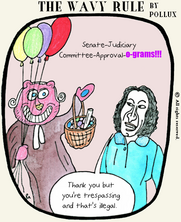
Click on the cartoon to enlarge it!
Read “The Wavy Rule” archive, and “order your Wavy Rule 2008 Anthology today!”:http://emdashes.com/2009/03/the-wavy-rule-anthology-now-fo.php
The Wavy Rule, a Daily Comic by Pollux: The Queen’s Arms

Click on the cartoon to enlarge it!
Read “The Wavy Rule” archive, and “order your Wavy Rule 2008 Anthology today!”:http://emdashes.com/2009/03/the-wavy-rule-anthology-now-fo.php
The Lost Algonquin Round Table Book Release: An Emdashes Exclusive
Martin Schneider writes:
A hidden treasure has been discovered.
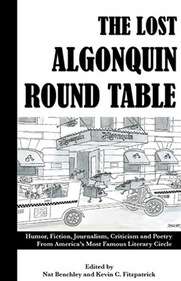
Unearthed from forgotten bookcases, dark desk drawers, and public archives comes The Lost Algonquin Round Table, a compendium of 50 pieces written by the Algonquin Round Table, the legendary group of writers and critics that met at New York City’s Algonquin Hotel in the 1920s.
For the first time ever, the writers of the “Vicious Circle” are together in one collection, just in time to mark the 90th anniversary of their launch in 1919.
This new collection presents—for the first time—many pieces from family collections and long-lost periodicals.
Published by iUniverse and Donald Books, The Lost Algonquin Round Table is edited by Nat Benchley, grandson of Robert Benchley, and Kevin C. Fitzpatrick, friend of Emdashes, president of the Dorothy Parker Society, and author of A Journey into Dorothy Parker’s New York.
The book includes:
*Humor pieces by Robert Benchley, Franklin P. Adams, Heywood Broun, Frank Sullivan, and Donald Ogden Stewart.
*Criticism from Dorothy Parker, George S. Kaufman, and Robert E. Sherwood.
*Short fiction by Laurence Stallings and Pulitzer Prize-winners Edna Ferber and Margaret Leech.
*Journalism from Alexander Woollcott, Ruth Hale, and Deems Taylor.
*Poetry by Adams, Marc Connelly, Dorothy Parker, and John V. A. Weaver.
The editors spent years searching for material. Not focusing on the humor—but not eschewing it either—they have pulled together a remarkable collection of writings that will highlight the literary skills of the famous lunch partners.
The Lost Algonquin Round Table is available as a perfect bound softcover, hardcover, and e-book. Nat Benchley and Kevin Fitzpatrick will be making several bookstore appearances and talks at literary events this summer and fall. The book will be available on August 4, 2009.
Some book signing events:
*Saturday, August 16, 11 am, Long Branch Free Public Library, 328 Broadway, Long Branch, New Jersey.
As part of the annual Dorothy Parker Day, Kevin C. Fitzpatrick will give a talk, reading and book signing. Free. Open to the public. Telephone: (732) 222-3900. Online: www.lmxac.org/longbranch/.
*Wednesday, August 19, 6 pm, The Corner Bookstore, 1313 Madison Avenue, at East 93rd Street, New York.
Official book launch and reception party. Editors Nat Benchley and Kevin C. Fitzpatrick will be on hand with special guests. Books will be available for purchase and signing. Free. Open to the public. Telephone: (212) 831-3554.
*Thursday, August 20, 8 pm, Don’t Tell Mama, 343 W. 46th Street, New York.
Big Night Out presents the “1930s Idol” cabaret competition. Kevin C. Fitzpatrick will be signing/selling copies of the book plus is a judge in the show. Two drink minimum. Open to the public. Reservations encouraged. Telephone (212) 757-0788. Online: http://bnonyc.com/Big_Night_Out.html.
*Saturday, August 22, 12 pm, Algonquin Hotel, 59 West 44th Street, New York.
Algonquin Round Table Walking Tour. Editor Kevin C. Fitzpatrick has led this literary walking tour for ten years. Walk in the footsteps of the Vicious Circle and see the locations they visited, from speakeasies to old haunts. Twenty dollars per person. There will be a book signing in the lobby at 3 pm, to be followed by a small celebration to mark Dorothy Parker’s birthday. Reservations encouraged. Telephone: (212) 222-7239.
*Sunday, September 27, 12 pm, Governors Island (Colonel’s Row).
The Jazz Age Lawn Party and Roaring Twenties Party. Live music by Michael Arenella and the Dreamland Orchestra. Book signing 12-3 pm. Five dollars admission. Open to the public. Onilne: www.dreamlandorchestra.com.
For more book news and events, visit Donald Books.
The Wavy Rule, a Daily Comic by Pollux: Honduras Café
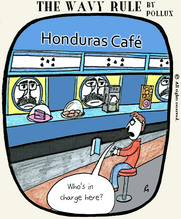
Click on the cartoon to enlarge it!
Read “The Wavy Rule” archive, and “order your Wavy Rule 2008 Anthology today!”:http://emdashes.com/2009/03/the-wavy-rule-anthology-now-fo.php
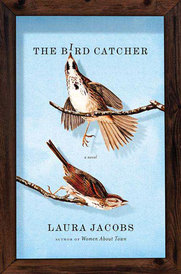
Congratulations to the Laura Jacobs Giveaway Winner!
Martin Schneider writes:
I’m pleased to announce that the winner of our giveaway for The Bird Catcher by Laura Jacobs is Patricia Fosen of Brooklyn, New York. Her favorite bird is the Black-chinned Hummingbird, who (she is told) “only hums Tchaikovsky.” That one is not on my life list!!
Thanks to the many people who entered, and better luck next time to all but Patricia (and sure, luck to her too). There will be other opportunities!
We asked for entrants to name their favorite bird, and you did not disappoint! The statements of avian fondness were delightful. Admired birds ranged from the familiar—Black-capped Chickadee (“highly entertaining at the bird feeder”), American Robin—to the fantastical—the Russet Crowned Motmot, Superb Starling, Bare-Faced Go-Away Bird).
Birds that received multiple mentions include the wren, the pelican, and the cardinal—a New Yorker who mentioned the cardinal said that she’s never actually seen one! (You must come out here to the burbs—they’re all over the place!) One reader on the west coast cited the wood thrush, saying that he gets to hear its song only when he watches golf tournaments on the east coast.
Finally, one wag mentioned “fried chicken”; another, the “Red-naped Border Tyrant (Customes officialus).” Keep it up—we at Emdashes admire whimsy!