
Martin Schneider writes:
A few months ago I was a little hard on an A.J. Liebling article about Chicago. Fortunately, Michael Gorra’s generous and lengthy assessment of the new Liebling volumes from the Library of America provides an occasion for me to reconsider. It’s in The Smart Set, courtesy of Drexel University, and it’s well worth a look. One reason I like The Smart Set is that their visual aesthetic is a bit like ours!
Author Archives: Emdashes
William Hamilton, Jack Russells, Mint Juleps, and Quality Road
Emily Gordon writes:
From the Andover homepage, courtesy of my alumni email newsletter (I went there for only a year, but it was an eventful year!), a nice horse story that also has a New Yorker cartoonist connection:
**Horse breeder Ned Evans ’60 has a Kentucky Derby contender**
April 15, 2009 – According to renowned New Yorker cartoonist and fellow PA alum **William Hamilton** ’58, Ned Evans would rather spend the day with his four Jack Russell terriers on his 3,000-acre farm in Casanova, Va., than sipping mint juleps at Churchill Downs on May 2. But Evans will just have to settle in and make do: his colt, Quality Road, posting 5 to 1 odds, will be competing in one of the biggest horse racing events of the year–the Kentucky Derby.
A top-ranked North American equestrian breeder, Evans has raised horses for 40 years on his sprawling Spring Hill Farm. And although he’s turned out some 70 stakes winners, three-year-old Quality Road is his first Derby contender. Evans, however, declines to partake just yet in the sweet conjecture of what a Derby victory would mean to him.
“I’ll tell you afterward what it means,” he proffers. “I’m mainly concentrating on getting there and doing the best we can.”
After graduating from Andover, the Greenwich, Conn., native earned a BA degree from Yale in 1964 and an MBA degree from Harvard in 1967. Known to many in New York’s top business circles as a shrewd entrepreneur, Evans’s many successes culminated in 1979 when he became chief executive officer of publishing giant Macmillan, a position he held for more than a decade.
What some associates may not have known until recently is that starting in 1970, while climbing the ranks of New York’s business world, Evans, a self-proclaimed “weekend commuter,” was quietly creating and expanding a vast horse farm on the old Civil War grounds of Virginia’s rolling countryside. Today, Spring Hill is home to roughly 200 horses at any one time, all handpicked and paired for breeding by Evans himself.
“I arrange all the matings and 15 months later a foal is born,” says Evans. “They don’t go into training until they’re 2, and all kinds of things happen along the way, not enough of them good.”
But it wasn’t until this past November that Evans knew he had bred a special one. Quality Road had burst onto the scene for his maiden race at Aqueduct and “caught everyone’s eye,” says Evans. According to reports, the proud owner turned down a $2.5 million offer for the galloping wonder and decided he would take Quality Road to the Derby himself, thank you very much.
As for what Evans would do if Quality Road were to take the Derby title, his fond friend Hamilton may know best. “A Derby win would leave him at least briefly ecstatic. He would probably give his terriers a treat and smile a moment at the sky.”
To which Evans replies, “He seems to know the situation.”
The Wavy Rule, a Daily Comic by Pollux: “Untersetzerangst”
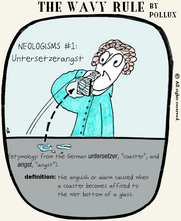
I felt we needed a word for an emotion we all feel sometimes. “Coasters with smooth flat surfaces,” as explained “on one site”:http://hubpages.com/hub/The-Many-Options-in-Buying-a-Coaster-Set, “often pool the liquid and this causes the glass or cup to stick to the coaster. Then when you pick up the glass or cup to take a drink, you find the coaster stuck to the bottom. If you don’t catch it in time, it will fall to the floor and possibly break into pieces.” And then your heart breaks too, because everyone loves coasters. Click on the cartoon to enlarge it!
Read “The Wavy Rule” archive.
The Wavy Rule, a Daily Comic by Pollux: Escape From Lorem Ipsum

Overall the city is well managed, but the Lorem Ipsums are blighted by violence, poverty, and bad graphic design. Click on the cartoon to enlarge it!
Read “The Wavy Rule” archive.
Hunting and Deciding: NYC Event Today With Jonah Lehrer
From the press release:
Please join us today—Monday, April 20—at 6 p.m., on the 7th floor of 20 Cooper Square, for food, drinks and a conversation with one of the brightest lights in the journalism of ideas: Jonah Lehrer.
Jonah will be discussing a story he wrote last summer for The New Yorker entitled “The Eureka Hunt: Why Do Good Ideas Come To Us When They Do?” That story sprung from his research for his latest book, How We Decide, which was published in February by Houghton Mifflin. Jonah will also be talking about the nexus between his book research, his magazine pieces and his very active blog, called The Frontal Cortex, which focuses on neuroscience. And yes, he’ll also be fielding questions about his recent appearance on The Colbert Report.
You can download Jonah’s New Yorker story at http://tinyurl.com/66qqhw. You can read his blog at http://scienceblogs.com/cortex.
The editor at large for Seed magazine, Jonah Lehrer is the author of Proust was a Neuroscientist (Houghton Mifflin, 2007) as well as How We Decide. In addition to The New Yorker and Seed, he has written for Nature, Wired, The Washington Post and The Boston Globe. He is also a contributing editor at Scientific American Mind and National Public Radio’s Radio Lab. A Columbia graduate, he also studied at Oxford as a Rhodes Scholar. The New York Times called Proust was a Neuroscientist “a precocious and engaging book that tries to mend the century-old tear between the literary and scientific cultures.” Publishers Weekly called How We Decide “a fascinating book . . . that will help everyone better understand themselves and their decision making.”
This event is part of the four-year-old “Inside Out” speaker series sponsored by the Science, Health and Reporting Program (SHERP) at NYU’s Carter Institute of Journalism. Leading the conversation, as usual, will be Robert Lee Hotz, distinguished writer in residence at the Carter Institute and the science columnist for The Wall Street Journal.
For logistical details, see: http://journalism.nyu.edu/events/?ev=2008-jonahlehrer
Omit Needless Controversy: Fifty Years of Strunk and White
Martin Schneider writes:
The fiftieth anniversary of the publication of Strunk and White’s The Elements of Style was last Thursday. I’m a copyeditor by trade, so one might say professionally implicated. My love of accuracy compels me not to pretend that the book is universally admired by all those who love words; far from it. (So much strong feeling!) For my part, I’ll just say it communicated certain things I needed to know at certain times in my life, and for that I am grateful.
A less contentious issue is E.B. White, who is always worth celebrating. Levi Stahl of I’ve Been Reading Lately has been lately reading his letters (you know, in a book, not in his desk drawer or anything), which sound delightful.
Oh yes, I almost forgot: subscribers can read the original 1957 article that sparked the publication of the book.
Sempé Fi (On Covers): Hoppers, Bears, and Nighthawks
_Pollux writes_:
“You people should be ashamed of yourself,” Elaine complains to _The New Yorker_’s cartoon editor in one _Seinfeld_ episode. “You know ya doodle a couple of bears at a cocktail party talking about the stock market ya think you’re doing comedy.”
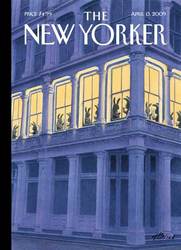
At first glance, “Harry Bliss’s”:http://www.harrybliss.com cover for the April 13, 2009 issue of _The New Yorker_ seems to be exactly what Ms. Benes was complaining about: a couple of cute animals talking about the stock market at a cocktail party. In this case, we see rabbits, not bears, but what is perceived as the spirit of the stereotypical _New Yorker_ cartoon and _New Yorker_ cover is there.
But Bliss’s cover is serious in intent, not comedic, and it visualizes a world in which we’re outside looking up at a convention of earnest Easter Rabbits, or perhaps ordinary gray rabbits (if rabbits who attend cocktail parties are ordinary), taking place in a late hour of the night. We’re shut out from the conversation, and from the warm yellows of a social club as we stand in a cold, violet-tinted avenue.
From street level, we can only imagine the low murmur of the rabbits and the clink of glasses bearing classy drops of Romanée-Conti. What are they discussing? Hindgut fermentation? The bail-out of Fannie Mae and the Flopsy Bunnies? The crisis in Mr. McGregor’s rubbish heap? The endless, expensive war with the badgers?
Bliss’s covers are beautiful, ranging from an “illustration”:http://www.cartoonbank.com/product_details.asp?mscssid=N75BLQT1QCKS9NR183NUWJWU397MBJ28&sitetype=1&did=5&sid=121165&pid=&keyword=Harry+Bliss§ion=all&title=undefined&whichpage=30&sortBy=popular of King Kong drenching grateful New Yorkers with a Super Soaker to “two museum-goers”:http://www.cartoonbank.com/product_details.asp?mscssid=N75BLQT1QCKS9NR183NUWJWU397MBJ28&sitetype=1&did=5&sid=123907&pid=&keyword=Harry+Bliss§ion=all&title=undefined&whichpage=9&sortBy=popular gazing at a digital camera’s rendering of a photograph of a painting while the original painting lies before them. Bliss is a master draftsman and his drawings are beautiful in the details.
The building in this cover is elegant and stately, the kind of place that you’re likely to feel nervous about entering if you have any number of social anxieties. You feel as if there may be a tough bouncer at the door—perhaps a hare from one of the tougher burrows, or a coney from below Coney Island’s Riegelmann Boardwalk.
Bliss’s cover evokes the feeling of separation and isolation encapsulated in an “Edward Hopper”:http://en.wikipedia.org/wiki/Edward_Hopper painting. Most of the cover, which is called “Spring Vision”, is enshrouded in darkness, emphasizing the coldness of a vantage point of a stranger looking into this springtime vision. It’s not only the distance but also the height that separates us from the warm light of a very exclusive leporid party. It may be springtime for these little rabbits, but it’s not spring yet for the rest of us.
Hopper’s paintings are less about loneliness than about the differences that keep people apart. Annie Proulx and Hopper himself felt that the lonely aspect of Hopper’s paintings was exaggerated. “The loneliness thing is overdone,” Hopper “once remarked.”:http://www.guardian.co.uk/artanddesign/2004/may/08/art His paintings, as Proulx “writes,”:http://www.guardian.co.uk/artanddesign/2004/may/08/art “were studies in mass and light expressed through the idiom of American landscape, architecture and figures.”
In the same way, Bliss’s cover is a study in mass and light. The sheer mass of the building dominates the cover. Bliss’s rabbits are an anonymous, almost featureless, mass of tipplers.
Bliss is an old hand at drawing rabbits for _New Yorker_ covers, which appear in the “form of skeletons”:http://www.cartoonbank.com/product_details.asp?mscssid=N75BLQT1QCKS9NR183NUWJWU397MBJ28&sitetype=1&affiliate=ny-slideshowsitetype=1&did=5&sid=51206&pid=&advanced=1&keyword=undefined&artist=Harry+Bliss§ion=covers&caption=&artID=&topic=&pubDateFrom=&pubDateTo=&pubDateMon=&pubDateDay=&pubNY=&color=0&title=undefined&whichpage=19&sortBy=popular of prehistoric megafauna or as “fedora-wearing commuters.”:http://www.cartoonbank.com/product_details.asp?mscssid=N75BLQT1QCKS9NR183NUWJWU397MBJ28&sitetype=1&affiliate=ny-slideshowsitetype=1&advanced=1&keyword=&artist=Harry+Bliss§ion=covers&caption=&artID=&topic=&pubDateFrom=&pubDateTo=&pubDateMon=&pubDateDay=&pubNY=2&color=0&isCacheSearch=1&whichpage=10 They also appear between the covers, in the form of loving rabbit families: a father hands his son a gift at a train station. The son is leaving for college. “Your mother wanted you to have this for good luck,” the father says. “It’s her foot.”
Bliss’s rabbits appear in various manifestations and display different attitudes. In “Spring Vision” they represent an image of exclusivity. We can’t reach them. Perhaps we don’t want to.
Olivia Gentile Book Giveaway: Closed for Entries
What’s in This Week’s New Yorker: 04.27.09
Martin Schneider writes:
A new issue of The New Yorker comes out tomorrow. A preview of its contents, adapted from the magazine’s press release:
Margaret Talbot examines the increasing off-label use of drugs such as Adderall, Ritalin, and Provigil as “neuroenhancers”—to stimulate focus, concentration, or memory—and looks at the ethical implications of their use for our society.
Peter J. Boyer explores the crisis in the Detroit auto industry, noting that the Big Three automakers—General Motors, Chrysler, and Ford—are “mired in arrangements” with workers and unions “made long ago,” which have “ultimately rendered their businesses untenable.”
Elizabeth Kolbert writes about on Obama’s Earth Day climate initiatives.
Ben McGrath visits the new Yankee Stadium on Opening Day.
Dana Goodyear talks to Bret Easton Ellis about a new film based on his stories, his upcoming book, and Twitter.
Elif Batuman writes about the return to Russia’s Danilov Monastery of eighteen church bells that had hung in Harvard’s Lowell House since the nineteen-thirties.
In Shouts & Murmurs, Paul Rudnick relates the story of a clergyman sympathetic to the plight of Ted Haggard.
Roz Chast chronicles the pitfalls of spring cleaning.
Sasha Frere-Jones discusses the pop-music phenomenon Lady Gaga.
Jill Lepore explains how Edgar Allan Poe’s writing was informed by his poverty.
John Lahr looks at how August Wilson’s Joe Turner’s Come and Gone and Schiller’s Mary Stuart explore ideas of self and state.
David Denby reviews The Soloist and State of Play.
There is a short story by Guillermo MartÃnez.
The Wavy Rule, a Daily Comic by Pollux: High-Speed Connection

President Obama “unveils his plan for high-speed rail in the US”:http://www.reuters.com/article/domesticNews/idUSTRE53D78C20090414. I say it’s long overdue -by about two decades. Yes, we can! Click on the cartoon to enlarge it!
Read “The Wavy Rule” archive.