
Martin Schneider writes:
A new issue of The New Yorker comes out tomorrow. A preview of its contents, adapted from the magazine’s press release:
Philip Gourevitch, who covered the genocide in Rwanda for The New Yorker and in his book We Wish to Inform You That Tomorrow We Will Be Killed With Our Families, revisits Rwanda on the fifteenth anniversary of the genocide to meet with some of the people he previously profiled, and explores the unique reconciliation process that has been taking place there; today it is “one of the safest and the most orderly countries in Africa,” Gourevitch writes.
Ryan Lizza goes behind the scenes at the White House to chronicle how Peter Orszag, the new director of the Office of Management and Budget, put together the Obama Administration’s first budget.
Peter J. Boyer profiles Larry Jones, the racehorse trainer who trained Eight Belles, the horse that had to be euthanized at last year’s Kentucky Derby, and one of this year’s Derby hopefuls, Friesan Fire.
Jerome Groopman writes about new drugs, developed to treat cystic fibrosis, that may be able to correct the mutated gene responsible for the disorder.
Hendrik Hertzberg asks if it might be better to let Texas secede.
Lauren Collins talks to Dolly Parton about New York and her new musical, 9 to 5.
In Shouts & Murmurs, Noah Baumbach describes bees getting “buzzed.”
Nancy Franklin reviews Amy Poehler’s new comedy, Parks and Recreation.
Peter Conrad explores the work of the Portuguese writer António Lobo Antunes.
Peter Schjeldahl attends “The Pictures Generation” at the Metropolitan Museum of Art.
Joan Acocella watches dance works by Merce Cunningham and Karole Armitage.
Alex Ross covers Esa-Pekka Salonen’s farewell to the Los Angeles Philharmonic.
Anthony Lane reviews Il Divo and The Limits of Control.
There is a short story by Gail Hareven.
Category Archives: Headline Shooter
Mirror Awards Bestow Nominee Status on Alterman, Auletta, Parker
From the press release:
Syracuse University’s S.I. Newhouse School of Public Communications today announced 29 finalists in six categories in the third annual Mirror Awards competition honoring excellence in media industry reporting. The competition drew nearly 140 entries. Fellow journalists and members of the media may vote for their favorites among the finalists by visiting mirrorawards.syr.edu/vote.cfm. Winners will receive the People’s Choice Award.
The media’s top writers, readers and leaders will gather to fete the Mirror Award winners at an awards ceremony in June in New York City. Ceremony details will be announced soon.
Finalists, chosen by a group of journalists and journalism educators, are:
Best Single Article–Traditional
* Eric Alterman, “Out of Print” (The New Yorker)
* Ken Auletta, “The Search Party” (The New Yorker)
* Seth Mnookin, “Bloomberg Without Bloomberg” (Vanity Fair)
* Clive Thompson, “Is the Tipping Point Toast?” (Fast Company)
[snip]
Best Profile–Traditional
* Mark Bowden, “The Angriest Man in Television” (The Atlantic)
* Mark Bowden, “Mr. Murdoch Goes to War” (The Atlantic)
* Lloyd Grove, “The Last Media Tycoon” (Condé Nast Portfolio)
* Charlie LeDuff, “Robert Frank’s Unsentimental Journey” (Vanity Fair)
* Ian Parker, “The Bright Side” (The New Yorker)
* Richard Pérez-Peña, “Web Sites That Dig for News Rise as Watchdogs” (The New York Times)
* Evgenia Peretz, “James Frey’s Morning After” (Vanity Fair)
[snip]
The Mirror Awards, established by the Newhouse School in 2006, honor the reporters, editors and teams of writers who hold a mirror to their own industry for the public’s benefit. Honorees are recognized for news judgment and command of craft in reporting, analysis and commentary on developments in the media industry and its role in our economy, culture and democracy.
For the full list of nominees, visit http://mirrorawards.syr.edu/vote.cfm—and vote!
Garry Trudeau Twitters, Talks (About Town), Takes a Moment to Tweflect
Emily Gordon writes:
1. Garry “Doonesbury” “Awesome” “Of Whom I Am a Lifelong Fan” Trudeau started Twittering as his self-absorbed, intrepid newsman character Roland Hedley.
2. Trudeau writes (or excerpts, or compiles) a Talk of the Town with some choice tweets from Hedley’s mystic journey to the G-20 Summit.
3. Mediabistro’s TVNewser interviews Trudeau about the whole twemonenon.
4. Starting words with “tw” is still funny, and maybe, like saying “www dot” to start a funny word or phrase to ironically convey its currency, it always will be.
What’s in This Week’s New Yorker: 04.27.09
Martin Schneider writes:
A new issue of The New Yorker comes out tomorrow. A preview of its contents, adapted from the magazine’s press release:
Margaret Talbot examines the increasing off-label use of drugs such as Adderall, Ritalin, and Provigil as “neuroenhancers”—to stimulate focus, concentration, or memory—and looks at the ethical implications of their use for our society.
Peter J. Boyer explores the crisis in the Detroit auto industry, noting that the Big Three automakers—General Motors, Chrysler, and Ford—are “mired in arrangements” with workers and unions “made long ago,” which have “ultimately rendered their businesses untenable.”
Elizabeth Kolbert writes about on Obama’s Earth Day climate initiatives.
Ben McGrath visits the new Yankee Stadium on Opening Day.
Dana Goodyear talks to Bret Easton Ellis about a new film based on his stories, his upcoming book, and Twitter.
Elif Batuman writes about the return to Russia’s Danilov Monastery of eighteen church bells that had hung in Harvard’s Lowell House since the nineteen-thirties.
In Shouts & Murmurs, Paul Rudnick relates the story of a clergyman sympathetic to the plight of Ted Haggard.
Roz Chast chronicles the pitfalls of spring cleaning.
Sasha Frere-Jones discusses the pop-music phenomenon Lady Gaga.
Jill Lepore explains how Edgar Allan Poe’s writing was informed by his poverty.
John Lahr looks at how August Wilson’s Joe Turner’s Come and Gone and Schiller’s Mary Stuart explore ideas of self and state.
David Denby reviews The Soloist and State of Play.
There is a short story by Guillermo MartÃnez.
What’s in This Week’s New Yorker: 04.19.09
Martin Schneider writes:
A new issue of The New Yorker, the “Journeys” issue, comes out tomorrow. A preview of its contents:
Burkhard Bilger looks at the dangerous exotic animals that now make their home in Florida. Bilger writes that Florida’s “ecology is a kind of urban legend come true—the old alligator-flushed-down-the-toilet story repeated a thousand times with a thousand species.”
Lauren Collins profiles Alain Robert, the “French Spiderman,” who recently climbed the Lloyd’s Building during the G-20 Summit, and follows Robert on February 17, 2009, as he climbs the Cheung Kong Center, a sixty-two-story office tower in Hong Kong.
David Owen visits South Uist, a sparsely populated island in the Outer Hebrides, off Scotland’s northwest coast, as groups battle over the restored Askernish golf course, which is also used for grazing animals.
Dorothy Wickenden discovers a Western comedy of manners in the story of two young women—seeking adventure, intellectual stimulation, and real jobs—who left their sheltered lives in the East in 1916 for a year on the American frontier. Wickenden collected the letters, photograph albums, memoirs, and oral histories left by the protagonists of the story, interviewed many of the descendants, and went to the still remote mountains of Elkhead, Colorado, to re-create a single year that changed dozens of lives.
Steve Coll writes about President Obama’s disarmament strategy in the face of a heightened nuclear-arms race.
David Sedaris connects with fellow train travelers in the bar car.
In Shouts & Murmurs, Larry Doyle opens a new amusement park, Fun Times!
Sasha Frere-Jones writes about the hip-hop songwriting team of Terius (The-Dream) Nash and Christopher (Tricky) Stewart.
Hilton Als examines Katherine Anne Porter’s life and work.
James Wood explores the travel-inspired writing of Geoff Dyer.
John Lahr reviews Why Torture Is Wrong, and the People Who Love Them and The Toxic Avenger.
Peter Schjeldahl checks out the younger generation of artists in the New Museum’s “Younger Than Jesus” show.
Anthony Lane reviews Anvil! The Story of Anvil.
There is a short story by Chris Adrian.
Le Clézio Joining PEN Festival Lineup
Jonathan Taylor writes:
An event featuring Jean-Marie Le Clézio, the 2008 Nobel laureate for literature, “in conversation with Adam Gopnik” April 24 at the 92nd St. Y, has been added to the PEN World Voices Schedule (here’s a link to my previous post with festival event picks).
It’s a shame that Le Clézio’s story “The Boy Who Had Never Seen the Sea,” which appeared in The New Yorker after his Nobel win, isn’t freely available online.
PEN press release below:
The PEN World Voices Festival is pleased to announce a very special
Pre-Festival event with Nobel Laureate Jean-Marie Gustave Le Clezio.
This will be Mr Le Clezio’s first major US appearance since being
awarded the Nobel for Literature.
Jean-Marie Gustave Le Clezio in conversation with Adam Gopnik.
Friday April 24 at 8pm
92nd St Y
1395 Lexington St
New York, NY
The 2008 Nobel Prize in Literature was awarded to French writer
Jean-Marie Gustave Le Clézio, the author of more than 40 works. The
Swedish Academy, in announcing the award, called Le Clézio an “author
of new departures, poetic adventure and sensual ecstasy, explorer of a
humanity beyond and below the reigning civilization.”
This event is made possible through the support of The Cultural
Services of the French Embassy and the 92nd St Y Unterberg Poetry
Center.
More information will be available on www.pen.org/worldvoices shortly,
and tickets will go on-sale later today through www.smarttix.com.
A Trivia–But Not Trivial–Matter: The Eustace Tilley Solution
_Pollux writes_:
The correct answer was Eustace Tilley.
It was the final round of the “Whatcom Literacy Council’s Trivia Bee”:http://www.americanchronicle.com/articles/yb/128436147 at Bellingham High School on April 3. Hundreds were in attendance. The question (What figure appears on the cover of _The New Yorker_?) broke the tie between two teams, the Bellingham Herald and the Community Food Co-op.
The Herald made themselves and us here at Emdashes by answering the question correctly and snatching victory from the hands of the Co-Op’s trivia team. _Veni vici Eustachium Tilleium_.
Mr. Tilley is only too happy to lend a hand to such causes (The Trivia Bee’s proceeds go to the Whatcom Literary Council).
Don’t forget Tilley’s face. He may help you achieve victory at a quiz bowl one day.
Lost & Never-Seen Thurber Cartoon: An Emdashes Discovery
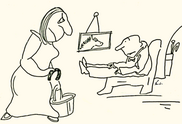
Emily Gordon writes:
We invite you to click on the Thurber cartoon above to see it enlarged. By doing so, you will have been the first people in more than fifty years to ever see this cartoon, which has been lost in time. Until now.
It so happens to be April Fool’s Day, when your co-workers lace your latte with laxatives and French schoolchildren attach paper fish to one another’s backs–when companies from Google to BBC Radio 4 run elaborate hoaxes on their sites and servers.
But this is not a tradition at Emdashes, which, as much as its staff enjoys a good joke now and again (and some of us not at all), is a serious site with serious New Yorker-centric goals. We don’t mess around with certain things.
So ignore for a second that it is the first of April, and focus your attention on this! Emdashes has the distinct honor of coming into possession of a heretofore unpublished drawing by New Yorker cartoonist and writer James Thurber. As you know, I am an ardent fan of another classic New Yorker artist, Rea Irvin, and have conducted various investigations concerning the life and work of the magazine’s first art director.
As sometimes happens during the course of research at the New York Public Library, I stumbled across gems that I did not expect to find. One of them was a rare first edition of S. J. Perelman’s Pillowbiters or Not–and the other was an original Thurber drawing that I had never seen in any published anthology or collection, online or otherwise.
The drawing, yellowed with age, is vintage Thurber, both in style and substance. It dates perhaps to the early 1940s. No caption was attached, but a caption is unnecessary. The cartoons that Dorothy Parker famously referred to as having the “semblance of unbaked cookies” are works of art, instant collectors’ items, and like, well, a plate of freshly baked cookies to the millions of Thurberphiles around the globe.
The New York Public Library will forgive me for what I did next: I smuggled the newly discovered Thurber “unbaked cookie” in a manila folder marked “non-smuggled items” and went straight to my apartment to devise a cunning plan.
To wit, in exactly two weeks, on April 15, 2009, we will be holding an Emdashes Thurber Festival at the Wollman Rink in New York’s Central Park. We will be making high-quality, limited edition facsimiles of this untitled Thurber drawing available for sale for the incredibly (under the circumstances) low price of $15 and will also be offering, in honor of Thurber’s origins, authentic Ohioan cuisine: Cincinnati Crumblers, Toledo Butterscotch Flan, and Cleveland Cork ‘n’ Beans. Please join us in this celebration of an invaluable find!
Update, April 3: There is, of course, no S. J. Perelman book called Pillowbiters or Not. There are (perhaps regrettably) no such Ohioan specialties as Cincinnati Crumblers, Toledo Butterscotch Flan, or Cleveland Cork ‘n’ Beans. We have no plans for an Emdashes Thurber Festival, since Columbus’s own Thurber House and Museum has all such celebratory events well and humorously in hand. There are, alas, no uncatalogued Thurber drawings that I know of, but if there were, you can bet everyone at Emdashes H.Q. would run to buy the freshly printed collection. (At least The 13 Clocks was recently reprinted by New York Review Books, a windfall applauded by our friends at the New Haven Review).
Most obviously, I would never take anything from the New York Public Library but a renewed resolution that I should really get back to Tristram Shandy. The drawing above is a fond Thurber homage by our own Pollux, resident cartoonist; the post above, also a close but detectable facsimile, is by Pollux as well. And that’s it for another April Fool’s Day! Three cheers for James Thurber, who is a continual inspiration and one of the world’s unmatchable greats.
And for a nearly Thurber-era New Yorker wavy-ruled infographic about April Fool’s–as the abstract describes it, “A list of recent quaint practical jokes and their outcome, as chronicled in the daily press”–get thee to 1929 and the Digital Reader. Enjoy! —E.G.
What’s in This Week’s New Yorker: 04.06.09
Martin Schneider writes:
A new issue of The New Yorker comes out tomorrow. Here is a description of its contents.
In “Syria Calling,” Seymour M. Hersh reports on the prospects for peace talks between Syria and Israel, and the opportunity that now exists for the Obama Administration to mediate them—”a role that could offer Barack Obama his first—and perhaps best—chance for engagement in the Middle East peace process.”
In “Cash for Keys,” Tad Friend looks at the housing crisis in Southern California and follows Leo Nordine, one of L.A.’s leading brokers specializing in selling foreclosed homes, who “has a knack for pricing houses aggressively, so they sell fast, a valuable skill in a county where values are declining two to three per cent a month.”
In “Message in a Bottle,” John Colapinto chronicles the development of Plastiki, a sixty-foot “bottle boat” which David de Rothschild, the environmentalist better known for his family’s banking fortune, and a crew hope to sail across the Pacific Ocean.
Nicholas Lemann comments on populist rage and the Geithner plan.
In Shouts & Murmurs, Bruce McCall launches a company to help executives escape their bad behavior.
Rebecca Mead profiles Matthew and Michael Dickman, twin brothers and poets.
There is a poem by A. S. Byatt.
Anthony Gottlieb explores the miserable history of the Wittgenstein family.
Peter Schjeldahl views paintings by European masters from the Norton Simon Museum at the Frick Collection.
Hilton Als reviews Exit the King, People Without History, and Rambo Solo.
Sasha Frere-Jones listens to U2’s new album.
Anthony Lane reviews Monsters vs. Aliens and Shall We Kiss?
There is a short story by Brad Watson.
What’s in This Week’s New Yorker: 03.30.09
Martin Schneider writes:
A new issue of The New Yorker comes out tomorrow. Here is a description of its contents.
Atul Gawande examines the use of prolonged solitary confinement in our nation’s prisons, and concludes that whether one is serving time at a supermax prison or being held in a cell in Beirut, Hanoi, or Guantánamo Bay, “all human beings experience isolation as torture.”
Evan Osnos profiles Cheung Yan, the head of Nine Dragons Paper, China’s largest paper manufacturer, and explores how the fortunes of the company that was once the largest exporter, by volume, of freight from the United States fell to the point “that the company’s market value was less than half the value of its own phalanx of paper machines.”
David Owen writes about how bad economic times can be good for the environment.
James Surowiecki responds to Europe’s conservative reaction to the economic crisis.
David Sedaris recounts stories from his latest book tour.
Woody Allen envisions revenge on Bernie Madoff.
Alec Wilkinson profiles Chris Ferguson, one of the most successful and strategic poker pros.
John Lahr reviews West Side Story and God of Carnage.
Hilton Als explores depictions of race and prejudice in Tracey Scott Wilson’s The Good Negro.
Anthony Lane examines the life and letters of Samuel Beckett.
James Wood considers paranoid schizophrenia in John Wray’s new novel Lowboy.
Alex Ross attends Il Trovatore and La Sonnambula at the Metropolitan Opera.
Paul Goldberger revisits the work of the architect Andrea Palladio.
Nancy Franklin reviews the new television drama Kings.
David Denby reviews Duplicity and Hunger.
There is a short story by Craig Raine.