
It’s great to pick up the paper in a strange city and see a friend—in this week’s Stranger, here’s Gabe Heller on Polish superstar Dorota Maslowska’s Snow White and Russian Red.
Category Archives: Looked Into
I believe that was once called “logrolling”
From the Times “What’s Online” column:
Naturally, readers are drawn to the blog, which picks up where the book leaves off. And unlike a lot of writers who blog their books with a seeming reluctance, the authors, Steven D. Levitt, an economist, and Stephen J. Dubner, a journalist, take to it with the same zeal they applied to their book, and the blog is abuzz with activity.
For example, Mr. Levitt tells of an e-mail message he recently received from a fellow trend-tracker, Malcolm Gladwell: A man approached Mr. Gladwell at the Toronto airport, asked for an autograph, and pulled out a copy of “Freakonomics” for him to sign. “We are totally co-branded!” Mr. Gladwell wrote.
They already were. Mr. Gladwell’s name, affixed to his blurb (“Prepare to be dazzled”) appears above Mr. Levitt’s and Mr. Dubner’s on the cover of “Freakonomics.” And Mr. Levitt heaps praise on Mr. Gladwell several times on his blog.
‘Blink’ Meets ‘Freakonomics’ [NYT; boldface mine]
You sneeze sixteen, going on seventeen
Arts editor Liesl Schillinger’s name may be only slightly less well known than that of fellow ex-checker Jay McInerney, but she’s been taking the Times Book Review by storm. She has a piece today about homeopathy and the flu.
Update: The American Council on Science and Health feels chills alternating with fevers, plus a runny nose, after reading Schillinger’s piece.
Betsy and the Great World, cont’d.
Here’s a cheerful Gothamist post about the Betsy-Tacy Society. When you’re done reading, go buy the reissues of the books—I plan to. This arbitrary division between children’s, young adult, and adult literature is pretty meaningless, don’t you think? Not to say that Memoirs of an Ex-Prom Queen and Linda Lovelace’s Ordeal shouldn’t be kept away from the average ten-year-old, since the experience (not my parents’ fault, I should add) was, at least for me, rather jarring.
The thirteen Betsy-Tacy books [summaries courtesy of a B-T fan page, which is rather pretty in pink and not in the mod Duckie way, but nice descriptions if you’ve never read the books or haven’t in a long, long time]
The less mysterious Ms. Quinn
In this archived interview with Alice Quinn from the Christian Science Monitor‘s good series, Quinn tackles these questions, among others:
How did you get started at The New Yorker?
What is the mission of The New Yorker, and how does poetry contribute to that mission?
How do you know when you are on track with readers? And when you are trying to reach a range of readers, how do you also set a standard in poetry?
What’s the selection process like for poetry at the magazine?
Poetry used to have a much larger audience (for example, the military sent thousands of copies of a Robert Frost book to soldiers). Can you shed some light on this?
What are some of the most significant trends in poetry that you’ve seen during your time at The New Yorker?
Have poets accepted the mistaken notion that poetry is a dying art form?
Should a poet have a public role other than teacher or ambassador?
A lot of people like old poetry more than contemporary work, which they feel is self-absorbed and has no universality. How would you respond to that?
What is the one issue that people need to be discussing but aren’t?
For a more skeptical perspective on the magazine’s poetic tone, here’s an interview with the editor of Light: A Quarterly of Light Verse. I see it all around me, this need to put “serious” and “funny” poetry at odds. I don’t see the conflict. Poets who never write anything silly might want to try it—I find it cheers me up; schticky “funny” poets (let’s say Billy Collins as a popular example) are usually writing about serious things (comedy and mortality—hasn’t this connection been proved to…death?). So poets divide and conquer themselves for fear of crossing genre lines. If we’re going to take back the world, people, we’d better start by agreeing that what we’re doing isn’t all that different.
Great Scotts
The staggeringly well-read Scott McLemee has reminded me (on his blog) to revisit The Dullest Blog in the World. The satire’s good, as always (“I was in a room carrying out some routine activities. I began to consider playing some music on the stereo system. I looked at some compact discs for a while, but didn’t put one on”), but it’s the exact same joke that Onion founder Scott Dikkers used about five hundred times—to great effect—for his small but immensely negative (in many senses) comic strip, Jim’s Journal. If you like anti-jokes and existential themes explored in insultingly simple line drawings, as I do, the anthology is definitely for you.
Also from Scott: a blog called Minor Tweaks, which is a perfect name and I crave it. Here’s MT (a.k.a. Tom Bartlett) on how he’s cheaper than Paris Hilton and some Dead Celebrity iTunes Playlists. (Speaking of Paris and her as yet unconceived children Paris and London, don’t skip this totally ridiculous AP interview, which contains the now infamous exchange “What did you want to be when you were a little girl?” “A veterinarian, but then I realized I could just buy a bunch of animals.” Thanks to DP for the tip!)
And I wouldn’t feel right if I didn’t mention this brief guide for journalists writing about the recently announced Rolling Stones world tour:
Make use of the band’s song titles to spice up that bland lead. Example: “It seems the Rolling Stones still can’t get no satisfaction.” Or “Start them up! Mick and Keith are preparing to embark …” Stay away from more obscure Stones songs. If you write “They may not be taking a silver train, but the Rolling Stones are hitting the road” most people won’t know what you’re talking about.
The members of the Rolling Stones are old. This should be mentioned often and high in the story. Consider playing with the name of the band a bit. Example: “The Rolling Stones are determined not to gather moss.” Or turn it around and say: “The Rolling Stones may be gathering moss but that doesn’t mean they can’t rock.”
When mentioning when the band will be in your area, don’t say “The Rolling Stones will arrive in TKTK on TKTK.” Instead say “The Stones will roll into town … ” See the difference?
Follow these simple rules and you will be on your way to writing a first-rate Rolling Stones article. And remember: Sometimes you can get what you want!
At the end of the day, real jokes still beat anti-jokes. Acknowledging the basic fruitlessness of human existence is important, but so is grinning.
At least the question should be ethical
Two notes on yesterday’s Ethicist, in which Anonymous, New Jersey, writes:
I stumbled upon my college-age daughter’s online journal. I have always regarded diaries as off limits to outsiders and have scrupulously avoided even casual glimpses of my children’s personal writings. Now, however, my daughter is offering her daily postings to the world. I imagine that the idea of her father’s reading her innermost thoughts would lead to self-censorship, and I don’t want to spoil a writing venue she enjoys. Is it ethical for me to read her journal without telling her?
1) “Stumbled upon” means Anonymous was either googling his daughter, digging for something to take offense at, or googling himself, which Anon. must do on such a regular basis that this caused him to sit up and take note. It’s very unlikely you’d be reading up on the WTO or tulip bulbs and mysteriously happen upon your college-age daughter’s blog, which is as likely as not about apple bongs. Cough up the whole story, Mister—there’s more to your ethics query than meets the eye. What you really want to ask is, “Is it violating my daughter’s privacy to google her every five days? Am I being a good parent or do I just have abandonment issues?”
2) Our friend Anonymous has obviously already read the blog in full, including archives, and followed every link to its shameful end. Clearly, this empty-nest dad needs his own blog to keep busy till Ashley gets home for summer break. By then she’ll be posting camera-phone photos of her family’s hideously embarrassing lawn furniture, so before further damage is done to family trust and serenity, starting anonymousinnewjersey.blogspot.com can start the healing.
Randy Cohen, the Ethicist [Gothamist]
The Ethicist [Steve Martin, New Yorker; via The Compleat Steve]
Two more movies that aren’t in Netflix
1) Crossing Delancey, and
2) The Miracle of Morgan’s Creek.
Netflix’s dearth of Robert Benchley films has already been noted. Just because it did manage to include the Criterion Collection’s two-DVD set of The Rules of the Game (which I just watched and enjoyed; the Peter Bogdanovich commentary seems to have been cranked up to His Girl Friday speed, though I do have a fever and could just be slow-witted) doesn’t mean it’s off the hook.
Criterion is releasing Hoop Dreams on May 10, which is swell; I’m especially looking forward to the stars’ special audio track. I also notice that ghostly New Yorker critic Michael Sragow has written a passel of essays for Criterion’s website, including this one on Le Cercle Rouge:
With his 1970 gangster epic, Le Cercle Rouge, Jean-Pierre Melville finally landed his white whale.
The French maverick who changed his last name from Grumbach out of admiration for Herman Melville had long since established himself as that most contradictory, elusive and essential character in narrative moviemaking—an individualistic genre master. Bob le Flambeur (1956), Le Doulos (1962), and Le Samourai (1967), stood out as elegant explorations of underworld style, duplicity, and professionalism. Of course, Melville had other credits, including his formidable 1950 rendering of Jean Cocteau’s Les Enfants Terribles. But his on- and off-screen affection for hard-guy glamour (he always wore a signature Stetson hat) and his aesthetic preference for the tough-minded, strong-boned storytelling of American directors such as John Huston (another Herman Melville admirer) drew him toward life-or-death drama in a criminal vein. Don’t be a philistine—keep reading…
Sragow, whom I’m happy to see is alive and well (I don’t like change, and seeing “MS” disappear from the Goings on About Town was most disturbing), also has smart, lively essays about The Long Good Friday, A Night to Remember, the David Lean Oliver Twist, Sanjuro (“in the Kurosawa movie family tree, Sanjuro [1962] is the sassy kid brother to Yojimbo, and like many light-hearted younger siblings, it’s underrated…”), and Fools’ Highway (which I haven’t seen, but has a way cool cover).
Sragow also writes admiringly about The Unbearable Lightness of Being, which is insanely enough out of print. I actually discovered this recently while browsing through Amazon Marketplace’s dirt-cheap DVDs. It seems crazy that it’s so hard to find—surely brand-new college students in sexual and existential agony are discovering Kundera along with Portnoy’s Complaint and Brodkey’s First Love and Other Sorrows? I may be stuck in a time warp, but if that’s not what they’re reading (aside from the Jonathans, of course), I’m not sure what’s to become of us. (The cover of the newest edition of the Brodkey, I notice, has an oddly Salingerish twang to it, and a little Woody Allen circa Without Feathers…I’m not sure, and it’s pleasing enough, but it seems to want to be part of an earlier era than it was. Which I have nothing against, of course.)
Sragow writes of Unbearable Lightness:
When asked why novelists don’t often make great playwrights, Kurt Vonnegut said, “It’s because they don’t know that theater is dance.†That notion applies triply to the kinetic art of movies. The triumph of The Unbearable Lightness of Being is that Kaufman and company choreograph the diverse segments of Kundera’s fiction like a folk dance, a rock musical, and a pastoral ballet.
Kundera’s prose could be compared to dance as well, but Sragow makes this point beautifully. Perhaps especially because I have Daniel Day-Lewis on the brain lately, I think it’s very wrong that this DVD is out of print. As Kundera wrote, “When the heart speaks, the mind finds it indecent to object.” True enough, so let’s put an end to indecency!
Speaking of Crossing Delancey, blogger Norman Geras does a little of what Randy Cohen is planning to do a lot of, that is, map the cultural references of Manhattan—and a few weeks sooner. But Geras does it with movies and music rather than books:
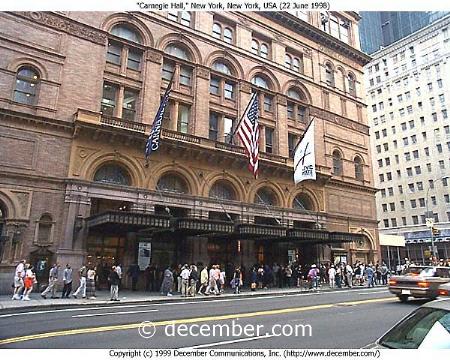
Yesterday at about 12.30 I found myself crossing Delancey. I thought, ‘Hey, I’m crossing Delancey‘. That’s how it is for me in this city. Everywhere I go there’s something charged with meaning. The day before yesterday I was walking up from Times Square towards Central Park and I came to Carnegie Hall. For me Carnegie Hall is – or was, first – this. That’s back in Bulawayo as the 50s were turning into the 60s or thereabouts. The Benny Goodman concert. Above all ‘Sing Sing Sing’; and, within that, a piano solo by Jess Stacey that is two or three minutes of immortality. I went in, to see what was on, and coming up on Sunday (today) at 4.00 was The Thomashefskys: Music and Memories of a Life in the Yiddish Theater. That’s me at the ticket window then. Sold out. Expletive deleted.
Anyway, the whole city is replete with personal and cultural meanings. Take it away you pomos; give out your stuff. Me, I’d prefer to walk the streets of New York – any day of the week.
Why I was crossing at Delancey at 12.30 yesterday was that I’d just been at the Tenement Museum on the Lower East Side and signed up for the ‘Piecing It Together’ tour. This was to see some of the tenements at 97 Orchard Street and to be told about two families who had lived there – and about the garment industry – by our tour guy, J.R. McCarthy, Educator. J.R. is a man of words and of some pazazz in their delivery. By him we were told that between 1865 and 1935 20 million immigrants from Europe had passed through this district, and that if you are Jewish in America there’s an 80% chance that your first ancestor in the country started off living somewhere close by. I was surprised also to learn – though I have not checked this, so can’t vouch for it – that German-Americans constitute the largest single US ethnicity. We were
taken through the lives of Harris and Jenny Levine, who lived in this tenement in 1897, and their children Pauline, Hyman, Max, Eva and Fay. We then moved on to the Rogarshevsky family. J.R. finished in some style.I headed off to meet a New York city blogger in Greenwich Village, and that involved crossing Delancey.
(All links his.) I hope Geras can forgive me for reprinting his whole post. I just thought it was perfect. If you haven’t been to the Tenement Museum, by the way, it’s really worth the trip—the tours are great and only take an hour, and you learn a whole lot and it’s actually fun.
I’m rereading Here at The New Yorker (Brendan Gill) and About Town (Ben Yagoda), in between something else, so I’ll be quoting now and then. Since I believe in book clubs of only two people, I hope that not too many other people start reading them at the same time—we’ll have to take turns. Or buy them (which I wholeheartedly endorse) and just don’t tell me about it.
Crossing Delancey [Normblog]
[I’d hoped to find a Vonnegut link from The New Yorker, but Google can be trying no matter how much I love it. Oh newyorker.com, why isn’t your archive searchable?]
Categories: Benchley, Movies, Criterion, Sragow, NYer, Books
(4.25.05 & 5.02.05 issues) Because you might not read the NY Post
Or at least not every day. I’ve been busy catching up on last week’s New Yorker—I’m particularly enjoying Ian Frazier’s piece on the marauder Hulagu (is there anything Frazier can’t write?) and reeling from Lillian Ross’ ecstatic litany of spiffy names (Solondz, Revlon, Perelman, East Sixties, Byrne, Deco, Christian Louboutin, JAR diamond, Warhol, Mao, Yorkie, Maltese, Wheaten, King Charles, Scruffy—just in the first graf) in the style of Bret Easton Ellis, under the auspices of a profile of “squinty” Ellen Barkin. Ross (I mean “a visitor”; they must let her do that as a nod to the old unsigned guard) doesn’t make it clear how a bookshelf can be “piled high with yarmulkes”—where books would normally be? on top? Hard to picture.
And yet she does, as always, provide answers to questions we didn’t know we had, like: Does Barkin, who must have heard some unkind remarks about her last name in the past, like her dogs? And: Who makes the brisket? And: What do cosmetics billionaries wear to work? Barkin, a Twizzler eater, is also remarkably frank on the record about the personality tics of her adolescent children, considering adolescents’ tendency to strike back in deeply unpleasant ways. But on to this week’s contents, courtesy of the sprightly Post writer/s (don’t see a byline):
Criminy, was there any news happening around the world? Lemme see what The New Yorker has. A second installment of Elizabeth Kolbert’s dive into the global warming pool, a David Remnick piece on Tony Blair and an opus on how dummies are helping doctors get better at doctoring. Nope, nothing here. Kolbert says scientists are trying to project future climate-changes by looking back at fallen civilizations. This is what teams of scientists studying for climates for years have determined: that the climate changes which doomed past civilizations “were caused by forces that, at this point, can only be guessed at.” Thanks for that. Remnick finds Blair in a tough race because of his pro-Iraq war stance. Sounds like a replay to most American readers, no?
Incidentally, from Frazier’s Hulagu piece: “Anyone who does research knows you have to stay focussed on your topic and not go down every interesting avenue you pass, or you will end up wandering aimlessly in attention-deficit limbo.” His story, of course, cleverly contradicts this. When, I wonder, will the sensible Remnick—known for resisting temptations to make the magazine into a mausoleum of past glories and styles—put his foot down about British spellings? Half-Canadian and U.K.-mad, I’m hardly one to complain about an extra U here and there in most circumstances, but really, “focussed”? It makes a magazine that’s making strong efforts to move closer to the heart of things American seem sorta precious and elite. That won’t do!
On the other hand, I do like—after initial suspicion—the Charles Addams ripoff/homage on p. 92 by Jason Patterson. It’s a good joke, and a clever drawing (it takes a few seconds to see how disastrous things are, as in the best Addams cartoons), and I say, except for some of Lillian Ross’ product placements and the crumpety spelling, looking back—like wandering aimlessly—is often to be recommended.
On the Newsstand: Celeb Mag Overload [NY Post]
Hair at The New Yorker
Blogger Dana Blankenhorn takes issue with Jim Surowiecki’s scalp management and with his stance on the falling dollar:
I’m a big James Surowiecki fan. (Not a Truly Handsome Man yet, like I am, but don’t you think his barber is starting to get creative?)
When I got into journalism, nearly three decades ago, I harbored a secret dream of writing for The New Yorker. I never got a sniff. But I harbor no grudges because Surowiecki did. And he’s run with it.
All this praise, naturally, is a prelude to my taking issue with his latest column, which covers the subject of the collapsing dollar, the subtext for my novel The Chinese Century.
He goes on, “As I noted in my novel the Chinese can squash us like a bug and effectively kill our democracy simply by selling our currency,” etc. But back to the question of hair. Veteran business journalist Blankenhorn is little burdened with excess foliage, and justly pleased; with his salt-and-pepper beard and smart-guy glasses he looks like a psychiatrist or professor, or both. Still, is he implying Jim is losing it? Last I looked, he was a man of hair. I think his cut is merely raffish, not compensatory. Either way, he’s got bone structure on his side. Jim, I wouldn’t change barbers for all the tea in China.
Be Very Afraid [Corante; photos of both on page]