
Political blogger Matthew Yglesias and some of his commenters confirm Jeffrey Goldberg‘s observation in his March 19 TOTT that Washington, D.C., has some pretty awful Chinese food. Anyone care to confirm? As he notes, “bad Chinese food” is a subset of Chinese food, and some of it can be quite good—New York has plenty. The problem is that D.C.’s bad Chinese food is Atrocious. According to Yglesias, this is an example of what makes The New Yorker so good. It’s the observational reporting, stupid.
(Any typos in this post should be considered my humble hommage to Ylgesias.)
—Martin Schneider
Category Archives: The Squib Report
The Pigeon Files, Part the First
A recurring bulletin from Martin Schneider, Emdashes Squib Report bureau chief, in which urgent matters regarding The Complete New Yorker are speedily and elegantly investigated.
If I were to tell you that pigeons were on the verge of becoming extinct in New York, would that delight or depress you? I’m sure that the range of reactions would include both glee and gloom. Although given their inescapable ubiquity in New York, you might instead question my sanity (or, more prosaically, merely my powers of observation).
Their status as an endangered species is restricted to a very specific domain, and I’ll address what domain that is in just a moment.
Rebecca Mead’s March 5 TOTT about Kader Attia’s “Flying Rats” art exhibit sparked Emily to inquire about prior coverage of pigeons in The New Yorker‘s glorious past. It turns out she’s a pigeon fan! Or more properly, a stalwart defender of the charms of the pigeon (Spec. Columba livia, Latin for “lives near Columbia University”), inexplicably overlooked by so many.
There must be a term for the historiographical practice of using a smaller subject to track the development of an era or empire. As aqueducts work well for the Roman Empire and heresy for the Middle Ages, so do pigeons for The New Yorker. Pigeons appear in many guises and forms, sometimes as the butt of the joke, sometimes held up for contemplation, sometimes exalted (well, not too often). So we’ve decided to launch a limited series of pigeon-related posts from the CNY.
Pigeon fact no. 1: They appear in lots of cartoons; indeed, a survey of pigeons in New Yorker cartoons would tax the resources of this humble venture.
Our first pigeon piece may even fall under “exalted,” a lovely 2/21/01 TOTT called “Some Pigeon!” by Sheridan Prasso that well-nigh claims that a specific pigeon that used to demand (and receive) nocturnal entry to a Burmese restaurant on the Upper West Side (since closed) may have embodied the soul of a former denizen of the premises. It’s just the kind of piece we look to TOTTs for, a charming slice of life nowhere else covered.
Pigeon fact no. 2: Once a staple of New Yorker covers, pigeons have since been almost banished as a cover subject. This is the “extinction” to which I earlier referred. The demise dates approximately from the arrival of Tina Brown; there has been only one pigeon-related cover since 10/5/92—don’t need to tell you what made that issue special, do I? And even that cover, by Peter de Sève for the 9/5/94 issue, seems really to be about the Hamptons and not pigeons per se.
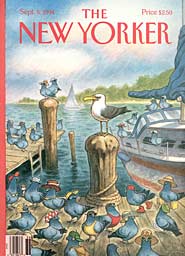
And I think therein lies a lesson: If you make a decision to increase topicality, to boost newsstand single-issue sales, to stretch the capacity of The New Yorker to cover the newsworthy and the trendy (as Tina Brown was no doubt right to do, don’t get me wrong), a price is nevertheless paid. New Yorker covers once regularly featured triste still lifes or plangent landscapes, a sometimes haven from the headlines rather than a cheeky “take” on them; they don’t really serve that purpose anymore, and that’s too bad.
But we’ll be visiting some of those in future installments of the Pigeon Files.
Investigation: Bruce McCall’s Wheel of Article Ideas
Happy 82nd birthday, New Yorker! (The magazine debuted on Feb. 17, 1925, with the Feb. 21 issue.) I asked Martin Schneider, Emdashes Squib Report bureau chief, to do a little sleuthing into a corner of Bruce McCall cartoon on pp. 168-69 of this week’s anniversary issue.
As Emdashes’s resident archival expert, I found McCall’s cartoon of the first-ever guided tour of The New Yorker‘s offices highly irresistible. My favorite invention is the “Wheel of Article Ideas,” which pokes fun at the identifiably New Yorker blend of subjects—often fascinating, often arcane, sometimes too trendy, sometimes too dusty, but never, ever straightforwardly or unselfconsciously au courant. (After all, any magazine can be merely up to date; only a special magazine asks what in going on in J.Lo.’s brain.)
Does there lurk in this inscrutable amalgam a hidden code, each item pointing to a different era or major leitmotif of The New Yorker? Were I better versed in New Yorker lore, would it be within my grasp to crack that code and watch the different shards of the enigma interlock into a grander pattern? (The other possibility is that it’s just a cartoon.)
Anyway, let’s get to it. Did McCall include any topics that The New Yorker has already handled? Armed with the bottomless Complete New Yorker, I decided to find out.
LOGS
In the 2/13/1984 issue, The New Yorker ran a poem by Karl Shapiro called “The Sawdust Logs.” Quoth Shapiro, “Why shouldn’t sawdust have its day?”
NAPS
In the 5/31/1941 issue is a cute little TOTT about two young women who are prepared for their suburban journey out of Grand Central. They produce an alarm clock and nap right up to one minute before their train arrives in Scarsdale. Then they scamper off the train.
OXEN
In the 8/24/1946 issue, Berton Roueche reports on a day in the company of Percy Peck Beardsley, breeder of Devon oxen, who plies his weary trade in the bleak and pitiless plains of…Connecticut. In my opinion, this is a dig at the Shawn era, what with its E.J. Kahn “Staff of Life” treatises on wheat and the like.
BALLET DESIGN
Joan Acocella’s 5/28/2001 review of a Jerome Robbins bio cites “Balanchine’s grand, unfolding design.” Arlene Croce’s 11/17/1997 showcase on Merrill Ashley refers to “the design of classical dancing.” I suppose any ballet production has set and costume designers, and the corps may have designs on the prima ballerina’s primo position, but I take “design” here to mean something closer to an engineering term. Essentially an absurd juxtaposition.
J.LO I.Q.
Astoundingly, The New Yorker has never devoted any significant space to the question of Ms. Lopez’s intellectual gifts. In the 10/2/2000 issue, however, Christopher Buckley did float the idea of someday replacing future VP Dick Cheney with J.Lo. So back off, hatas! If “Oxen” is the kind of profile Shawn would have run, here we surely hark back to the Tina Brown era.
MAMBO
This seems to be a dig at the uneasy fit that such a steamy, sultry subject would be in the pages of The New Yorker, and McCall certainly has a point: The New Yorker has never produced much copy on the subject. There’s a TOTT from 4/18/1988 about an uptick in dance-course enrollments in the wake of Dirty Dancing. There was also that 2000 Oscar Hijuelos book The Mambo Kings Play Songs of Love, which got some coverage too.
IRAN’S BILLBOARD CRISIS
No such thing. I take this somewhat absurd reference to be essentially a compliment. The implication is that The New Yorker has a knack for producing fresh coverage—perhaps at times perversely—even on hot spots that have already received plenty of exposure. Who can forget that 2002 look at trampoline fetishism in Karbala?
FERNANDO PÓO
What a marvelously supple reference. Fernando Póo, Fernando Pó, and Fernão do Pó refer to both a person and a place. He was a Portuguese explorer who in 1472 discovered an island off the west coast of Africa in the Gulf of Guinea that for centuries was named after him. In 1979 it assumed the name Bioko after some sort of revolution. His name was also applied to certain places in Cameroon, which he also explored, this fact leading to the only mention I could find in The New Yorker—a 2/18/1961 TOTT about “Cameroun.” Other Fernandos mentioned in The New Yorker include Meirelles, Luis Mattos da Matta, Scianna, Medina, Collor, Henrique, Ferrer, Ochoa, Valenzuela, and Nottebohm. The Fernandos created by ABBA and Billy Crystal have apparently escaped The New Yorker‘s notice.
JAM
Oh, could we get any more quaint and cozy? Why not just choose the tea cosy, for that matter? As it happens, jam figures prominently in the searing 9/10/1966 TOTT on the National Fancy Food and Confection Show. So there.
MILLARD FILLMORE
Ah, our most risible president. Does anyone even know whether he was any good or not? His amusingness seems a priori. Alas, the world awaits the definitive New Yorker treatment of the subject. In the meantime, Morton Hunt’s 11/3/1956 account of the presidential race of 1856 will have to do.
Can anybody read that last one? “Zoo”? I await further clarification (shout? murmur?) from Mr. McCall.
Wednesday Guest Post: This Week’s David Heatley Cover
Martin Schneider, our trusty Squib Reporter, writes:
Our friends over at FLOG! (that’s Fantagraphics’ blog) are excited
about David Heatley‘s cover this week. Heatley’s work is very interesting. He had a running series in the Fantagraphics anthology Mome called “Overpeck” (soon to be a full-fledged graphic novel) that was a somewhat surrealistic treatment of childhood and suburbia; it would merit the term (David) Lynchian. Heatley’s contribution to McSweeney’s 13, the vaunted comix issue edited by Chris Ware, was called “Portrait of my Dad”; it was about as unflinching and profoundly moving as contemporary comix get.
Heatley’s Achilles’ heel, if he has one, is that the drawing isn’t always very pretty. When I heard that The New Yorker had commissioned a cover from him, I confess my first thought was to wonder whether, stripped of narrative and the latitude to be so powerfully affecting, Heatley’s work would function well in that setting. Having now seen the cover, I’m happy to see that it’s very good.
A reader adds: Just a few days ago the Poetry Foundation’s website published Heatley’s comic-strip adaptation of a poem by Diane Wakoski, the first in a series inviting cartoonists to adapt poems of their choice from the Foundation’s archives.
Friday Squib Investigation: A Nut Museum, Tad Friend, and Enterprising Squirrels
Martin Schneider, our trusty Squib Reporter, writes:
On Wednesday, Emily noted: “And R.I.P., too, Elizabeth Tashjian, who seems to have been, among many other things, the subject of a New Yorker piece.”
Yes, she was; more than one, in fact. Two times, more than twenty years apart, she was the subject of a Talk of the Town item. The dates are March 26, 1984, and April 18, 2005. The first one, “Raided,” by William Franzen, covered the hibernatory habits of small northeastern museums like Ms. Tashjian’s Nut Museum. Her problem that winter, and for all I know every winter, was that hungry chipmunks and squirrels were prone to invade the museum, eager to usurp all the nutty goodness. We see her deciding to place her museum’s holdings under glass, but she has a place in her heart even for the greedy little poachers: “They’re making a nut museum of their own, I guess.” Note that Franzen does not call her the Nut Lady.
The second piece, “Legacies,” by Tad Friend, is especially poignant, as it has largely to do with her impoverished last years. Somewhat strangely, Friend does refer to her as the Nut Lady, even though he states quite clearly that she dislikes the nickname. Still: Friend puts the focus squarely on her plight, emphasizing her loss of control over her holdings. We learn that after being declared a ward of the state, she won back her
right to manage her own affairs. However, her museum had been sold to a woman who them cut down her nut trees (!); the item ends by describing a dispute over her (at the time) eventual burial. All in all, a terribly affecting article.
The only real question left is: Will Ms. Tashjian be interred in a plot of her choosing? I hope so.
Friday Morning Guest Review: Afternoon of a Shawn (Wallace Shawn’s “The Fever”)
Martin Schneider, our trusty Squib Reporter, writes:
Last night I went to see Wallace Shawn—son, of course, of William—deliver his monologue/play The Fever at the Acorn Theatre on 42nd Street. When I entered the auditorium, there was a clot of people on the stage. Ah yes, I recalled, anyone viewing the performance was encouraged to “join Mr. Shawn for a sip of champagne one half hour before each performance.” It’s only after the play that the lacerating bite of the gesture becomes evident.
My companions and I observed that sipping champagne in a crowd full of theatergoing New Yorkers came perilously close to “hobnobbing.” When we spotted Ethan Hawke on the other side of the stage, we realized that hobnobbing status had indeed been attained. (Shawn appeared in the New Group’s 2005 production of Hurlyburly, starring Hawke; both The Fever and Hurlyburly were directed by Scott Elliott.)
Before assuming his character of “the Traveler,” Shawn spoke for a few minutes about the strange conventions of theater. Theatergoers like to go to plays even though they are fully aware that plays are awful; the conventions involved in theater programs are mystifying; disembodied voices with demands about our cell phones are over-hasty; and so on. Charming and astute.
The play is about the unsettling thoughts of any educated, cultured person: Who had to toil so hard so that I could enjoy this latte? Do my fondness for Schumann and my considerate manners represent any contribution to the public weal? On what basis can my privileged status be justified? And so on. It’s brave and thought-provoking stuff, and I enjoyed it a lot. For a clever fellow, Shawn is awfully dark. Or possibly the other way around.
I also liked him in the underrated 1985 movie Heaven Help Us.
The Fever is playing through March 3 at the Acorn Theatre, 410 West 42nd Street between Ninth and Tenth Avenues. Performances are Monday-Friday at 8 p.m., Saturday at 2 p.m.
Friday Afternoon Guest Review: Hot Dog! A Calvin Trillin Reading
Martin Schneider, our trusty Squib Reporter, reports from a Calvin Trillin reading last week at the Upper West Side Barnes & Noble. Trillin read from from his new book, About Alice (about whose prospects we hear Random House is very excited, incidentally), just for starters.
One of the few posts on my old blog, Between the Squibs, was about Trillin. See, Trillin’s a bit stealthy: His basic persona is of an avuncular, curmudgeonly Keillor type, and almost as a sidelight, he’s the best goddamned reporter in the country. If you have the Complete New Yorker DVD, I really recommend spending a week or two with his “U.S. Journal” entries. You’ll thank me.
Anyway. I realized listening to him on Friday that one reason I love Trillin is that he represents the premise that The New Yorker and Middle America aren’t separate entities that need to be “bridged”; I love the lack of self-consciousness with which he would likely present himself as a New Yorker correspondent to, say, the proprietor of a Cincinnati chili stand.
The New Yorker must, of course, define itself as the best of a certain kind of thing, but it’s even better when it sees itself as obviously “of” America rather than in any way in opposition to it. To me, that’s exactly what Trillin represents—The New Yorker immersed in the country, not aloof from it.
Wisely, Trillin didn’t read exclusively from the book, but instead read a selection of short pieces in which Alice figures and then the first (brief) chapter of About Alice. In one he talks about how much he hates his highly organized neighbor Elwood; one was from his “Uncivil Liberties” column at The Nation, about how the de la Rentas never invite him to their fashionable soirées (from the early 1980s; when Francoise de la Renta does finally call, he calls himself “Calvin of the Trillin”); one was a fine poem from The New Yorker called “Just How Do You Suppose That Alice Knows?” My favorite was about how vacationing in the countryside is irksome because the tangible reality of the life of the land renders all-too-literal so many of the cliches that we use (like “a long row to hoe”). The excerpt from About Alice was excellent, of course.
I rarely ask questions at these events, but a good one occurred to me. I asked what his last meal at Shopsin’s was. I was hoping to get a little insight into Shopsin’s last days, some juicy tidbit or some bit of business that he could never disclosed while the restaurant was still in operation. Somewhat surprised at the question, he instead avowed that he could not recall what his last Shopsin’s concoction was and took a moment to explain the restaurant to the assembled, quoting himself to the effect that their Burmese Hummus was neither hummus nor Burmese.
I also only occasionally have books signed, but, finding myself towards the front of the audience and hence without long to wait, this time I did. The older lady in front of me pointed out that Trillin “never smiles,” which was true—except when he was actually signing the books and interacting with his readers. When I got home I realized that my used copy of Uncivil Liberties is also inscribed.
Oh—never let it be said that Emdashes doesn’t break the big stories. [No, indeed! —Ed.] A woman seated in the row behind me handed me a flier. Trillin’s A Heckuva Job (“deadline poetry” from The Nation) has apparently been set to music by the composer Tom Flaherty and will be performed by the Speculum Musicae Monday, January 29, at 8 p.m., at Merkin Concert Hall.
Friday Afternoon Guest Post: Cartoonists Under the Microscope
Martin Schneider, our trusty Squib Reporter, writes:
Peter Carlson of The Washington Post looks at the selection process for New Yorker cartoons. (I should have remembered Emily’s mention of it; in any case, Kottke jogged my memory.) Like everything else about The New Yorker, it seems to boil down to an emphasis on quality while policing the boundaries of good taste.
New Yorker cartoons stand for something in a way that not even the magazine itself always does. Speaking only of public perception here, I think they stand for a certain kind of ineffable gnomic brilliance—that’s if you like them. If you don’t, they’re all incomprehensible non-jokes in which people who look too much like Dick Cavett make non-quips about Connecticut—hey, we’ve all been there. I think somehow Richard Cline got singled out as representing the insularity of the magazine’s cartoon culture, which is unfair both to Cline and the rest of the diverse cartoonists (think of Glen Baxter, for one).
Cartoonists mentioned: Roz Chast, Matthew Diffee, Bruce Eric Kaplan (BEK), Sam Gross—indeed, we “see” the editors evaluate a new one of Chast’s. The piece even comes with a cartoon by Mankoff of the selection process! Surely a first. We may need to hold a caption contest or call to arms the Radosh street team.

Gladwell Ruckus, Brunetti Fever: A Friday Afternoon Guest Post
By Martin Schneider, whose terrific Squib Report is now a regular Emdashes feature. Over to you, Martin!
On his blog, Malcolm Gladwell has followed up his contrarian New Yorker article on Enron with an intriguing request. He wants someone to explain, in three sentences or less, what the legal case against Jeff Skilling actually was. The thread of comments that ensued has been highly contentious (and entertaining). Full disclosure: I’m the jackass who brought up Terrell Owens.
Meanwhile, comix aficionados are excited about this week’s cover by Ivan Brunetti; witness Eric Reynolds’s blog at Fantagraphics, called FLOG!. Brunetti is one of the true champs of the current scene: his recent comix anthology by Yale U. Press has received kudos from nearly all quarters. If you want to see some single-panel comix offensive enough to have sent Harold Ross instantly into a coma, check out his Hee! and Haw! mini-books.
Walken Away With the Answer to the Squib Report Challenge
As you know, yesterday Martin “Between the Squibs” Schneider posed a tricky trivia question presented by The Complete New Yorker. Luckily, he also has the solution. Read on.
It’s time for the answer to yesterday’s Christopher Walken challenge. John Lindsay was the mayor, LBJ was the president, and one of the Talk of the Town items was about Schrafft’s. A different world. The date was March 12, 1966. The issue included a review of a new play, The Lion in Winter. The critic, John McCarten, called a certain Christopher Walken “persuasive” as Philip of France. Walken would later win the Clarence Derwent Award for most promising male actor. Unbeknownst to the voters of the Clarence Derwent Award, this citation would eventually lead to a spike in demands for increased quantities of cowbell.
If you go by the search archive, the first mention of Walken happened in 1992—twenty-six years off! Well, nobody said it was perfect.