The poem was first published in The New Yorker; here, he reads it aloud and talks about writing it. Galway’s voice always moves me. I’m also rereading Kim Addonizio’s lovely, forlorn poem “What the Dead Fear,” and I think you’ll find it apropos, too.
Extremely incidentally, I was among the students Galway mentions in his introduction, whose first class in the NYU creative writing program was scheduled for that day.
Author Archives: Emdashes
The Wavy Rule, a Daily Comic by Paul Morris: Get a MoveOn.org!
Today’s installment reminds me of the supermarket scene in the movie American Splendor, about Harvey Pekar. As always, click to enlarge!

More by Paul Morris: “The Wavy Rule” archive; “Arnjuice,” a wistful, funny webcomic; a smorgasbord at Flickr; and beautifully off-kilter cartoon collections for sale (and free download) at Lulu.
If It’s Mid-September, It Must Be New Yorker Festival Schedule Time!
As we were excited to report recently, it’s New Yorker Festival season! And here’s the lineup for your browsing and ticket-buying pleasure. Oh, and Calvin Trillin’s walk–you can try, but don’t be crushed if it doesn’t work out. It so rarely does, but then again, it could be your year for the golden ticket! Tickets go on sale Friday, September 12, and you can find them at the Festival website. Quoting from the press release: “Tickets will also be sold during the weekend at Festival Headquarters, located at 125 West 18th Street, and at event doors.” See you there!
FRIDAY
OCTOBER 3
An evening of discussions among writers whose stories have appeared in The New Yorker; an interview with Alice Munro; a New Yorker Town Hall Meeting on race and class in America; a Cartoon Caption Contest at Festival HQ; and a New Yorker Dance Party.
FICTION NIGHT: DISCUSSIONS AMONG WRITERS
Writing About Home
Sana Krasikov, Yiyun Li, and Manil Suri, moderated by Cressida Leyshon
7 p.m. Acura Stage at Cedar Lake Theatre ($25)
The Devil Within
Matthew Klam, Elmore Leonard, and Joyce Carol Oates, moderated by Daniel Zalewski
7 p.m. Ailey Citigroup Theater
Joan Weill Center for Dance ($25)
The American Dream
T. Coraghessan Boyle, Jeffrey Eugenides, and Jhumpa Lahiri, moderated by Leo Carey
7 p.m. Angel Orensanz Foundation ($25)
Family Secrets
Roddy Doyle, Anne Enright, and Tobias Wolff, moderated by Willing Davidson
9:30 p.m. Acura Stage at Cedar Lake Theatre ($25)
Outlaws
Peter Carey, Hari Kunzru, and Gary Shteyngart, moderated by Peter Canby
9:30 p.m. Ailey Citigroup Theater
Joan Weill Center for Dance ($25)
Where I Come From
Sherman Alexie, Shalom Auslander, and Junot DÃaz, moderated by Carin Besser
9:30 p.m. Angel Orensanz Foundation ($25)
FICTION NIGHT: IN CONVERSATION WITH
Alice Munro interviewed by Deborah Treisman
8 p.m. Directors Guild of America ($25)
THE NEW YORKER TOWN HALL MEETING: Race and Class in America
With Barbara Ehrenreich, Thomas Frank, John McWhorter, Leslie Sanchez, and Cornel West. Moderated by David Remnick.
7 p.m. Town Hall ($20)
CASUAL FRIDAY
The Cartoon Caption Game
Hosted by Robert Mankoff
8 p.m. Festival HQ
Metropolitan Pavilion ($25)
A NEW YORKER DANCE PARTY
Hosted by Sasha Frere-Jones, with special guest d.j. Ghislain Poirier. Opening set by Megasoid.
10 p.m. Hiro Ballroom and Lounge ($25)
SATURDAY
OCTOBER 4
A day of interviews, panel discussions, and talks by New Yorker writers; an excursion to Governors Island; Early Shift and Late Shift events; preview screenings of the upcoming films “Fear(s) of the Dark” and “Frontrunners”; and book signings at Festival HQ.
WRITERS AND THEIR SUBJECTS
Alexei Ratmansky and Joan Acocella
1 p.m. Acura Stage at Cedar Lake Theatre ($25)
Clint Eastwood and Lillian Ross
1 p.m. Directors Guild of America ($25)
Richard Brody on the films of Jean-Luc Godard
4 p.m. IFC Center ($25)
IN CONVERSATION WITH
Jean-Michel Dubernard interviewed by Atul Gawande
10 a.m. Acura Stage at Cedar Lake Theatre ($25)
Seamus Heaney interviewed by Paul Muldoon
1 p.m. New York Society for Ethical Culture ($25)
Chuck Hagel interviewed by Ryan Lizza
4 p.m. Acura Stage at Cedar Lake Theatre ($25)
Elizabeth Edwards interviewed by Atul Gawande
4 p.m. New York Society for Ethical Culture ($25)
Lynda Barry in conversation with Matt Groening
4 p.m. Festival HQ
Metropolitan Pavilion ($25)
NEW YORKER TALKS
Malcolm Gladwell: “The Ethnic Theory of Plane Crashes”
2 p.m. Ailey Citigroup Theater
Joan Weill Center for Dance ($25)
Art Spiegelman: “Breakdowns: Comix 101”
4:30 p.m. Ailey Citigroup Theater
Joan Weill Center for Dance ($25)
PANELS
If I Were Running This Campaign
Donna Brazile, Alex Castellanos, Edward J. Rollins, and Joe Trippi, moderated by Jeffrey Toobin
10 a.m. Directors Guild of America ($25)
Extreme Sports
Greg Child, Lynne Cox, and Andrew McLean, moderated by Nick Paumgarten
10 a.m. Festival HQ
Metropolitan Pavilion ($25)
Covering the Candidates
Ta-Nehisi Coates, Bill Keller, Peggy Noonan, and Jack Shafer, moderated by Ken Auletta
10 a.m. Cathedral NYC ($25)
The Next Generation of Fashion
Louise Markey, Makoto Takada, and Joeri Van Yper, moderated by Judith Thurman
1 p.m. Cathedral NYC ($25)
The Campaign Trail
Hendrik Hertzberg, Ryan Lizza, and George Packer, moderated by Dorothy Wickenden
1 p.m. Festival HQ
Metropolitan Pavilion ($25)
Political Humor
Samantha Bee, Andy Borowitz, James Downey, John Oliver, and Allison Silverman, moderated by Susan Morrison
4 p.m. Cathedral NYC ($25)
Young Shakespeareans
Lauren Ambrose, Ethan Hawke, Kristen Johnston, Martha Plimpton, and Liev Schreiber, moderated by Adam Gopnik
4 p.m. Directors Guild of America ($25)
ABOUT TOWN
A Governors Island Bike Tour
Adriaan Geuze, Leslie Koch, and Ricardo Scofidio talk with Paul Goldberger.
11 a.m. Governors Island Ferry Terminal ($80)
EARLY SHIFT
Saturday Night Sneak Preview: “Frontrunners”
Moderated by Rebecca Mead.
6:30 p.m. Stuyvesant High School ($25)
Paul Rudd talks with Michael Specter
7:30 p.m. Acura Stage at Cedar Lake Theatre ($35)
Dawn Upshaw talks with Alex Ross
7:30 p.m. Ailey Citigroup Theater
Joan Weill Center for Dance ($35)
Stephen Colbert talks with Ariel Levy
7:30 p.m. Cathedral NYC ($35)
Worst Nightmares Part 1: Horror Movies
Wes Craven and Hideo Nakata, moderated by Ben Greenman.
7:30 p.m. IFC Center ($35)
LATE SHIFT
Tom Morello talks with James Surowiecki
10 p.m. Acura Stage at Cedar Lake Theatre ($35)
Mary-Louise Parker talks with John Colapinto
10 p.m. Ailey Citigroup Theater
Joan Weill Center for Dance ($35)
Oliver Stone talks with David Denby
10 p.m. Directors Guild of America ($35)
Worst Nightmares Part 2: “Fear(s) of the Dark”
Charles Burns and Lorenzo Mattotti, moderated by Françoise Mouly.
10 p.m. IFC Center ($25)
SUNDAY
OCTOBER 5
A day of About Town excursions and events throughout the city; talks by New Yorker writers; interviews with Tommy Lee Jones and Haruki Murakami; a series of master classes in political cartooning, humor writing, and literary criticism; and book signings at Festival HQ.
ABOUT TOWN
Morning at the Frick
With Peter Schjeldahl
10 a.m. Frick Collection ($65)
Come Hungry
With Calvin Trillin
11 a.m. Ticket buyers will be contacted concerning the starting point. ($100)
Inside the Artist’s Studio
John Currin talks with Calvin Tomkins
11 a.m. Ticket buyers will be contacted concerning the location. ($80)
Presto Change-o
Matthew Holtzclaw, Charles Reynolds, Jamy Ian Swiss, and Johnny Thompson, moderated by Adam Gopnik
11 a.m. Spiegeltent-Salon Perdu ($30)
Spice World
Claudia Roden talks with Jane Kramer
12 noon. Culinary Loft ($80)
WRITERS AND THEIR SUBJECTS
Tommy Lee Jones and Lillian Ross
11 a.m. Directors Guild of America ($25)
IN CONVERSATION WITH
Haruki Murakami interviewed by Deborah Treisman
4 p.m. Directors Guild of America ($25)
NEW YORKER TALKS
Paul Theroux: “Reliving ‘The Great Railway Bazaar'”
1 p.m. Ailey Citigroup Theater
Joan Weill Center for Dance ($25)
Salman Rushdie: “The Composite Artist: The Emperor Akbar and the Making of the Hamzanama”
4 p.m. Ailey Citigroup Theater
Joan Weill Center for Dance ($25)
MASTER CLASSES
Political Illustration
With Barry Blitt and Steve Brodner
10 a.m. Festival HQ
Metropolitan Pavilion ($35)
Humor Writing
With Ian Frazier and Mark Singer
1 p.m. Festival HQ
Metropolitan Pavilion ($35)
Literary Criticism
With James Wood
4 p.m. Festival HQ
Metropolitan Pavilion ($35)
BOOK SIGNINGS
Saturday, October 4
11 A.M.
Joyce Carol Oates – “My Sister, My Love: The Intimate Story of Skyler Rampike”
Tobias Wolff – “Our Story Begins: New and Selected Stories”
12 noon
Roddy Doyle – “The Deportees: And Other Stories”
Anne Enright – “Yesterday’s Weather: Stories”
1 P.M.
Alice Munro – “The View from Castle Rock”
Haruki Murakami – “What I Talk About When I Talk About Running: A Memoir”
2 P.M.
Sana Krasikov – “One More Year: Stories”
Manil Suri – “The Age of Shiva: A Novel”
3 P.M.
Peter Carey – “His Illegal Self”
Paul Theroux – “Ghost Train to the Eastern Star: On the Tracks of the Great Railway Bazaar”
4 P.M.
Robert Mankoff – “The New Yorker Cartoon Caption Contest Book”
Susan Orlean – “Lazy Little Loafers”
Sunday, October 5
11 A.M.
Hari Kunzru – “My Revolutions”
Jhumpa Lahiri – “Unaccustomed Earth”
12 noon
Richard Brody – “Everything Is Cinema: The Working Life of Jean-Luc Godard”
John Seabrook – “Flash of Genius: And Other True Stories of Invention”
1 P.M.
Salman Rushdie – “The Enchantress of Florence”
Art Spiegelman – “Breakdowns: Portrait of the Artist as a Young %@&*!” and “Jack and the Box”
2 P.M.
Peter Schjeldahl – “Let’s See: Writings on Art from The New Yorker”
James Wood – “How Fiction Works”
3 P.M.
Lynda Barry – “What It Is”
Steve Brodner – “Artists Against the War”
4 P.M.
John McWhorter – “Our Magnificent Bastard Tongue: The Untold Story of English”
I Love Peter Hessler
Hessler‘s Letter From Beijing this week is yet another standout. He could write an entire issue, John Hersey-style, and I would be happy as a clam in black bean sauce.
The Wavy Rule, a Daily Comic by Paul Morris: Palin’s Drome
In today’s “Wavy Rule,” Paul continues his wine labels series with a kind of northern wine we’d rather not be drinking come November. Click to enlarge!

Paul adds: Like most of America, I had no idea Wasilla ever existed before it became a name uttered by thousands of pundits, voters, orators, and average people in the street. The Wikipedia article on the town has seen a lot of activity recently. And I don’t mean the article on the Sarmatian god of the same name. Let’s face it: it’s a small town, no matter how the Republicans spin it. And there’s nothing wrong with small towns. The United States is dotted with small towns, from Stovepipe Wells, California, to Iceboro, Maine. But saying that running a small town qualifies one to run a country is something of a stretch. That wouldn’t even be so bad if the corollary of that argument wasn’t always added: that Obama is less qualified or experienced because he’s never been an “executive.” The implication is that an “executive” is necessarily of a higher rank than a “legislator” no matter what, even if that executive is the mayor of a small Alaskan town and the legislator is a United States Senator.
The official website for the town of Wasilla has added a section called Questions & Answers Concerning Former Mayor Palin. The only actual question on the page, and on the bottom of it, is “What are the duties of the Mayor of Wasilla?” If you click on that, you are taken to “Document Central.” Click where it says “City Documents–Recently Requested–Former Mayor Palin,” and again on the bottom of the page, is a link to a PDF document titled “What are the duties of the Mayor of Wasilla?”
That document is three pages long. A description of the mayor’s actual duties fill up one of those pages. A description of the mayor’s salary is on page 3. If someone can send me a document listing the duties of a U.S. Senator, I’d be happy to compare the two.
More by Paul Morris: “The Wavy Rule” archive; “Arnjuice,” a wistful, funny webcomic; a smorgasbord at Flickr; and beautifully off-kilter cartoon collections for sale (and free download) at Lulu.
Read More Fiction: Tastes Great, and it’s Good for You!
It’s back-to-school time, so it seemed appropriate to link to an 81-book syllabus Donald Barthelme used to give out to his students. (It appears in the margins of a nice 2003 essay by Keith Moffett in The Believer about his experience of tackling the list.)
If that’s too much for you, then I recommend you read Barthelme’s hilarious and thought-provoking story “The School,” which appeared in the June 17, 1974, issue of The New Yorker. In the story, a grade school class keeps adopting living things that then die. Yet there’s enough uplift in the improbable, left-field ending to carry you through the rest of the school year. (Don’t cheat and read the capsule summary on TNY‘s website—it’s a spoiler.)
The story typifies what I love about Barthelme: his ability to explore serious topics with larky wit and surreal turns. Though I find him sometimes obscure, I vastly prefer his lightheartedness and unpredictability to the emotionally detached and/or humorless narrators who appear in contemporary TNY fiction with such regularity these days.
But evidently, reading TNY‘s fiction section is better for you than reading the nonfiction, at least when it comes to your social reasoning skills. Need proof? I quote from Liam Durcan’s Toronto Globe and Mail article from July, which I found courtesy of Jonathan Shipley’s blog, A Writer’s Desk:
In a recent study conducted by University of Toronto psychologists, subjects who read a short story in The New Yorker had higher scores on social reasoning tests than those who had read an essay from the same magazine. The researchers concluded that there was something in the experience of reading fiction that made the subjects more empathetic (or at least take a test more empathetically). The study provided some proof for what has often been intuitively argued: Fiction is, in some very important ways, good for us.
To read the rest of Durcan’s article, go here, but be prepared to fork over $4.95. If that’s too rich for your blood, there’s more detail here.
Upside-Down Question-Mark Contest: Now, You Choose the Winner!
Update: The winners!
The ghost of James Murray, patron saint of the OED, hovers over us tremulously as we offer you our poll of finalists from Emdashes’ very own Upside-Down Question Mark Contest. Meanwhile, Pablo Neruda, who refused to use this form of punctuation, throws up his hands in a corner of that celestial Scribbler’s Green where all writers go–a place that all deceased literary critics are barred from entering. ¿Will this stop us? We say, respectfully but firmly: ¡no!
We offer you these names, hand-picked from an Emdashes orchard of more than 60 great entries, so thank you to all who submitted! The winner of this poll will win our grand prize, which, as you know, is either dinner for two at the Spanish, Mexican, Ecuadorian, Dominican, &c., restaurant of your choice, or, if you prefer, a beautiful copy of Neruda’s immortal The Book of Questions.
1. the qué mark–submitted by Liesl (our own Martin Schneider submitted a variation on this entry, but since he’s an editor and judge, he’s disqualified from prizewinning; sorry, Martin!)
2. splainu–submitted by John
3. quiggle–submitted by Carolita
4. interroverti–submitted by Nadine & Chris LaRoche
5. ¿nu?–submitted by Paul Shaw
6. Prask and Pre-Q–both submitted by J.D.
7. Askin–submitted by N.F.
We also want to offer you some etymological background and information on some of these entries. Note that ¿nu? reads the same right side up or upside down. (Turn over your computer–see?) “Splainu” derives from I Love Lucy, specifically from Ricky Ricardo’s “Lu-seee, you haf some splainu to do!” The venerable interroverti is derived from the Latin components “interrogo” and “verti/verto/versum,” meaning “to turn over,” “to turn about,” &c.
And here are the final eight–may the best mark-marker win, and watch out for those hanging ¿chads?
New Yorker Announces Festival Schedule; Buy Tickets Friday!
The headline says it all; a full list of New Yorker Festival events, complete with times and locations, is now available at the Festival website.
I can’t improve on the wording they provide:
Tickets for The New Yorker Festival will go on sale at 12 noon E.T. on Friday, September 12th. For more information, click here.
We will be printing a version of the schedule ASAP.
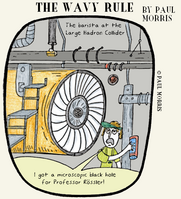
The Wavy Rule, a Daily Comic by Paul Morris: Collider!
Here’s Paul on today’s “Wavy Rule”:
Well, they’re going to switch it on, officially unveiling the thing on October 21, 2008. If you happen to have read Dan Brown’s Angels and Demons, you already know about the Large Hadron Collider–which does in fact exist, and was first built by Mary Magdalene after she was exiled from Jerusalem after being outmaneuvered by Saints Peter and Paul in an early example of ruthless office politics. It lies near Geneva, Switzerland.
Rössler isn’t some German-sounding name I invented out of multi-particled air. He’s a real German scientist named Dr. Otto E. Rössler who has theorized that if the Large Hadron Collider creates micro-black holes–which is a scary possibility–they could destroy the Earth by the next time the Olympics come around. Sorry, London. Sorry, Earth.
More by Paul Morris: “The Wavy Rule” archive; “Arnjuice,” a wistful, funny webcomic; a smorgasbord at Flickr; and beautifully off-kilter cartoon collections for sale (and free download) at Lulu.
Dick Cavett: The Intellectual’s TV Sensation of Yore
Recently I’ve been watching some old episodes of The Dick Cavett Show on DVD. (By the bye, if you get the chance, do absolutely see the one with Orson Welles.)
For some reason, watching it made me think quite strongly of The New Yorker—what struck me was that The New Yorker never had as close a correlative on television as Dick Cavett. Cavett was The New Yorker in television form, if you will. (Anyone have any other candidates?)
It seemed to me that Cavett was a celebrity too close to the actual TNY demographic to ignore for long, and sure enough, he was the subject of a Profile by L. E. Sissman in the May 6, 1972 issue.
I don’t have much to say about the article, which amply met my expectations. Reading about the (let’s face it) somewhat dilettantish Nebraska native and Yale grad who was never any great success as an actor or comedian—well, he makes one of the more improbable television sensations. And yet he was talented, and his notoriety was entirely deserved. I suppose that most talk show hosts are generally hybrid talents whom you can’t quite picture attaining stupendous success in any other pursuit.
The Profile does have one very striking feature: it comes with a kind of artist’s notebook by Charles Saxon, who incidentally also executed hundreds of cartoons over more than four decades. The eleven-page article features twelve pleasing sketches of some behind-the-scenes activities at the offices of The Dick Cavett Show, an unshowy way of adding value and verve to the piece. A fine idea.
Two other points: one of the staff members of the show is described as having a “a Walter Ulbricht beard,” the almost aggressive obscurity of which I (more than thirty-five years later) found hilarious. Turns out Ulbricht was a politician from East Germany with a wholly unexceptional goatee.
The other thing is that one of the guests on the workday described was … James Brown! Holy moly.