
The Washington Post account of the Judd Apatow event.
An excellent Huffington Post review of the evening with Junot Díaz and Annie Proulx.
Nice tag-team coverage of several events by the Columbia Spectator, for which Emily once reviewed the debut issue of Allure, among other things.
The New York Observer calls two people conversing a “tiff.”
More sensible coverage of the Salman Rushdie and Orhan Pamuk event, plus a brief mention of George Saunders.
Enthusiast thinks the Voice‘s Rose Jacobs is mistaken (and presumably never saw our take.)
This writer notes much cursing at the Apatow event (she should have heard David Milch.)
An exhaustive and worthwhile account of the Mike Mignola, Jonathan Lethem, &c. comics event.
Is On Chesil Beach a novel? Not his problem, says Ian McEwan.
—Martin Schneider
Author Archives: Emdashes
Festival: Werner Herzog Hates Penguins
Continuous reports from the 2007 New Yorker Festival, by the Emdashes staff and special guest correspondents.
“Is there such a thing as insanity among penguins?†Werner Herzog poses this question to a taciturn biologist seated before an Antarctic field full of the flightless birds. Before the perplexed scientist can fully answer, Herzog cuts to a shot of a lone penguin who suddenly decides to make a dash for the distant mountains. As the shot widens to reveal a desolate, white world dotted by a mad penguin, Herzog, in his familiar solemn narration, asks “But why?†and then informs us that this penguin is certain to meet death.
The scene, from Herzog’s newest film, Encounters at the End of the World, invoked both wonder and laughter from the audience during Saturday night’s screening. Sitting in the row in front of the director, I turned to register the reaction of the German genius to the round of gasps and chuckles. I was curious to see if he would be put off by the reaction. Indeed, the edges of Werner’s lips crept ever so slightly up into a smile.
Billed as a documentary about Antarctica, Encounters is certainly unlike anything else I have ever seen about the frozen continent. Neither a homage to the wonders of the outdoors nor a call to arms to protect our endangered environment, it’s ultimately a dark and existential film. It’s vintage Herzog, who is ever interested in the people who choose to put themselves in the middle of the brutal, unpredictable chaos we call nature. In many ways it picks up where Grizzly Man left off, but instead of focusing on a bear-lover who answered the call of the wild, Herzog spends time with the scientists and lab techs, the fork lifters and mechanics who call Antarctica home.
All the characters, including Herzog, seem to share a Wanderlust. But Herzog is out to debunk the myth of Antarctica as an unspoiled, pristine frontier. Instead he proclaims “the end of adventure.†For an artist who has focused so much energy on studying explorers, the film exudes a deep sense of loss. While the film is something of an elegy, it’s not depressing. In fact, it’s mesmerizing, because Herzog is one of the few artists who can make a compelling film that, to me, is also a profound philosophical discourse.
What is perhaps most surprising is that Herzog’s newest masterpiece will be shown on the Discovery Channel. I am curious to know how it will translate to the small screen, possibly disrupted by commercial breaks. I only wish I could see people’s reactions when they turn on the tube to catch a rerun of Cash Cab or Dirty Jobs, but instead see an extended shot of a man crawling through an ice tunnel and hear an ominous, heavily accented voice state, without a trace of alarm, that “the end of human life is assured.â€
March of the Penguins this certainly is not.
More on the film and the post-screening discussion to come. —Toby Gardner
Festival: The Art of Jumping on Concrete
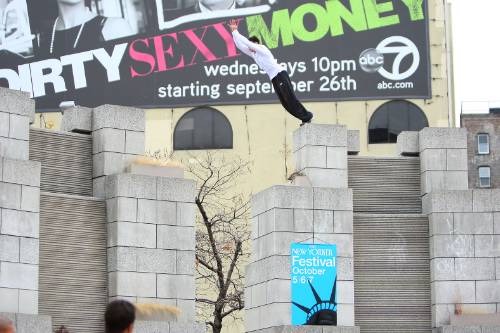
The “Parkour New York” event with David Belle happened at the same time as the Master Class on Profile Writing. I scurried over to Javits Plaza as soon as I could, hoping for a hyperactive last few minutes. By the time I got there, the event was more or less over. As the picture below demonstrates, the location was exceedingly well chosen.
I was due at the Joan Weill Center to see Alex Ross, but I took a few minutes to mill about (and dodge the occasional hurtling body). As it happened, some fellow was in the process of taking an arm’s-length self-portrait with Belle; I intervened and took a more standard posed shot from a few feet away.
Then Belle wordlessly (I think he does not speak English) called for a group photo to commemorate the event. If you ever see any such picture (I’ll be sure to post it if I do), I’m in there somewhere, certain to prompt in the other participants the pressing question, “Who the hell is that guy?”

Fortunately, Jason Kottke was there and therefore is able to provide a much fuller report than I can.
—Martin Schneider
I’ll See You Somewhere in Dreamland
Do you know that magical Max Fleischer animation from the ’30s? (“I’m gonna dunk!”) It’s probably on YouTube (yes it is), and I’ll reward myself with it after I’ve caught up with, you know, my job. All the sleeplessness and doubling up this past week has been worth it, because it was a thrilling festival, inspiring and humbling, and there’s more to say about it. So Martin, Toby, and I (filmmaker Quin and poet and fiction writer Tiffany are done with their reports; scroll through a few pages and read them all) will continue to post till we run out of notes, or until our eyes start crossing, whichever comes first.
Meanwhile, here’s Glynnis MacNicol (I am jealous of your fantastic name) on the Annie Proulx and Junot Diaz event (and Quin’s take).
Another blogger reviews the Lucinda Williams show, and is working on a David Remnick/Semour Hersh and a David Denby/Seth Rogen/Judd Apatow post. I was at those discussions as well—in the same venue and with equally intent audiences, which probably did overlap slightly—so will start working on decoding my elliptical symbols.
Best news of all: pretty soon, a brand-new Ask the Librarians! I saw a lot of stars this weekend, but none compare to Erin Overbey and Jon Michaud, in my book.
Festival: The Art of Seducing Readers
Sunday’s Master Class on profile writing with Mark Singer and Susan Orlean was the best event I saw all weekend. The talk was structured basically as Singer grilling Orlean, in a friendly way, on the process of writing profiles, while Orlean would occasionally turn the tables. As the have been friends for decades, their shared references made it a powerfully informative, probing, and intimate session. The two writers were both so genuinely curious about the other’s process, it was as if the audience were not there at all. It was a truly remarkable session.
What follows is a more or less unstructured selection of observations and quotations.
It was fascinating to observe the many things Singer and Orlean have in common (curiosity, thoroughness, mad typing skills) while approaching very similar projects quite differently. Orlean is warm and seeks emotional connection with her subjects; Singer is more detached, calling his a “deadpan approach.”
Singer prefers to do exhaustive research before meeting the subject; Orlean prefers to learn about the subject in a more haphazard way. Singer made a great point about questions, saying that you should never ask a subject for information that you could acquire independently. In other words, don’t ask “Where were you born?”—ask what it felt like to grow up in Sheboygan. The former is publicly available; the latter is what you’re hired to find out. Orlean saw this differently; as she said, “I write a profile the same way I would go about making a friend,” and you would certainly ask a budding friend where she was born.
More than you would think, a lot of the process of writing these profiles occurs before it’s even agreed that there will be a profile at all. There’s a great deal of negotiating with the subject about access, and many profiles never end up happening at all. Some of Singer’s more interesting stories had to do with unwritten profiles. Since profiles at that stage are so amorphous, the process, later too, is necessarily infused with self-doubt—is this a subject? why would people read this? What am I doing here? And so on.
To counter this, a good profilist needs a compensating sense of worth: As Orlean said, “You have to have the confidence to say, as a writer, that somehow the choices you make are, in and of themselves, justifiable.” A simple and yet elusive point—as the example of a profile she did for Esquire about “the typical ten-year-old boy” demonstrates. She had to assume, on some level, that she was, of necessity, capable of “proving” to the reader that this material worth reading. “I love seducing readers,” she said, starting with a subject that seems of doubtful interest and then winning the skeptic over. She observed that Tina Brown, someone who would normally suggest very well-known people for profile subjects, could never really understand how Orlean achieved her effects (the two women have an abiding friendship nonetheless).
On the subject of editors, both writers were unabashed in their praise—indeed, awe—of David Remnick’s reportorial skills. As Singer said, “He is so good that he can spend a week in Israel and write a ten-thousand-word piece on the flight home,” a process for which the two panelists and most of their colleagues presumably would need far longer, on both the data collection and production sides. That had come up as a tangent on the subject of notes—both Singer and Orlean take copious notes, but Orlean insisted that the writer should be able to tell the story of the piece entirely out of her head, as it were. Until you’ve gotten immersed to that extent, you’re not ready to write. She compared the process to that of telling an anecdote at the dinner table. If you say, “I heard about this car that got stolen, but the owner’s dog was still inside,” your dinner-mates will likely not wrest the floor from you anytime soon. The same dynamic is in play with a successful profile. (That anecdote was the basis for an actual profile Orlean wrote, by the way.)
Orlean raised the question of tape recorders. Singer said that he has used them but hates them, “because then you have to listen to it.” As many people do, he detests transcribing as well as the sound of his own voice. Rather surprisingly, to me anyway, Singer likes to bring his laptop along as often as possible, and will often transcribe conversation with his subjects on the spot. Singer said the best course he ever took was typing, and Orlean laughingly bragged that she types exceedingly well, even better than the well-known Meryl Streep incarnation of her .
I did not know that Orlean did profiles for Rolling Stone for a long time. She explained that the material for a Rolling Stone profile is usually gathered an hour or less, in a hotel room with the subject, a process so truncated that the writer must, of necessity, invest random utterances and actions with absurd significance. (Singer: “The best approach in those situatons is just to shoot yourself before the interview.”) In addition, “nut grafs” are a Rolling Stone requirement: “The Fugees are important right now because …” At The New Yorker, unsurprisingly, things are different. Writers are encouraged to come up with a form and approach that fit the material, even if it means spending weeks with the subject. Singer said that the process is often so attenuated that subjects frequently question whether he is competent, wondering how on earth anyone could ever make a living this way. Orlean offered that she is always grateful that she can spend three weeks not apparently accomplishing much while she gets a sense of the subject at hand.
On the subject of form, Singer referred to his “cinematic” understanding of content, which leads him to use “scenes” to help him structure the material. As he said, “You have to have a really great reason to abandon chronology,” something that Orlean does more often than most. Singer observed that it is very difficult to write profiles about very funny people. There is a constant temptation to reproduce shtick, which never comes off nearly as good in print; such pieces are always threatened by a “you had to be there” quality that is death to a good profile.
Orlean once did a kind of mental tally of the geographical origins of New Yorker employees, concluding that the staff was “overwhelmingly midwestern” (I pass on the information in the interests of sociology). Singer and Orlean agreed that in a city like New York, many good profiles arise out of a kind of restless, pavement-pounding inquisitiveness. See an odd shop? (Orlean’s example was a shop specializing in ceiling fans.) Talk up the proprietor, you’ll likely discover a hidden expert in some arcane subject: “Everybody’s more intensely whoever they are in New York.”
I could easily go on for another ten paragraphs, but I won’t. Clearly, this material fascinates me in a big way. I’ve read a great many profiles in my time, and now I have at least an inkling of how they are put together. For that I am thankful. —Martin Schneider
Festival: Alex Ross Will Get You to Dig Arnold Schönberg
Alex Ross called his late-Sunday presentation, “The Rest Is Noise: A Multimedia Tour of Twentieth-century Music,” an “improvement” on his book, as he would be able to supplement the points in his narrative with musical excerpts, so that we could actually hear examples of composers’ work along the way.
Make no mistake about it: Ross’s presentation was fabulously successful by almost any set of criteria. Simply put, it’s difficult to imagine a human being better suited to the project of explaining the tortuous path of what we might call “serious” music in the years following 1900 to a lay audience. (I can already hear the objections to that word piling up.) If Ross has any plans to reproduce his presentation elsewhere, I highly recommend catching it; it is an experience sure to benefit any enthusiast of any kind of music. If you enjoy the intentional arrangement of aural tones to achieve an effect in the listener, you will probably enjoy this. Further, it is profoundly inspiring to see the high degrees of passion, engagement, expertise, and erudition that Ross brings to the subject.
I combine fairly low affinity for what is called contemporary music (or classical music for that matter) with a high degree of exposure. Staying in the twentieth century only, I’ve seen operas by Janáček, Korngold, Strauss, Glass, Prokofiev, Harbison, Berg, and Britten, and maybe a couple others I can’t think of right now. In all honesty, most of them had a kind of “Isn’t that impressive!” impact on me without really getting me where I live.
All of which either makes me Ross’s ideal audience member or the worst one imaginable—possibly both. For my part, I got a lot out of the presentation. Ross said that his goal was to “defeat any preconceptions” about twentieth-century music, and there’s no doubt he succeeded in that. To take two examples at random, he was able to present both the forbidding and supposedly melody-free clangor of atonal music and the barren-sounding prospect of minimalism in a way that both was memorable and piqued the interest.
Anyway, enough of my yakking. Whaddaya say? Let’s boogie! —Martin Schneider
Festival: Squeeze a Drop of Blood from a Sugarcube
If the New Yorker Festival Debate hadn’t ended so early (about 9:15), I might not have bothered hauling my sorry ass out to Gowanus to see Yo La Tengo. I’m lucky I did. Ben Greenman did a fine job ushering the band through an always potentially awkward blend of music and Q&A in a large darkened space. His suggestion of “Autumn Sweater” was particularly genius; that was the high point for me. I saw YLT do a proper rock gig at Irving Plaza years ago, and I must say I prefer the quasi-unplugged variant quite a bit more. YLT trades on its remarkable flexibility—every time you think they’re a step and a half away from becoming a folk band, they bust out a dose of skronk that would rouse even J. Mascis from slumber.
From the interview portions, my two favorite comments came from bassist James McNew (these are very close paraphrases): “An English teacher gave me a copy of White Light/White Heat, and it just broke my mind…. I was like, ‘I hope you realize this means I’ll be flunking your class….'” and, “A lot of the songs I write are messages to present-tense-me from just-slightly-future-tense-me telling me everything will be all right.”
Here’s what they played:
The Cone of Silence
Stockholm Syndrome
Story of Yo La Tango
Magnet (NRBQ)
Madeleine
Autumn Sweater
I Heard You Looking
Pass the Hatchet, I Think I’m Goodkind
This Man He Cries Tonight (The Kinks) (live debut)
Sugarcube [excellent choice for a closer]
(Accurate set list provided by Jesse Jarnow.) —Martin Schneider
Deviant Matters: A. M. Homes and Miranda July
Continuous reports from the 2007 New Yorker Festival, by the Emdashes staff and special guest correspondents.
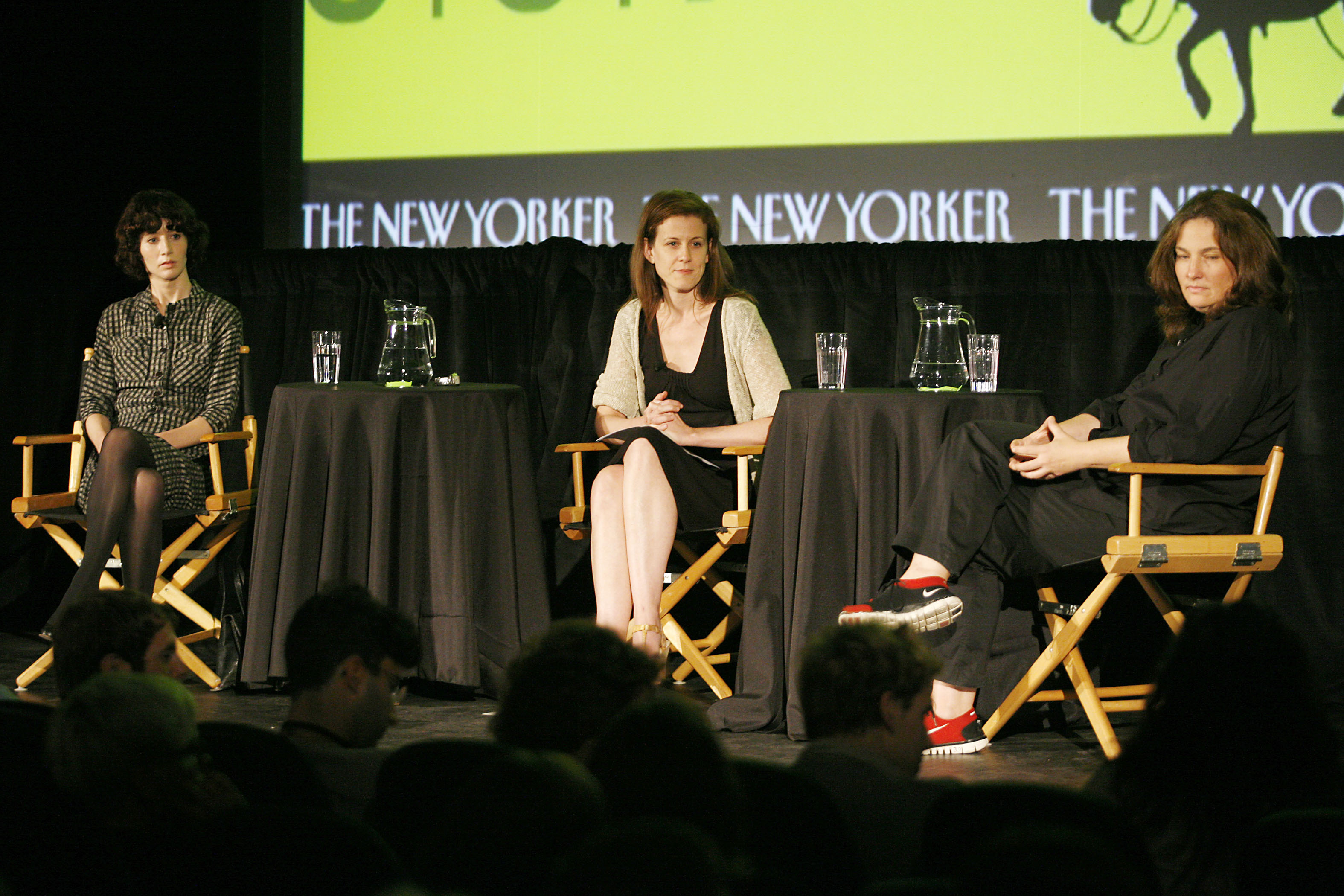
One of my favorite moments from Friday night’s conversation on deviants between Miranda July and A. M. Homes occurred at the very start. After Homes opened rather seriously by proclaiming that we are all deviants, July squirmed slightly in her chair, turned to Homes seated far across the stage and shyly said, “Um, yeah. I pictured us closer together.†The large audience, generally young and solidly hipster in style, exploded in laughter and, just like that, the tone for the evening was set. Perhaps the physical distance (see photo) partly accounted for the lack of sustained engagement between Homes and July. More likely, it had to do with the two artists’ approaches. While Homes the writer and July the performer never seemed to click entirely, the juxtaposition made for an entertaining evening accented by insights into the unique approaches of each artist.
The fun was no more evident than when July attempted to engage the audience in a trivia contest about Homes’s work. What she thought would be a fun little activity quickly turned humorously awkward. Her first two questions on rather obscure details from Homes’s work were not only met by the audience’s collective silence but also seemed to stump Homes herself. A slightly flummoxed July lightened the mood, timidly saying that she now realized that “no one reads like this unless they’re writing trivia questions.†Homes, who seemed a bit uncomfortable with the whole situation, suggested that the questions should be about July’s more popular film. July asked one final question about a character’s nickname from Homes’s recent memoir, someone thankfully knew the answer was “Dragon Lady,†and order was restored. (The prize? Two well-earned Festival tickets to Saturday’s debate on the Ivy League. )
Oh wait, wasn’t this talk supposed to be about deviants? Despite moderator Carin Besser’s efforts, the conversation weaved in and out of the topic. It turned out to be more of a springboard into some of Homes and July’s fascinating insights into their motivations as artists. Homes spoke about the joy of inhabiting brains other than her own. Beyond sheer pleasure, this act of distancing is actually what enables her to write fiction. She indicated that occupying the mind of a pedophile, as she did in her book The End of Alice, in some sense was easier than simply drawing on personal experience. At the same time, she acknowledged the difficulties of fully stepping outside oneself and spoke of “the inescapability of the artist’s mark.†At one point, after some pauses and false starts, July summarized her artistic intention beautifully, saying she tries to get to the place where mystery is supposed to make sense. She added that, in her work, she is “going beyond getting to have it be correct.â€
The evening became even more intriguing when the subject turned to pen pals. Homes and July have each been correspondents with some rather interesting characters. While Homes had communicated with the likes of Pete Townshend and filmmaker John Sayles (who, in one letter, apparently advised the college-aged Homes to suffocate an annoying roommate with a pillow), July maintained a multi-year correspondence with a convicted murderer (July said he will be released in 2012). With her typical sensitivity and humor, she said, “I was lucky, he was a good guy.â€
Next year’s panel recommendation: John Sayles on deviants. —Toby Gardner
Review: “King’s Gambit,” by Paul Hoffman (Newsday)
KING’S GAMBIT: A Son, a Father, and the World’s Most Dangerous Game, by Paul Hoffman. Hyperion, 400 pp., $24.95.
By Emily Gordon
Chess brings out grandeur and brutality in its human players. Paul Hoffman, who’s been deeply involved in the game since he was a child, is an intimate observer of — as David Remnick put it in a recent interview with grandmaster Garry Kasparov — “the absolute, singular concentration of a life bent over 64 squares.” Hoffman’s memoir, “King’s Gambit,” a chronicle of his and others’ lives spent at that level of concentration, is as jagged, passionate and methodical as the game itself.
Hoffman (who ranks as a Class A chess player) is the former editor in chief of Discover magazine and president of the Encyclopedia Brittanica, as well as the author of two well-received nonfiction books about an eccentric mathematician and an early pioneer of flight. Hoffman clearly likes to gets his facts right — this is a sturdy volume of carefully explained (and footnoted) details and digressions — but it’s chess that really grips his psyche. Its rules, characters and histories occupy his head, a labyrinth of positions and personalities.
Is that a form of madness? Throughout the book, Hoffman asks it directly. “Chess was an insane game,” he writes. “When I lost, I was unhappy. And yet it was necessary to play and risk defeat if I was ever going to win and relish victory.” In essay-like chapters, Hoffman ranges over this and the other great subjects of chess: chess as war strategy, the challenge of computers, the domination of Russians, the emergence of women players, chess-world politics, and so on. Hoffman illuminates his account with many well-chosen quotes from the literature of chess, fiction and nonfiction, although, curiously, he skims over Walter Tevis’ peerless novel “The Queen’s Gambit.”
Chess is truly a great subject: There’s nothing sedentary about the players of this seated game. Hoffman — who once played Kasparov himself — seems to have met most of them, and he has a terrific ear for dialogue. He shows us that chess rivals can be close as lovers: “After he downed another vodka, Karpov looked a bit wistful. ‘I know Kasparov as well as I know anyone,’ he told me. ‘I know his smell. I can read him by that.’ Indeed, the two men had sat face-to-face for a total of perhaps 750 hours, their foreheads sometimes only millimeters apart as they leaned in over the chessboard. ‘I recognize the smell when he is excited and I know it when he is scared. We may be enemies, but we are intimate enemies.'”
This is not just a book about chess, however, and the danger referred to in the title is not just in the chance of losing a game or a tournament. Hoffman is preoccupied with plenty of chessmen, but the central character here turns out to be his father. James Hoffman was a B-grade journalist who wrote salacious, punning stories for gossip magazines and forged layers of deception in his own life that Hoffman is still trying to figure out. After he and Paul’s mother (who is not much discussed here) divorced, he moved to a downtown Manhattan bachelor pad. When Hoffman started coming in from Westport, Conn., to see him, he began to play in an American chess mecca: Washington Square Park and the chess clubs and stores that surrounded it at the time.
This childhood and adolescent relationship wounds and provokes Hoffman the writer and adult, and he seems to return to it almost fresh each time, as though he’s only just sitting down at the board against a baffling opponent. Hoffman struggles to believe in and promote a valiant image of his father, but must constantly question him; his father undermines his son in turn. Still, some of his father’s parental crimes (“dragging” him to Quaker meeting as a child so that someday he can stay out of a draft on religious pacifist grounds, for example, or “imposing” “experimental New Age braces”) can surely be seen as loving, if not always especially considerate. Since Hoffman’s father died in 1982, he can’t speak to these stories.
One of the qualities Hoffman admires in his father — his giddy, carefree way with language — eludes him during these psychological meditations, which can have an austerely formal quality. At times, he seems to be attempting an impossible project. It might be possible to write a thorough oral history of chess, or of Hoffman’s father’s career, of Hoffman’s own games, or of his chess-world friends; the latter was what made “Word Freak” so engaging on the equally obsessive subject of Scrabble.
But when you add further categories, like Hoffman’s marriage, a nearly debilitating and mysterious illness, and his ambivalence about his father, complete documentation becomes futile. “Chess players live in an alternative world of what might have been,” he writes early in this book, and like Mary Gordon’s “The Shadow Man,” this is a search for an inadequate, elusive parent that can never be completed.
On the other hand, whenever Hoffman gets carried away with a story that gets him, and us, outside his history and head — as when he gets into situations filled with international intrigue and peril, like being interrogated by the police while trying to play in Libya — his prose is vigorous and very funny. His unselfconscious portraits of neurotic or outrageous characters are as effective as good fiction, and his chapter about women chess players — especially the section about top player Jennifer Shahade — is one of the book’s liveliest and best.
Obsession is often unquenchable, parents frustrating, love and the mind prone to failure, the sweetest dreams unrealizable. Hoffman is a noble character here, all the more noble because he’s so self-effacing, and he’s careful in his writing not to show off too much. He has some things to show off about, and he deserves a victorious break from replaying so many real and metaphorical games, whose results are unalterable.
Published October 7, 2007
In the Company of Men: Neil LaBute and John Lahr
Continuous reports from the 2007 New Yorker Festival, by the Emdashes staff and special guest correspondents.
Into a venue filled with avid Neil LaBute fans, I committed the grievous sin of arriving late. Thankfully, Neil LaBute doesn’t have a Catholic bone in his body, so, I wasn’t punished by being sent to Limbo and denied access to his chat with John Lahr.
Mormon, misogynistic, misanthropic, male: the first three words are wrongly used when reviews or interviews are written and comments made about the playwright/screenwriter/director. Only the last is true.
LaBute opened the discussion by saying his time on stage with Lahr was better than therapy, and all of his issues should be worked out by the time they were done. He was easygoing, with an affable manner tinged with the sharp wit that is found in his writing—some of which moved past his audience’s heads, then boomeranged back to catch them after a beat or two. He has gimlet eyes that hold down the person he is directing his answers toward and a grin that belies the gaze.
The subject was Men. And there was 90 minutes to discuss it with the man who has created some of the most vile male characters ever seen in film or on stage. For LaBute, the discussion started with the father. His own was a distant man, a hard man, someone who was not easy to grow up with or around—a man frustrated in his own life, who displayed the proper emotions and actions to the world but changed when the doors were shut and the curtains closed. His older brother emulated their father, something LaBute couldn’t do; he says he paid a price for that decision. He said the atmosphere in his home was Pintersque, quiet yet volatile. He had no control there; things there “shifted with the breeze.”
Lahr asked, “When you show us in your work how we are, does it go to the silence of your life?” LaBute’s answer: “I never felt it was my work to draw from that dark place.”
While LaBute grew up in a home that didn’t nurture a playwright, he says, his parents were filmgoers. These days, his mother sees his work in motherly terms; she mentions the language on occasion, and “wishes I’d write more comedies.” He started writing monologues for himself to see if he could fool his teachers into believing they were actual monologues that he’d discovered. Once he put pen to paper, he said, he didn’t stop. Writing gave him something he didn’t have elsewhere: control.
“Wow. I’m really feeling better. How much do I have to pay for this session?” he asked Lahr. Laughter again.
Attendance at B.Y.U, mandated one thing; students signed a paper agreeing to its terms. By the time LaBute had become a graduate student, the love affair between his brilliance and the strict doctrines taught weren’t exactly bound for marriage. They blocked his stage time, and closed theaters to him. In order to stage Lepers, which later became Your Friends and Neighbors, he gave a one-hour exam, then quickly staged the play for its one-time performance. A director friend of mine was part of that audience, his theater experience after returning from his two-year Mormon mission. It’s theater he still talks about, in all of the right ways.
The discussion moved on to the film In the Company of Men. Lahr asked, “Do you feel Restoration comedy and its entertainment and the society of the 1990’s, when you were writing this, had parallels?” LaBute: “I saw the more privileged groups who were taunting me [the audience laughed], but I just couldn’t hear them.”
Clips were shown from the film, starting with the scene where Chad (Aaron Eckhardt) admits to Christine (Stacy Edwards) that, yes, she’d been set up. He is harsh, stinging in the delivery of his words, and you can hear the wind howling in the wound he leaves behind. Apparently, according to LaBute, you were also close to hearing the film as it ran out in the camera.
LaBute said he felt uncomfortable watching the scene, and then went on to discuss the ascetics of the creative process behind the making of a film that got to the pinnacle for all independent filmmakers: the winner of the 1997 Sundance Filmmakers Trophy. On his first film, ever.
“This film isn’t an editor’s film,” he said. “This is an actor’s movie. We didn’t do any cutting back and forth between faces. We did it in one long take. Aaron was starting to worry because he knew we only had a little bit of film left in the camera.” He calls this particular scene, “a textbook of male behavior—lies, charm, and ‘fuck it; it’s too much work. I’m leaving.'”
“On a first film, you stand around and (moves his hands) and say, ‘Oh, fuck.’ Thing is, there are other people standing around saying, ‘Oh, fuck.’ So, you have to have some authority—and you [moved his hands firmly] and say, ‘OH, FUCK!'”
The next scene discussed at length was the steam room scene in Your Friends and Neighbors. The intensity of dialogue is matched by Jason Patric’s delivery when he describes the best sex he ever had, with a young schoolmate, Timmy, who is gang-raped in the showers at school. It, too, was shot in one long sequence, with pick up shots taken afterwards of Aaron Eckhardt and Ben Stiller’s reactions to this revelation.
Lahr: “Something about all of your plays is a passion for ignorance. Pinter hears pauses. You hear something else.”LaBute: “I hear a self-regard. We spin circles in life—back on ourselves. ‘Whatever’ is an example. When people use the word ‘honestly’ a lot, they aren’t being honest at all. We want to connect, but, the cost is too great. We ask people for things we aren’t willing to give. It’s too much. It’s more important to sound interested than to be that way. We ask, ‘How was your day?’ And, when they start to answer, we roll our eyes and think, ‘Oh, fuck.’ ”
The floor opened up for Q & A’s. One young man said he’d started to laugh a third of the way though In the Company of Men when he first saw it.
Q: “What does it take for a man to move from the lying and the way they present themselves?”
LB: A good hour with Mr. Lahr (laughter). I don’t know, really. It’s human behavior. We are good at it. An armour created from youth on. Be strong. Don’t be weak. It’s our culture to come out on top. It that’s our nature…to lose a bit of yourself. To push to come out on top. It’s hard to shed that. You become one with that kind of ethic. I don’t the answers. It’s hard for people to let their guard down.
Q: What’s up with Wicker Man? I didn’t see you at all in the film.
LB: I got into the project because I loved the original. I was asked to give it a go. I kept the concept of a cop, and I took them to a zenith, to a world run by women. The producers wanted something different than I wanted to make.
Q: What is the film rehearsal process and how do you feel about the word “like”?
LB: Like is a serviceable word, and I use it on the page. I like rehearsals. I understand them, the process. I like the process in the theater. You can follow the process in theater, you move from start to finish in a smooth line. In film, what you start out with has to remain that strong seven weeks later. You don’t get the full rehearsal process. Rehearsal is the method along with [at this point, he started discussing yoga, natural foods and this reporter started to laugh. Loudly. Alone. Thankfully, others joined in]. What is going to go on stage…if it’s repeated, will prove if it’s strong or weak with the repeating. Ultimately, when working on a piece we are going to present working on a scene is what it is all about.
Q: How do you work?
LB: No particular clothing or process or food or time of day. I tend to not want to write until I want to write. I tried that, to be disciplined and I threw it all away. I wander around with plots and characters in my head and play devil’s advocate. You look for reasons not to see it through. If they stay with me, if after a year, I still have them in my head, I suddenly start writing dialogue in a hurried frenzy—I don’t do breakdowns of plot—I write. Sometimes, you get to page 50, and think, “There really should be a plot by now.” It’s the most exciting way I’ve found to write and by transference, a way to excite the audience.
Time was up, we all exited, leaving me with a wealth of my own questions, and a greater respect for an artist who produces amazing work. I wish we’d had another few minutes, which would lead to a few more and a few more, and the man would never get another thing done. But, he’d have his issues worked out thanks to John Lahr, I’d be entertained, and in the end, it’s really all about me. Or so I’d like to think.
—Quin Browne (Read more about Quin.)