
In which some or all of us review the high points and discuss the particulars of a recent issue.
This issue brought us the first article by Ryan Lizza, and it bodes well. One sign of a good political article is that it is truer two months down the road than the day it came out, and that’s the case here—health care is an asset for Hillary, Obama is cagey and difficult to get a handle on, and Edwards supplies the populist attack on Hillary.
The clear pick in this issue was Mark Singer’s wonderful Letter from England on pianist Joyce Hatto. I don’t even want to say anything about it. If you have a half hour, give it a whirl—you won’t be disappointed. (Then listen to Singer’s audio interview with Matt Dellinger on newyorker.com, and hear more of Singer’s thoughts and some of the music in question.)
Other than that, the cartoons by Zachary Kanin and Paul Noth both have just the right touch of enjoyable daffiness. —Martin Schneider
Author Archives: Emdashes
Lawrence Wright! Pulitzer!
Grand news.
Also, briefly: a New Yorker cartoon rejection (by an artist who did a sort of proto-Rejection Collection for Details).
Speaking of comics, here’s a review of R. Crumb and David Zane Marowitz’s take on Franz Kafka.
Obsessed with the umlaut over certain vowels in The New Yorker? Know first that it’s not an umlaut.
The Times They Are A-Changin’
My final New Yorker Festival wrap-up—in rhyming couplets!—and the return of Pick of the Issue, coming soon to a Mainly Nice New York Media Blog (patent pending) near you. For all of our coverage of the 2007 Festival—for which I thank, from the bottom of my not-yet-bilious bloggy heart, the incredible contributors Martin Schneider, Quin Browne, Toby Gardner, and Tiffany De Vos, as well as everyone at The New Yorker and Print who made it possible—take a gander here.
Avenue Queue: Special Festival Report From the Front (& Middle & Back of the) Line
I had the privilege to meet the talented young writer Ben Bass after the Steve Martin event at the New Yorker Festival this past weekend. Ben was kind enough to send me his report from the impressive–in length and in fervor–line that formed on the festival’s opening day.
When advance tickets for the eighth annual New Yorker Festival weekend went on sale online, events sold out quickly. Happily, more tickets were released on the weekend in question, and so it was that a line formed outside Metropolitan Pavilion on West 18th Street on the first day of the Festival.
First in the queue was Eileen Fishman of North Caldwell, New Jersey, who arrived four hours before tickets went on sale. Unlike others in line, who stood or sat on the pavement, she surveyed the landscape from the nylon comfort of a Tanglewood-appropriate collapsible lounge chair. Someone observed that Fishman looked like a hardcore fan camping out for Bruce Springsteen tickets at the Meadowlands. “I bought this chair around the corner at Bed Bath & Beyond,” she explained. “My kids are coming in from Boston and I want to get Calvin Trillin tickets.”
Arriving early was a wise move. There was room for only thirty people at this year’s version of Trillin’s popular gastronomic walking tour, and magazine insiders were rumored nearly to have cornered the market. Tickets to it are an October tradition not unlike the post-season base hits of Alex Rodríguez: more talked about than seen.
The Festival also evoked Yankee Stadium in the way that it brought families together. Lisa Kittrell of Mississippi, seventh in line, chose this weekend to visit her daughter, an NYU film student. “She told me she’d go to Miranda July with me if I went to Judd Apatow with her,” said Kittrell, who was attending her fourth straight Festival.
As the line slowly lengthened in the bright October sunshine, people settled in for an afternoon of purposeful idling. One might have expected to find some of them reading this magazine, but iPod listening and text messaging were the distractions of choice, and the most prominent magazines on display were Us Weekly and InStyle. “When you go see a band, you don’t wear their T-shirt,” explained Angie Rondeau, 28, an Oxford Press production editor who nonetheless was furtively perusing a New Yorker article on Elizabeth LeCompte.
Not everyone agreed with Rondeau’s fashion mandate against bringing coals to Newcastle. Suzanne Undy, a freelance writer fifteenth in line, was clad in a New Yorker T-shirt emblazoned with a George Booth dog drawing. She was waiting to buy tickets to see Jeffrey Eugenides and Oliver Sacks. “Everything sells out so quickly,” said the first-time Festival attendee, sounding like a veteran.
Wearing a Los Alamos National Laboratory polo shirt, Columbia M.D.-Ph.D. student Sean Escola, 26, whiled away the time working on a full-page theoretical neuroscience problem resembling the contents of a blackboard in a Pat Byrnes cartoon. Blithely unaware of the attractive fellow student forty spots behind him in line with an “I Love Nerds” button on her backpack, Escola (who, in fairness, projected a certain Weezeresque charisma) was third in line, well positioned for tickets to the Icelandic music group Sigur Rós. Their two Festival concerts had sold out online in seconds.
Hoboken’s Carter Frank, thirty-eighth in line, was buying tickets to see a panel of television writers. “I’ve got a soft spot for David Milch since he hired my daughter as a writing intern on John From Cincinnati,” she said. Asked whether she’d read the magazine’s recent Milch profile, she replied, “They got his bad back right. He interviewed my daughter lying flat on the floor.”
As the sun beat down and ennui mounted, patrons become more forthcoming with their petty New Yorker grievances, both Festival and magazine. Josh Frankel, 19, a Drew University economics major, complained that The New Yorker had attracted too much attention to his favorite hidden gem, the Brooklyn Heights restaurant Noodle Pudding.
“They ruined it,” he said. “They put a profile right in the front of the magazine and now you can’t get a table there after 5 p.m.” Princeton senior Amelia Salyers, twentieth in line, expressed dismay that Salman Rushdie and Junot Díaz were appearing at the same time; they represented two-thirds of her thesis topic, along with Vladimir Nabokov.
Less conciliatory was Marty Katz of Bloomfield Hills, Michigan, a perennially frustrated online Festival ticket buyer. “It sucks,” he said. “They should get a bigger venue.”
Predictably, the media-centric weekend spectacle also attracted Fourth Estate types, though relatively few from breakaway former Soviet republics. Shorena Shaverdashvili was covering the Festival for a literary magazine in Georgia, “the country, not the state.” Shaverdashvili, the magazine’s publisher, winkingly disavowed any conflict of interest in awarding herself the New York City weekend gig. “I just subscribed to The New Yorker because they added Georgia,” she said. “I used to have to buy it in airports or get my friend to send it to me.”
Shortly before tickets went on sale, the door to the Pavilion swung open and patrons were ushered inside. As the line started moving, a burly security guard tried to maintain open space in front of the building next door, where an Hermès sample sale was attracting a steady stream of customers. “You wouldn’t think these Hermès ladies would be that tough, but they are,” muttered the guard. “One lady this morning almost knocked an old man over. She said she was a columnist from the Post so I should let her in early. I told her to come back when we were open.”
Finally it was 3 p.m. and the ticket counter opened for business. The Festival was underway. —Ben Bass
On Blackwater and Military Contractors
My brilliant sister Laura Dickinson, who is and always will be smarter than me and is writing a book called The Death of the State? The Promise and Perils of Outsourcing War and Peace, was just on the BBC program “The World” to talk about prosecuting security contractors. Here she is on WBUR’s “Here and Now,” on the same topic. Also, revisit David Remnick’s Comment, from 2006, on Al Gore and An Inconvenient Truth.
Postest With the Mostest: Organic Breakfast Links
Some weeks all one is capable of, blog-wise, as Jack Lemmon would say, is short, be-linked bursts. This is one of those weeks, my friend.
A beautiful design for a New Yorker party.
Goody! Jesse Thorn at The Sound of Young America—the eerily gifted young radio host who’s been taking WNYC by storm—has interviewed George Saunders again.
Marisa Acocella Marchetto interviewed. Have you read her book Cancer Vixen yet? It’s astonishingly powerful, and funny, too.
Who will save the Saul Steinberg boat mural? I repeat: who?
Some wonderful old-cartoon tidbits, courtesy of Mike Lynch.
If you’re still bobbing for Dylans after I’m Not There, dig Theme Time Radio Hour, the best show anywhere. Thanks, Bill, for this WaPo story about the sandpaper-smooth DJ with a nose for goofy trivia and a weakness for women’s names.
Is text-messaging the solution for administrations dealing with crises like the one at Virginia Tech? It might be.
Just because, the His Girl Friday screenplay.
“Interesting mention of TNY’s fiction,” writes Carolita, and she’s right.
Speaking of writers for the magazine, I reviewed Paul Hoffman’s new book about lives spent puzzling out heady and confounding strategies in chess games and in families (for Newsday); it’s called King’s Gambit: A Son, a Father, and the World’s Most Dangerous Game.
Ask the Librarians (VI)
A column in which Jon Michaud and Erin Overbey, The New Yorker’s head librarians, answer your questions about the magazine’s past and present. E-mail your own questions for Jon and Erin; the column has now moved to The New Yorker‘s Back Issues blog. Illustration for Emdashes by Lara Tomlin; other images are courtesy of The New Yorker.
Q. When did The New Yorker start publishing letters to the editor? Did it publish letters in any form before that?
Erin writes: The Letters to the Editor department has had several incarnations at the magazine. In the twenties and thirties, the magazine published occasional letters to the editor, but no consistent weekly column from readers. These early letters were usually quite brief and appeared under headings like “The Amateur Reporter” or “Our Captious Readers.” Some of them were actually parodies written by New Yorker staffers under pseudonyms; a typical example is this excerpt from a letter, written by “Rye Face,” in the March 13, 1926, issue:
That smart New Yorkers read your confounded paper may be true. But why imply that decent people would become smart if they read it? Dammit, I read it. And I am a bootlegger. And practically all bootleggers and others with a sense of humor read it. Accept my sincerest expressions of disgust. THE NEW YORKER is not smart. Please have the decency to cease from accusing the honest people who support your senseless waggery with their good cash of vices they don’t possess. We may not be perfect but God knows we aren’t smart.
From the forties through the early nineties, letters to the editor would occasionally appear in the back of the magazine, usually identified as Departments of Amplification. Those who wrote letters to the magazine during this period include Eudora Welty, John McNulty, George S. Kaufman, and Thomas Mann. The following is excerpted from a letter written by Eudora Welty and published as a Department of Amplification in the January 1, 1949, issue. Welty is responding to Edmund Wilson’s review of William Faulkner’s Intruder in the Dust (1948):
How well Illinois or South Dakota or Vermont has fared in The New Yorker book-review column lately, I haven’t noticed, but Mississippi was pushed under three times in two weeks…. Such critical irrelevance, favorable or unfavorable, the South has long been used to, but now Mr. Wilson fancies it up and it will resound a bit louder. Mr. Faulkner all the while continues to be capable of passion, of love, of wisdom, perhaps of prophecy, toward his material. Isn’t that enough? Such qualities can identify themselves anywhere in the world and in any century without furnishing an address or references…. Mr. Wilson has to account for the superior work of Mr. Faulkner, of course he has to, and to show why the novelist writes his transcendent descriptions, he offers the explanation that the Southern man-made world is different looking, hence its impact is different, and those adjectives come out. (Different looking–to whom?) Could the simple, though superfluous, explanation not be that the recipient of the impact, Mr. Faulkner, is the different component here, possessing the brain as he does, and that the superiority of the work done lies in that brain?
In October of 1992, with Tina Brown’s first issue, the magazine began occasionally publishing single letters under the heading “Mailbox.” The first stand-alone Letters to the Editor column, titled “In the Mail,” ran in the October 4, 1993, issue. The weekly column was renamed “The Mail” in the January 20, 1997, issue. Today, the magazine receives about one hundred letters to the editor per issue, and every letter is read by someone on the editorial staff. Usually, the letters editor selects three or four for the weekly column. The criteria for choosing a letter vary, but typically the editor is looking for something that furthers or clarifies a point in the piece or is an interesting addendum. Some of the people who have written letters to the magazine in the past fifteen years include Norman Mailer, Erica Jong, Colin Powell, Stephen Sondheim, Gore Vidal, Arthur Schlesinger, Jr., and Dick Cavett.
Q. Did The New Yorker always publish a pre-holiday “On and Off the Avenue”?
Jon writes: Each year, for most of its history, The New Yorker has published holiday shopping guides under the “On and Off the Avenue” rubric. Until the early nineties, these gift guides appeared annually over several issues in November and December, broken up into such categories as gifts for children, gifts for the house, holiday food, and wrappings and trimmings. During the Second World War, the magazine ran, earlier in the year, a guide to gifts for men and women in the armed forces. The pre-Christmas gift guides were written by the regular Avenue correspondents: Lois Long, Sheila Hibben, Marion Miller, Barbara Blake, Cecil Webb, and Kennedy Fraser. In the nineteen-eighties, Lynn Yaeger, Cynthia Zarin, Andy Logan, and Mary D. Kierstead contributed. Since the mid-nineties, the column has run occasionally; Patricia Marx has published gift guides the last two Decembers.
The style of these columns has been consistently direct and pragmatic. “Paging Mr. Claus,” a pre-Christmas guide from the December 7, 1929, issue, warns readers, “Please don’t phone us for information, and if it’s peace you want, shop early in the morning.” The column sums up Hammacher Schlemmer like this: “Labor-saving devices a specialty. Innumerable electrical tricks; all kinds of hardware; anything for kitchens.” When it comes to buying beauty products for wives, the column writer suggests, “If you know her preferences, you need read no further.”
The writer of a 1944 column on gifts for servicemen and -women notes: “Women on tropical stations must have cotton lingerie, such as Lord & Taylor slips ($3.95)…. For girls in cold climates, Macy has two-piece pajama suits, knit like balbriggan and cut like ski pants; $3…. Navy nurses, poor things, must wear black cotton or rayon stockings. Saks has them.” The writer goes on to suggest gifts for soldiers in hospitals. “Sleight-of-hand paraphernalia delights both men who are bedridden and those able to get around. You can easily assemble a bag of tricks yourself.” Six months later, Lieutenant Alton Kastner wrote a letter to the magazine from the South Pacific critiquing some of the suggestions: “Fruitcake is ‘surefire,’ you say. One mammoth fruitcake we got was sadly massacred by our industrious little insect friends…. Only ten per cent of the hundreds of fruitcakes arrived in edible condition.”
In later decades, the columns were less list-like and more discursive. Andy Logan’s “Under the Children’s Christmas Tree,” from December 9, 1985, considers the new fad of including documentation such as “birth” certificates with dolls, ascribing the trend to the pervasive influence of Cabbage Patch Kids. Later, commenting on a “Peanuts” anthology, she quotes Umberto Eco, who said of Charlie Brown and friends, “They are the monstrous, infantile reductions of all the neuroses of a modern citizen of the industrial civilization.”
In her recent columns, Patricia Marx has brought back something of the lighter touch of the gift guides’ earliest years. In her 2005 guide to holiday gifts for women, Marx puts forward the following theory:
Everything costs so much these days that everything starts to seem cheap. Speaking as a pretend economist, I must explain that this is because the rate of real inflation cannot keep up with the rate of inflation in one’s head. And so when a person hears of a brownstone going for twelve million, even a person who happens to gulp at the monthly mortgage on her puny one-bedroom, she finds herself thinking, What a bargain! Maybe I should buy that!
Q. Who have all the cartoon editors been over the years? Are they all cartoonists themselves? Is the cartoon editor the same as the cover editor and the art editor?
Erin writes: The New Yorker‘s first art editor was Rea Irvin, the illustrator and cartoonist who created Eustace Tilley–the monocled dandy who appears on the magazine’s cover each February–and was the driving force behind the magazine’s graphic identity and early artistic innovations. Irvin, along with a few other staffers, met with editor Harold Ross every Tuesday afternoon, from 1925 to 1951, to peruse the weekly submissions of covers, cartoons, illustrations, and so on. In 1939, James (Jim) Geraghty, a cartoon-gag writer at the magazine, was hired as art editor, and Irvin was from that point on known as the art director. Irvin continued to sit in on art meetings throughout the forties, but he left the magazine after Ross’s death in 1951. From the fifties until his retirement in 1972, Geraghty oversaw all art in The New Yorker and acted as the liaison between the cartoonists and the magazine. Some of the artists he nurtured during that period include Peter De Vries, Charles Addams, Saul Steinberg, George Booth, William Steig, Ed Koren, and Charles Barsotti.
In 1972, William Shawn hired the cartoonist Lee Lorenz, who had worked for Geraghty since 1958, as art editor, and Lorenz retained that position until 1993, when he became cartoon editor. During his tenure, which ended with his retirement in 1998, Lorenz cultivated such artists as Jack Ziegler, Roz Chast, Jean-Jacques Sempé, Bruce Eric Kaplan, and Michael Crawford. Bob Mankoff, Lorenz’s successor as cartoon editor, has been a cartoonist at the magazine since 1977. Mankoff also runs The Cartoon Bank, the leading searchable database of cartoon humor on the web. In his nine years as cartoon editor, Mankoff has fostered cartoonists like William Haefeli, Carolita Johnson, Drew Dernavich, Alex Gregory, Matthew Diffee, and David Sipress.
Caroline Mailhot, the current art director, joined the magazine in 1992, and, with the design consultant Wynn Dan, adapted the magazine’s design to incorporate photography and a wider use of illustration. She continues to be responsible for the overall design of the magazine and of each issue. Françoise Mouly assumed responsibility for covers when she was named art editor in 1993. Elisabeth Biondi, the visuals editor, oversees photography, and Christine Curry, the illustration editor, oversees the assignment of illustrations.
Q. Is The New Yorker available on audio?
Jon writes: There are several ways to access content from The New Yorker on audio. A weekly audio edition, with a selection of pieces from the week’s issue of the magazine, is available online from Audible.com. Listeners may buy individual issues or an annual subscription. A typical week’s content might include the Comment, two Talk stories, a Shouts & Murmurs, two feature stories, and a movie review. Audible also offers packages of recordings from The New Yorker Festival.
Under the “Online Only” tab on The New Yorker‘s web site, browsers will find a list of recent Q. & A.s with New Yorker writers as well as Audio Slide Shows and the Fiction podcast, a monthly feature in which a current New Yorker fiction writer selects and discusses a story from the magazine’s archive.
Podcasts of The New Yorker‘s audio content are also available for free through the Apple iTunes store and other podcast sites (and via RSS readers). In addition to the monthly Fiction podcast mentioned above, the magazine produces two weekly podcasts. The New Yorker Out Loud features the Q. & A.s and other audio content from the web site. The Comment Podcast contains a reading of the week’s commentary column from the magazine (produced by Audible). Readers can also subscribe to these podcasts via The New Yorker‘s RSS page.
Associated Services for the Blind produces recordings of articles from newspapers and magazines, including The New Yorker. A recent visit to the ASB web site revealed that The New Yorker was among the top ten best-selling items in their Braille and Audio Resource Center. Like Audible, the ASB records selections from the magazine, rather than the contents of an entire issue.
Perhaps best of all, each year you can hear New Yorker writers read their work in person at The New Yorker Festival, whose 2007 program can be found here.
Q. I know that Lois Long created Tables for Two. When was that, and what were some of the restaurants she reviewed? Who started writing it after her, and when did the tradition start of different staffers (or freelance writers) doing weekly reviews?
Erin writes: The magazine’s Tables for Two department was originally called When Nights Are Bold, and it included reviews of nightclubs and speakeasies as well as restaurants. Charles Baskerville wrote the column, under the pseudonym Tophat, until July 18, 1925, when Lois Long took over, writing under the pen name Lipstick. The column was renamed Tables for Two in the September 12, 1925, issue. Long, a former Vanity Fair reporter, brought a lively and effervescent tone to the column, which typically ran to two or three pages. That tone is reflected in this excerpt from a review she wrote about Harlem’s Cotton Club in the May 4, 1929, issue:
Another thing that your most high-hat friends have recently discovered in a body is the Cotton Club in Harlem, which has a perfectly elegant revue that goes on at twelve-thirty and again around two o’clock. I fondly think that this revue…is the reason for their presence there–I cannot believe that most of them realize that they are listening to probably the greatest jazz orchestra of all time, which is Duke Ellington’s–I’ll fight anyone who says different. It is barbaric and rhythmic and brassy as jazz ought to be; it is mellow as music ought to be. There are throbbing moans and wah-wahs and outbreaks on the part of the brasses, and it is all too much for an impressionable girl.
In addition to the Cotton Club, Long reviewed most of the upscale hot spots of the Jazz Age, including the Stork Club, the Four Seasons, Tavern on the Green, the Rainbow Room, and the Algonquin. Her last Tables for Two review ran in the May 28, 1938, issue. After that, the column was written by other New Yorker staffers, including David Lardner and the prolific R. E. M. Whitaker, until February of 1963.
The magazine also published a separate Restaurants column, written by Sheila Hibben and Katherine Blow, which began in 1935. That department reviewed restaurants as varied as Grand Central’s Oyster Bar, “21,” Pete’s Tavern, and the Russian Tea Room. The Restaurants column ran for just seven years, but Tables for Two reemerged, as an occasional department, in the Goings On About Town section, beginning in May of 1995. It expanded to a weekly department, still in GOAT, in the spring of 2000. Today, the column is written by a rotating group of five or six staffers.
Q. What is the origin of the vertical band of solid color that appears on the left side of every cover of The New Yorker?
Jon writes: That vertical band is known as the cover strap. The strap was included in Rea Irvin’s design for the first cover in 1925, and it has appeared on every New Yorker cover since. Usually the strap is rendered as a solid column of color, but over the years a number of artists have used it as a way of ornamenting or enhancing their illustrations. Some notable uses of the strap include the August 6, 1927 cover by Ilonka Karasz depicting a concert at the Central Park bandshell. The strap contains passages from a musical score.

More recently, for his January 8, 2007 cover “On Thin Ice,” Ivan Brunetti accentuated his drawing of a young girl skating on a shrinking ice floe with smaller visions of global warming in the strap, including a polar bear sipping a drink in front of a fan and an igloo with a melted roof.

Addressed elsewhere in Ask the Librarians: VII: Who were the fiction editors?, Shouts & Murmurs history, Sloan Wilson, international beats; VI: Letters to the editor, On and Off the Avenue, is the cartoon editor the same as the cover editor and the art editor?, audio versions of the magazine, Lois Long and Tables for Two, the cover strap; V: E. B. White’s newsbreaks, Garrison Keillor and the Grand Ole Opry, Harold Ross remembrances, whimsical pseudonyms, the classic boardroom cartoon; IV: Terrence Malick, Pierre Le-Tan, TV criticism, the magazine’s indexes, tiny drawings, Fantasticks follies; III: Early editors, short-story rankings, Audax Minor, Talk’s political stance; II: Robert Day cartoons, where New Yorker readers are, obscure departments, The Complete New Yorker, the birth of the TOC, the Second World War “pony edition”; I: A. J. Liebling, Spots, office typewriters, Trillin on food, the magazine’s first movie review, cartoon fact checking.
If Jonathan Schell Doesn’t Speak to You, You Haven’t Seen Jonathan Schell Speak
Buy tickets and get more information here. From the General Society website:
The Nation: Is Peace Possible?
Jonathan Schell, Nation Correspondent
Tuesday, October 9, 6:00 p.m.
20 West 44th Street (between 5th and 6th Avenues)
Known for his empathy, humor and hope, Jonathan Schell is The Nation‘s peace and disarmament correspondent. His latest book, The Seventh Decade: The New Shape of Nuclear Danger, will be published in November. The book examines threats posed to the world by nuclear power and continuing arms development. Mr. Schell will share excerpts from the book and discuss disarmament, the promise of peace and the state of the anti-war movement today.
And speaking of war and peace, here’s an excellent report, from HuffPo’s Rachel Sklar and Glynnis MacNicol, on the Seymour Hersh and David Remnick discussion at the New Yorker Festival.
The Fantastic Pickin’ On Series
Pick of the Issue, our weekly selection of the best of each week’s issue of New Yorker (in other words, the pieces, cartoons, &c. we specifically recommend), has been on temporary New Yorker Festival-related hiatus, but will return soon for your reading pleasure. Meanwhile, what’s your pick of the issue this week?
Festival: Salty TV Writers Also Salty on Stage
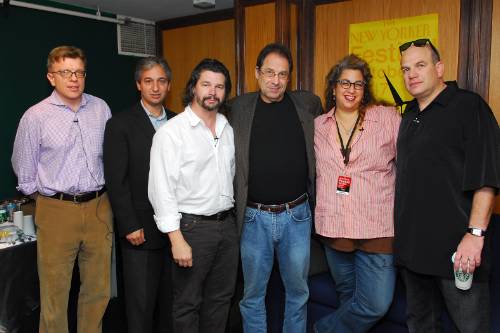
There was no better place to celebrate the current Golden Age of TV—anyone seriously doubt that one is under way?—than at the Festival’s early-morn “Outside the Box” panel, which included the creative forces behind House, M.D. (David Shore), The Wire and Homicide (David Simon), Deadwood and NYPD Blue (David Milch), Weeds (Jenji Kohan), and Battlestar Galactica (Ronald D. Moore).
The panel mostly agreed on the following givens: TV stations want to make money, and it’s good to tell your story and not the demographically dictated story that the higher-ups want you to tell. Halfway through, in full-on Crazy Uncle mode, Al Swearengen, er, Sipowicz, I mean Milch began calling spades spades (and I’ll allow the metaphoricity only if pressed), and it took the combined efforts of the rest of the panel to parry with the behemoth suddenly in their midst. A born thrower of bombs (and not only of the F kind), Milch goosed the audience with his story of a discussion years ago, when the prospect of a black man and a white woman holding hands on the air was still shocking to the network contemplating such a scene. Milch’s solution? Have the man place his penis on the woman’s shoulder, natch. The show duly fired him. The kicker? “That was the last note I ever took.” I bet!
Even more provocatively, Milch brought up the high ratio of Jews not only in show business but also on that very stage (four out of five, by a show of hands). Milch’s thesis being that Jews are well-positioned to be outsiders to the process while also passing for insiders, a tactic often denied African Americans or Asian Americans, for example. But his real point was that the bohemian/suit divide the rest of the panelists were selling was only so much pap. The suits are not looking for art, and they don’t pay for it; they’re looking for people who can give their audience the expected fare with perhaps a small edge or twist to it. For their part, so Milch, every move the so-called artists on the stage make is governed in part by commercial considerations. Better to be candid and abandon the artiste pose.
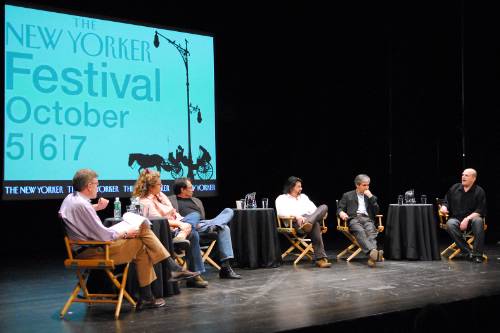
At times Milch’s positions seemed reductionist, as when he reminded David Simon that the only reason HBO is interested in The Wire is because it wants black viewers. That may be true—what’s wrong with that?—but does that mean that HBO’s frequent mention of the tidal wave of critical accolades directed Simon’s way does not also exist? It’s just as useful for HBO to be able to say it has “the best show in the history of television” (or whatever formulation however many critics have by now driven into the ground), no matter how tiny the actual audience is, a sad fact Simon mordantly referenced several times.
I’ve grown to admire Simon’s mature and ingrained modesty, groundedness, high standards. He’s famous for ripping network fare to shreds in interviews (as in this Fresh Air interview), so it wasn’t surprising that he defended HBO with vigor. It was inspiring to hear his reel off the only people whose criticisms Simon would take seriously: the cops, lawyers, city officials, judges, etc. of Baltimore and similar rust-belt cities. Those people are in a position to say: “You got it all wrong.” He doesn’t care what the rest of us think at all. I love that.
Ronald Moore spoke perceptively about the network’s preference for for one-offs over longer plot arcs, the latter a decided strength of Battlestar Galactica. BG touches on subjects like suicide bombings and therefore, albeit metaphorically, Iraq. Networks always seem to want shows to present and resolve a major social issue in 45 minutes. Since Moore himself doesn’t know how to solve Iraq, it’s more rewarding to present the complexity of the issues rather than pretending that the conventions of televised drama provide that answer.
Asked about product placement, Kohan and Simon were quick to point out that objections in the other direction often arise after the script is written. In Season 4 of the The Wire, gangs of drug-dealing teens realize that the powerful electric nail guns at Home Depot (or the show’s fictional facsimile) are far cheaper than automatic weapons and just as useful for puncturing cartilage. Similarly, in Weeds, one drug dealer purchases seven quiet Priuses—advantageous when sneaking up on “mothafuckas,” an advantage that had not yet occurred to the rest of us.
—Martin Schneider