
Click on the image for a detailed view!
Author Archives: Emdashes
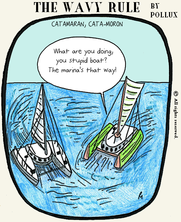
The Wavy Rule, a Daily Comic by Pollux: Cata-moron
Click on the image for a detailed view!
The Wavy Rule, a Daily Comic by Pollux: Assistant to the Assistant to the Assistant Secretary of the Treasury

Click on the image for a detailed view!
The Wavy Rule, a Daily Comic by Pollux: Mars Trace Detection

Click on the image for a detailed view!
The Wavy Rule, a Daily Comic by Pollux: Nuclear Love

Read Seymour Hersh’s “article”:http://www.newyorker.com/reporting/2009/11/16/091116fa_fact_hersh in the latest issue of _The New Yorker_, called “Securing the Arsenal.”
Click on the image for a detailed view!
Juicy New Yorker Cartoon Revelations From the Chicago Humanities Festival
Emdashes exclusive: A dispatch by our friend Ben Bass from the recent Chicago Humanities Festival–in particular, an event in which New Yorker cartoonists told fascinating stories and Bob Mankoff made cogent observations about modern youth (and encouraged more people to submit). Bass is a theater critic, culture watcher, devoted attendee of the New Yorker Festival, puzzler, and writer (not to mention tool maker, stacker of wheat, player with railroads and the nation’s freight handler in the city of the big shoulders) who would have to be considerably windier before we tired of reading him. Here’s his engaging report.
Chicagoans who make an annual pilgrimage to the New Yorker Festival are getting a local cherry on top of their recent Manhattan sundae. Now underway within Windy City limits is the Chicago Humanities Festival, a yearly cultureklatsch that recently retained New Yorker staff writer Lawrence “Ren” Weschler as its spiritual leader. As a result, this year’s CHF has more representation than ever on the Eustace Tilley front.
Simon Schama, for example, joined Weschler onstage to tell Jewish jokes to a capacity crowd at the Spertus Museum of Judaica. The fast-talking two-man vaudeville show was punctuated by sound effects from beatbox artist Yuri Lane. Artist Chris Ware, whose ghostly Halloween cover and four-page cartoon spread graced last week’s issue, appeared with Matt Groening, Lynda Barry, Jules Feiffer, and Michael Miner for a discussion on the dire state of alternative comics.
And Saturday morning, a panel of New Yorker cartoonists assembled at Thorne Auditorium in the Northwestern University School of Law. The popular Illinois attorney general Lisa Madigan introduced them; I imagine she’s no stranger to making appearances at elite law schools, but even more relevantly for this purpose, she’s married to the New Yorker cartoonist Pat Byrnes. The other panelists: Roz Chast, Ed Koren, and moderator Robert “Bob” Mankoff.
Mankoff, the magazine’s cartoon editor, kicked things off with a joke: “We’re running late, so please hold your laughter until the end.” Before turning things over to Koren, he discussed the recent history of humor and The New Yorker‘s cartoon selection process. The audience got a delightful peek at the latter during a screening of the short film Being Bob, in which Mankoff roundly rejects everything from piles of cartoons (“No… no… nah… too funny… normally I would but I’m in a pissy mood”) to a selection of sandwiches to passing taxicabs.
Koren’s dapper appearance was a surprise to some of those who follow his work, in which every person, place, and object looks like a large, shaggy dog. He emphasized the importance of drawing in a personal style, showing a 1966 submission that the magazine rejected. It looked a lot like a William Steig cartoon, and represented Koren’s attempt to capture what he thought The New Yorker wanted. When he eventually stopped trying to please an audience and started drawing for himself, he found to his surprise that the audience liked his work, too. That began his long, distinguished, and ongoing New Yorker tenure.
The cartoonists spoke in turn over a projected series of their New Yorker cartoons, expounding on certain drawings and placing referential material in cultural context. Koren mentioned Dorothy Parker and James Thurber as in-house inspirations and repeated an old definition of cartooning as “angry generosity.” Summarizing his life’s work, he quoted Lily Tomlin: “No matter how cynical I get, I can never keep up.”
Next up was Pat Byrnes, whose sweetly childlike drawings belie a stinging sense of humor. In one, a lawyer says to another on the courthouse steps, “Remember, we can only afford to do all this pro bono because of how much anti bono pays.” A father tells his baseball mitt-toting six-year-old, “Just remember, son, it doesn’t matter whether you win or lose–unless you want Daddy’s love.”
An audience member asked Byrnes whether he ever runs out of ideas. He replied, “You don’t run out of ideas, you run into them. They’re all around you. Do you run out of ideas for waking up in the morning?” Cartooning, he argued, is not something you do, it’s something you are.
Roz Chast took the podium to a rousing ovation. Proving Koren’s point about the importance of a personal approach, Chast has become perhaps the most popular New Yorker cartoonist by illustrating her own neuroses. She also documents the silliness inherent in raising teenagers in suburban Ridgewood, New Jersey. Chast’s idiosyncratic foibles are highly specific yet easy to relate to–there’s a certain empathetic release in seeing them laid bare on the page. They’re also extremely funny.
Chast told how she hit the ground running at The New Yorker when then-cartoon editor Lee Lorenz bought a quirky drawing entitled “Little Things” from among her very first batch of submissions. (Long-suffering Mankoff, sitting to her left, had over two thousand drawings rejected by the magazine before it finally bought one.) These days Chast submits six or seven cartoons a week (“it used to be more”), and usually sells one, sometimes two. Still, like Ted Williams at the plate, even the most successful cartoonist must contend with constant failure. Chast says her stack of rejects could fill two file cabinets.
She showed some of her best-loved cartoons from over the years. Her drawing “In a Just World” shows a boy sitting in the corner of his classroom wearing a conical cap reading DUNCE, supervised by an angry old schoolmarm whose conical cap reads BITCH. Her well-known Venn diagram–in which the intersection of Fun and Boring circles contains a guy named Bob–got a big laugh, then a wave of follow-up laughs at the idea that the Bob in question might be Mankoff. Chast explained that she simply needed a short name.
Mankoff, meanwhile, expressed concern that so many of today’s children have been effusively praised and coddled from a young age–“kvelled over” to excess. He thinks this makes them incapable of handling life’s rude shocks, including editorial rejection, as they enter the real world. It’s become commonplace for recent graduates of top schools to present cartoon submissions to The New Yorker, he said, and when their entries aren’t accepted, the talented twentysomethings give up and are never heard from again. “I was lucky,” Mankoff cracked. “My parents didn’t even know I was there.”
Since Mankoff is the public face of the New Yorker cartoon editorial staff, his contact with laypeople fits into some familiar patterns. “My cardiologist told me he had an idea for a cartoon,” he said. “I told him I had an idea for a bypass.” He also chuckled ruefully about a genus of super-idealists who draw ten cartoon submissions over 40 years, then submit the batch when they retire and expect the magazine to run them.
Mankoff prefers more regular contact, and stresses perseverance above all. “Submit a hundred,” he said. “A thousand!” And he took care to emphasize that the New Yorker cartooning circle is not closed to new members. Anyone may submit work for consideration and talent will out. New Yorker cartoon space is “open like the New York Yankees,” he said. “Just hit it into the stands.”
Related on Emdashes: Bass critiques the redesigned Cartoon Bank and writes up the 2009 and 2008 and 2007 New Yorker Festivals; Pollux has an Ouija Board session with Chris Ware’s Halloween cover; our April Fool’s homage to James Thurber, which alarmed some suggestible lawyers; Emily interviews Roz Chast.

Sempé Fi: The Fall

_Pollux writes_:
Fall is here, and perhaps it is inevitable that we should get a _New Yorker_ cover that features the image of leaves turning colors and falling on the grounds of Central Park. “Delicious autumn,” the novelist George Eliot once wrote. “My very soul is wedded to it. And if I were a bird I would fly about the Earth seeking the successive autumns.”
But for the November 9, 2009 cover, called “Autumn in Central Park,” we do not get a peaceful, calm scene of yellow, gold, orange, red, and red-orange leaves. The cover artist, “Eric Drooker”:http://www.drooker.com/, gives us a fiery blaze of paint blots that is more dynamic than calming.
The cover is eye-catching, making the _New Yorker_ magazine stand out on a long rack of competing titles.
The color reminds me of a Californian wildfire, the two figures in its center burn victims rather than peaceful pedestrians in Central Park. They’re not in love; they’re not even touching. They walk right into the epicenter of the autumnal conflagration. They are painted in a black smoky color; their long, afternoon shadows look like plumes of smoke.
Drooker creates an image not of touristic leaf peeping but of leaves dominating, encircling, and enveloping an almost antediluvian man and woman, and a fence and lamppost that seem almost flimsy in the face of a fiery fall.
The autumn of course signals change, and change is often violent, and often explosive. Instead of leaves falling gently on the ground, Drooker gives trees exploding with painful transformation. In life, we see change caused by confrontation rather than contemplation.
In any case, leaves do not fall so much as they are ejected by the trees that bear them. As “reported”:http://www.npr.org/templates/story/story.php?storyId=114288700 by NPR not too long ago, trees, triggered by chemical signals, discard the leaves when they become nonfunctional. It’s a “shoving” of the leaves by the tree, not a gentle falling.
And so our souls may be wedded to delicious autumn, but without even knowing it, our souls are wedded to intense change as well.
The Wavy Rule, a Daily Comic by Pollux: Dashes
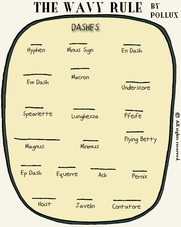
Click on the image for a detailed view! Yes, I’ve made most of these up. Thirteen out of nineteen of these dashes are made up. I love punctuation; there should be more of it. Invented dashes include the spearlette, the lunghezza, the pfeife, the magnus, the minimus, the Flying Betty, the ep dash, the equerre, the ack, the pernix, the hoist, the javelin, and the contatore.
We Are Amused: The Bloghorn Looks at New Yorker Cartoons
_Pollux writes_:
The desire to understand and analyze _New Yorker_ cartoons is not exclusively an American phenomenon: the “Bloghorn”:http://thebloghorn.org/, the digital cartoon blog of the UK Professional Cartoonists’ Organisation, “writes”:http://thebloghorn.org/2009/11/02/dont-get-it-new-yorker-explains-itself/ on _The New Yorker’s_ “Cartoon I.Q. Test.”:http://www.newyorker.com/humor/polls/cartoonidontgetit/091102
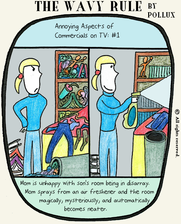
The Wavy Rule, a Daily Comic by Pollux: Annoying Aspects of Commercials on TV #1
Click on the image for a detailed view!