
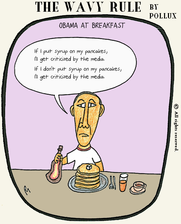
Click on the image for a detailed view!
Author Archives: Emdashes
The Wavy Rule, a Daily Comic by Pollux: Green Bean Casserole, 1623
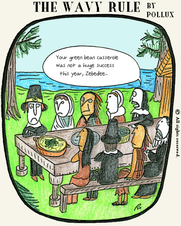
Happy Thanksgiving, Emdashes readers! Click on the image for a detailed view!
The Wavy Rule, a Daily Comic by Pollux: Heaven
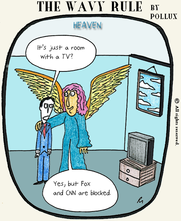
Click on the image for a detailed view!
In Absentia? Gay-Themed Cartoons in The New Yorker
_Pollux writes_:
At his blog “Streetlaughter”:http://ukjarry.blogspot.com/, British writer Matthew Davis takes an interesting “look”:http://ukjarry.blogspot.com/2009/11/314-days-of-future-past.html at the absence of gay-themed subject matter in _The New Yorker_’s cartoon section until the early 1990s.
As Davis points out (with visual examples),
Bear in mind that “Private Eye” and “Playboy” had been publishing gay cartoons since the beginning of the ’60s, and even “Punch” and “Mad”, with their particular audiences, had followed suit by the end of the ’60s, while “National Lampoon” had started in 1970 and never blanched at any gay gag…. The gay cartoonist William Haefeli, who has since produced a significant percentage of “The New Yorker”‘s gay gags, with a career of twenty years in almost every major magazine, didn’t begin appearing in “The New Yorker” until 1998 with the appointment of a new cartoons editor, Bob Mankoff.
He asks an important and relevant question: Why were gay themes seemingly “comedically unprintable” in _The New Yorker_’s cartoon section until just over fifteen years ago? Unless you know of other examples; if you do, let us know.
In Search of New Humor: David Remnick Explains
_Pollux writes_:
How hard is it to find new cartoonists for _The New Yorker_? It’s tough, David Remnick explains, in this “video”:http://bigthink.com/davidremnick/whats-the-deal-with-new-yorker-cartoons posted at BigThink.com. “It’s easier for me to get somebody to go sleep on the ground in Sudan and dodge bullets in Afghanistan than it is to get something authentically funny,” Remnick says.
Remnick mentions in the video that he shared his thoughts with _New Yorker_ writer and fiction editor “Roger Angell”:http://en.wikipedia.org/wiki/Roger_Angell on this difficulty of finding new humor. Angell replied that Remnick was the fifth editor of _The New Yorker_ to make this observation, beginning with Harold Ross.
Remnick remarks that he works closely with cartoon editor Bob Mankoff to review the new batches of incoming cartoons. Finding of the humor of the highest order is exceedingly difficult. Making a living as a cartoonist is even more so.
The Wavy Rule, a Daily Comic by Pollux: Waterworld
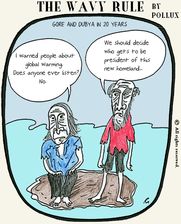
Click on the image for a detailed view!
The Wavy Rule, a Daily Comic by Pollux: Kaprosuchus Saharicus Tinkerbellicus

Yes, I know “Kaprosuchus”:http://en.wikipedia.org/wiki/Kaprosuchus, discovered recently, is extinct, but this species lives on in the world of cartooning.
Click on the image for a detailed view!
The Apartment: Carolita Johnson and Michael Crawford at Home
_Pollux writes_:
It’s always interesting to see a cartoonist in his or her own environment. Many cartoonists work at home; the walls are usually covered with sketches, paintings, posters, rejection letters, and (hooray!) letters of acceptance. It’s even more interesting to see _two_ cartoonists at home, sharing space as well as ideas.
_The New York Times_ has a terrific Real Estate section “piece”:http://www.nytimes.com/2009/11/22/realestate/22habi.html?_r=2 on the New Yorker cartoonists “Carolita Johnson”:http://newyorkette.com/ and “Michael Crawford”:http://www.michaelcrawford.org/, who share a 3-bedroom apartment in Inwood, New York. Their large, sunshine-flooded apartment is a place of inspiration and comfort. Cartoonists are often solitary figures, but they don’t have to be.
As Johnson remarks in the accompanying audio slide show, “It’s sort of nice knowing, while I’m in my room drawing away or trying to think of something funny, or working on some other project, that there’s someone in the other side of the apartment doing the same as me.”
Sempé Fi: Lumino-city

_Pollux writes_:
“Jorge Colombo’s”:http://www.jorgecolombo.com/ new cover, “Night Lights,” for the November 16, 2009 issue of _The New Yorker_, is as much about negative space as it is about positive space. The blackness and void of nighttime occupies most of the cover; the rest is filled with dots, blots, and rectangles of white and colored light.
Colombo has become a magician with his iPod-created covers. He creates visions of New York City, giving us new versions of it through the filter of his Brushes application. He gives us atmosphere rather than a literal depiction. We already know what the city looks like. Colombo tells us what the city _is_.
His New York is not just a city of light. It is a city entirely composed of light. Amidst the negative space of the night, lights unconnected to one another create a pattern, like a constellation in the night sky. Colombo’s cover is a collection of street lights, stop lights, office lights, building lights, and car lights.
His illuminations vary in size, strength, and color. His lights do not have boundaries; they radiate and emit indistinct glows that seem to pulse like the radii of a giant red star or the corona of the sun. His lights are blurred by nighttime, by weather, by movement, and by distance.
Colombo’s New York City is beautiful, unburdened by the mass and gravity of solid structures. During the night, the city is pure light. And then day comes, and we must face, and see, the solidness of reality.
Graphic Design Comics: Rosscott, Inc.
_Pollux writes_:
Emily and I have been tickled, at different times and at different locations, by a graphic design-themed comic strip called “Rosscott, Inc.”:http://www.notquitewrong.com/rosscottinc/ Check out the “Comic Archive!”:http://www.notquitewrong.com/rosscottinc/comic-archive/
One of my favorites: “Ikea and Typefaces.”:http://www.notquitewrong.com/rosscottinc/2009/08/31/the-system-270-ikea-and-typefaces/
As described on his website, “Rosscott is a graphic designer, web designer, illustrator, animator, comic artist, lover, fighter, and is generally kinda famous on the internet.” Deservedly so.