
Martin Schneider writes:
The annual Parkerfest (it is the 11th) takes place on June 6 and 7. The always ambitious Kevin Fitzpatrick has much planned. (By the bye, June 7 is also the anniversary of Dorothy Parker’s death, in 1967.)
It will be held on Governors Island. Come attend a huge Roaring Twenties weekend, with vintage clothes, automobiles, live jazz, and outdoor cocktail parties.
The Governors Island Jazz Age Lawn Party is produced by Michael Arenella, who will lead his famous Dreamland Orchestra in “hot-and-sweet” period music. Vintage attire is encouraged, and there is a wide range of fun things to do both days.
All information about the schedule of activities, which runs from 11 AM to 5 PM, can be found the Society’s website.
Sign up for the Society’s newsletter, and you will be constantly up to date on all matters Parker-related.
Author Archives: Emdashes
The Wavy Rule, a Daily Comic by Pollux: Twi-Light Reading
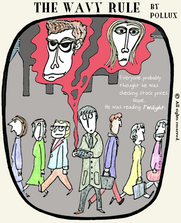
Click on the cartoon to enlarge it! Read “The Wavy Rule” archive, and “order your Wavy Rule 2008 Anthology today!”:http://emdashes.com/2009/03/the-wavy-rule-anthology-now-fo.php
Annals of Cartography: Will Google Incorporate Broadway Closure?
Jonathan Taylor writes:
Pedestrians, beware iPhone-bearing out-of-town drivers: Checking in on Google Maps’ driving directions, it seems like one is still instructed to plow through the parts of Broadway recently closed to vehicles.
The Wavy Rule, a Daily Comic by Pollux: The Rotarian
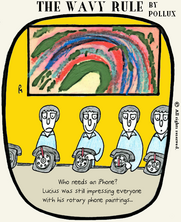
“Cartoon inspired by Jorge Colombo’s artwork.”:http://emdashes.com/2009/05/of-pixels-and-pastels-new-york.php
Read “The Wavy Rule” archive, and “order your Wavy Rule 2008 Anthology today!”:http://emdashes.com/2009/03/the-wavy-rule-anthology-now-fo.php
Mastery of Syntax Fuels Apparent “Michael Jordan of Captioners”
Martin Schneider writes:
I was tickled by Steve Johnson’s post at the Chicago Tribune‘s website on Larry Wood, who has now won the New Yorker Caption Contest for the third time.
Here are Wood’s previous two victories. (Hat tip to David Marc Fischer’s indispensable Blog About Town.)
Reading between the lines, it seems that economical wording is key to the Chicago attorney’s success. Johnson quotes Caption Contest honcho Robert Mankoff that “Wood’s was clearly the best worded of several submissions that went after the same basic joke.”
Also noteworthy is the news that every week, Farley Katz, who administers the contest, “culls through the submissions, catagorizes [sic] them by type of joke.” It hadn’t really occurred to me that so many people would coincide on their jokes every week, but it does make sense.
Even readers with exceptional eidetic memory will probably need reminding that Wood is an Emdashes reader. Congratulations, Lawrence—or may I call you Larry?
The Wavy Rule, a Daily Comic by Pollux: The Deals of the World Are a Constant Quantity
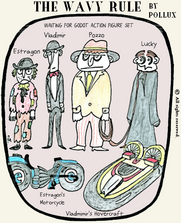
Read John Lahr’s New Yorker “review”:http://www.newyorker.com/arts/critics/theatre/2009/05/18/090518crth_theatre_lahr of “Waiting for Godot,” which is back on Broadway.
Read “The Wavy Rule” archive, and “order your Wavy Rule 2008 Anthology today!”:http://emdashes.com/2009/03/the-wavy-rule-anthology-now-fo.php
New Yorker Fiction Podcast Continues on its Royal Way
Benjamin Chambers writes:
On the eve of the release of The New Yorker’s fiction issue, it seems like the right time to mention (again) how amazing the magazine’s fiction podcasts are. Back in January, I reviewed the 2008 podcasts and even threw in a plug for this year’s reading by Thomas McGuane of James Salter’s chilling story, “Last Night.”
Now there’s three more treats waiting for the unwary:
- First, there’s Joyce Carol Oates reading Eudora Welty’s searing “Where Is that Voice Coming From?” from the July 6, 1963 issue. To my mind, Oates’ Yankee accent can’t do Welty justice, but the narrative’s acid power still leaks through. If it drives listeners to read the story on their own, then the podcast will have done its job.
- I’ve not read much Isaac Bashevis Singer, so it was a special treat to hear Nathan Englander read Singer’s “Disguised,” from the September 22, 1986 issue, about a woman who searches for the man who inexplicably abandoned her only to find he’s taken up an unthinkable new life without her. A marvel of economy, the story’s simply delightful, and Englander’s reading enhances it.
- After a great performance last September reading Stephanie Vaughn’s “Dog Heaven” from January 1989, Tobias Wolff returned to read another classic (albeit better-known): “Emergency,” by Denis Johnson, first published in the magazine on September 16, 1991 and later collected in Johnson’s book Jesus’ Son.
Bottom line: you can’t go wrong with any of these. Go forth and listen!
What’s in This Week’s New Yorker: 06.08.09
Martin Schneider writes:
The summer fiction issue of The New Yorker comes out tomorrow. A preview of its contents, adapted from the magazine’s press release:
In “Good Neighbors,” Jonathan Franzen’s first piece of fiction in four years, an upwardly mobile couple, Walter and Patty Berglund, deal with their recalcitrant son while their neighbors gossip and their blighted St. Paul block gentrifies in the nineteen-eighties and nineties.
The issue also features début fiction by Téa Obreht, a previously unpublished writer who graduated from Cornell University’s writing program in January, 2009. Obreht was born in Yugoslavia, grew up in Egypt and Cyprus, and moved to the United States in 1997.
In an excerpt from his upcoming book, The Book of Genesis Illustrated, due out this fall from W.W. Norton, R. Crumb illustrates the story of creation and of Adam and Eve’s expulsion from the Garden of Eden.
Louis Menand explores the rise of university creative-writing programs.
In “Old Wounds,” Edna O’Brien chronicles the difficulty that two cousins have in trying to reconnect after a long family feud.
David Grossman writes about the Jewish Polish writer Bruno Schulz, and investigates the circumstances of his death—ostensibly as a victim of a feud between two Nazi officers—in 1942.
In “A Soldier Home,” Yiyun Li remembers reading Hemingway and other writers in English as a way to escape from her life during and after her military service in China.
In “Two Emmas,” Roger Angell describes the bookshelves at his summer home in Maine and recalls fondly his experience reading The Garrick Year by Margaret Drabble.
In “The Magic Mountain,” Aleksandar Hemon reminisces about his long solo summer reading holidays in his family’s remote cabin on Jahorina, a mountain in Bosnia.
Jeffrey Toobin, in Comment, examines Sonia Sotomayor’s nomination and reflects on diversity on the Supreme Court.
In The Financial Page, James Surowiecki looks at the role that fear has played in the U.S. credit crunch and Buenos Aires’s recent coin shortage.
Nancy Franklin watches Nurse Jackie.
Sasha Frere-Jones listens to the Hypnotic Brass Ensemble.
Alex Ross attends a musical “marathon” of Gustav Mahler’s symphonies.
Hilton Als explores race and desire in Tennessee Williams’s Vieux Carré.
David Denby reviews Up, Night at the Museum: Battle of the Smithsonian, and Away We Go.
Sempé Fi (On Covers): Pachydermatitis

_Pollux writes_:
In 1814, Joseph Constantine Carpue became the first man in England to perform the procedure of rhinoplasty. He had adopted methods that had been practiced in India for thousands of years, and the whole operation took about 15 minutes. The patient was an army officer, who remarked after the operation was done, “It was no child’s play and extremely painful, but there was no use in complaining.”
A nose job can still be extremely painful, and the decision to get one should never be taken lightly. One gets a nose job for either health-related or functional reasons, or for aesthetic or cosmetic reasons. As one plastic surgery site “states”:http://www.theplasticsurgeon.org/rhinoplasty-phoenix.htm, “because the nose is a dominant feature of the face, it has an important role in determining overall appearance.”
The dominant feature on an elephant is of course its trunk, and serves the elephant well as an extra pair of fingers, an olfactory periscope, a drinking straw, a weapon, and a snorkel.
An elephant thus does not get a nose job on a whim. There has to be a pressing reason for a pachyderm to enter a plastic surgeon’s office: it is a question of survival.
But whose survival? Not this individual elephant’s, but that of the Republican Party, whose association with this symbolic animal “dates”:http://en.wikipedia.org/wiki/File:NastRepublicanElephant.jpg from the 1870s.
“Barry Blitt”:http://www.cartoonbank.com/search_results.asp?mscssid=N75BLQT1QCKS9NR183NUWJWU397MBJ28&sitetype=1&advanced=1§ion=all&artist=Barry+Blitt has visualized, on his May 25, 2009 cover for _The New Yorker_, the uncertainty that greets the Republican Party after Obama’s victory in November.
As David Brooks “has remarked”:http://www.guardian.co.uk/world/2009/apr/18/us-politics-republican-party, the Republican Party is “just a circular firing squad, with everybody attacking each other and no coherent belief system, no leaders. You’ve got half the party waiting for Sarah Palin to come rescue them. The other half waiting for Bobby Jindal, the Louisiana governor, to come rescue them. But no set of beliefs. Really a decayed conservative infrastructure.”
Blitt’s cover is called “Nip and Tuck,” and the general opinion amongst Republicans has been that their party needs to do a lot of nipping and tucking. But what appendages need to be nipped and which ones need to tucked?
Is it Karl Rove who needs to “crawl back to Texas, curl up beside a cactus and contemplate the ruin he has inflicted on the party”, as one panelist at the Conservative Political Action Conference “remarked?”:http://www.guardian.co.uk/world/2009/apr/18/us-politics-republican-party Or is it Rush Limbaugh who needs to stick a pacifier into the mouths of the “eight bawling babies”:http://emdashes.com/2009/03/sempe-fi-on-covers-1.php that comprise his toxic body mass?
And what to make of the Republican commentators who are so scared of Obama’s reforms that they seem to have misplaced their history textbooks? “Creeping socialism has been taking over the country piece by piece,” “one of them has written”:http://www.renewamerica.us/columns/dieckmann/090519. “It is the same socialism that early Americans left Europe to escape.” Perhaps I was asleep in my American History class (Ms. Goldberg, 1st period, 11th grade) when we were discussing how the Pilgrims fled England due to the introduction of the National Health Service.
There seems to be more than one party these days sharing the name of “Republican”: the Moderates, the Extreme Rightwingers, the Palinites, the Jindalians, the Dittoheads, the Romney-vians, the Sharks, the Jets… As it happens, Blitt’s elephant is going about it the wrong way. Instead of downsizing the length of its proboscis for the benefit of the whole party (there is no “whole party”), it would make more sense for it to metamorphose into several smaller, different animals.
I would love to see Blitt, a talented illustrator, draw a Moose for the Palinites, a Crawfish for the Jindalians, a Hedgehog bristling with AK-47s for the Extremists. It will be a new symbology for a new age. But Democrats will keep the donkey. The length of our ass’s nose is just fine.
The Wavy Rule, a Daily Comic by Pollux: The Moon’s Ear
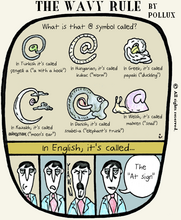
Back in 2008, we decided to come up with a “name for the upside-down question mark.”:http://emdashes.com/2008/07/what-do-you-call-an-upside-dow.php Our winning entry was _interroverti_.
Come on, loyal Emdashes readers! Come up with a better name for the “at sign”!
Click on the cartoon to enlarge it!
Read “The Wavy Rule” archive, and “order your Wavy Rule 2008 Anthology today!”:http://emdashes.com/2009/03/the-wavy-rule-anthology-now-fo.php