
Kirsten Andersen writes:
Zadie Smith and Jonathan Safran Foer sat down on April 30 at New York University for a ninety-minute discussion that began with a list—originally drafted by Smith in an email to Foer—of topics the two writers covered in a recent (and one assumes more private) conversation.
That list included foreskin, farting, and a nation’s romantic love for its president, and it served as the springboard to a milder discussion moderated by Foer, during which Smith addressed the Internet’s effect on writing (“an absolute disaster for writers”); writing about family (“writers come to destroy their families; there’s no doubt about it”); and her insistence on writing in the third person, despite the fact that “it looks antique now.”
The stage at Vanderbilt Hall remained unlit as the sun set in the windows along MacDougal Street, and it became difficult to see the faces of Smith and Foer from my seat in the middle of the auditorium. Still, I could easily make out Smith’s red head wrap, peacock blue mini-dress, and yellow stack heels. She was, as Foer might say, luminous, and when the conversation was opened to the audience for questions, a group of adoring men in front of me smiled at each other and shook their deferent heads.
Asked about her definition of failed writing, Smith scratched her arm and rubbed her neck. “Indulgence, making a fool of one’s self, caricature, overplotting, bad confused endings, too many semicolons,” she said. She smoothed her dress and crossed her legs as she dismissed femininity as a code for “passivity and delicacy”; she cited Pnin as one of her favorite novels.
“I’m constantly feeling like I’m on the back foot,” insisted the 2005 Orange Prize winner. Smith said that her forthcoming book, Changing my Mind: Occasional Essays, was an extended exercise in self-education. Citing her less than desirable primary school experience, Smith said she feels she is constantly learning “on the hoof.” A few heads pulled back and the brilliant writer nodded in earnest. All things considered, it seemed unlikely. Still, I took her elegant, artful word for it.
Kirsten Andersen is a poet, writer, and editor.
Author Archives: Emdashes
The Wavy Rule, a Daily Comic by Pollux: The Listener
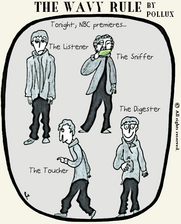
Click on the cartoon to enlarge it!
I don’t why but NBC’s new show “The Listener”:http://www.nbc.com/the-listener/ strikes me as such a silly name for a show or hero.
It’s been used before. When the comic series featuring the World II-era “Blackhawk”:http://www.internationalhero.co.uk/g/gablahaw.htm squadron “got a revamp”:http://www.superdickery.com/index.php?option=com_content&view=article&id=714:blackhawk-gets-the-worst-revamp-ever&catid=36:stupor-powers-index&Itemid=38, they transformed Chuck Wilson, one of the team members, into a “superhero” called _The Listener_. It was a ridiculous name then, and it’s a ridiculous name now.
Read “The Wavy Rule” archive, and “order your Wavy Rule 2008 Anthology today!”:http://emdashes.com/2009/03/the-wavy-rule-anthology-now-fo.php
Gratis Greens: The New Yorker’s Guide to Foraging
Jonathan Taylor writes:
Heirloom food culture is converging with the New Thrift, even if many practices, like shopping farmer’s markets and the home canning featured in the Times Wednesday, are most readily practiced by those with a surplus of time, if not money. The Wall Street Journal Wednesday charted a number of nutritious greens that were once commonly eaten but now proliferate, unnoticed and underfoot, in the guise of weeds. They’re had at greenmarkets for greenbacks, but are ripe for wider rediscovery as an opportunity for frugal foraging.
As the Journal notes, plants like purslane and sorrel went by the wayside by the mid 20th century, as “immigrants and rural Americans moved to cities, leaving behind both their gardens and their ethnic origins.” In 1943, during World War II days of rationing, The New Yorker‘s Sheila Hibben offered a timely reminder of “those perfectly edible greens which in happier times we called weeds.” Hibben’s “Markets and Menus” department was normally given over to the offerings of carriage-trade suppliers of glazed hams, cookies and wine.
- Milkweed: “as succulent and tender as any asparagus that has been made to grow by toil and patriotic enterprise” (Hibben raised the specter of the “shiftless country dweller” who might exploit “an untrimmed roadside” while “industrious Victory gardeners” labored away in their plots); to be harvested “just when the young shoots have pushed up to no more than six inches or so out of the ground.”
- Home-cut fern tips: “likely to be a fresher and altogether pleasanter green than the vegetable which used to come to town all worn out by the long trip down from Maine”; “serving them provides a satisfying pride and comfortable sense of living off the land.”
- Sorrel: “at this very minute is probably taking possession of your strawberry bed”; “Soft-cooked eggs or egg timables turned onto a bed of creamed sorrel provide as handsome a lunch dish as you could want of a hot day.”
- Dandelion: “only the very young dandelion leaves are edible and they must be cut far enough below the ground so that they are partly etiolated.” (???)
- Pokeweed shoots: “a slight, rather pleasant taste of iron”; “should be washed and carefully scraped and left in cold water for an hour”; “you had better look out” for poison in older plants. (The Journal says, “Eat with caution if at all,” cooking in at least two changes of boiling water.)
- Wild mustard: “more generally accepted socially,” and good boiled with bacon. (“If bacon makes too great a strain on the ration book, you’ll find that bacon rind, which has only a one-point value, adds the same rich flavor.”)
- Purslane: known as “pussley” by American farmers, and good “just to eke out a dish of boiled spinach.”
But note to New Yorkers: foraging in city parks is illegal without a permit, but there are sanctioned foraging tours by “Wildman” Steve Brill (Adam Gopnik went on one in 2007.)
Polansky’s Story Has Leg
Benjamin Chambers writes:
A couple of weeks ago, I used the random number generator to find a 2004 story from The New Yorker that I’d never read before by Yoko Ogawa, “The Cafeteria in the Evening and the Pool in the Rain.” This week, it took me to to the January 24, 1994 issue of TNY and Steven Polansky’s story, “Leg.”
In the story (and yeah, there are spoilers coming), Dave Long is a forty-four-year-old whose main trouble appears to be his thirteen-year-old son Randy’s new and implacable anger, a by-product of adolescence, which he spews at Dave every chance he gets. Even Dave’s liking for reading is a target:
If Dave sent Randy to his room or otherwise disciplined him … Randy would say, in his cruelest, most hateful voice, “Why don’t you just go read a book, Mr. Reading Man, Mr. Vocabulary. Go pray, you praying mantis.”
Sliding into third in a church softball game, Dave skins his leg from knee to ankle. Except for basic First Aid, he neglects the injury. It gets infected, leaks pus all over his pants, and he spends much of the story lying on the kitchen floor or on the couch with his foot elevated until the pain is so bad he can no longer stand. Four people tell him to go see the doctor (including the doctor himself, who warns of gangrene, sepsis, and amputation); Dave cheerfully deflects each request. He finally capitulates when his son asks him to go—too late, however, to save his leg.
It’s hard to understand why this apparently normal, well-meaning man would allow a minor injury to fester and keep him home from work, why he’d lie to others in order to avoid going to the doctor. But we get our first clue shortly after he gets home the night of the softball game, hours after he’s hurt himself.
We already understand that the scrape on his leg isn’t ordinary. He’s tried staunching the blood first with a whole roll of toilet paper, then gauze. He’s even applied a dish towel fresh from boiling water to the wound.
Then he sat down on the kitchen floor, his left leg stretched out before him, and prayed.
His praying was rarely premeditated or formal. Most often it was a phototropic sort of turn, a moment in which he gave thanks or stilled himself to listen for guidance. He shied from petitionary prayer. With all he had, it felt scurvy—scriptural commendation notwithstanding—to ask for more. This night, his leg hurting to the bone, he permitted himself a request.
“Father” he said quietly, “please help me to see what I can do for Randy. He is in great pain. I love him. If it is your will, show me what I might do to bring him peace.”
His request is surprising, and gives us a sense of the line he’s going to take: his injury is of no importance, except, perhaps, as a means to healing his relationship with his son and with God.
I can’t prove it, but I suspect Dave’s relationship with God matters more to him than Randy does, though the author, like Dave himself, keeps this fact low-key. For example, I had to re-read the story to catch a second meaning when the left fielder, a pastor, calls to Dave as he’s caught between bases, “You’re dead, man.” Dave smiles at this, and then reflects, “But Pastor Jeff had the straight truth here: Dave was dead. To rights. Dave had been fast, but he was forty-four now, and he was too slow to pull this sort of stunt.”
The awkward syncopation of “Dave was dead. To rights,” is meant (clumsily I think), to call attention to Dave’s real problem. It’s not Randy: it’s the fact that he is in some way, spiritually, or perhaps in the afterlife, dead.
And then there’s the pun wrapped up in the “straight” (or strait) truth. For the very morning of the softball game, Dave and his own pastor had discussed Matthew 7:13-14, a passage that
… Dave had lately found compelling and vexing. “Enter through the narrow gate. For wide is the gate and broad is the road that leads to destruction, and many enter through it. But small is the gate and narrow the road that leads to life, and only a few find it.”
Dave, pressed by his pastor, defines the “narrow gate” variously as severe, pinched, straitened, exclusive, simple, severe. Hence the extra oomph when the left fielder is described as having the “straight [strait] truth.”
Later, when Dave’s suppurating wound has confined him to the couch, he tells his pastor that he thinks that some of the faithful (meaning himself) need a prescriptive theology: “We’re sloppy. We’re slack. We’re smug. We’re just flat-out disappointing. You got to whip us into shape, or we embarrass ourselves. And each other.”
In this context, it’s possible that Dave sees his son Randy’s constant insults as a kind of necessary “straitening,” a scarifying test. By testing himself in even harsher terms and allowing his infected wound to inflict him with unrelenting pain, Dave is pushing himself through the “narrow gate” into a new life.
Which explains why Dave does not spend his time moaning or complaining. Instead, his wife describes him as “calm and reasonable and in amazingly good spirits.” When his family joins him in the living room to eat dinner and watch television, we are told that “Dave, who was light-headed and running a low-grade fever, was happy.” He has the serenity of the saved.
Dave relies on his faith to resolve his tension with Randy, yet without taking any direct action himself, a device that definitely sets the story apart. After all, it’s not everyone who would address the storms of his child’s adolescence with a strict and self-lacerating commitment to avoiding medical care, completely certain that rapprochement will result.
The Wavy Rule, a Daily Comic by Pollux: Sverige är ett underbart land
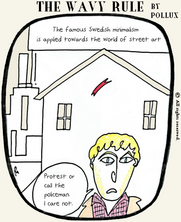
Read “The Wavy Rule” archive, and “order your Wavy Rule 2008 Anthology today!”:http://emdashes.com/2009/03/the-wavy-rule-anthology-now-fo.php
Roger Angell Beats Jeffrey Toobin to Sotomayor by Fourteen Years
Martin Schneider writes:
One of the few things we know about President Obama’s recently announced nominee for the Supreme Court, Yankees fan Sonia Sotomayor, is that she played an important role in the resolution of the baseball strike of 1994-1995 (glad I was living abroad for that stretch; I barely noticed it). She issued the injunction against the baseball owners after ruling that their actions against the players’ union had violated federal law. As Avil Zenilman noted, that happenstance bit of notoriety caused Roger Angell to mention her name in the magazine, twice, in 1995:
“Comment: Mind Game,” April 10, 1995, p. 5
“Called Strike” May 22, 1995, p. 46
Jeffrey Toobin, who mentioned Sotomayor back in February, is catching up fast, though:
“After Ginsburg”
“The Arc of Justice”
Amy Davidson has also written about Sotomayor several times since the announcement of Justice Souter’s retirement:
“Uncharitable Judgments”
“Insults and Impunity”
“A Deep Bench”
“Saving the Season”
Cocktail Contriver: Rea Irvin’s Illustrations for Crosby Gaige’s Cocktail Guide and Ladies’ Companion
“Beer drinkers lead a dreary and gaseous life … Whiskey enthusiasts are … confined to a three-lane highway – straight, soda, or just plain water. But the cocktail contriver … has the whole world of nature at command…” So declares _Crosby Gaige’s Cocktail Guide and Ladies’ Companion_, published in 1941.
Crosby Gaige (1882-1949), a book publisher and book collector, had help from fellow travelers in the world of potent potables: “Lucius Beebe”:http://en.wikipedia.org/wiki/Lucius_Beebe provided a foreword; “Alexander Lawton Mackall”:http://en.wikipedia.org/wiki/Alexander_Lawton_Mackall an afterword or “final insult.”
And, lucky for Emdashes, the center for all things Irvinian, Gaige employed the talents of Rea Irvin, who “richly embellished” the book “with drawings almost from life.” Check out Lady Brett’s “post”:http://ladybrettashley.wordpress.com/2009/05/22/femme-guide-to-butch-drinks-part-3/ on her copy of the book.
The Wavy Rule, a Daily Comic by Pollux: Gumby and Friends and Enemies
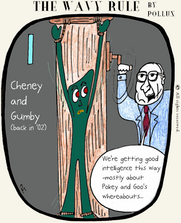
Click on the cartoon to enlarge it!
Read “The Wavy Rule” archive.
Of Pixels and Pastels: New Yorker artist Jorge Colombo’s iPhone Art

_Pollux writes_:
If you call “Jorge Colombo”:http://www.jorgecolombo.com/, he may not pick up.
He’s busy using his phone for something other than talking, e-mailing, and finding directions. He’s creating artwork with his iPhone, whose Brushes feature is a sophisticated “mobile painting” application complete with color wheel, undo/redo functionality, and a selection of brushes.
This is powerful technology, and the Portuguese-born Colombo applies an artist’s sensibility to create immensely delicate and interesting iSketches that capture the city in a new medium. The iPhone has become one more tool in the artist’s kit. “I got a phone in the beginning of February, and I immediately got the program so I could entertain myself,” Colombo “remarks.”:http://www.newyorker.com/online/blogs/tny/2009/05/jorge-colombo-iphone-cover.html
But Colombo’s art isn’t gimmicky ephemera, and his art is not, thankfully, trapped on his phone. The June 1, 2009 “_New Yorker_ cover”:http://www.newyorker.com/online/blogs/tny/2009/05/jorge-colombo-iphone-cover.html is in fact a Colombo iArtpiece. He is also selling 20×200 iPhone drawings “at 20 x 200.”:http://www.20×200.com/aaa/jorge-colombo/
Colombo, born in Lisbon in 1963, is not a greenhorn graphic designer or emerging artist (not that there’s anything wrong with that), but an established illustrator, filmmaker, and photographer, who has worked as art director for various Chicago, San Francisco, and New York magazines. He has books under his belt, including the photographic novel “”Of Big and of Small Love””:http://www.jorgecolombo.com/bsl/index1.htm (”Do Grande e do Pequeno Amor”), a work of half-photography and half-fiction writing. iPhone’a Brushes app, then, is for him a new and useful tool rather than a replacement for camera or pen.
Paul Éluard once remarked that “the poet is not he who is inspired but he who inspires.” In the same way, Colombo is a poet who, no doubt, will inspire a new market for iPhone-generated art.
**James Falconer** “reports”:http://www.intomobile.com/2009/05/25/iphone-and-brushes-app-used-to-create-june-1st-cover-art-for-the-new-yorker.html on this story, and includes an image of Colombo’s cover.
The **Knight Center** “covers Colombo’s new artwork.”:http://knightcenter.utexas.edu/blog/?q=en/node/4118
Colombo’s isn’t the only one: the “iPhone Art Flickr group.”:http://www.flickr.com/groups/brushes/
The Wavy Rule, a Daily Comic by Pollux: Grunge Fonts
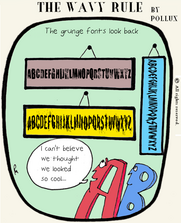
Click on the cartoon to enlarge it!
Read “The Wavy Rule” archive.