
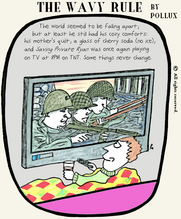
Click on the cartoon to enlarge it!
Read “The Wavy Rule” archive.
Author Archives: Emdashes
The Wavy Rule, a Daily Comic by Pollux: The Gift of Green
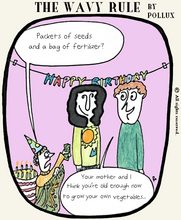
Boy, this kid gets the most “awful”:http://emdashes.com/2008/12/the-wavy-rule-a-daily-comic-by-114.php “gifts.”:http://emdashes.com/2008/12/the-wavy-rule-a-daily-comic-by-100.php Click on the cartoon to enlarge it!
Read “The Wavy Rule” archive.
Natasha Richardson in The New Yorker
Martin Schneider writes:
One day after the passing of Natasha Richardson, we present a list of her mentions in the magazine.
January 12, 1998: John Lahr, a showcase on Richardson
Digital Edition, website (abstract)
(Max Vadukul’s picture is magnificent.)
April 6, 1998: Nancy Franklin reviews “Cabaret”
Digital Edition, website (abstract)
May 18, 1998: Lillian Ross “Talk of the Town” item
Digital Edition, website (abstract)
April 5, 1999: John Lahr review of “Closer”
Digital Edition, website (abstract)
June 11, 2001: Dana Goodyear “Talk of the Town” item
Digital Edition, website
March 28, 2005: Lillian Ross “Talk of the Town” item
Digital Edition, website
May 9, 2005: John Lahr, review of “A Streetcar Named Desire”
Digital Edition, website
August 22, 2005: Anthony Lane, review of “Asylum”
Digital Edition, website
There’s also this interesting search of the archives, hits include a lot of random material from the “Goings On About Town” section. In a sense, you get a more accurate picture of her career as an actress by clicking on these (subscription to the magazine required).
New Yorker Blog Roundup: 03.19.09
Martin Schneider writes:
It’s about time we added to that Britney Spears keyword up there. Click it, you’ll see she’s come up before.
(This content is taken directly from the left nav bar on the magazine’s website.)
James Surowiecki overhears someone wishing they’d bought Citigroup.
Steve Coll considers Clay Shirky’s take on the collapse of newspapers.
Elizabeth Kolbert on who’s donating to climate-change deniers.
Evan Osnos marvels at which American movies make it to China.
News Desk: Pre-register for the New Yorker Summit.
Hendrik Hertzberg on why Paul Krugman is right about Europe’s economy.
The Front Row: Almodóvar’s latest, “Nightmare Alley.”
George Packer recommends a photography exhibit of the war in Congo.
Sasha Frere-Jones sees Britney Spears and feels like he’s at a theme restaurant.
The Book Bench: Millard Kaufman, collecting trees, Paul Muldoon to music.
The Cartoon Lounge: Dispatches from SXSW.
Goings On: The N.C.A.A. Men’s Basketball tournament, a John Lennon biopic.
Ask the Author: Submit a question to Keith Gessen about the Politkovskaya murder trial.
Title Tales Told: A Worthy New Blog
Jonathan Taylor writes:
Journalists rarely write their headlines, we all know, but the formulation of a book’s title is usually a murkier affair between author and publisher. And that is the subject of Gary Dexter’s excellent new blog, How Books Got Their Titles—with daily posts giving “the story behind a famous title of world literature.”
Some are behind-the-scenes tales of the title-deciding process; others puzzle out the title’s (not obvious) basis within the work itself. Plus: how to pronounce Sketches by Boz, and did you know that Thomas Hobbes also wrote a Behemoth?
I first became aware of the possibility that books might not be inseparable from their titles during my grade-school phase of speed-reading Agatha Christie mysteries, many of which bore inscriptions noting that they had been published under a different title in Britain. (An issue perhaps worth a Dexter digression?)
The next logical step is, how books get their covers. I content myself with the Financial Times‘s weekly feature, Book Covers. But there is, naturally, a whole book-coversphere to explore!
Call for Information / Opinion: Lyll Becerra de Jenkins
Martin Schneider writes:
On one of our most popular pages (it attracts a lot of search engine traffic), a reader called Arya Breton contributes a terrific bit of context for a mentioned writer:
Lyll Becerra de Jenkins was an extraordinary journalist, writer of fiction and teacher of writing. She wrote three books—The Honorable Prison, Celebrating the Hero, and So Loud a Silence. Her short stories, such as Tyranny, which later evolved into the prize-winning YA fiction, The Honorable Prison, were masterful. During a time when everyone from Latin America was writing in the style of the magical realists, she set herself apart. A resident of New Canaan, Connecticut, where she emigrated with her North American husband and five children, she seeped herself in the writing of the Brits and North Americans and developed her own distinct voice and approach to story-telling. Frances Kiernan of The New Yorker, who was her editor in the 70s, said her writing had “unique tension,” a flamenco style.
Sounds fascinating! I notice my public library has copies of The Honorable Prison and Celebrating the Hero. I’d be happy to spark a Lyll Becerra de Jenkins revival. If you are a fan or simply know something about her, please write in. And that includes you, Arya Breton!
Before Hersh and Mayer: Waterboarding Described in a 1946 New Yorker
Jonathan Taylor writes:
After reading Mark Danner’s New York Review of Books revelations and meditations on the Red Cross reports on Guantanamo, and trying to recapture some perspective on “torture”—what the word meant to all of us before it was associated on a daily basis with the United States first and foremost—I put the word into The New Yorker‘s search engine. The first thing I was reminded of was Lawrence Weschler’s 1980 two-parter on the use of torture under the Brazilian military dictatorship, “A Miracle, a Universe” (although these, of course, implicated the U.S., too). There’s also a lot on the subject relating to Nazi and Japanese World War II atrocities. Peter Kalischer’s 1947 story “Neighbor: Tokyo, 1947” describes an accused war criminal said to have forced “sick men to march up and down the damp stone corridors without their clothes”—the kind of thing that made Rummy chuckle.
But I also found a curious and disturbing story called “Police Duty,” by James A. Maxwell, from 1946, that the words of Red Cross report echo across the decades. The narrator describes a British policeman in Tripolitania (in Libya), his attitudes toward “Arabs,” and particularly an episode in which he elicits a confession from a suspected murderer.
Captain Westcott went over to the Arab and placed a hand on his shoulder. He asked several more questions in the same soft voice, but no sound came from the prisoner. Suddenly the Captain drove his right fist hard into the Arab’s stomach. The man gave a high cry and dropped to the floor, where he writhed, gagged, and gasped for breath. After a few moments, one of the guards jerked him to his feet, but he stood doubled up. My companions at the table looked at him as impersonally as if he were a stranger seated opposite them in a streetcar. Westcott came back to the table, poured a cup of tea for himself, and asked the Arab if he was ready to talk. The man said he knew nothing about the murder.
And, after an episode with a gruesome technique using “what looked like a pair of handcuffs,” described with clinical expertise by the narrator, produced no results,
Captain Westcott told one of the guards to get some water. When the policeman returned with two bottles of water, the prisoner was stretched out on the floor, face up, with one guard holding his feet and another on each of his arms. The guard with the water tipped the Arab’s head back and began to pour water down his nose. The man thrashed and gagged, and then retched. He was literally drowning. Wetcott told the men to stop. The guards pulled the man to his feet. He nodded his head when the Captain asked if he was ready to confess.
The story has all the chilling detachment of its abstract: “The policy of violence for violence is demonstrated….”
Who was James Maxwell? “Police Duty” and other New Yorker pieces (categorized Fiction) of his were collected in I Never Saw An Arab Like Him, published in 1948. He seems to have been a counterintelligence officer in the Middle East during World War II.
I haven’t found much about Maxwell or his book outside pay archives containing initial reviews of it. Commentary ran a review by Anatole Broyard; the free snippet on its site seems to herald a takedown:
As the land of technical genius, America has perfected millions of pleasure-giving, work-saving devices—smooth-riding cars, static-free radios, automatic washing machines, and so on indefinitely. It seems only natural then that Americans should have perfected a style of writing compatible with these mechanical conveniences—a style also mechanical, smooth, without static, full of devices, laundered of all distressing odors and smudges, etc.
Anybody know more about this Maxwell character? (Not to be confused with editor William Maxwell, of course.)
Natasha Richardson, 1963-2009
Martin Schneider writes:
This just came across the wires. I don’t often get too emotional about celebrity deaths, but I’m feeling this one. This is really sad. Our condolences go out to her family and friends.
New Yorker Nominated for a Bunch of National Magazine Awards!
Emily Gordon writes:
Quoting from the American Society of Magazine Editors website, the most relevant and, for Emdashes writers and readers, exciting bits (OK, I’m also very happy for my own magazine, Print):
• The New Yorker leads the list of finalists with a total of 10 nominations, including General Excellence, Reporting and Feature Writing. The New Yorker is the most honored magazine in the history of the awards, having received 187 nominations and 47 Ellies.
GENERAL EXCELLENCE: Recognizes overall excellence in magazines in six circulation categories. The award honors the effectiveness with which writing, reporting, editing and design work together to command readers attention and fulfill the magazine’s unique editorial mission.
Circulation 1,000,000 – 2,000,000
Bon Appétit; Field & Stream; The New Yorker; Popular Science; Vogue
[The New Yorker was nominated for the issues of February 11 & 18, 2008; May 26, 2008; and November 17, 2008.]
REPORTING: This category recognizes excellence in reporting. It honors the enterprise, exclusive reporting and intelligent analysis that a magazine exhibits in covering an event, a situation or a problem of contemporary interest and significance.
Fast Company; GQ (2 nominations); The New York Times Magazine; The New Yorker
[Ryan Lizza on how Chicago shaped Barack Obama: “Making It,” July 21, 2008]
FEATURE WRITING: This category recognizes excellence in feature writing. The award honors the stylishness, flair and originality with which the author treats his or her subject.
The Atlantic; Esquire; GQ; Harper’s Magazine; The New Yorker
[Nick Paumgarten on the lives of elevators: “Up and Then Down,” April 21, 2008]
ESSAYS: This category recognizes excellence in essay writing on topics ranging from the personal to the political. Whatever the subject, the award honors the author’s eloquence, perspective, fresh thinking and unique voice.
The Antioch Review; Backpacker; Glamour; Harper’s Magazine; The New Yorker
[Roger Rosenblatt on death and family: “Making Toast,” December 15, 2008]
COLUMNS and COMMENTARY: This category recognizes excellence in short-form political, social, economic or humorous commentary. The award honors the eloquence, force of argument and succinctness with which the writer presents his or her views.
Automobile; The Nation; The New Republic; The New Yorker; Sports Illustrated
[Hendrik Hertzberg, Comments on Barack Obama’s visit abroad (“Foreigners,” August 4, 2008), on McCain supporters calling Obama a socialist (“Like, Socialism,” November 3, 2008), and on the passing of Proposition 8 in California (“Eight is Enough,” December 1, 2008)]
REVIEWS and CRITICISM: This category recognizes excellence in criticism of art, books, movies, television, theater, music, dance, food, dining, fashion, products and the like. The award honors the knowledge, persuasiveness and original voice that the critic brings to his or her reviews.
The Atlantic; The Nation; New York (2 nominations); The New Yorker
[James Wood, Books, on Richard Price and the art of dialogue (“Say What?,” April 7, 2008), on Marilynne Robinson and religion (“The Homecoming,” September 8, 2008), and on the life of V.S. Naipaul (“Wounder and Wounded,” December 1, 2008)]
FICTION: This category recognizes excellence in magazine fiction writing. The award honors the quality of a publication’s literary selections.
The American Scholar; The New Yorker (2 nominations); The Paris Review; The Virginia Quarterly Review
[Annie Proulx, “Them Old Cowboy Songs,” May 5, 2008; Aleksandar Hemon, “The Noble Truths of Suffering,” September 22, 2008; Roberto Bolaño, “Clara,” August 4, 2008; Joshua Ferris, “The Dinner Party,” August 11, 2008]
LEISURE INTERESTS: This category recognizes excellent service journalism about leisure-time pursuits. The practical advice or instruction presented should help readers enjoy hobbies or other recreational interests.
Esquire (2 nominations); Field & Stream; The New Yorker; Texas Monthly
[Patricia Marx, On and Off the Avenue, on shopping in China (“Buy Shanghai!” July 21, 2008), on buying shoes in New York (“Sole Sisters,” September 1, 2008), and on going discount (“The Price is Right,” December 8, 2008)]
PHOTO PORTFOLIO: This category honors creative photography and photo illustration (including portraiture or specially produced layouts on fashion, food, decorating, travel, design, the arts, etc.).
Bon Appétit; GQ; Gourmet; The New Yorker; W
[Platon, photographs of the men and women who volunteered to serve in Iraq and Afghanistan, and their families: “Service,” September 29, 2008]
The Wavy Rule, a Daily Comic by Pollux: Pump Up (and Down) the Volume
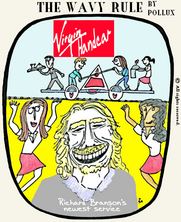
Click on the cartoon to enlarge it!
Read “The Wavy Rule” archive.