
Martin Schneider writes:
I have the vague impression that the magazine’s newfound interest in its blog section has not penetrated the awareness of its audience, as much as one might hope. There has been a lot of activity over there since about Thanksgiving; there’s terrific writing there every single day, and you should check it out. Hence this recurring feature.
Also: Comments! Some of these blogs accept comments. Steve Coll’s “Think Tank” accepts them, Richard Brody’s “Front Row” accepts them, and George Packer’s “Interesting Times” accepts them. New terrain, indeed!
So go over and make those writers feel good—everyone appreciates a little feedback. And more to the point, make the magazine feel good about its decision to give you a voice!
As always, I’ll be putting this little message in front of the roundup: (This content is taken directly from the left nav bar on the magazine’s website.)
Steve Coll on why energy efficiency matters in a time of war.
Evan Osnos puts himself in Richard Nixon’s shoes.
The Front Row: Danny DeVito will tell the story of “Crazy Eddie.”
Hendrik Hertzberg revisits election results and reaches a conclusion.
News Desk: Grown men, in unfamiliar places, can do strange things.
James Surowiecki asks what it means to bury a bank.
George Packer praises a civil servant helping Iraqi refugees.
Sasha Frere-Jones finds his soulmate.
The Book Bench: Generation twit, is Joan Acocella a vampire?
The Cartoon Lounge: Warren Miller draws man’s best friend, playing dead, one million dogs.
Goings On: U2 disappoints fans, guess the name of Rihanna and Chris Brown’s duet.
Ask the Author: Submit a question to the editor the Style Issue, Susan Morrison.
Author Archives: Emdashes
The Wavy Rule, a Daily Comic by Pollux: Death By Design

Click on the cartoon to enlarge it!
Read “The Wavy Rule” archive.
David Foster Wallace’s “Wiggle Room” and Updike’s “Basically Decent”
Benjamin Chambers writes:
I’ll confess up front that I don’t care for novel excerpts. The pleasures of fiction include completing a narrative arc, seeing a character in the round, or comprehending the whole of the author’s conceit and execution, yet all of these are thwarted by an excerpt. The New Yorker publishes a lot of such excerpts, and they are invariably unsatisfying. (Recent examples include Colson Whitehead’s “The Gangsters,” from the December 22, 2008 issue, or Louise Erdrich’s “The Fat Man’s Race” from the November 3, 2008 issue.)
TNY might reasonably be excused, however, for publishing work excerpted from novels that are to be published posthumously, as it did in the March 9, 2009 issue, with David Foster Wallace’s “Wiggle Room,” which is taken from his unfinished novel, The Pale King. On the other hand, with Wallace’s suicide still so recent, you can’t read “Wiggle Room” without being acutely aware of the poignant reason it’s before your eyes. And what can you say about it? You can’t praise it without wondering if you’re making unwarranted allowances; nor can you critique it without feeling that you’re kicking Wallace while he’s down.
That said, I soldier on. “Wiggle Room” focuses on a young I.R.S. agent’s fight against boredom as he does his stultifying work. The agent is suddenly visited by an improbable hallucinatory figure who knows all about the etymology of “boredom” and “interesting.” (D. T. Max, in his introductory essay, “The Unfinished,” tells us this figure is the ghost of another I.R.S. agent). The relief with which I greeted this hallucination speaks to how well Wallace conveys, during the first half of the piece, how unpleasant tedium can be.
One of my favorite aspects of the excerpt is the recurring image of the beach. The agent has been taught to visualize a pleasant afternoon at the beach as a way of refreshing himself mentally, but when he tries it, the imagery proves a flimsy defense. It starts off as “a warm pretty beach with mellow surf,” but “[a]fter just an hour [of work] the beach was a winter beach, cold and gray and the dead kelp like the hair of the drowned.” A little later, the agent’s sunny beach has devolved even further:
The beach now had solid cement instead of sand and the water was gray and barely moved, just quivered a little, like Jell-O that’s almost set. Unbidden came ways to kill himself with Jell-O.
Still, “Wiggle Room” isn’t terribly satisfying. It’s slightly more so than most excerpts because it narrates a complete incident, but it’s not a complete story. An I.R.S. agent is visited by a smart-ass ghost: why? Does it change him? Does the ghost come back? Does the ghost do anything besides belch up etymologies? Does the agent manage to stick with the job, despite his obvious hatred of it? None of these questions can be addressed by the excerpt, though I have to admit that it does its job—and Wallace would’ve been wryly savage about this—of teasing prospective buyers to read the entire novel-fragment when it’s published.
It’s also poignant to read (in the same issue as “Wiggle Room”) “Basically Decent,” John Updike’s posthumous review of Blake Bailey’s new biography of John Cheever. It’s poignant not only because the review may well be Updike’s last book review for the magazine, but because he was writing about John Cheever, who, like Wallace, was famously tormented and struggled all his life with doubts about the merits of his work; but who, unlike Wallace, was able by some miracle of grace to keep trying.
Updike doesn’t like Bailey’s bio much. Though he applauds its thoroughness, he nails its drawback with characteristic elegance, observing that “all this biographer’s zeal makes a heavy, dispiriting read.” The pleasure of reading Cheever’s fiction, in other words, and the “glimmers of grace and well-being” experienced by his characters, are “smothered” in the biography, which cannot ward off “the menacing miasma of a life which, for all the sparkle of its creative moments, brought so little happiness to its possessor and those around him.”
In this, though, Bailey’s biography is no different from literary biographies as a class. I’m sure Bailey did an excellent job of documenting the facts of Cheever’s life and the chronology of his work, but a life can only go so far to explain its art; explanation rarely improves the work. (This is partly what is meant by saying that art is transcendent, after all.)
Charles McGrath also reviewed Bailey’s biography for the New York Times. I preferred his review to Updike’s because McGrath, in addition to addressing the biography, took the time to argue that it’s not just Cheever’s life that deserves new attention, but his work does too. In particular, I appreciated the fact that he disassembled the ridiculous-but-common canard that Cheever was a chronicler of suburban malaise, when in fact, as McGrath notes, “…far from being another Sloan Wilson-like chronicler of suburban malaise—or even a meticulous painter of middle-class life like Updike—Cheever was a writer pressing against the very limits of realism itself.”
McGrath proves his case, I think, but I urge any doubters to check out Cheever’s story, “Some People Places and Things That Will Not Appear in My Novel”, which appeared in the November 12, 1960 issue of TNY, and which I wrote about here. In it, he uses metafictional techniques to talk about his impatience with the complacency and foolishness of then-contemporary fiction—and with his own.
But the phrase Updike uses to describe Cheever’s unhappy life, “menacing miasma,” is apt, and applies to accounts of David Foster Wallace’s life as well. Perhaps it’s only because Wallace’s story was published next to Updike’s review of Cheever’s biography, but I couldn’t help feeling that the degree to which Cheever’s unhappiness haunted his work (as in the “Some People Places and Things” story) was echoed in Wallace’s life and work as well. It’s hard not to think of Wallace when one reads Updike’s observation about Cheever: “Like Kafka and Kierkegaard, Cheever felt his own existence as a kind of mistake, a sin.”
Peace be upon them both, and upon Updike for good measure.
Thru You, Through the New Yorker Blog, to Most of the Rest of Us
Martin Schneider writes:
A friend sent me a link to Kutiman’s marvelous “Thru You” website, and now I’m all excited about it. After the initial delight had worn off, I thought, “I wonder if Sasha Frere-Jones knows about this?”
Relax, man, his blog was on it way back last week (an eternity in meme propagation terms). Unsurprisingly, what he has to say is well worth a look.
But more to the point, go visit Thru You.
The Wavy Rule, a Daily Comic by Pollux: Futility Treatment
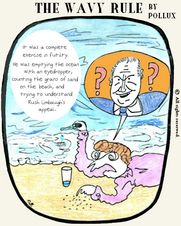
Click on the cartoon to enlarge it!
Read “The Wavy Rule” archive.
New to the Twittersphere: Richard Brody of “The Front Row”
Martin Schneider writes:
Richard Brody, who covers movies from “The Front Row” in the blogs section of the New Yorker website, has taken up Twitter.
The main New Yorker/Twitter post has been updated accordingly.
The Wavy Rule, a Daily Comic by Pollux: Love in the Time of Grammar
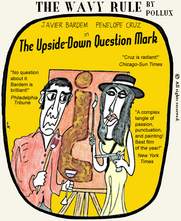
Written and directed by Juan “Interroverti.”:http://emdashes.com/2008/09/winners-weve-got-winners.php Click on the cartoon to enlarge it!
Read “The Wavy Rule” archive.
Area Twitterer Muses About Literary Magazine in 140 Characters or Fewer
Martin Schneider writes:
You guessed it, more New Yorker mentions from the aether! Let’s dive right in, shall we?
LeonardoZ Reading The New Yorker. Such a well written magazine. Wondering how even good mags can survive, specially in this economy.
cazelk It’s about time the New Yorker coughed up a solid 12,000 words on DFW. What do we pay them for again? Ohhhh right, I get it.
PaigeWiser The cover of the New Yorker magazine features Michelle Obama… with sleeves. Didn’t recognize her.
ericaceous Is there a bookstore in all of New York that carries anything by James Wood? He writes for the New Yorker, fer cripes sake!
judygoldberg I’m a finalists in this week’s New Yrker Caption Contest! I’ll just come right out and ask pls vote 4 me!!! http://tinyurl.com/anban5
mnreads listening to the new David Foster Wallace excerpt in the New Yorker, the read pronounces Edina, Minnesota wrong
nancheney David has the newly arrived New Yorker with the David Foster Wallace article. I had it first. grrrrrr.
alsolikelife: thinks David Denby’s New Yorker mumblecore piece reads like a teacher-parent consultation during PTA week: “Little Joey is making movies…”
wackjack I find it charming that The New Yorker still refers to publicists as press agents.
ErikHagen I like his beard so much that I want to draw pictures of it, and send them to the New Yorker to be published.
samduke left my new yorker at the taqueria only a 1/3 way through that epic DFW profile. 2nd time this week i’ve lost something before finishing it.
Cartoonless Captions Twitter: Inspired by TV on the Radio?
The Wavy Rule, a Daily Comic by Pollux: Clocks Have Feelings Too
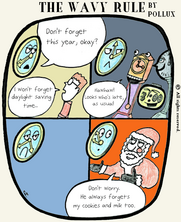
Click on the cartoon to enlarge it!
Read “The Wavy Rule” archive.