
Martin Schneider writes:
(This content is taken directly from the left nav bar on the magazine’s website.)
George Packer wants liberals to put principles first (or second).
The Front Row: Novels we wish filmmakers would bring to the screen.
Steve Coll offers readers a biodegradable coffee mug.
James Surowiecki remembers the early nineties.
Evan Osnos on when boats collide.
News Desk: Mass famines, bad bishops.
Hendrik Hertzberg tentatively concludes that Americans love their (political) parties.
Sasha Frere-Jones is neither old nor grouchy, in case you were worried.
The Book Bench: Charlotte’s Web, John Wray on writing a book on the subway.
The Cartoon Lounge: Dispatches from SXSW.
Goings On: Pop music’s brain drain, Neil Young, the Flaming Lips.
Ask the Author: Submit a question to the editor of the Style Issue, Susan Morrison.
Author Archives: Emdashes
Best of the 03.16.09 Issue: You Go, Girl
Martin Schneider writes:
The Style Issue! Floc’h’s vision of multiple Michelle Obamas on the catwalk was on the cover. Features included Lauren Collins’s report on Bill Cunningham, Judith Thurman’s article on Yasmina Reza, and Ariel Levy’s look at Alber Elbaz.
Save the Date: New Yorker Summit, May 5
Martin Schneider writes:
In lieu of the regular New Yorker Conference that has taken place in early May the last two years, The New Yorker will be hosting a somewhat more urgent event befitting our nervous times. Called “The Next 100 Days,” the New Yorker Summit evokes FDR’s first 100 days in office in 1933, an implicit nod to the daunting challenges we face in 2009.
Quoth the magazine: “The New Yorker convenes today’s most prominent thinkers and decision-makers to address the unprecedented challenges facing the new Administration, and to detail their visions for the future, in discussion with New Yorker writers.”
Information:
May 5, 2009
Skirball Center for the Performing Arts, New York University
Speakers: Robert Shiller, Malcolm Gladwell, Richard Holbrooke, Geoffrey Canada, Neera Tanden, Howard Dean, Nassim N. Taleb
Tickets: $350 (on sale March 23, 2009)
More information to come in the March 30 issue.
Where Are They Nows: Where Are They Now?
Jonathan Taylor writes:
As previously posted, the new New Yorker includes a piece by Ron Chernow delving into the financial schemers of the past. Charles Ponzi was also the subject of a May 8, 1937, article called “The Rise of Mr. Ponzi,” that recapped the fraud, with special emphasis on how quickly it grew. (Aided, perhaps, by the Boston press, which “avoided mention of Ponzi’s scheme as carefully as if it had been an elevator accident in a department store.”) The reporter—the piece is signed “L.B.C.” but credited on the website to Russell Maloney—caught up with Signor Carlo Ponzi in Italy, where he had been deported, “unsuccessfully trying to finance publication” of a memoir by “selling shares in it”—with shareholders’ returns to be partially reinvested in the Italian national lottery.
Ponzi was “going to pieces” because his wife, still back in Boston, was divorcing him: “I’m going to hell, and I’m going to take a lot of people with me. To emphasize my attitude, you can say that I frequently get drunk.”
The article was filed under the “Where Are They Now?” Department, which seems to have run from 1936 to 1960, and includes follow-ups by James Thurber on Virginia O’Hanlon of “Is there a Santa Claus?” fame and on “the men who composed ‘Yes! We Have No Bananas,’ Irving Conn, and Frank Silver”; as well as articles checking on on former Vice-President (the hyphen is New Yorker style, you know) Henry A. Wallace, “Kaiser Wilhelm’s yacht, Meteor III, & its successive owners, 12 in number” (by Lillian Ross) and “Joe Knowles, the Nature Man, who in 1913 entered the wilderness of Maine, naked, to start a 2-month’s bare-knuckle fight against nature.”
What’s in This Week’s New Yorker: 03.23.09
Martin Schneider writes:
A new issue of The New Yorker comes out tomorrow. Here is a description of its contents.
Jeffrey Toobin profiles the newly appointed junior senator from Illinois, Roland Burris, and examines the scandal surrounding his appointment to the Senate by disgraced Illinois governor Rod Blagojevich.
Ron Chernow traces the evolution of the Ponzi scheme, from Charles Ponzi’s postal-coupon racket to Bernard Madoff’s money-management fraud.
Keith Gessen chronicles the trial this winter, in Moscow, of the men accused of organizing and abetting the murder, on October 7, 2006, of the Russian journalist Anna Politkovskaya.
Hendrik Hertzberg looks at how eliminating the payroll tax could help to stimulate the economy.
There is a short story by Tessa Hadley.
John McPhee on the history of lacrosse and how it is played today.
Dan Chiasson reviews Daniel Mendelsohn’s new translations of C. P. Cavafy’s poetry.
Paul Goldberger visits the new stadiums for the Yankees and the Mets.
John Lahr delves into the past with Moisés Kaufman’s 33 Variations and Noël Coward’s Blithe Spirit.
Joan Acocella observes puppetry onstage in New York.
Anthony Lane reviews Tokyo Sonata and The Great Buck Howard.
New Yorker Artist Could Always Moonlight as Interior Designer
Martin Schneider writes:
New Yorker cover illustrator (and Twitterer) Bob Staake has posted a pictorial tour of his studio. He seems to have designed it with an eye toward convincing intelligent children (or humans of any age) that previous decades were waaaay more fun than today. Staake has a keen eye for old-timey bric-a-brac, which makes it just completely delightful. Go have a look.
The Wavy Rule, a Daily Comic by Pollux: Job Search
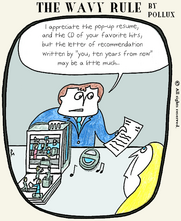
Click on the cartoon to enlarge it!
Read “The Wavy Rule” archive.
James Purdy, 1914-2009–and His One New Yorker Story
Jonathan Taylor writes:
James Purdy died today, the Times‘s ArtsBeat reports, saying that he “labored at the margins of the literary mainstream, inspiring veneration or disdain.”
I was a little surprised to find a Purdy story published in The New Yorker, but not that surprised that it was a very early one: “About Jessie Mae” in the May 25, 1957, issue—just after the 1956 publication of Purdy’s novella 63: Dream Palace. It’s a grotesquely decorous little dialogue between two nieghbors in St. Augustine, Fla., seething in harmony. Myrtle and Mrs. Hemlock are bursting simultaneously with the uncontrollable urge to gossip about the breathaking “untidiness” of their rich frenemy Jessie Mae—and with Mrs. Hemlock’s icebox full of homemade fudge bars. “About Jessie Mae” was included in Purdy’s 1962 story collection Children Is All.
Here‘s a 2005 appreciation by Purdy champion Gore Vidal.
If Pnin is In, Does That Mean Kilgore Trout is Out?
Martin Schneider writes:
Last week we posted the syllabus of Zadie Smith’s fiction seminar at Columbia University. I noticed that one of the books was Vladimir Nabokov’s Pnin. It triggered a memory: last October, on a New Yorker Festival panel with Hari Kunzru and Peter Carey, Gary Shteyngart answered moderator Peter Canby’s request to name a favorite or most influential work by intimating that he reads Pnin “once a month.”
I know the journalistic credo has it that once is an occurrence, twice a coincidence, thrice a trend. I have only the two mentions, yet nevertheless cry “Trend!” My impression is that Pnin is relatively obscure; it doesn’t come up in conversation much, at least not with the people I know. I’ve read four Nabokov novels, and Pnin isn’t one of them. As far as I know, Pnin is noteworthy for being somewhat more autobiographical than most of Nabokov’s work, as it is about a Russian emigre who is working in the United States as a professor.
So much for this focus group of one. Have you been running into Pnin lately?
As it happens, Pnin has a slight familial resonance for me; my father used to tell how impressed he was with the original Pnin stories when they appeared in The New Yorker in the mid-1950s, so it feels like I’ve been aware of it for years. I’m now traveling and have a limited number of books at my disposal, but, triggered by Shteyngart perhaps, elected to bring that one with me. I’ll get to it soon.
National Book Critics Circle: Winners, Honors, New Yorker-ers
Emily Gordon writes:
I’m SXSW-bound in a few hours, but I wanted to send a brief report from a stirring and satisfying National Book Critics Circle awards ceremony and reception. The 2008 finalists for NBCC awards included a good group of New Yorker-related people: the late Roberto Bolaño for 2666, Pierre Martory for The Landscapist, which was translated by John Ashbery; Richard Brody for Everything Is Cinema: The Working Life Of Jean-Luc Godard; Steve Coll for The Bin Ladens: An Arabian Family in an American Century; and Honor Moore for The Bishop’s Daughter (an excerpt of which ran in the magazine)–and it’s true, there are other people in the list you can certainly call New Yorker-related as well. After the ceremony, I spoke with Richard Brody, whose blog and Twitter presence we’ve noted recently with pleasure; he’s a lovely fellow, and I’m glad to have met him.
Bolaño’s book got the fiction prize, and after seeing the multiple-cover design, I want to own it. The rest of the prizes came home with Ron Charles, who won the Nona Balakian Citation for Excellence in Reviewing; my former employer the PEN American Center, which got the Ivan Sandrof Lifetime Achievement Award; August Kleinzahler and Juan Felipe Herrera in a surprise poetry tie that had the brainy audience whispering in delight; Seth Lerer for criticism; Patrick French for biography (James Wood reviewed the book, The World Is What It Is: The Authorized Biography of V. S. Naipaul, in December) Ariel Sabar for autobiography; and Dexter Filkins for nonfiction. I’m sure the NBCC website will be full of details tomorrow, so look there then!