
Benjamin Chambers writes:
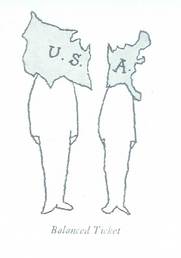
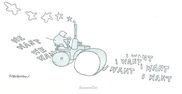
What with the Democratic Convention going on and all, it was highly serendipitous to find a two-page spread of great cartoons entitled “Political Conventions” by James Stevenson in the August 25, 1968 issue of The New Yorker. I couldn’t find them among “Stevenson’s work “:http://www.cartoonbank.com/search_results_category.asp?sitetype=1§ion=all&keyword=james+Stevenson&advanced=0&x=12&y=13featured at the Cartoon Bank, so I’ve uploaded a couple of my favorites below. (For the complete set, I’m afraid you’ll have to reach for the Complete New Yorker.) Stevenson has always been one of my favorite cartoonists; “click here”:http://biography.jrank.org/pages/1693/Stevenson-James-1929.html for a very thorough profile of his artistic career.
While chuckling at Stevenson’s quietly satirical sketches, though, I’ll admit I experienced a bit of cognitive dissonance, since after all, they were published during the infamous 1968 Democratic National Convention.
Here’s the first (click to make it bigger):
And here’s the second one (click on it for a larger version):
Category Archives: Looked Into
Dorothy Parker (& Her Society) Will Always Be Newsworthy
Martin Schneider writes:
City Scoops, a periodical that can be found in some of our city’s most luxurious lobbies, has a swell two-pager by Larry Getlen on the Dorothy Parker Society, run by our friend Kevin Fitzgerald. Click here to read it on pages 8 and 9 of the pdf file (click on the Marsalis image, at least until the next issue comes out). The pdf file itself can be found here.
Truthiness in Advertising
Benjamin Chambers writes:
Might just be me, but I don’t hear people grumble as much as I used to about “truth in advertising.” Maybe it’s because nobody expects it anymore. As with campaign finance reform, we all wish it could happen, but are afraid to admit we could be so childishly naive.
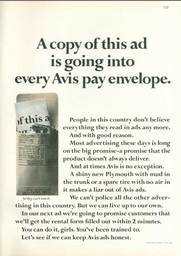
Well, be careful what you wish for there, in the secret spaces of the heart. Here’s a couple of examples from the October 1, 1966 issue of The New Yorker of why honesty might not always be the best policy. First, a mild, “Yeah-we-screw-up,” from Avis (click for full-size):
Then, the major-league, all-our-warts example, from Renault (click to see all the fun):

Had it come in the mail, TNY would’ve classed this ad copy under “Sales Pitches We Never Finished Reading.” Check it out, though: 35 mpg. Where can I get one?
Bad News, Good News, Good News, News That May Strike You Either Way
Bad news: Nikos (as I now believe it’s spelled), the magazine shop whose politically minded employees I reminisced about not long ago, is closing. I am sad about this in a way I can’t process just now.
Good news: smart young blogger folks who can’t wait to get magazines in the mail. Good news: this list in the Times of London of brilliant boarding school novels, including When JFK Was My Father, written by Amy Gordon, my warm and talented aunt.
News that may strike you either way: I’m going to Quebec till the 17th, so enjoy the posts by the Emdashes brain trust, including the extremely promising interns; Martin “The Squib Report” Schneider, who is particularly busy at the moment, so he may be a bit mum as well; the erudite Benjamin “The Katharine Wheel” Chambers; and, of course, Paul “The Wavy Rule” Morris, who will continue to delight you daily.
If you still find yourself without enough to think about over the next week, try your hand at Emdashes’ exclusive upside-down question-mark naming contest, which is getting very thrilling, and is open to further entries till August 25. ¿Clever? I know you are! When I get back, I’ll check out the new submissions, and by then, it’ll be the crucial last week of competition. This won’t be easy!
Looking Back at the Future, Circa 1964
Benjamin Chambers writes:
What did the future look like back in 1964? Here’s a clue: this rather puzzling cartoon by Alan Dunn (click to see it full-size) from the October 3, 1964 issue of The New Yorker.
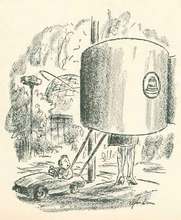
Judging from the globe in the background, you probably could find phone booths like the one drawn here at the 1964 New York World’s Fair. So far, so good. But what the heck is the kid riding in, and what’s so funny about the cartoon?
As to the first question, the Complete New Yorker index describes the kid as sitting in an “automobile pushcart.” Perhaps these were commonly available at the World’s Fair, perhaps not—but I don’t think it’s supposed to attract our attention. Instead, the kid’s dismayed look tells us what’s funny: the phone booth itself.
No doubt such booths were a radical departure from the full-size, glassed-in phone booths typical of the period, an intimation of the future. (Though those were not as ubiquitous as I thought. According to “this advertisement”:http://www.phonebooth.org/phoneadverts/portrait_of_a_city.html posted by the folks at “The Phonebooth”:http://www.phonebooth.org/index.html, the first outdoor telephone booths weren’t installed in Manhattan until around 1960.) Is it possible that the joke here is simply that the kid can’t see his mother? Your ideas welcome.
[UPDATE: I’ve gotten a lot of useful information from commenters and elsewhere that throws some light on the cartoon, so I’ll collate it here. First, thanks to Marc Francisco of www.phonebooth.org, who sent me this photo from a Bell System press release:

According to him, the copy read, “A pretty World’s Fair visitor makes a call from a Serpentine booth, so called because of its unique serpent-like design. All booths on the Fairgrounds are equipped with the Bell System’s newly developed Touch-Tone service which speeds calling by push buttons instead of a dial.”
(Touch-Tone! Another intimation of the future!) Note that the “pretty visitor” is wearing pumps, like the woman in the cartoon. No kid in a pushcart, though. Perhaps “she’s calling the operator”:http://www.phonebooth.org/phoneadverts/full_of_bees.html to find out where he went.
Then Bill Cotter sent a link to a shot of the booths “in use”:http://www.worldsfairphotos.com/nywf64/phones.htm at the time of the Fair, as well as a photo “explaining”:http://www.worldsfairphotos.com/nywf64/hertz.htm the kid’s “pushcart”. Thanks also to Mike for sending another link to photos of the booths at the time of The Fair, and several shots of them in their current state of “tragic disrepair”:http://64nywf65.20m.com/Booth/Booth.htm. He’s got more to say in his comment below …
Finally, for those of you astonished to learn that outdoor phone booths weren’t installed in Manhattan until about 1960—where did Superman change clothes when he was outside?—this ad from 1955 suggests they came late (?!) to Manhattan.]
In the same issue, too, I accidentally ran across an ad for perfume that was so modern, it jumped off the page (click for larger size):

Compare it to these two ads, one for perfume, and the other for makeup, taken from the same issue, that exemplify the competition (click for larger size):


By comparison, the ad for the Fabergé perfume stands out, doesn’t it? Unlike the other two, it’s selling a feeling, an impression of carnality, rather than features (“the modern way to carry spray,” “glides on easily”). It’s like an ad for, well, the future.
Often, though, the future has been around for longer than we think. Lycra® (generic name: “Spandex”:http://en.wikipedia.org/wiki/Spandex) is a case in point. I always thought that it was a relatively recent invention. Turns out I’m wrong: it was invented in 1959. Didn’t take long to get it to market, either, evidently. Check out this ad featuring it from the February 3, 1962 issue of TNY:

Still, I’ll bet you not one Beatles fan who saw this ad suspected that “hair bands” were already a foregone conclusion…
Let’s Track Presidential Campaign Spam
I’ve been seeing a lot more Obama-related spam (I think I remember one like “Michelle Obama takes lover”) than McCain-related spam. Why? Are spammers Republicans? Are the Obamas just sexier to think about than the McCains?
Either way, as we know from modern media strategy, every little meme counts, so I’m going to keep track (in a casual, unscientific way) of what election-related spam I get from here to November, and try to suss out what it says about the collective unconscious of the electorate (or the spamectorate). Please copy and paste the spam you get into the comments, or email me the subject lines/relevant content–not the emails themselves, or they might just never get to me. If you’re reading this and you’re a spammer yourself, I hope you’ll consider balancing out the content, and please do spell-check.
Here are my first two, which appeared right after each other in my work spam box:
McCain withdraws support for offshore drilling
Obama bribes countrymen to win votes
Holt’s New Book: Not About “Shy, Bald Buddhist”
Martin Schneider writes:
You can divide the world into people who understand that headline and people who don’t.
Yes, yet another book whose origins can be traced to the pages of The New Yorker. Jim Holt has expanded his April 19, 2004, book review into a laughable, if not risible (wait, those are pejorative), in any case highly amusing volume about the nature of the joke. It’s called Stop Me If You’ve Heard This, and Norton is the publisher (no, not Ed, nor Jim neither).
If Amazon had any wit, they’d pair it with James Wood’s How Fiction Works.

Google, Apple Bat Eyelashes at New Yorker
As well they should, really. Occasionally people ask me if I’m a “media watchdog.” In this context, no–I gave at the office. Maybe more like a watch Golden Retriever, or possibly Norton Juster’s Tock. Anyway, Google’s new wikiblogthing, Knol, gives users a way to legally use New Yorker cartoons in posts (“authors are allowed to use one cartoon from The New Yorker magazine per article”), and its inventor, Udi Manber, is a major fan of the cartoons in The New Yorker. What’s more, one of the new iPhone ads features the magazine’s website, showing off how nice it looks in that shiny, happy, my-birthday-is-September-12 device. I saw another iPhone demo recently in which March of the Pengins played a prominent role, and how perfect are those penguins and their ice for the iPhone screen? We will ignore, for the time being, the fact that both birds and habitat are likely doomed, because we (meaning I, in this case) were Appleized from too early an age to ever rethink different, so there.
Thanks to everyone who’s written to me about these news items today! By all means, keep sending us any relevant tips you come across; we can’t read our Google Alerts all day, because there are just too freaking many of them, and besides, the wisdom of crowds!

Peter J. Boyer Has an Extraordinarily Soothing Voice
I’m listening to the New Yorker Out Loud podcast in which Matt Dellinger (who has a calming, pleasant voice himself) interviews Boyer about the latter’s recent story about newsman Keith Olbermann, and am struck by how resonant the latter’s speaking voice is. It is a mellow, searchingly thoughtful voice, with a note of the South (Texas, I’m guessing), and the sound of the two of them together makes for a sort of duet for cello and bassoon. It’s a good interview, too.
Matt, bring back Mr. Boyer for another discussion soon, won’t you? In the meantime, he could read a short story for the fiction podcast, perhaps something by John Graves. This makes me think: Paul Muldoon‘s similarly unboastful, shapely voice. A poetry podcast to complement the rest, complete with songs (Muldoon would choose them well), and it would be as lively as can be–something like the Favorite Poem Project, but with a New Yorker-specific tilt. Let’s hope that this is in the works.
You Say “Potato,” and I Say “Victuals”
Benjamin Chambers writes:
Fans of The New Yorker (TNY) “fiction podcast”:http://www.newyorker.com/online/podcasts/fiction may not have noticed, but when author “Mary Gaitskill”:http://www.newyorker.com/search/query?query=mary+gaitskill&queryType=nonparsed&submitbtn.x=0&submitbtn.y=0&submitbtn=Submit recorded her otherwise-excellent “reading”:http://www.newyorker.com/online/2008/06/09/080609on_audio_gaitskill of Vladimir Nabokov’s story, “Signs and Symbols” (or, as TNY’s first fiction editor, Katharine White, preferred for no very obvious reason, “Symbols and Signs”), Gaitskill mispronounced the word “victuals” by reading it as it’s spelled, rather than the correct way: vittles. I didn’t notice it myself, because I’ve always pronounced “victuals” the way Gaitskill does, thinking that “vittles” was just a hillbilly synonym, but otherwise unrelated. (Thanks to “Languagehat”:http://www.languagehat.com/archives/003174.php for setting me straight. When TNY asks me to read for their fiction podcast, I won’t make that gaffe!)
In a similar fashion, another corner of the blogosphere has been busy weighing the merits of “Jared Diamond’s piece “:http://www.newyorker.com/reporting/2008/04/21/080421fa_fact_diamond in the April 21st issue on the comparative value of exacting vengeance vs. the contemporary western justice system. The main post, by Rex (Alex Golub), is excellent, the following (lightly copyedited) segment in particular:
… Diamond fails to think anthropologically even if the people he discusses are stereotypically anthropological subjects. Anthropologists insist that culture is a force which has its own unique power to shape people’s lives and cannot be reduced to an effect of an underlying, deeper cause. So when Diamond remarks that pigs are valuable to highlanders because they (the highlanders) are “protein starved,” an anthropologist is not satisfied. This has probably been true of different places in different times in the highlands … and nutritional needs obviously affect human behavior, but so does culture.
Pigs are always valuable in culturally specific ways. When highlanders in PNG [Papua New Guinea] give pigs, do they exchange live pigs or pork? Who gets the piglets from the live pigs, and who gets the pork when it is eaten? These questions are deeply tied up in issues of nutrition, but they are also culturally structured. Equally, Diamond writes that in Nipa, fighters exhibit “unchecked” aggression, [but] then goes on to describe in detail the culturally specific ways in which they fight: rules regarding engagement (or non-engagement if you have relatives on the other side of the fight) and so forth. So in fact, while the human desire may be universal (and that’s a big ‘may’), so is the fact that it is always shaped and channeled in culturally specific forms. The more you know about people’s lives, the less easy it is to explain them wholly in terms of protein, geography, genetics and what have you.
Nicely put. Wade through the comments, too, if only to watch anthropology wonks in a dust-up. (Hope nobody ended up with a vendetta on their hands!)