
In the latest New Yorker Out Loud podcast, Matt Dellinger talks to Atul Gawande about “The Itch,” an investigation into (eek) uncontrollable itching:
Dellinger: Did you itch a lot while writing the piece?
Gawande: Constantly. At various points I would imagine there was a bug on my flank or in my hair, and I’d just have to get up and walk away. At one point I literally did ask my wife to just look and make sure that I didn’t have a bug in my hair!
Category Archives: Looked Into
You There! Contributing Tidal Restlessness, Solidity and Continuity, or Passion?
At City Room, Jennifer 8. Lee has a thoughtful riff on E. B. White’s searing, searching essay “This Is New York”—an excerpt from which is running on the subway as part of the “Train of Thought” series—and White’s description of the “roughly three New Yorks”:
There is, first, the New York of the man or woman who was born there, who takes the city for granted and accepts its size, its turbulence as natural and inevitable. Second, there is the New York of the commuter–the city that is devoured by locusts each day and spat out each night.
Third, there is New York of the person who was born somewhere else and came to New York in quest of something. Of these trembling cities the greatest is the last–the city of final destination, the city that is a goal. It is this third city that accounts for New York’s high strung disposition, its poetical deportment, its dedication to the arts, and its incomparable achievements.
As Lee writes, “The selection, which is supposed to represent a slice of history, seems particularly meaningful on the subway.”
Pigeons in the Grass Kick Ass

Martin, who has done some lovely flights of pigeon reporting himself, just let me know that according to Gothamist, it’s National Pigeon Day today, and here’s the pigeon post from those eagle-eyed swifts at City Room. I don’t want to hear any boring cliches about winged rodents; these are our birds, and we’re all living together trying to peck out a living in this pitiless metropolis, so let’s show our fellow citizens a little compassion. And appreciation: They’ve got a beauty and gumption all their own. (John Tierney knows so, too.) Cast not the first stone at a beaked neighbor, lest you be shat on in return!
So, to paraphrase Pogo’s Churchy LaFemme, Friday the 13th comes on a bird’s day this year.

Neither a Book Borrower Nor a Book Lender Be?
On the new New Yorker blog The Book Bench, Caleb Crain does a close reading of a Random House/Zogby poll on American reading habits. (I was trying to think of another phrase for “reading habits” so as not to lean on the wording of the benchers, but I’ve got jet lag, and I’m afraid I’m flagging.) I thought this was really funny:
The Zogby poll reflects not only the way that Americans buy books, but what’s socially acceptable to say about buying books. For example, Zogby reports that only thirty-two percent of Americans borrow books, while seventy-one per cent lend them. That might be true; it’s possible to reconcile the disparity by supposing that a small cadre of predatory moochers are taking advantage of a vast cow-like herd of good-hearted people who can’t say no. But the disparity is awfully large. A likelier explanation is that people would rather say that they give books than that they take them.
More Adventures in Advertising
Benjamin Chambers writes:
I love The Complete New Yorker, not least because tracking down one item will inevitably set me off on the trails of six other things. And then there are the unexpected surprises. For example, this ad for a Smith Corona word processor, from the October 9, 1989, issue of The New Yorker (click for a larger version):
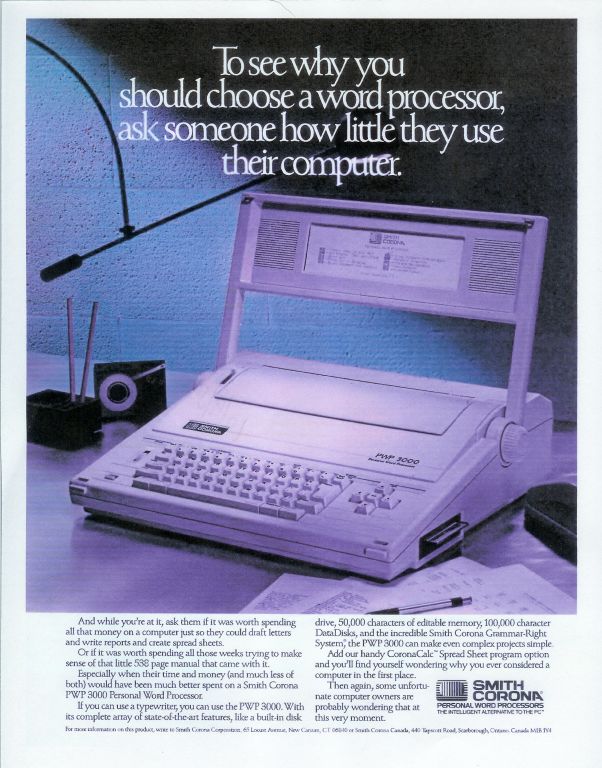
Having just spent 10 hours at my computer, I simply had to laugh. Still, hindsight is always 20/20, though come to think of it, by 1989, I had put a heck of a lot of mileage on my Macintosh. Much harder to comprehend is this bizarre ad from the April 18, 1959, issue of TNY (click for larger version):
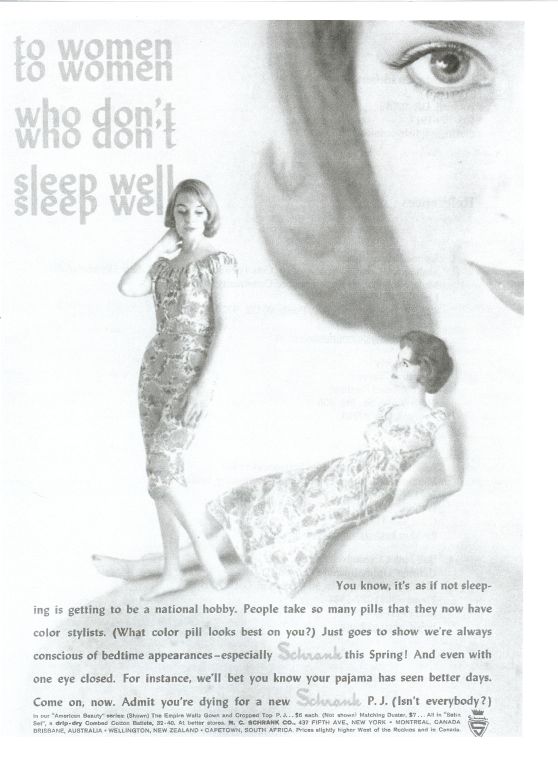
I should have reproduced it in color, but you can still get a sense of how strange a piece of copywriting it is. I’m always skeptical when people complain about things being “written by committee,” but this ad surely was. First, the thinking must have gone, we’ll bewitch bored readers with a headline evoking the double vision of the bleary-eyed sleepless; then we’ll joke about how many barbiturates they’re taking, appeal to their vanity, and then accuse them of wearing shabby PJs. If that won’t hook ’em, nothing will!
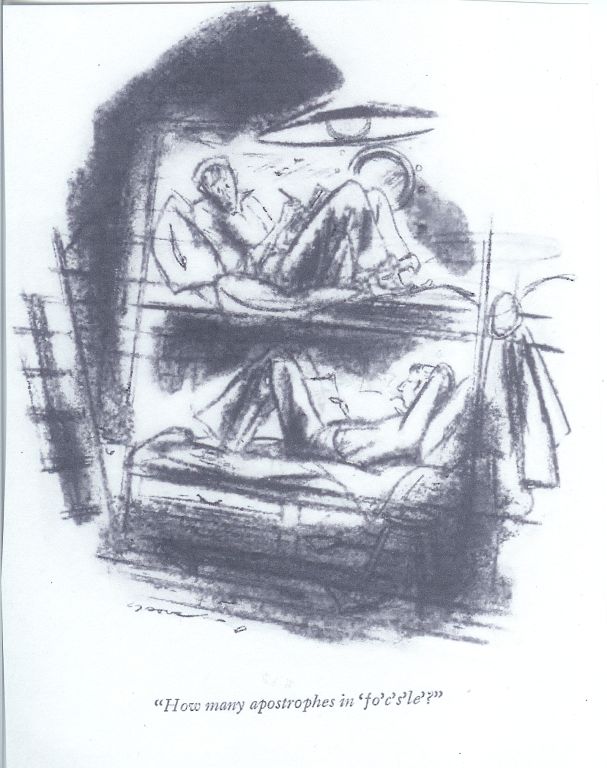
And, though it’s not advertising, I was equally entertained by the Leonard Dove cartoon below, from the May 25, 1935, issue. Only one of his many cartoons for TNY is available at The Cartoon Bank, and unfortunately this is not it. To enjoy a larger version, click here:
Nicely Put: On Paul Muldoon
The New Yorker, which I’ve now read for nearly 40 years, is surely publishing better poems now that Paul Muldoon has taken over for Alice Quinn. His selections are interesting, witty, striking, running the gamut from free verse to traditional poems. Quinn’s poems were often self-indulgent, sentimental, mannered, boring.
This is just another sign of the magazine’s revival under David Remnick, who has returned it to the best days of Shawn and Ross, and perhaps surpassed them. Too bad this excellent, wide-ranging cultural treasure keeps improving in a climate of anti-intellectualism and short attention spans. I often hear quite well-read folks say they no longer read the New Yorker, or just glance at the cartoons. Too bad, you fools.
That’s from Chasing the Blues, and that’s a fine site, by the way. I’m so happy I happened on it. I would argue there are many exceptions to the note about Quinn’s taste, but I’m not here to argue; I’m here to be glad we’re not said fools, often the very people who don’t read poetry because—we know the real reason, right? It’s too much work to worry about whether you’ll understand it. Be brave, prosey people!
“Endings Are Elusive, Middles Are Nowhere to Be Found, But Worst of All Is to Begin, to Begin, to Begin”
On Slate, Jessica Winter meditates on Ralph Ellison, Truman Capote, and the difference between writer’s block and procrastination. Joan Acocella wrote about those awful blocks, too; not entirely tangentially, John Lahr wrote movingly about stage fright.
Donald Barthelme’s narrator in “The Dolt” saved me from the anxious swirl that might have prevented my writing this headline, or indeed this post at all. It’s true, even “bloggers” can have blocks! If they were only alphabet blocks, then we’d really be in business.
Spondees and Anapests Fly at Union Square Cafe, YouTube
Martin Schneider writes:
“Word Feast” was that toothsome Talk of the Town by Lauren Collins in the May 12 issue about the versifying waitstaff of Union Square Cafe. (Seneca got beat up a bit.) It’s turning a certain Matt Gould into the kind of star that only New York can produce. Collins writes:
The biggest hit of last year’s series was a catchy rap poem written by a waiter named Matt Gould, which the bosses eventually got him to turn into a video holiday card. “Things never change or change later than sooner / Like the calamari, Billecart, filet mignon, and tuna!†Gould sings, while his co-workers shimmy on top of tables. (The Peppermill could be a new dance.)
Next, the good people of New York magazine’s blog Grub Street stated their intention to find a copy of the elusive Matt Gould holiday card. It took a mere quarter hour for a commenter to post a link to the video! (“Embedding disabled by request.”) Maybe they could combine their talents with a succulent Mark Strand special.
Tweetly Deedly Deet, Tweetly Deedly
I was in the middle of reading the following sentence early this morning — “The wire services piped the story straight to Dubuque” — when I got my first New Yorker Twitter text about David Remnick’s online list of 100 Essential Jazz Albums. (He wrote about Phil Schaap in this week’s issue, and I’m going to reward myself with the piece if/when I get through today. I once saw Schaap swing dancing, years before I started doing it myself, and I was impressed.)
It’s all happening so fast! Also, I will not be generating Twitters myself. I am, we are, posting to this blog, which is our “feed,” if not our daily bread. So just keep coming back to the tasty trough, Templetons and friends. (By the way, this is a truly rocking version of “Rockin’ Robin” by McFly. I am awake. )
Designing Woman Tina Brown
From today’s New York Post (via MediaBistro): “Tina Brown has turned to legendary avant-garde design firm Number 17 to handle her new yet-to-be-named Web venture, a news-aggregation service that is being backed by her longtime friend, media mogul Barry Diller.” I can attest both to No. 17‘s design acumen and their laudable foosball hosting and playing skills.
Elsewhere in design, journalism and political science double major (and keyboard player) Teddy Applebaum, given the challenge of a mock blow-in card, struggled among various versions of Rea Irvin’s New Yorker typeface and their cost (“oodles of cash”), and had to settle for a poor imitation. Occasional spelling oversights aside, I think the kid‘s got something, don’t you?
Speaking of blow-in cards, there was an eloquent defense of them in Wired some months ago that I keep thinking about, and not just because of the witty execution. It seems the cards really bring in the dough, and in these uncertain times, that’s something we’ve got to support (as this Jack Ziegler cartoon suggests), right? Or at least not judge too harshly, especially when in the forest, which could probably use more edifying reading material, anyway.