Category Archives: Looked Into

The Lap of Luxury (Hotels), Circa 1958

Benjamin Chambers writes:
One of the sweeter pleasures of paging through the Complete New Yorker is looking at the dated advertising, especially when a copywriter describes, with a flourish of trumpets, amenities we regard as either standard or puzzling.
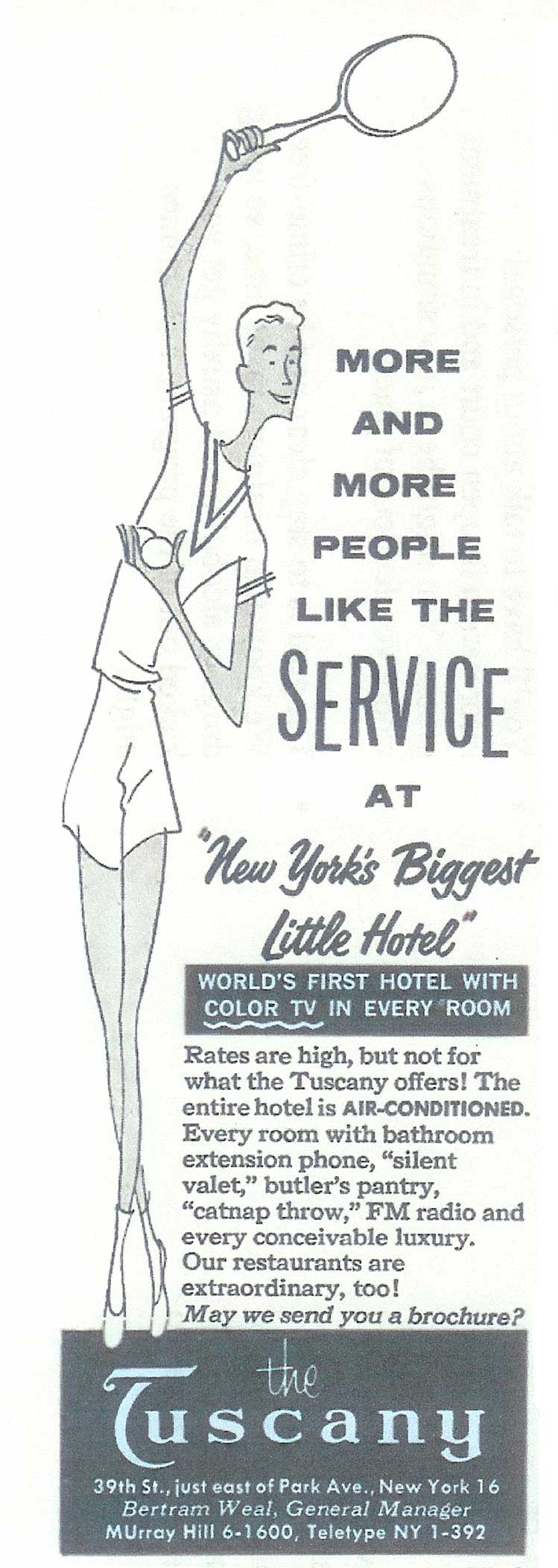
For example, if you’d been looking for a quiet, upscale hotel in 1958, you’d have done well to choose The Tuscany on 39th Street. I know, because I came across an ad for it while reading a sweet-but-forgettable memoir by Grover Amen in the June 14 issue of that year. (I’ve displayed the ad here for your viewing convenience, much as The Tuscany’s staff would have turned down your bed at night.)

TuscanyHotel_1958.jpg

How could you beat a hotel that was the first in the world to have color TVs in every room? Plus, each room had FM and AC, and every guest could count on finding a phone extension in the bathroom: all items at least as breathtaking, apparently, as its rates.

So what else would you get for your money? A “catnap throw” (pillow), butler’s pantry (a small staging area in which to store plates, glassware, and silverware), and a “silent valet” (a rack on which to hang your clothes).

All part of a strategy, it would appear, to net readers of The New Yorker who wanted class, but who were new to travel. These small details imply that prospective guests will be waited on by their own staff of quiet, liveried servants. After all, if one’s room has a “butler’s pantry,” the butler it belongs to has to be there to count the silver, right?

Ah, innocence! Gone now, though I see hotels still advertise silent valets, so maybe we’re still suckers for promises of elegance. But the romance of travel has definitely waned. These days, hotels simply hand over the keys to the mini-bar and don’t even pretend that a genteel staff member will be there to serve you the contents.

Whither The Tuscany? The hotel is still extant, it appears, appropriately upgraded and still advertising a “chenille throw” fifty years later. Imagine all the people who’ve passed through there since (many no doubt loyal readers of The New Yorker).

O, if only those valets could speak!
How Do You Say “Gently Sir” in Japanese?

Martin Schneider writes:
If this video doesn’t make you think of George Price, well, it certainly should.

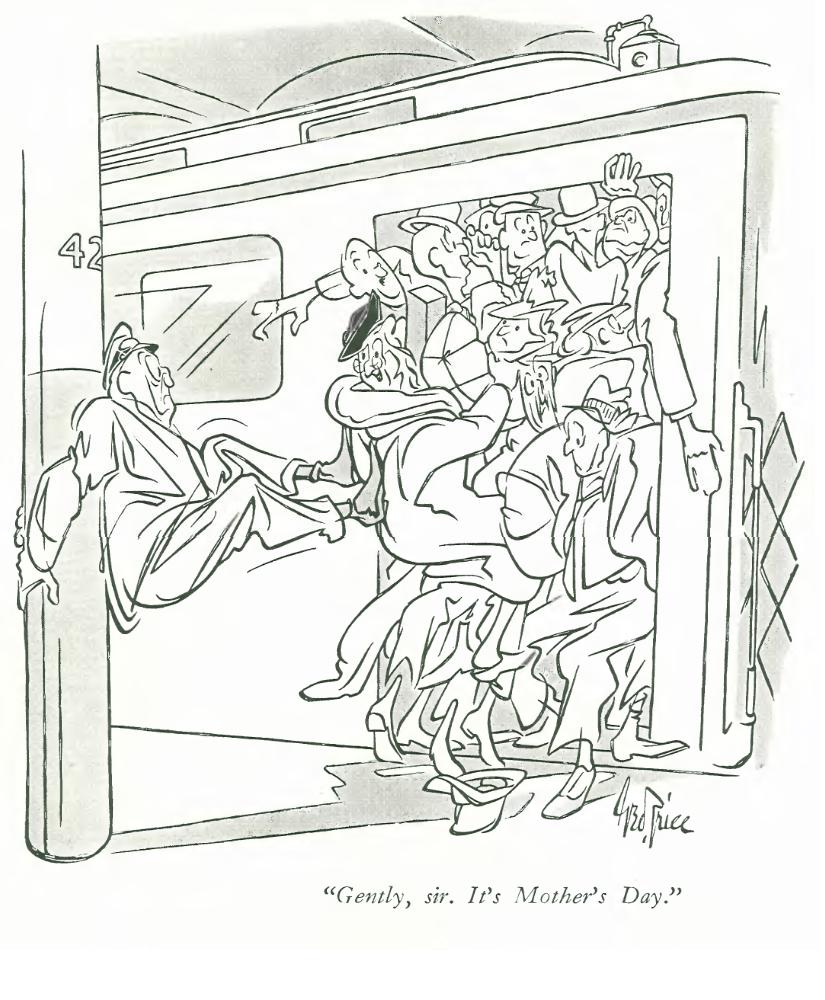
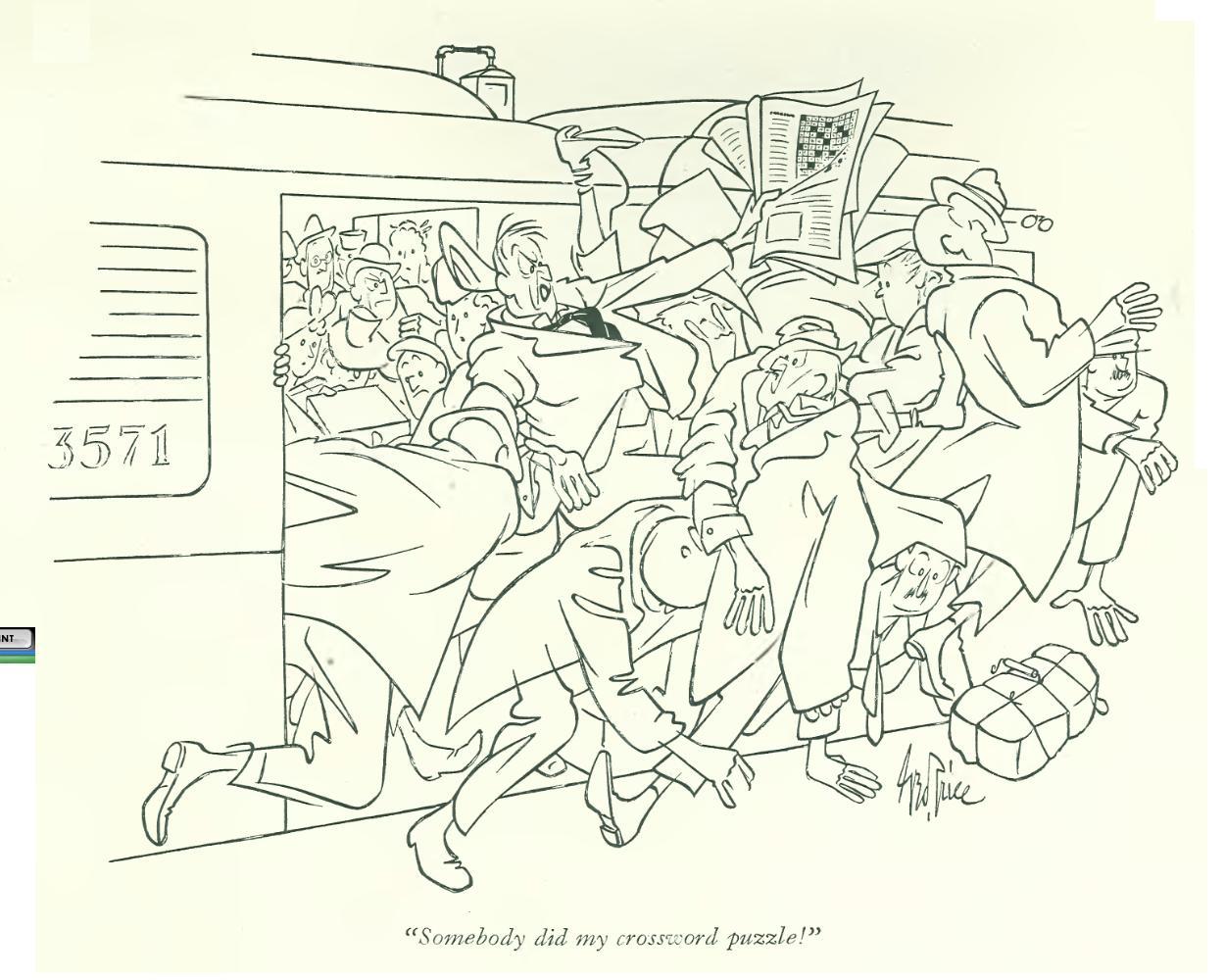
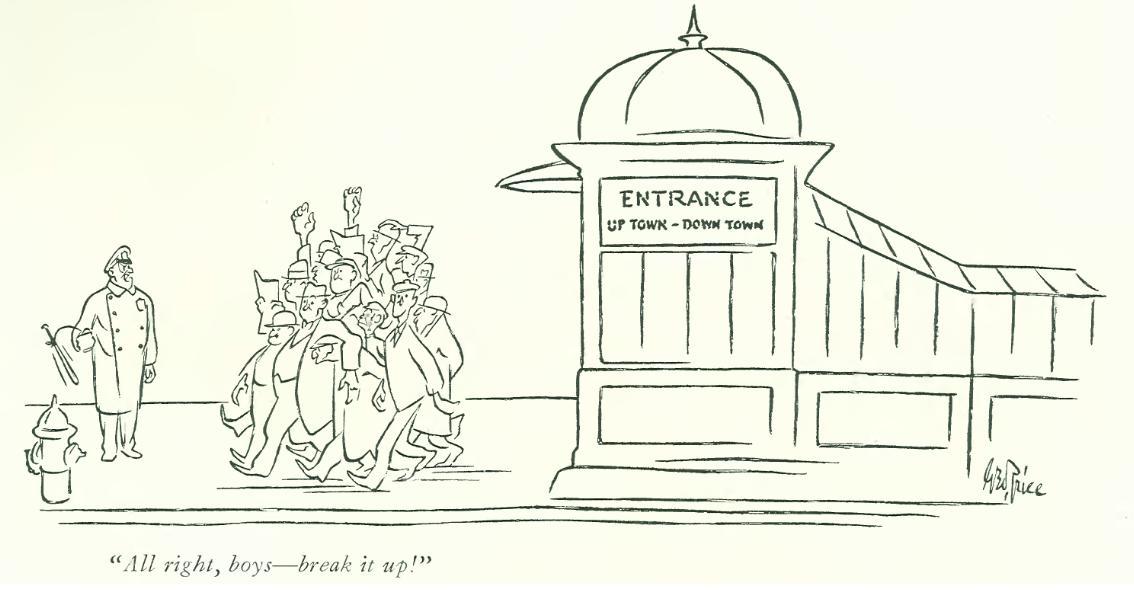
As a reminder, a few classic cartoons from Price’s “crammed subway” period:

break.JPG

“All right, boys — break it up!” (February 25, 1939)
gently.JPG

“Gently, sir. It’s Mother’s Day.” (May 11, 1940)
crossword.JPG

“Somebody did my crossword puzzle!” (December 11, 1943)

That first one is a favorite of Emily’s, the second a particular favorite of mine. (We’ve discussed all of this already, natch.)

After You’re Done Reading Everything in Edith Wharton’s Library…

You can move on to the book collections of Carl Sandburg, Susan B. Anthony, and noted fallen rhymester Tupac Shakur. These and other literary libraries are on the Lilbrarything group I See Dead People[‘s Books]. A perfect way to fill in those gaps in your shelves! (Thanks to the indispensable Very Short List for the link.)
On the other hand, space may be tight, and life is certainly short, so you could also get rid of books instead—or at least contemplate the bookshelf with half an eye to getting rid of them, which is what my friends Caleb Crain and Scott McLemee have been doing and debating.
As for Edith Wharton, whose foundation’s house-preserving troubles Rebecca Mead documented in a recent issue, there’s another defender of her home: Kate Bolik in Slate; it looks like Slate readers (and others?) have helped delay the foreclosure of The Mount to May 31. Finally, here’s John Updike’s review in The New Yorker, from 2007, of a recent Edith Wharton biography.
If you’re the good-vibes-sending type, please direct some over to the National Magazine Awards this evening, won’t you?

An Elevator Romance

That’s the name of a 1911 movie whose IMDb plot synopsis is empty. I bet Robert Benchley saw it at the time, though. He probably followed it up with a short subject called “How to Make Love in an Elevator.” (Get your mind out of the gutter—back then “making love” was more like bundling.)

Anyway, another elevator romance is Nick Paumgarten’s, as demonstrated in his engaging story last week about the curious vertical conveyances in which people stand at genetically predetermined distances. As I read it, I remembered that I’d written something about Paumgarten and elevators before, and it was in 2005, when I was testing out the urban myth he reported on in the October 17 issue of that year. To wit:

Supposedly, if an elevator passenger simultaneously presses the “door close” button and the button for the floor he is trying to reach, he can override the requests of other passengers and of people waiting for the elevator on other floors. The elevator shifts into express mode, racing directly to the floor of his choosing—becoming, in essence, a private lift. Apparently (that is, according to Internet chatter and what you might call secondhand anecdotal evidence), people (pizza men, college students, hotel guests) have been doing this for years, which might explain why the rest of us have occasionally had the feeling that elevators were passing us by.

The experts, however, say that the idea is nonsense, that elevators are not designed to do this, that people are talking crazy.

I did the experiment myself in the Condé Nast building at the time. Did it work? See for yourself! And try it in an elevator near you; let me know what happens. But don’t get stuck. It just goes to show you that no one should ever go anywhere without a good, long book, just in case.

By the way, how about that stylishly trippy photo by Maurizio Cattelan that accompanied the most recent elevator piece? He doesn’t seem to have a website, but I see from this lowercased interview that “cattelan did not attend art school but taught himself. he worked as a cook, gardener, nurse and mortuary attendant, before turning to making art with the hope that the art world might offer him ‘better treatment’.” How’s that for a love story, huh?

Of Course, the Lonely Planet Scandal Makes Me Think of Favell Lee Mortimer

…the Victorian maker-upper who wrote numerous guides to world travel, all of them questionable, since she’d hardly ever left England. Mortimer is now immortal thanks to my friend Todd Pruzan, who presents selections from her highly biased, nay, often offensive oevre in the endlessly funny The Clumsiest People in Europe: Or, Mrs. Mortimer’s Bad-Tempered Guide to the Victorian World.
Before I even knew Todd, I was praising his piece about her in The New Yorker. (NPR ran some choice excerpts from the book.) For real kicks, don’t bother rushing to read some kid’s faux Lonely Planet entries—just see what a very, very opinionated lady has to say about your friends and relatives. She was herself often disappointed, one surmises, but she certainly won’t disappoint you.

Of Gentle Soul, to Human Race a (Tad) Friend

It’s Tad Friend’s turn on Mediabistro’s running interview feature; Julie Haire does the honors. I like this quote, among others: “Some people write by polishing each sentence as they go, like a jeweler. I tend to spend lots of time painstakingly making an outline that I realize, a dozen paragraphs in, makes no sense, and then I put my head down and type nouns and verbs and quotes in a kind of grumpy blur, hammering out an extremely rough, totally un-publishable draft that I then go over and over and over before I hand it in.” Some of his observations about research and reporting techniques sound a lot like Susan Orlean’s in the terrific recording An Evening with Ira Glass and the New Kings of Nonfiction, which is most definitely worth buying.

Hey, it looks like Friend and I might have lived in Buffalo at the same time. (He wouldn’t have been quite old enough to babysit me.) I was going to cite something about blizzards, one of which I certainly remember, but found this great pro-Buffalo-weather propaganda instead. I passed through the city recently, for the first time since my family moved away in the mid-’70s, and had dinner at a lively microbrew restaurant whose name I can’t remember, where college kids danced to a rooftop DJ; the cab driver who took me to my long-ago street (and to the zoo, and the park, and the museum—it was the kind of nostalgia joyride you see in the movies) told stories about white flight and floundering department stores as we glided past the Frank Lloyd Wright buildings and pockets of prosperity. I’m of the opinion that you should go home again, given the shortness of things.

The Royal “We”

I love the Chicago Style Q&A. In the most recent edition, there’s a question that will amuse longtime readers of Talk of the Town:

Q. I am writing a thesis for my university and use the pronoun “we” instead of “I.” For example, “From this, we can conclude that . . .” I personally think this looks more scientific than using the “I” pronoun. However, a colleague of mine states that if I am the only one writing the thesis and doing the research, I should use “I,” because otherwise readers might wonder who else wrote the document. Do you know which one is better to use in my case?

A. “We” used to be more common in scholarly writing than it is now. The British use it more than Americans do. CMOS recommends using “I,” but if the literature in your field avoids this, you should follow suit. Either way, it’s fine to use “we” when referring to something that author and readers are implicitly doing together, as in your example.

CJR Presents Hamill on Liebling: Listen In!

Martin Schneider writes:
A. J. Liebling is one of those storied writers from The New Yorker‘s past whose work I keep meaning to read more of. Fortunately, on the occasion of the release of the Library of America’s A. J. Liebling: World War II Writings, the Columbia Journalism Review got Pete Hamill, who edited the book, to make the case, at typically vigorous length, that I should do that sooner rather than later.
Here’s an audio file of the event, which was held last Tuesday at Columbia’s Graduate School of Journalism. (It’s a .mov file, but it is audio-only.) For the aspiring journalists out there, the discussion includes essential tips in the strategic use of bearded Norwegians in the fine art of finding a job. The presentation gets extra points for name-checking St. Clair McKelway.

The McCain on the Bus Goes ‘Round and ‘Round

In the Times (which may be the paper of record but, as I was intoning to some of the lively and charming guests at last night’s party for Daniel Radosh‘s new book, Rapture Ready!: Adventures in the Parallel Universe of Christian Pop Culture, should still not be referred to as “the paper”), Neal Gabler reflects on the curious camaraderie of John McCain’s populous tour bus.
In the piece, Gabler muses that McCain “may be the first real postmodernist candidate for the presidency,” and makes note of Ryan Lizza’s lucid story on the subject, which was, for me, the clearest window into McCain’s brain (not to be confused with Reagan’s brain) yet.
I read somewhere that Lizza said the bus is a germ parade—perhaps it should be nicknamed the Stray Bug Express—and everyone on it is constantly ailing. Hope he, and they, are feeling better! Yes, even the Republicans.

Murakami Previews the Cubs’ 2008 Season

Benjamin Chambers writes:
It’s only a parody, but I fell for it at first. Who wouldn’t? Haruki Murakami is the one person in the world who could make me believe the Chicago Cubs were finally going to take it all the way. Fortunately, he only uses his powers for good, even when he’s being parodied.
The best part of the “season preview”?

On the way to the elevator, I walk past a man wearing a shabby sheep costume. At first, it seems like this guy I knew in Kyoto once upon a time, a guy who wasn’t really alive. Then I realize that this other guy is just an insane Cubs fan wearing a shabby sheep costume. Apparently this happens all the time.