
Beppe Grillo’s website is #9 (not to be confused with Client 9) on Reddoc’s list of the world’s 50 most powerful blogs. If you haven’t read Tom Mueller’s profile of Grillo (which was my Pick of the Issue that week), go read it!
Also, The New Yorker is not the “MSM.” That’s a label I dislike almost as much as “blogger,” by the way, though I reluctantly refer to other writers on the web as bloggers, for lack of a better alternative. I’ve noticed that the phrase “online columnist” is gaining currency, and I like it, especially for people who are online columnists.
Like “radio host” or “airplane skywriter,” the term “blogger” refers only to a medium of communication, a method of delivery. The first two descriptions might indicate something about a person’s source of income; they say a little more about his or her temperament and skills (the ability to get to a radio studio, win the slot, speak into a microphone, and work the dials, at minimum; the agility and daring to fly a plane in signifying loops).
But “blogger,” like “caller from Schenectady” or “chronicler of skywriting,” reveals next to nothing about that person’s training, philosophy, background, intelligence, education, politics, reporting or research skills, social life, ethics, age, poise, lucidity, conventionality, effectiveness, impulsiveness, discretion, or relationship to (or experience in) traditional media, whether “mainstream” or not. Only watching what the skywriter spells, and listening to what Schenectady has to say, will begin to make them known.
In any case, writers who pride themselves on their sensitivity to language should avoid lumping their fellows into mass categories of either variety, don’t you think?
Category Archives: Looked Into
Everything–Bagel–Is Illuminated
Emily Gordon writes:
What do you get for the man who has everything? Why, the everything bagel, of course, whose varicolored, multiflavored origin story Michael Schulman investigated in this week’s New Yorker. Founding father David Gussin, whom Schulman interviewed, was also just on the radio, talking to NPR about the triumph of miscellany and the inevitable controversy: Seth Godin remembers seeing the seedy-oniony rings of starch B.E., or Before Everything, which date Gussin sets at 1980.
I called Jerry, who’s been working at the uptown H&H since 1985, when he was a teenager with a summer job. When did everything begin? “I should know this, because I kinda helped it. Let me see–it was invented before we made it. I was a cashier, and customers kept requesting it. It took about a year to put it together. This was back in 1985, 1986, 1987…” I told him the date has been set at 1980. “That makes sense, because when I was working on the weekends in high school, I kept hearing about it, but I never had one. I kept getting requests–it has a very strong aroma–but people would say, ‘It’ll never sell. It’s a gimmick.’ It’s one of our best sellers.”
Want to play bagel God? Make some yourself, and have the satisfaction of saying, “You are my Everything.”
New Yorker Editors Weren’t Taken in By JT LeRoy
A reassuring aside in Simon Dumenco’s piece about how even he was taken in by a memulist (by now, there should be a single word for memoirist-fabulist):
LeRoy, who lived in San Francisco, had a way of insinuating himself into the lives of the writers, editors and celebrities in his ever-expanding circle, and before long he started calling me at odd hours in New York to engage me in endless therapy sessions (he was a wreck, for instance, when a story of his was rejected by The New Yorker). He was needy, nutty and fascinating.
Meanwhile, here are two useful perspectives on the amorality and historical insult of Margaret Seltzer’s particular device, the “Native American” gambit. David Treuer in Slate:
But why pretend to be an Indian? What is so appealing about stripping off one’s own identity and donning a reddish one?… What non-Indians know about Indians does not come from the kinds of daily interactions that typically shape their understandings of people different from them…. There are many Indian writers with stories to tell that are ignored because they do not fit the preconceived notion of tragedy and cheap melodrama that make books like Love and Consequences so appealing.
And commenter Kit Prate on a New York Sun story about memoirs and fact-checking; her comment is titled “How about an apology to the Indians???” and begins:
Since the concept of “it takes a village to raise a child” has been the heart of tribal culture (and well publicized at that) why were no red flags raised when this woman claimed to have been taken from her family? With one parent (supposedly) being a full-blood, and the practice of taking Indian children from their families coming to a screeching halt in the 50’s, how could two well-educated people — the agent and the editor — buy into this fantasy? (Especially when one of them, according to their bios, was an ex-reporter and a researcher.) Nobody asked what her tribal affiliation was?
Fact-Checkers Are Always in Vogue
At least whenever there’s a new fake-memoir scandal or a general railing against “irresponsible bloggers,” which becomes a meaningless phrase as soon as veteran journalists and, ah, newsmen start blogging up a storm.
At other times, fact-checkers are often forgotten, underpaid, and/or belittled as comical Bartlebys, toiling by lamplight with poor eyesight and minimal glitz and celebrating minute victories like the ones chronicled in “Are You Completely Bald?,” a brilliant old New Republic story about the art and agony of fact-checking that’s a lot harder to find than you’d think (and I’ve tried!). Fact-checkers are fussy ghosts, invoked respectfully in their absence and mildly teased for their pedantic obsessions just out of hearing range.*
Except at a few good magazines, primarily The New Yorker, where fact-checking is considered such a vital necessity that only the most well-rounded and world-savvy applicants are interviewed (and I mean interviewed). There’s a reason the checkers there are routinely cited by those outraged about the crimes of too-inventive writers. All fact-checkers grumble, in my experience, but there’s less cause for it when they have steady jobs, salaries, benefits, lore (confess, who would you rather be in Bright Lights, Big City—Nameless Narrator as he wakes up cold and lonely on the friendless street after too much coke, or NN in the library amid the reference volumes, making courageous international phone calls, and paging through, say, Ian Frazier’s notes to verify an intricate New Yorker profile?) and the faith of the majority of the writers whose stories they verify and strengthen.
Speaking of which, Slate’s Daniel Engber has assembled a funny collection of revelations about other well-known autobiographies, past, present, and future. Also on Slate, newyorker.com editor Blake Eskin’s reflection on fake memoirist Misha Defonseca, who was not brought up by wolves as she escaped the Holocaust, is worth reading. If you want a rigorously researched and compelling book, read Eskin’s memoir/exposé A Life in Pieces, whose accounts and investigations are all the more electrifying and poignant for being absolutely true.
While we’re telling panicky book publishers how to conduct their increasingly imperiled business (although the news that people like reading books on paper is somewhat comforting), could we add a politely voiced plea for the return of the publishing-house copy editor? Forget about made-up facts for a moment—I just want most of the words to be spelled right.
*By the way, as a former fact-checker myself, I can assure you that many of them are in fact adorable, attractive, and socially ept.
Lizzie Widdicombe: An Ingenious Talk Technique
Widdcombe covered a festive book event (Not Quite What I Was Planning). Each pithy phrase is subtly witty: It’s no longer than six words. Appropriate for the book in question! I couldn’t make the party, sadly. But I did contribute a tale. Oh, you’d like to hear it? “Do as say, not as did.” (P. 180, in all its glory.) Another memoirist compiled a master list. Moved to write your short story? Show off your quick, dirty syntax.
Michael Specter on Fresh Air, on Those Pesky Carbon Footprints
Wasn’t that a good piece? He spoke about it on Fresh Air, and in a New Yorker Out Loud audio interview with Matt Dellinger.
Later: There’s a fascinating debate at Speak Up about whether artists and designers, and Stefan Sagmeister in particular, are or should be obligated to keep their footprint, or bananaprint, small. (And speaking of being green, here’s my sister Kate’s letter in yesterday’s Times on the best bet for “EcoMoms.”)
“First Priest in White House” Encounters Prickly Troublemaker
Martin Schneider writes:
Obama takes Wisconsin, with Hawaii results to come.
In late 2006 a New Yorker podcast of David Remnick interviewing Barack Obama did a fair amount to convince me that Obama was my kind of candidate. There’s nothing like 45 minutes of sustained discourse (at that time, hard to come by) to clarify one’s impression of a person. I’ve supported Obama ever since.
Today, it’s a curio, but perhaps all the more interesting for being more than a year old. Here’s the file itself; here’s a transcript. Terms from the headline are derived from the interview (natch). Enjoy.
Gladwell Raises New and Troubling Questions About New and Troubling Questions
Martin Schneider writes:
The Adam Baumgold Gallery has been on New Yorker streak lately. In addition to showcasing a number of intriguing works by Saul Steinberg, the gallery is putting on “Chris Ware: Drawings for New York Periodicals,” which features a number of New Yorker covers in the draft stage. Here are a couple of examples:

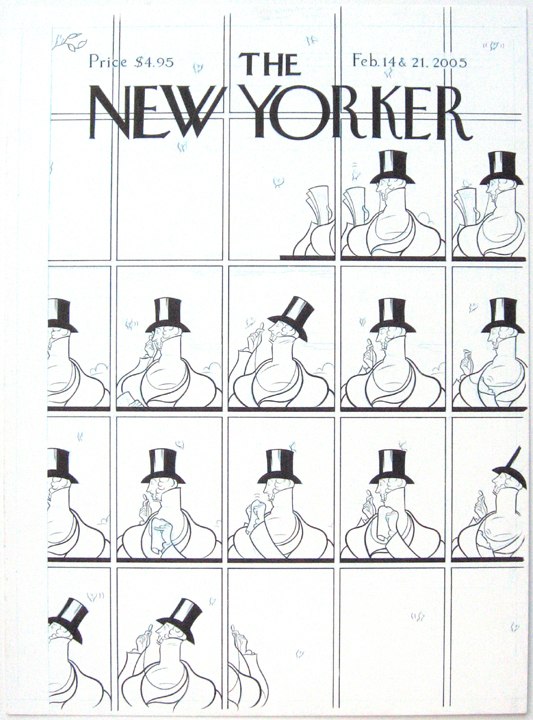
I find these images haunting; I don’t know why. I run a little hot and cold on Ware, but his technique is undeniably staggering. Judging from these images, the show provides a great deal of insight into his way of working.
The gallery is located at 74 East 79th Street, and the show runs through March 13. I can’t wait to check it out.
Meanwhile, in a more aural vein, last week’s episode (#348) of This American Life featured Malcolm Gladwell describing some prankery from his days at The Washington Post. The mp3 is available on TAL‘s website, and you can also get it on iTunes. For those who don’t own iPods or are allergic to podcasts, Gladwell told a version of this story in a 1996 Slate diary.
Dept. of Intense Admiration
I saw the comedian Will Franken at Upright Citizens Brigade a few months ago, and I’m still reeling from, marveling at, trying to process the hilarity, erudition and outrageousness of Franken’s mind and his eerie gift for projecting dozens (multiple, manifold dozens!) of personalities in a single performance. Download his podcast. Listen to an interview he did with Jesse Thorn of The Sound of Young America (completely coincidentally, I appear as a voice at the beginning of this recording). Watch some videos. If you’re still not convinced, read this Gothamist interview. And see him live. The next New York show is this Saturday, Feb. 16, at Karma Lounge, 51st 1st Ave. (between 3rd and 4th Sts.), 8 p.m. And I’m not just promoting a friend; I don’t even know him yet. But please take my word for it—his talent and imagination are well out of the ordinary.
Maryann Burk Carver Responds to the Latest Story About Carver and Lish
At Pinky’s Paperhaus—where Carolyn Kellogg also wondered why there was no byline on “Rough Crossings,” the recent essay in The New Yorker that introduced an exchange between Raymond Carver and Gordon Lish, and preceded Carver’s original draft for “Beginners”—Carver’s first wife, Maryann Burk Carver, posts a series of thoughts about her life and Carver’s, Lish’s editing, Carver’s writing process, and the intersection of all of the above. From her comments:
My seeing this site has made me aware of the extent of the response to the New Yorker piece, and the need perhaps to rebut some of it, much of which I already have done in my memoir. I talk about Ray’s early association with Gordon Lish and the good he did Ray as a publicist for him and his work in New York: The agents he introduced him to, and the other markets, besides Esquire, where he was Fiction Editor and published “Neighbors†and “What Is It?â€, aka “Are These Actual Miles?â€, (a title change I emphatically disagreed with, as the first reader and “editor†of Ray’s stories for over twenty years).
The question of who wrote the New Yorker intro, should that be haunting you, is still up in the air, but Carol Sklenicka, who writes in to say she’s working on a new biography of Carver, provides a plausible clarification that echoes that of fellow biographer Michael Hemmingson: “I checked with several people in New York, including Gary Fisketjon (Ray’s last editor, who is quoted in the New Yorker article) and was told that David Remnick, the editor-in-chief of The New Yorker, wrote the article. [That was also the understanding of NPR reporter David Gura. —Ed.] But it seems likely that William Stull, who edited the proposed book of stories with Tess Gallagher’s cooperation, provided the template for this unsigned piece.” Sklenicka concludes, sensibly: “The whole story of Carver’s life is complicated, as Kellogg points out, and I’m trying to get all of that into my book. It takes time and care.”
Still, why leave it unsigned? Since when does the modern The New Yorker use “templates” and not bylined writers? It’s too long a piece to be a generic introduction. Oh well, I’m sure there’s a long story we may never know. It didn’t put me off, in any case; I always like reading about complex writer-editor relationships, and I’m always interested in both Carver and Lish. That said, as you can see, it’s a daring decision to perpetuate a mystery among an already conspiracy-mad fan base!