
Category Archives: Looked Into

Coliseum Books Is Closing, and R.I.P., R.W. Apple

I saw the news on my RSS feed last night but blocked out the doleful knowledge till now. It was my first New York bookstore—back then, it was across the street from my first New York job, fall semester of my freshman year, working (in a very roundabout way, believe me) for Sting, Trudie Styler, Lou Reed, Joan Baez, and the doomed Michael Hutchence, whom I saw in the elevator. (This is also the location of my first New York celebrity street sighting, and luckily for my enthusiasms at the time it was Paul Shaffer, who was a gent.) I’d go to Coliseum every lunch hour and after work, sometimes taking a side trip to Lee’s Art Shop on 57th St. and a peek at the longhairs who were always lounging on the steps of the Art Students League, sometimes petting the horses at Columbus Circle. Coliseum was the sturdy ship that was always in the harbor. It was depended upon. Then it closed. Then, miraculously, it resurfaced on 42nd St., where Condé Nast people and Nortonites and others frequented it and its superlative cafe.
So what happened? I know this is Barnes & Noble’s fault. I always meant to bring that place down. Perhaps it’s time to renew my efforts. Jurgen Habermas my elbow. Coliseum’s founder George S. Leibson blames Amazon in part, and that’s probably justified, too. Note that many of the links on Emdashes are to Powell’s Books and, when things are out of print, Alibris; I almost always buy books new when I know the writers need the money, which most writers do. Leibson says, and what a sad statement, “I believe we will simply disappear.” It’s more like the Simon & Garfunkel line, Coliseum; our love for you’s so overpowering I’m afraid that we will disappear.
In other news of life cycles coming to a close, the longtime Timesman R.W. Apple has died. From the NYT:

“I used to say that Johnny grew into the person he was pretending to be when we were young,” Joseph Lelyveld, a contemporary who rose to become The Times’s executive editor, told the writer Calvin Trillin in a 2003 profile of Mr. Apple in The New Yorker. “Now I wonder whether he actually was that person then, and the rest of us didn’t know enough to realize it.”

The New Yorker website now has this up: Calvin Trillin’s 2003 Profile of Apple, “Newshound: The triumphs, travels, and movable feasts of R. W. Apple, Jr.”
Event Review: Joan Acocella, Alex Ross, Greil Marcus, and More

At the excellent and beautifully organized site In Search of the Miraculous, Brian Sholis reports on last night’s “Criticism and the Arts” panel. He begins:

Given past experience with panel discussions, and common assumptions one brings to them, I didn’t have the highest hopes for one titled “Criticism and the Arts,” held last night at Hunter College. It featured Joan Acocella (of the New Yorker, Greil Marcus (author, most recently, of The Shape of Things to Come: Prophecy and the American Voice, Alex Ross (of the New Yorker and the weblog and forthcoming book The Rest Is Noise), and Mark Stevens (of New York magazine), four eminent critics one must respect no matter one’s opinion of their opinions. Thankfully, the panel was moderated adroitly by Wendy Lesser (of the Threepenny Review), and the brisk pace—two questions from Lesser to all four panelists; two more questions thrown open to them generally; three or four questions from the audience—engaged until the end, when it was “time for wine and fizzy water, so you’ll feel this is more of a conversation than an opportunity for us to talk at you.”

What does Marcus think of Anthony Lane? When did Ross know he wanted to be a music critic? Who had to fight off T.S. Eliot? What did Pauline Kael say on the phone? (This is sounding like an Encyclopedia Brown wrapup.) Keep reading; it’s as satisfying as a tableful of wine and fizzy water.

Now I Know! And I Cheer!

Caleb Crain, who wrote the terrific Mass-Observation movement piece last week, not only has some fab links and photos and suchlike so we can keep making observations of our own, but reports that the blogger who does Drunken Volcano has been writing a haiku summarizing every piece in The New Yorker. I love everyone involved, instantly. (Caleb, I already had great affection for you, but now have still more.) Said blogger (“inmichigan”) writes at the start of the project:

Welcome to the haiku synopsis of The New Yorker. Like many people, I enjoy reading The New Yorker on a weekly basis, but often feel like it could be more concise. For example, Seymour Hersh’s piece “Watching Lebanon” in the Aug. 21 issue was brilliant, original reporting on the thinking behind Israel’s bombing campaign in Lebanon. I think we can all agree that it does no disservice to the importance of the article to observe that, at 5077 words, it was roughly 5060 words too long.
I hope to post these regularly. I’m still fiddling with formatting, and welcome suggestions. Preferably in haiku form.

I like this one about the magazine’s recent celebration of conducting:
Onward And Upward With The Arts: Measure for Measure
By Justin Davidson
Conducting’s first rule:
Win hearts, earn respect, or else
Players will play you.
Later: Even more Mass-Observation, as reported in The Global Game:

Bolton, England | A New Yorker article by Caleb Crain has peaked our interest in the Mass-Observation phenomenon and its relationship to football in Britain. Near the top of Crain’s treatment (see “Surveillance Society,” 11 Sept 06), “Anthropology of football pools” appears, tucked between “The aspidistra cult” and “Bathroom behaviour,” as one of the potential objects of study….

Finally, because I get to do whatever I want, happy birth, Noah Lennox Baker! I’m sure, given your mum and dad, it was a dramatic entrance.

A Goldmine of Pauline Kael Reviews

Emily Gordon writes:
Just discovered this, here; it may even be the entirety of 5001 Nights, but I’ll have to look into that. Just because it’s a now-unsightly Geocities page (though there are far worse) doesn’t mean it doesn’t contain essential information. Like this, her review of Jaws (condensed from the long version in When the Lights Go Down:

Jaws
US (1975): Horror
124 min, Rated PG, Color, Available on videocassette and laserdisc

It may be the most cheerfully perverse scare movie ever made. Even while you’re convulsed with laughter you’re still apprehensive, because the editing rhythms are very tricky, and the shock images loom up huge, right on top of you. The film belongs to the pulpiest sci-fi monster-movie tradition, yet it stands some of the old conventions on their head. Though JAWS has more zest than an early Woody Allen picture, and a lot more electricity, it’s funny in a Woody Allen way. When the three protagonists are in their tiny boat, trying to find the shark that has been devouring people, you feel that Robert Shaw, the malevolent old shark hunter, is so manly that he wants to get them all killed; he’s so manly he’s homicidal. When Shaw begins showing off his wounds, the bookish ichthyologist, Richard Dreyfuss, strings along with him at first, and matches him scar for scar. But when the ichthyologist is outclassed in the number of scars he can exhibit, he opens his shirt, looks down at his hairy chest, and with a put-on artist’s grin says, “You see that? Right there? That was Mary Ellen Moffit-she broke my heart.” Shaw squeezes an empty beer can flat; Dreyfuss satirizes him by crumpling a Styrofoam cup. The director, Steven Spielberg, sets up bare-chested heroism as a joke and scores off it all through the movie. The third protagonist, acted by Roy Scheider, is a former New York City policeman who has just escaped the city dangers and found a haven as chief of police in the island community that is losing its swimmers; he doesn’t know one end of a boat from the other. But the fool on board isn’t the chief of police, or the bookman, either. It’s Shaw, the obsessively masculine fisherman, who thinks he’s got to prove himself by fighting the shark practically single-handed. The high point of the film’s humor is in our seeing Shaw get it; this nut Ahab, with his hypermasculine basso-profundo speeches, stands in for all the men who have to show they’re tougher than anybody. The shark’s cavernous jaws demonstrate how little his toughness finally adds up to. This primal-terror comedy quickly became one of the top-grossing films of all time. With Lorraine Gary; Murray Hamilton; Carl Gottlieb, who co-wrote the (uneven) script with Peter Benchley, as Meadows; and Benchley, whose best-seller novel the script was based on, as an interviewer. Cinematography by Bill Butler; editing by Verna Fields; music by John Williams. Produced by Richard D. Zanuck and David Brown, for Universal. (Spielberg didn’t direct the sequels-the 1978 JAWS 2, the 1983 JAWS 3-D, and the 1987 JAWS THE REVENGE.)
For a more extended discussion, see Pauline Kael’s book When the Lights Go Down.

Related on Emdashes:
Paulette Does Dallas
Anticipation (as Sung By Carly Simon)

Chicklets, Alight

My friend Ron Hogan has some wise words at Galleycat about the foolish, ill-informed debate about what is and isn’t “chick lit.” A sample:

“The women whose stories are collected here are not the party-girl likes of Plum Sykes and Candace Bushnell, who got their starts writing fashion copy and sex columns,” sneers [the St. Petersburg Times‘ Collette] Bancroft. Funny—you know who else got her start writing fashion copy? Dorothy Parker. Oh, and I guess Bancroft would like to ask Dawn Raffel to hand in her literary credibility card, since working as an editor for Oprah magazine probably means she can’t be a real writer. But wait, Bancroft’s not done yet: “Instead, these women have studied at the Iowa Writers Workshop, taught at Princeton and Sarah Lawrence, published in Granta and McSweeney’s.” Well, if you’ve been through a creative writing program, I suppose you must be a real writer…like Princeton graduate Jennifer Weiner, perhaps?

One of the things you learn pretty quickly in publishing is that writers make their living however they can, and there’s no shame in or necessary identification with even the fluffiest-seeming jobs, because work is work. An Iowa MFA graduate may earn some of her income writing peppy copy for the Martha Stewart TV-show website (the least fluffy workplace I’ve ever seen, by the way; these people are like air traffic controllers and day traders in one, and they almost never take breaks) and some of it teaching literature as an adjunct at City College, while reading manuscripts for free for The Paris Review. There are temps at Life & Style who edit literary magazines and submit near-perfect Talks of the Town; a Condé Nast drone may have just had a play produced and runs a reading series after work. Perhaps the smartest person I know just finished a stint at O magazine. It should go without saying that there are hordes of non-Ivy Leaguers publishing good contemporary literature (and enrolled in top-quality MFA programs, or else going it alone). And people who write book reviews for the St. Petersburg Times as often as not have a novel or nonfiction book or screenplay of their own in the works and will someday be on the other side of the critical table. Haven’t we learned by now that it’s foolish to judge a book by the profession or education of its writer?

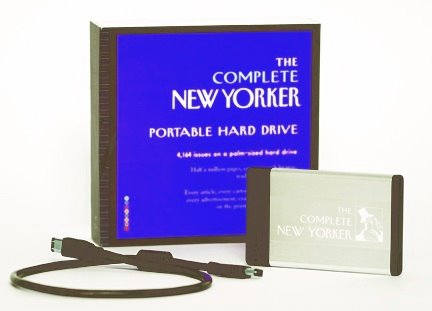
New in New Yorker Technology News: It’s a Hard Drive’s a-Gonna Let You See the Entire Archive Just Like That


First the Complete New Yorker update disk and now this, which I wasn’t expecting at all. From the press release because I am several feet underwater with the puffer fish and the corals, and our internet was down for half the day which has meant much cursing and gnashing of pencils:

“THE COMPLETE NEW YORKER” ARCHIVE TO BE MADE AVAILABLE ON PORTABLE HARD DRIVE

First Major Editorial Collection Published via a Portable Hard Drive

In one of the first digital publishing initiatives of its kind, The New Yorker will release its comprehensive “The Complete New Yorker” archive on a hand-sized portable hard drive, it was announced today by Pamela Maffei McCarthy, Deputy Editor.

The USB-powered drive, which will retail for $299, represents an evolution of “The Complete New Yorker,” which incorporated the entire archive on eight DVD-ROMs and was released last year. Featuring the same program and design as the DVD collection, the hard drive contains every page of every issue of The New Yorker from February 1925 to April 2006—more than 4,000 issues and 500,000 pages.

The drive is designed to provide easy access to the archive virtually anywhere. It connects to a computer or notebook through a simple USB port, providing instant access to every article, review, poem, illustration, and cartoon, exactly as it originally appeared in the magazine. Users can easily search, browse, read, zoom in, and print any stories, covers, or cartoons they choose. They can bookmark them with notes, or share their reading lists with co-workers, family or friends.

“The Complete New Yorker” hard drive will be available September 18th. Pre-orders are available now at www.thenewyorkerstore.com.

I’m excited. I have a jarring birthday coming up, but since it falls not far from the 18th, I suspect that the trauma may be somewhat alleviated via Tilley microchips. Meanwhile, just in and very much Complete New Yorker-related, the first report from a talented new contributor to Emdashes. But you’re going to have to wait for it, because exciting things are happening in the next month here. As the Addams cartoon says, “It’s a baby!” In this case, the symbolic, brainchild kind. Patience, fortitude.

Related: Additional posts about the DVD archive.

And Update Makes Nine


A letter bearing good tidings from the New Yorker Store (boldface is boldly mine; there were a few more links in the email, but it’s been a long day):

The New Yorker Store is pleased to announce that the Updated DVD for The Complete New Yorker is now available for pre-order.

The updated disk replaces DVD 1 of The Complete New Yorker. It includes more than 56 new issues, from February 2005 through April 2006–that’s two bonus months of your favorite magazine.

The Updated DVD also contains upgrades and improvements that will help your program run smoother and your searches search faster. And the magazine-quality image reproduction has never been better.

Best of all, the updated disk costs just $19.99 and is available only through The New Yorker.

You can pre-order your Updated DVD today at The New Yorker Store. The DVDs will begin shipping after Labor Day.

So place your order for your Updated DVD 1 today and soon you’ll be enjoying an even more complete Complete New Yorker.

Cheers,

April L. McKenzie
Web Sales & Promotions Manager

P. S. The Complete New Yorker DVD set is now being sold with the new Updated DVD for $69. It makes a great gift for friends and family.

Well, that’s welcome news, especially about the fast searches, which will be appreciated. Thanks, A.L.M., and may I say I’m so glad you didn’t sign your letter either “Regards” or “Best”? Not that I mind them that much in a business context, but I get hives when I see them dispensed by purported friends. They’re but one treacherous degree away from the dreaded, deadly blank subject line of doom.

I know just the person to review the new disk, so stay tuned…

Operation Homecoming Reading Tour

In June, The New Yorker published, in the words of the website (links added by me):

a selection of letters, journal entries, and personal essays by soldiers, airmen, sailors, and marines who served in the current war in Iraq. The writings are part of a project sponsored by the National Endowment for the Arts called Operation Homecoming. An anthology of the work, edited by the historian Andrew Carroll, will be published this fall by Random House. Here, in an Audio Slide Show produced by Matt Dellinger, five of the servicemen read from their work, accompanied by their photographs.

Here’s the riveting slide show. Now, there’s a nationwide tour of readings. From the San Diego Union-Tribune:

The stylish magazine with the literary bent even devoted its famous cover to this unparalleled explosion of wartime writings.

Last week, the local press reported that Encinitas, thanks largely to the relentless lobbying of former mayor (now councilman) Dan Dalager, would host a free “Operation Homecoming” reading on Sept. 22 at the Encinitas Community Center.

The 40-city tour’s opening venues: New York, Washington and . . . Encinitas. (Fancy that.)

Taken all around, a fair amount of publicity for an anthology you can’t buy in bookstores.

“Operation Homecoming,” conceived and cultivated by the National Endowment for the Arts, won’t be available for sale until Sept. 12.

These hundred or so personal narratives, e-mails, poems and short stories are the distilled result of some 50 workshops conducted by authors the likes of Mark Bowden (“Black Hawk Down”), Tom Clancy (“Clear and Present Danger”), Victor Davis Hanson (“Why the West Has Won”), Bobbie Ann Mason (“In Country”), Tobias Wolff (“In Pharaoh’s Army”) and editor Andrew Carroll (“War Letters”), who edited “Operation Homecoming.”

The Union-Tribune reprints one of the poems in the Random House collection, which, like all the entries, is hard to read without grief and anger:

Now consider this spare poem in the William Carlos Williams vein. It’s by Billie Hill-Hunt, who made an audiotape of her husband sleeping the night before he left for Iraq.

I used to say

“You are cutting down an en-

tire forest with your snoring.”

Now without it

Bedtime seems boring

I recorded you

The last time you were here

Call me crazy

But I play it from time to time

Just to keep you near.