
On the heels of the stupendous “success”:http://twemes.com/nyfest of our New Yorker Festival Twitter “experiment”:http://emdashes.com/2008/09/twitter-your-way-through-the-f.php, I still found myself wondering what the point of the service really is—the similar function on “Facebook”:http://www.gravity7.com/blog/media/uploaded_images/fbook_feed-707592.jpg has the virtue of being integrated into pages that people will consult in the course of other activities.
But then in the course of just a few days, Twitter popped up in probably the two most attention-getting presidential campaign stories of the moment. It turns out that Michele Bachmann (the Minnesota representative who announced a desire to investigate “anti-American” members of Congress) and Ashley Todd (the McCain worker who faked the politically motivated attack by an Obama supporter) used their Twitter accounts just before they became notorious. In both cases their tweets actually bear on the reasons for their eventual fame.
In retrospect, Bachmann’s optimistic “tweet”:http://twitter.com/MicheleBachmann a few days ago that she would soon be appearing on _Hardball_, where she made her unfortunate remarks, is almost touching: she had no way of knowing that appearing on the show would undo her career. And Todd intentionally used Twitter to lay the “groundwork”:http://www.thesmokinggun.com/archive/years/2008/1023083twitter1.html for her hoax, indicating that she was hunting for a Bank America “on the wrong side of Pittsburgh,” complete with helpfully racist conception of what constitutes the right side of that fine town. How odd. Does William Ayers have a Twitter feed? (“Watching Bears game w/ BHO, planning violent overthrow of TPTB, LOL.”) Does Levi Johnston?
Author Archives: Emdashes
Norman Lewis’s Letters From a Vanished Spain
Jonathan Taylor writes:
Patrick French’s authorized biography of V.S. Naipaul, The World Is What It Is, will come out in the U.S. next month, complete with its salacious revelations of marital cruelty. After it was published in Britain in spring, the formidable Stephen Mitchelmore questioned the connection being hastily drawn between the writer’s vices and his books:
When I found out Naipaul was married, it was after I’d read and enjoyed the overtly autobiographical novel The Enigma of Arrival which does not (if a twenty-year-old memory serves) mention any other presence in the narrator’s Wiltshire cottage. Does this demonstrate a protective love or contemptuous indifference? Such is the ambiguity of writing.
Another new British bio, Semi-Invisible Man by Julian Evans, is not set for U.S. release. Like Naipaul, its subject, Norman Lewis, was a novelist and travel writer whose work appeared in The New Yorker. This work, too, turns on the writer’s sculpting of lived experience, switching, almost silently, between fiction and nonfiction as needed. An observation about Lewis in the Times Literary Supplement review of Semi-Invisible Man nicely illustrates the parallel. Lewis’s Voices of the Old Sea (1984) is a spare memoir of three summers he spent in an isolated Catalonian fishing village in the 1950s:
Lewis’s visits, we learn from the biography, were made in a large Buick, in the holidaying company of his partner of the the time and their children. You wouldn’t guess this from Voices of the Old Sea. Lewis was a secretive, contradictory man who nursed his inconsistencies because they fitted his understanding of how the world worked.
I haven’t gotten my hands on Semi-Invisible Man yet. But the UK reviews sent me to Voices of the Old Sea, and thence to some of Lewis’s New Yorker articles, mostly published in the 1950s and 60s.
Voices conjures the elemental traditional life of the village he called Farol, on the eve of its destruction by the tourist industry. This conquest was decades old by the time Lewis wrote the book. Farol’s residents were adamantly attached to a hardscrabble subsistence economy and a culture of atavistic paganism still not yielding completely to Catholicism, much less to anything called “Spain.” Their cosmology was dualistic: one world was Farol, the seaside, cat-infested village whose authority figures were fishermen. Its eternal Other was Sort, and inland, dog-riddled hamlet of cork farmers and other peasant landlubbers who wore shoes rather than rope sandals (chief among Farol’s superstitions was an abhorrence of leather).
As land and houses are bought up to build a hotel, a kind of suspense builds slowly, even though the final outcome seems obvious. And in fact it is shocking when suddenly the villagers, once dismissive of the possibility of change, cheerfully exterminate any private habit of life once the price became irresistible, to be replaced with something palatable to visitors’ expectations of Spain. It’s a sobering read for anyone historically minded who has been to the Costa Brava, or any other part of Europe extensively developed for tourism, and is tempted to think they have an eye for what is “authentic” to the place.
Lewis’s contemporary account of his sojourns in southern Spain, in a March 10, 1956, New Yorker “Letter from Ibiza,” has the same principal theme. He sought out Ibiza as he migrated “farther south each year to keep ahead of the tourist invasion.” Ibiza also exhibited a basic dichotomy between fisherman and peasant.
The existence of the generous, impoverished fisherman and that of the peasant, with its calculation and lacklustre security, are separated by a tremendous gulf. For a fisherman, to be condemned to plant, irrigate and reap, bound to the wheel of the seasons, his returns computable in advance to the peseta, is the most horrible of all fates.
However, the fisher and the farmer had in common their absolute faith in methods and customs that Lewis dated back to Roman, Carthaginian, and Arab rule over the island, equidistant between Iberia and Africa.
The Ibizan peasant is the product of changeless economic factors—a fertile soil, an unvarying climate, and an inexhaustible water supply from underground sources. These benefits have produced a trancelike routine of existence…. Much of the past is conserved in the husk of convention, and archaic usages govern his conduct toward all the crucial issues of life.
But already, Ibiza had a steady flow of transient bohemians and “modern remittance men—the free-lance writer who sees two or three of his pieces in print a year, and the painter who sells a canvas once in a blue moon.” And as in Catalonia, mass tourism was approaching, luring Ibiza’s fishermen into the unthinkable occupation of captaining boat excursions, and sometimes into trysts with “fair strangers.”
In Ibiza, Lewis describes this phenomenon almost whimsically; when he refers to the island’s “first cautious step forward into the full enlightenment of our times,” the undoubted irony is gentle. Similarly, in his October 15, 1955, New Yorker “Letter From Belize,” Lewis sees a “glamorized and air-conditioned Belize emerging as another Caribbean playground for the people of the industrial North” as a bona fide solution to the country’s economic problems, however unappealing it might be to the discriminating traveler. While alluding knowingly to the New Yorker reader’s distaste for “the chagrins of the tourist area,” he concludes with tips for “someone seized by weariness of the world” to retire in Belize, “Gaugin-style.”
But by the 1980s, Lewis had no remaining illusions about “the full enlightenment of our times.” His 1968 London Times article “Genocide in Brazil,” which exposed the oppression of Amazon peoples, had led to the founding of the tribal rights group Survival International. And in place of the little ironies facing the lucky discoverer of an “unspoiled” place, Voices of the Old Sea is a terse requiem. The beginning of tourist boat outings in Farol represent the collapse of the main pillar of the existing order, recorded with the bitter knowledge that there is now no traditional society that is not doomed, if it has not already disappeared.
Given how much Spain’s Costa Brava had changed already by the time Lewis was writing, Voices of the Old Sea is devastating in its understatement. Refraining from overtly referring to the full extent of the later transformation of the place, Lewis lets us fill in the blank sequel ourselves with the shocking knowledge we already have about our “enlightened” age. (I can only wonder what Lewis would have made of The New Yorker‘s other “Letter from Ibiza,” by Nick Paumgarten in 1998.)
Some differences between the article and the book point to the ways Lewis reshaped his experiences in order to bring out what he saw, in hindsight, as their ultimate meaning. An apparent allusion to Farol in the “Letter From Ibiza”—”my favorite Catalonian village”—gives it a “native population of a thousand,” and says 32 hotels had already been built. Without saying so explicitly, Voices of the Old Sea gives the impression of a village of perhaps a few dozen households, and the drama focuses on the creation of a single hotel, heightening the sense of nearness to extinction of the bearers of the old ways.
This misleading effect seems to amount to a clever method of omission, rather than an altering of the facts outright. But without the biography, I haven’t even succeeded in tracking Farol down to correlate his account to any known place. This epic blog comment is the most extensive discussion I’ve found about whether the village exists, or existed, under that name, or was perhaps a fictionalized place in which Lewis synthesized his area experiences.
Lewis’s longest New Yorker work was the 1964 serialization of his book on the Sicilian Mafia, The Honored Society. What keeps him interested in Sicily is the same thing as in Ibiza. The glittering history of an island, its Roman and Arab past seemingly concealed under a decrepit present, but to the lingering eye, actually revealed by it. The Mafia, he writes, is the descendant of an organization formed to defend the poor from the depredations of the Inquisition, which were more economic than theological. It eventually allied itself instead with the feudal landowning class, and after World War II, inhabited the shell of electoral politics (with the help of the U.S. military).
It is the same deadly combination of atavism and modernity that is also often Naipaul’s subject; the two also share a dazzling focus on its material manifestation in landscapes scarred by man. Joan Didion wrote in 1980 that for Naipaul, the world is “charged with what can only be described as a romantic view of reality, an almost unbearable tension between the idea and the physical fact.” The World Is What It Is, indeed. Or, as Lewis put it in the title of a memoir: The World, The World.
Like any other writer, a biographer is wrestling with “the tension between the idea and the physical fact.” French has the goods on “the physical fact”: Naipaul handed over his wife’s damning diaries, sight unseen, and The Guardian says they “take us probably as far as it is possible to go to the core of the creative process.” Andrew O’Hagan in the London Review of Books notes that in Semi-Invisible Man, Evans, who was Lewis’s editor and friend, reveals his misgivings about whether and how to use his own diary entries about a maritally sensitive incident. O’Hagan suggests the degree to which Evans grapples with “the idea,” in fact calling the book “an improvisation on the very idea of being Norman Lewis.”
In either case, it’s worth remembering that, however close we are getting to “the creative process,” it’s only through another’s creative process. I for one am looking forward as much to reading Evans’s book as French’s.
The Wavy Rule, a Daily Comic by Paul Morris: For Whom the Nobel Tolls
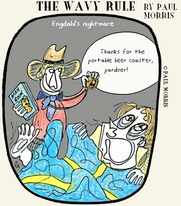
Martin “has been covering”:http://emdashes.com/2008/10/american-writers-to-emulate-no.php Horace Engdahl’s snobbish, narrow-minded, and rather insensitive remark that Americans are “too insular and ignorant” to really be in the running for a Nobel Prize for Literature. If I ever write a novel, it’ll be called _Engdahl’s Nightmare_. Let’s hope it wins the Nobel.
Click on the cartoon to enlarge it!
Read “The Wavy Rule” archive.
Two Thoughts on the Subject of Barry Blitt
1. On September 23, Kevin Drum at the _Mother Jones_ website wrote a “post”:http://www.motherjones.com/kevin-drum/2008/09/obama_and_ayers.html about conservative efforts to find evidence of deep ties between Barack Obama and William Ayers, the former Weatherman who committed several serious terrorist acts in the early 1970s. The point of Drum’s post was that those efforts had turned up virtually nothing. As most potential voters know, John McCain has since attempted to make the relationship between Ayers and Obama a central theme of the election campaign.
When I first read Drum’s post, I had a revelation, which is that _the underlying truth always matters._ It seems to be true that Obama is not close to William Ayers, which, if it is important to you to prove that the two men have a close relationship, is a serious problem.
But more to the point, it also seems clear that, whatever one thinks of Obama, he is not an especially “radical” thinker, apparently has never shown the slightest interest in using violence to further his goals, and doesn’t subscribe to the antiestablishment antipathy of Ayers or his former pastor Jeremiah Wright.
Again, the underlying reality matters: In much the same way that Obama is not a 1960s-era radical who has shown any interest in blowing up buildings for political reasons, Obama is also not a box turtle. Ads that set out to prove that Obama is such a radical or box turtle are equally likely to fail—because the underlying premise is moot.
Speaking of Barry Blitt’s now notorious “fist jab” cover, Art Spiegelman said something related to this at the New Yorker Festival; I mentioned it in my “writeup”:http://emdashes.com/2008/10/new-yorker-festival-art-spiege.php of the event. He said that it took the whole country two news cycles to realize that … Obama is not a radical. This fact lies at the core of the sneaky brilliance of the cover.
The underlying truth matters. The cover, and the decision to run the cover, both stem from an understanding of Obama’s nature as patently not very radical, and that may be why the slow, slow fuse of the cover was so effective, and (in the end) so much less worthy of contempt.
2. Yesterday Daniel Radosh put up a very insightful “post”:http://www.radosh.net/archive/002512.html about the potential misuse of satire once it is “liberated” from its original context.
To back up a moment, most of us are familiar with the occasional phenomenon of satirical news stories from _The Onion_ or some other source popping up in the press as “legitimate news stories”:http://en.wikipedia.org/wiki/The_Onion#The_Onion_taken_seriously. Also at the Festival, Stephen Colbert alluded to a similar incident in which a website dedicated to defending Tom Delay incorporated a clip from _The Colbert Report_ in which Colbert “defended” Delay. (Thanks to Rachel Sklar’s comprehensive “account”:http://www.huffingtonpost.com/2008/10/05/stephen-colbert-at-the-em_n_132019.html of that event, which helped me pin down my memory.)
One of the premises of the original debate around the Blitt cover was that _New Yorker_ readers or really anyone seeing the cover with the familiar “New Yorker” lettering would be very unlikely to regard the drawing as a smear against Obama; others, presumably fearful of future Republican attacks, contended that the image was so loaded that its power might well exceed the borders of that _New Yorker_ frame.
True to his fellow satirists, Radosh disclaims any responsibility on the part of the satirist for the unintended uses of his or her work and simultaneously takes the position that such uses are unlikely anyway. (I stress I’m not slamming him for this; this stuff is tricky.) In the post yesterday, Radosh brought to our notice a fascinating counterpoint to the Blitt cover.
You see, it turns out that those horribly “racist” “Obama Bucks”:http://thinkprogress.org/2008/10/16/obama-bucks/ (scare quotes are necessary, I’m afraid) started out as a liberal satire of Republican excesses—a distant shadow of the Blitt cover, one might say—and then got widely reported as an _example_ of those excesses. Remarkably, Diane Fedele, a Republican Party official in California who found the image and decided to use it in a newsletter, has been obliged to “resign”:http://www.salon.com/wires/ap/2008/10/23/D940B6OO0_obama_illustration/index.html her post.
I’m not sure that Fedele’s credulity or ill intent, however defined, really makes the original satire any better or worse; from where I sit, it still looks pretty crude to me, if undeniably potent. Maybe it all reflects poorly on Republicans, that a satire of their excesses could be regarded by friend and foe alike as legitimate examples of same; I don’t know.
But as for Blitt’s cover, it is a reminder that the existence of the frame matters, and quality matters too. I’m guessing that Blitt is a more experienced practitioner of visual satire than the creator of those Obama Bucks, and that experience may be the element that prevented the image from actually harming people, instead sparking a discussion about whether it might harm people.
The Wavy Rule, a Daily Comic by Paul Morris: Age of Aquarius

_Paul writes_: I suppose we should be grateful that McCain “cleared things up” after a woman “remarked”:http://www.politico.com/news/stories/1008/14479.html that Obama was an “Arab” instead of proclaiming: “He sure is! Straight from Arabland, somewhere east of prissy, socialist Europe!” Of course, the two are not mutually exclusive, as this country is home to more than a million Arab Americans. McCain should have mentioned that too, but the Republicans, those nabobs of negativity, are more than happy to encourage people to think that Obama is somehow not wholly American. The ignorance that led this woman to call Obama an “Arab” is understandable, but these hate rallies also have people yelling “traitor.” Where does that come from? What is the justification for that charge?
Click on the cartoon to enlarge it! Read “The
Wavy Rule” archive.
Click One, Click All: Festival Link Mega-Post!
The dust has settled, and the wide reach of another successful Festival has been registered in the only place that really matters, little differently colored words that you can click on.
“A Party of One”:http://katemalay.wordpress.com/2008/10/08/october-2008-new-yorker-festival/ on the whole weekend
“Places to Go, People to Meet”:http://placestogo-manomi.blogspot.com/2008/10/first-stop-nyc.html on the whole weekend
“I Love New York”:http://iheartmanhattan.blogspot.com/2008/10/supermom.html on the whole weekend, with SuperMom cameo (I love this post)
“Con C De Arte”:http://concdearte.blogspot.com/2008/10/new-yorker-festival.html on the whole weekend (in Spanish!)
“_The Oregonian_”:http://blog.oregonlive.com/books/2008/10/new_yorker_festival_is_highbro.html seems impressed with the Festival
“Eat the Press”:http://www.huffingtonpost.com/2008/10/09/emnew-yorkerem-fest-polit_n_133192.html on the political humor panel
“Eat the Press”:http://www.huffingtonpost.com/2008/10/09/the-campaign-trail-nouns_n_133190.html on the campaign trail
“Eat the Press”:http://www.huffingtonpost.com/2008/10/07/post_171_n_132602.html on the poltiical reporting panel
“Eat the Press”:http://www.huffingtonpost.com/2008/10/06/donna-brazile-dont-ever-p_n_132007.html on the political strategy panel
“Eat the Press”:http://www.huffingtonpost.com/2008/10/06/stephen-colbert-at-the-em_n_132019.html on Stephen Colbert
“Back of the Room”:http://backoftheroom.wordpress.com/2008/10/05/stephen-colbert-at-the-new-yorker-festival/ on Stephen Colbert
“Citizen Sugar”:http://www.citizensugar.com/2293686 on Stephen Colbert
“The Geek Prospectus”:http://geekprospectus.blogspot.com/2008/10/thoughts-on-new-yorker-festival-comics.html on Stephen Colbert and Art Spiegelman
“If Liz Were Queen”:http://iflizwerequeen.com/?p=808 on Donna Brazile (this event probably got the most “reaction”:http://blogsearch.google.com/blogsearch?q=%22donna%20brazile%22%20%22new%20yorker%20festival%22&ie=UTF-8&oe=utf-8&rls=org.mozilla:en-US:official&client=firefox-a&um=1&sa=N&tab=wb in the blogosphere)
“Jezebel”:http://jezebel.com/5059749/elizabeth-edwards-i-think-we-have-the-capacity-with-great-leadership-to-change-things on Elizabeth Edwards
“Benny’s World”:http://bennycat.blogspot.com/2008/10/elizabeth-edwards-refuge-is-passion-for.html on Elizabeth Edwards
“Irish Voice”:http://www.irishabroad.com/news/irish-voice/entertainment/Articles/new-york-festival101008.aspx on Roddy Doyle and Anne Enright
“_Paper Magazine_”:http://www.papermag.com/blogs/2008/10/the_new_yorker_festivals_next.php on the “Next Generation in Fashion” panel
“Stilettos on Cobblestone”:http://stilettosoncobblestone.blogspot.com/2008/10/new-yorker-festival-next-generation-of.html on the “Next Generation in Fashion” panel
Emdashes friend “Newyorkette”:http://newyorkette.com/2008/10/04/caj-at-the-new-yorker-festival-plus-before-and-after-pics/ at the Festival
“Joe Trippi”:http://joetrippi.com/blog/?p=2510 on the political strategy panel that he was on
“Ta-Nehisi Coates”:http://ta-nehisicoates.theatlantic.com/archives/2008/10/if_you_shoot_you_aint_the_real_pretty_tone.php on the political reporting panel that he was on (nice moment involving Remnick too)
“The Apiary”:http://www.theapiary.org/archives/2008/10/the_new_yorker.html on the political humor panel
“Francsesco Explains It All”:http://francescoexplainsitall.blogspot.com/2008/10/sarah-and-dina-hit-town.html on the political humor panel
“The Litter in Littérateur”:http://www.rickyopaterny.com/blog/2008/10/09/donna-brazile-from-the-new-yorker-festival/ on the political strategy panel
“Straight Chuter”:http://www.straightchuter.com/2008/10/trip-report-new-yorker-festival-nyc/ on Lynne Cox and Greg Child (and a few other events)
“Gawker”:http://gawker.com/5059425/peggy-noonan-at-the-new-yorker-festival-kind-of-embarrassing twits Peggy Noonan
“Dancing Perfectly Free”:http://dancingperfectlyfree.com/2008/10/05/ratmansky-at-the-new-yorker-festival/ on Alexei Ratmansky
“Elizabeth Reed”:http://www.aaaah.org/comment_on_alexei_ratmansky_at_the_new_yorker_festival_by_elizabeth_reed.html on Alexei Ratmansky
“The One Ring”:http://www.theonering.net/torwp/2008/10/16/30296-guillermo-del-toro-i%E2%80%99m-so-voracious-about-the-hobbit/, “obsessively”:http://www.theonering.net/torwp/2008/10/20/30314-del-toro-interview-part-2-this-is-the-hardest-movie-i%E2%80%99ll-probably-ever-do/, on Guillermo del Toro
“Newley Purnell”:http://newley.com/2008/10/05/elmore-leonard-on-writing-and-new-yorker-stories/ quotes a pithy Elmore Leonard nugget
“Matthew Klam’s sister”:http://julieklam.wordpress.com/2008/09/12/the-new-yorker-festival-with-matthew-klam-elmore-leonard-and-joyce-carol-oates/ is excited
“Politics and Prose”:http://politics-and-prose.blogspot.com/2008/10/new-yorker-festival-i-american-dream.html on Jeffrey Eugenides and Jhumpa Lahiri
“Ivy Gate”:http://www.ivygateblog.com/2008/10/the-american-dream-brought-to-you-by-the-new-yorker/ on the American Dream
“Blah Blog Blah”:http://mingum.blogspot.com/2008/10/new-yorker-festival-part-one.html on the American Dream
“Blah Blog Blah”:http://mingum.blogspot.com/2008/10/new-yorker-festival-parts-two-and-three.html on Ian Frazier and Mark Singer
“You: On My Blog”:http://youonmyblog.blogspot.com/2008/10/post-in-which-i-post-massive-amounts-of.html engages in a bit of namedropping
“BizBash”:http://www.bizbash.com/newyork/content/editorial/e12951.php disliked the corporate tone of the weekend
“Your Blog About Town”:http://thelmagazine.com/lmag_blog/blog/post__10070804.cfm on Alice Munro
“City Life and the Social Worker”:http://stevetm.com/2008/10/take-this-down-new-yorker-fest/ on the Town Hall
“D.B. Burroughs”:http://dbborroughs.livejournal.com/2458286.html on Clint Eastwood and the Young Shakespearians
“MegExpressions”:http://megexpressions.blogspot.com/2008/10/new-yorker-festival.html on the political strategy forum and the Young Shakespeareans
“Irish Stage in NYC”:http://irishstagenyc.blogspot.com/2008/10/liberal-media-elite-presents-unfiltered.html on Seamus Heaney
“Lodge Porch”:http://www.lodgeporch.com/2008/10/sen-chuck-hagel-at-new-yorker-festival.html on Chuck Hagel
“The Autograph News”:http://theautographnews.com/2008/10/20/matt-groening-gets-animated-while-sketching-the-simpsons/ has footage of Matt Groening … signing his name.
“The Village Voice”:http://blogs.villagevoice.com/music/archives/2008/10/pulp_fictions_l.php on Lynda Barry and Matt Groening
“Tim’s Family Journal”:http://timkau.blogspot.com/2008/10/grace-and-her-boyfriend-paul-rudd.html on Paul Rudd
“Carpathian Kitten Loss”:http://kittenloss.blogspot.com/2008/10/that-pig-has-some-powerful-friends.html on Paul Rudd (with excellent picture)
“Sequenza21”:http://www.sequenza21.com/2008/10/meet-press.html on Dawn Upshaw (with encouraging anecdote about Festival press tickets)
“Celebrity Baby Blog”:http://www.celebrity-babies.com/2008/10/for-mary-louise.html on Mary-Louise Parker (more interesting than you might expect)
“FOX News”:http://onthescene.blogs.foxnews.com/2008/10/21/an-evening-with-oliver-stone/ (yes) on Oliver Stone
“Rundagerously”:http://rundangerously.blogspot.com/2008/10/haruki-murakami-running-novelist-at-new.html on Murakami (with prominent Emdashes plug)
“_NY Times_”:http://www.nytimes.com/2008/10/06/nyregion/06trillin.html on Calvin Trillin, “Come Hungry”
The Wavy Rule, a Daily Comic by Paul Morris: If You’re Going to Naypyidaw
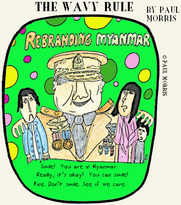
_Paul writes_: “From Despotism to Destination” was the name of an interesting article by Ben Carmichael for the February 2008 issue of Print. Carmichael explored how countries came up with branding campaigns to make themselves attractive to tourists. Myanmar, and its “corrupt and repressive regime”:http://www.newyorker.com/reporting/2008/08/25/080825fa_fact_packer, has not done the same; the cartoon is my own leap into the unknown. Incidentally, Emily has pointed out that The New Yorker has been running Spanish tourism ads with the tagline “Smile! You are in Andalucia.” We weren’t sure why it’s “You are” instead of “You’re.” Any theories on that would be appreciated.
Read “The Wavy Rule” archive.
American Writers to Emulate Nobel Chief’s Splendid Humanity (Not)
I’ve been moving some my books around this week, some of which are by David Foster Wallace and others of which are by recent Nobelists, among them Doris Lessing, Naguib Mahfouz, Orhan Pamuk, J.M. Coetzee. Every time I handled one, I would think about the Nobel, and I would think about Horace Engdahl, who is the top member of the award jury. And I realized that something about Engdahl’s “rebuke to American writers”:http://www.breitbart.com/article.php?id=D93H89QO0&show_article=1 last month was still nagging at me (even though I have already “weighed in”:http://emdashes.com/2008/10/score-it-literary-magazine-1-s.php), and I think I finally recognized what it was.
What bothers me, I realized, was the timing, indeed the appalling lack of sensitivity implied by the timing. Wallace committed suicide on September 12; Engdahl made his comments on September 30. His take on American letters may or may not have merit; less ambiguous is the fact that American letters had lost a particularly bright light just 18 days earlier.
The astonishing thing is that (as far as I saw) there was little connection made between Wallace’s suicide and Engdahl’s comment in the media. Did anyone even notice that these two events sit fairly uncomfortably aside one another? I’m not saying Wallace was headed for Nobel status; far from it, he wasn’t that kind of writer. But Engdahl even went so far as to say that American writers are “too sensitive to trends in their own mass culture,” an observation that could easily be taken as a veiled reference to Wallace—and yet the sentiment that perhaps Wallace’s death made this an awkward moment to point fingers at America’s literary deficiencies went relatively unexpressed.
As sometimes happens, the United States gets treated differently. A hypothetical: if one of Indonesia’s top young writers were to perish in a plane crash, say, and two weeks later the head of the Nobel committee were to single out Indonesia for having an immature literary culture, the ensuing embarrassment might well be substantial enough that the self-appointed critic would be obliged to step down from the position. Less dramatically, people would make that connection very quickly and consider the speaker insensitive. But Americans are not accorded that kind of tact these days.
The Wavy Rule, a Daily Comic by Paul Morris: We’re All in This Together

Click on the cartoon to enlarge it!
The Wavy Rule, a Daily Comic by Paul Morris: Cup of Joe
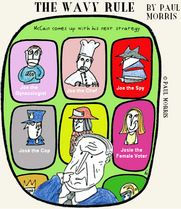
_Paul writes:_ Will McCain plant another “common man” amongst the crowd to grill Obama? Click on the cartoon to enlarge it!