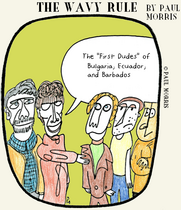
_Paul writes_: He’s called the “First Dude.” He’s been CC’d on e-mails from the office of his wife, Governor Sarah Palin of Alaska, although he has no official title or role in the state government. He has also involved himself in other matters of governance, both financial and personnel-related. For all Sarah Palin’s talk about being a modern independent woman, she can’t take two steps without the suffocating presence of this one-time secessionist snowmachiner. God forbid that he become a sort of co–Vice President of the country in the same way that he served as a sort of “shadow governor” of Alaska.
Click on the cartoon to enlarge it! Read “The Wavy Rule” archive.
Author Archives: Emdashes
Happy Birthday, David Remnick!
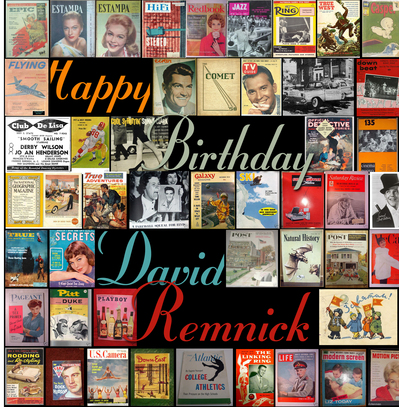
Remnick was born October 29, 1958. For this, we are thankful. And for those looking for a birthday present for him, may we suggest The Best of Bob Dylan’s Theme Time Radio Hour?
—E.G.
Most Popular Topics From the New York Times Today
_A friend notes: _
Most Popular Topics:
1. Jennifer Hudson
2. Barack Obama
3. Ted Stevens
4. Oil and Gas
5. Sarah Palin
6. Credit Crisis
7. John McCain
8. David Axelrod
9. Global Warming
10. General Electric
Deadline Poets: Obituaries Panel at the NYPL
Jonathan Taylor writes:
I got a last-minute ticket to Monday’s sold-out “Perverse Pleasures of Obituaries” event at the New York Public Library. It’s fair to say that The Economist‘s obituaries editor, Ann Wroe, stole the show, or was smartly handed it by the NYPL’s Paul Holdengräber, on a platter of quotes from Aristophanes and Rilke. Wroe and her predecessor, Keith Kolquhoun, have edited the new Economist Book of Obituaries.
The Economist publishes just one substantial, often heroically sympathetic, appreciation a week. Wroe frequently plucks a relatively obscure figure from among the deaths covered by other papers to illuminate his or her illuminatingness, as in the case of Martin Tytell, New York City’s last typewriter “surgeon.”
However, Wroe evidently does have the latitude to commit the occasional “double-header,” in an instance such as the synchronous deaths of Brooke Astor and Leona Helmsley. This obit rather belabors the obvious contrasts between the two rich women before concluding with a leveling wave of the scythe: “Both ended sadly, left alone with their dogs and the ghosts of their husbands in dust-draped city apartments or empty summer homes. But in the memory of most New Yorkers one was a saint and the other a sinner. Richesse oblige.”
Unlike newspapers like The New York Times and London’s Daily Telegraph (which, Wroe noted, specializes in “colonels” and “decadent aristocrats”), The Economist doesn’t have need for an extensive file of prewritten obits. Only seven, in fact, one of which is Saddam Hussein’s, evidently never published for whatever reason; she let slip that others include the (now former) king of Nepal, bookish former British Labour Party leader Michael Foot, and Nelson Mandela. It was not clear whether the bigger package she promised for Margaret Thatcher’s death was counted as one of these seven. Prince Philip, she said, was not among them, although she declared he wasn’t “looking too well lately” (!).
The presence in the audience of Times obit writers Bruce Weber and William Grimes, along with former public editor Daniel Okrent, steered the event toward Times protocol fetishism. For a lot of people present, I don’t think this was an idle concern, although in reality it is. Weber piped up at one point with an allusion that I think went mostly unheard, to the status conferred by the inclusion in an obit’s headline of “the verb”—presumably “Dies.” Something else to take account of in the morning scan.
The obit of the day to crop up in the conversation was that of southwestern mystery novelist Tony Hillerman, with Okrent emitting, virtually in a heartfelt cry, that “the world has changed.” Before the event, I had been looking in The Complete New Yorker at the magazine’s obituary practices over time (81 under the category “Obituary,” another 85 under “Postscript,” numerous others under “Comment”), and bethought myself to see whether it had taken note of Hillerman’s novels.
The earliest citation was from 1970; author: Edmund Wilson. Here was a find! I thought—Wilson, famous for his blinkered dismissal of “detective fiction,” on Tony Hillerman!? In fact, the interminable Wilson piece was the second part of a consideration of “Two Neglected American Novelists,” Henry B. Fuller and Harold Frederic.
Hillerman’s The Blessing Way was reviewed in the appended Briefly Noted section: “Highly recommended.”
The Wavy Rule, a Daily Comic by Paul Morris: Bad News Bears

Click on the cartoon to enlarge it! Read “The Wavy Rule” archive.
Why Do People Talk so Much about the Bradley Effect?
Ever since Barack Obama failed to win the New Hampshire primary (for reasons probably having little to do with people lying to pollsters), the media just cannot get enough of the Bradley effect. (For a cogent explanation of why the Bradley effect has been on the endangered species list since about 1991, and why it probably didn’t even happen to Tom Bradley himself, in the mayoral race of Los Angeles for 1982, see “here”:http://www.onthemedia.org/transcripts/2008/10/24/04.)
The Bradley effect is an attempt to measure the existence of hidden racism among the electorate. People are racists but cloak their views before a judgmental pollster, goes the theory. It’s worth pointing out that the phenomenon itself requires a special combination of circumstances. If you make a line chart of “racism in society over time,” where it starts out at 100% (everyone is always racist) and it slopes diagonally downward to 0% (nobody knows what racism is), the Bradley effect would only obtain when you have a bunch of racists but the racists aren’t really in charge of the discourse. In other words, too much racism in the society and nobody’s embarrassed about expressing it; too little racism and it doesn’t get expressed. You have to have a whole bunch of racists who are feeling a bit sheepish. In a way, it’s not surprising that the window for the Bradley effect is always a fleeting one.
My opinion is that for a subject of a poll misrepresent what candidate he or she supports to an anonymous pollster who possesses no power to alter the subject’s life … well, you have got to be talking about some serious shame/embarrassment. In other words, not wanting to vote for the black guy isn’t a potent enough cocktail of shame and embarrassment to induce the lie. You have to be supporting … pretty much a Klansman or a Nazi to elicit it.
At this point, I’d like to bring in two men, “David Duke”:http://en.wikipedia.org/wiki/David_Duke and “Jörg Haider”:http://en.wikipedia.org/wiki/J%C3%B6rg_Haider.
I hear a lot about the Bradley effect, but I rarely hear anyone mention David Duke. David Duke was a former Grand Wizard of the Ku Klux Klan who participated in a runoff election in the Republican primary for the gubernatorial race in Louisiana in 1991. A man named Edwin Edwards beat Duke pretty solidly, it turned out, but there were a few weeks there in which that outcome did not seem ensured, and in that period you heard a lot about white racists lying to pollsters. To be frank, it’s the last time (barring the possible exception of Harold Ford’s 2006 Senate run) that people talked about this subject at all in the United States. Here’s _The New York Times,_ after Duke “got beat”:http://query.nytimes.com/gst/fullpage.html?res=9D0CEFD91F3AF93BA25752C1A967958260:
Although the prospect of a large “hidden vote” for David Duke received a lot of speculation from poll takers and commentators in the weeks before Louisiana’s runoff election for governor, a hidden vote did not materialize in Edwin W. Edwards’s victory over Mr. Duke.
A hidden vote could have occurred if some voters were not willing to disclose their preferences to poll takers. In Mr. Duke’s past attempts at public office, his support was stronger than some polls had predicted, making some poll takers wary about simply using their standard methods in the runoff.
They seemed to take the effect pretty darn seriously, even if it didn’t manifest.
Between 1991 and 2008, you didn’t hear much about the Bradley effect in the United States. But you did hear about it (albeit not by that name) quite a bit in Austria, a country that featured the most successful radical right-wing politician in Europe: Jörg Haider.
By chance, Haider died in car crash a couple of weeks ago. In the 1990s, he led the Freedom Party of Austria to a series of very successful showings, finally entering a coalition government in 2000. Before Haider, the FPÖ was kind of a forgotten little right-wing party where the former Nazis would hang out; not a big deal. Haider changed all that, gradually building it up to nearly 30% of the vote and generally freaking a lot of liberals out, both inside and outside of Austria. Also, Haider would occasionally say flattering things about the Third Reich, which would get him into trouble.
And in Austria, you heard constantly about how polls were underrepresenting his support. I’m not an expert, but well-informed Austrians assure me that the electoral tallies tended to outstrip his support in polls.
In Austria, support for the Nazis is a crime punishable by “incarceration”:http://en.wikipedia.org/wiki/David_Irving; it’s a serious business, and the social sanctions against it are high—maybe not as high as here, but still very high. As with the KKK, perhaps, you don’t just casually admit to any anonymous caller that you are into supporting crypto-Nazis in Austria. Haider was deft enough a politician to blur his own Nazi ties (I myself think they were somewhat overstated)—but the whiff of social sanction was never far from him.
So that’s my thesis. if it’s just mild distaste for the black candidate, you’re not going to go and _change the candidate you support_ to a pollster—that’s the threshold we’re discussing here. You might not admit the racism on the phone, but you’ll say you support the other guy because of his tax policies. Only for a candidate who is synonymous with evil are you going to cloak your views.
Personally, I think that the Duke and Haider cases constitute almost a death blow to the Bradley effect if you think through their implications; in one of the two cases, it didn’t even exist! The media want to keep interest in the race high, so they have incentives to dismiss countervailing examples like David Duke. But that doesn’t mean we should believe them.
New Yorker Prehistories: Entourage, Algonquin Edition
_A friend notes: _
The Algonquin Round Table makes Mental Floss‘s fab list of “7 Entourages That Changed the World.” Lou Harry and Todd Tobias write: “We love Vincent Chase and his HBO cohorts as much as the next magazine, but we’re not going to stand idly by while they hog the entourage limelight. Those guys might make waves in Hollywood, but the following power crews made history.” Read and cheer! Then learn lots more about the sharp-edged rounders at the Dorothy Parker Society website, a treasure trove of all things Algonquin.
The Wavy Rule, a Daily Comic by Paul Morris: Dr. No and Dr. I-Couldn’t-Agree-More
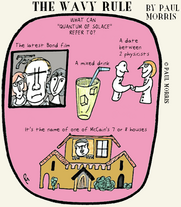
_Paul writes:_ You’ve seen the billboards for the new Bond film, and maybe, like me, you’ve wondered what the meaning of “Quantum of Solace” is. This was the name of a short story by Sir Ian Fleming, but the plot of the film has no similarity to that of the short story. The name sounds mysterious enough to intrigue moviegoers, I suppose. _Beverly Hills Chihuahua,_ by the way, delivers exactly what you’d expect.
Click on the cartoon to enlarge it! Read “The Wavy Rule” archive.
Literary Notes from All Over: a Digital Edition
Benjamin Chambers writes:
* Anyone else notice that The New Yorker is launching a “digital edition” later this year? You’ll read this edition via the Web, it’ll look just like the magazine, but you’ll get access to it before the print edition arrives in your mailbox or even most newsstands. Current subscribers can get the digital version free for the duration of their subscriptions, as long as they sign up; non-subscribers can get a free, four-issue trial subscription, though after that, it’s $39.95. Looks promising. (Searchable, too.)
* Wouldn’t it be nice if you could collect all of your favorite TNY stories in one place? Thanks to Emily, I found a link on Galleycat about AnthologyBuilder.com, a service that allows you to pick and choose from its list of stories to create your own anthology. Right now, there’s a limit on what you can choose from, but the possibilities are obvious. Perhaps TNY is already figuring out a way to pay its current authors so it can build such a service of its own? If I could create a personal TNY anthology, I’d include some John Cheever, Mary Lavin’s “The Great Wave,” Muriel Spark’s “In the House of the Famous Writer,” and … well, I’m just getting started. I’ll have to work on a list. Which stories would you include?
* Something I didn’t expect to ever see, but found touching: notes from David Foster Wallace’s memorial service, courtesy of Stephen, of the blog Band of Thebes. I quite liked the notes, but there’s something terribly ironic about Wallace’s memorial service being rendered in bursts of shorthand reminiscent of Twitter.
* Dzanc Books, an independent literary publisher (which numbers among its authors TNY poet Terese Svoboda), is holding a Write-a-Thon on November 15th to raise funds for its writers-in-the-schools workshops. Check it out, round up some sponsors for the big day, and when November 15th comes, write your heart out.
He was E-mail Before E-mail was Cool
Benjamin Chambers writes:
Remember when e-mail was new? If you’re like me, probably not as well as you think you do, if John Seabrook’s January 10, 1994 story on Bill Gates, “E-mail from Bill,” is anything to go by.
For instance, Seabrook talks about how odd it was to meet Gates for the first time, after first exchanging a number of e-mails:
As we shook hands, he said, “Hello, I’m Bill Gates,” and emitted a low, vaguely embarrassed chuckle. Is this the sound one E-mailer makes to another when they finally meet in real space? I was aware of a feeling of being discovered.
Doesn’t this seem to be a fairly odd observation under the circumstances—not to mention precious? I have to wonder how in this context e-mailing people before meeting them in person differs from corresponding with them by letter: what had really changed? Hindsight is 20/20 and all that, but Seabrook gets even goofier:
Maybe this is the way lots of people will communicate in the future: meet on the information highway, exchange messages, get to know the lining of each other’s mind, then meet face to face. In each other’s physical presence, they will be able to eliminate a lot of the polite formalities that clutter people’s encounters now, and say what they really mean. If this happens, it will be a good thing about the information highway: electronic communication won’t reduce face-to-face communication; instead, it will focus it.
Still, it’s kind of fun to read such an unabashedly wide-eyed view of the medium from a time when e-mail really was new. It’s like opening a time capsule.
Seabrook followed up his Gates profile with an “In the Mail” piece on pp. 8-9 of the February 7, 1994 issue of TNY. (It doesn’t appear on the TNY website or in the index of The Complete New Yorker.) In it, he summarizes reader response to his article and includes some additional thoughts on what it was like to go from having virtually no e-mail correspondence to an amount of e-mail that must have seemed overwhelming for the time:
“[T]he morning that article appeared on the newsstands, I checked my mailbox and found it stuffed: twenty-nine messages. In the following three weeks, I received three hundred and ninety-six electronic messages from readers, almost all of them strangers. Over that period, I also received eight phone calls about the article, seven letters, and one fax … In my greenness about the information highway, I put my E-mail address in the article, and now I suppose I will be hearing from readers for years.”
I gather Seabrook wasn’t put off by his readers’ responses though, because he helpfully supplied his e-mail address again. I’ll reprint it here, just as a reminder of times (and companies) gone by: 73124,1524@compuserve.com. (Remember when you could put a comma in your e-mail address? Oh, for the days of the open range!)
Seabrook also writes about his changing feelings about receiving so much e-mail: at first he was thrilled, then overwhelmed, and finally more interested in the process than the content: “Now I find myself looking forward more to composing E-mail than to receiving it … Composing E-mail composes me.” Wonder if he still feels that way?
He quotes from a number of readers, who are variously humorous, frivolous, and bemused by the possibilities of the new medium. My favorite:
Real problem with the Information Superhighway is typified by this letter: God only knows how many idiots like me will tie up your time with responses.
Amazing how much things have changed, no?