
Author Archives: Emdashes

Forget Jet-Paks: We Demand More Skybridges for New York

Jonathan Taylor writes:
A few weeks ago, a friend and I were admiring a skyscraper in lower Manhattan, the American International Building at 70 Pine Street. Its tower—well described as an Art Deco hypodermic needle—is so thin and set back that it’s hard to look at from street level, but the almost parodically Deco style of its lobby can be seen despite the security guards posted to ward off idle venturers. A few weeks later, after the rescue of American International Group, I confirmed my guess that the building is the company’s headquarters (the Federal Reserve Bank of New York is conveniently nearby) but learned that it hasn’t always been. It was completed in 1932 as Sixty Wall Tower, known also as the Cities Service building, because it was the headquarters of oil company Cities Service Co. until the company moved to Tulsa, Oklahoma, in 1974. (I remember from growing up in Tulsa the ubiquity of the name “Cities Service,” probably as where a lot of kids’ dads worked. A relatively literal-minded child, I was perplexed by the company name’s stubborn failure to make clear to me what kind of company it was. Cities Service later became Citgo, now owned by the government of Venezuela.)
Frequently noted about the Cities Service building is the fact that it originally had eight “double-decker” elevators that served the floors above 28, two floors at a time, saving on elevator shafts and maximizing rentable floor space. In the April 30, 1932, issue of The New Yorker, E.B. White wrote a Talk piece about these new Otis elevators. White’s description of the system’s logic made it crystal clear, only after making it painfully clear that I should have been more confused by it than I thought I was:

People seem to think that to get into a double-decker, you have to walk either up a flight of stairs or down a flight. This isn’t so. The Cities Service building has two street entrance levels (on account of the way the land slopes off), and no matter whether you enter downstairs or upstairs, there will be four elevators that will make the even stops and four that will make the odd stops. No walking. In other words, when the double-deckers are at the starting position, their upper decks are being loaded with people coming in from one street, their lower decks with people coming from another street; four will stop ODD/EVEN and four EVEN/ODD.

The double-decker system was phased out in the building in the 1960s, according to this 1998 Times article. Among the buildings that today use double-deckers is the Citigroup Center in Midtown, itself the subject of a gripping May 29, 1995, New Yorker article by Joe Morgenstern (department: “City Perils”) about the discovery of a structural defect that might have caused it to collapse in a major hurricane, and the secret, after-hours work undertaken to correct it.
White ended his Talk piece on the elevators by noting, a bit sourly, that Sixty Wall Tower “isn’t in Wall Street, and can’t even be seen from Wall Street,” which is one block away. But the name stems from another of the building’s gewgaws, even more interesting from the point of view of that wonderful topic, the futurism of the past. The tower was joined to another belonging to Cities Service, at 60 Wall Street, by a connecting bridge on the 16th floor, allowing it to lay claim to that address. The bridge is now gone, but in that age, when the city was rapidly levitating upward in a skyscraper-building race, such bridges might well have seemed to be the logical wave of the future. In light of what seems to be the omnipotence of real estate values in the city’s economy, it’s still hard to believe that someone hasn’t found a way to profit from turning more corridors of air space into rights of way. That dream—and a hint of the obstacles to it—can be found in another Talk piece, of October 21, 1933, about the city’s taxation and regulation of such bridges (then numbering about 100, according to the article). They required the approval of the Board of Estimate, the Borough President, the Fire Department, and the Municipal Art Commission.
Somewhere in there (the piece is not clear) was the crucial say-so of “Edward Libaire, Assistant Engineer of the Division of Franchises” and “the city’s bridge expert for twenty-eight years.” Libaire rejected a proposal for another skybridge between the Cities Service tower and 60 Wall Street, on the second-story level, arguing that it would “hide too much of the sky.” But despite his stern standards for bridges that “won’t shut off too much light and that people will admire,” Libaire “pictures New York in 1983 with block-square skyscrapers connected with bridges that form great aerial highways.”
Now that New York City’s revenue base is being threatened by the financial crisis, perhaps Mayor Bloomberg would like to take a new look at skybridges. The Talk piece says that at that time—during the original Great Depression—”Nearly $400,000 of the yearly income of the city is from its tax on bridges between buildings.” (That’s $6.7 million in today’s dollars, according the federal government’s own “inflation calculator”:http://data.bls.gov/cgi-bin/cpicalc.pl.)
By the way, the Sun in January carried this update on the state of skybridges in the city today.
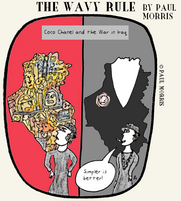
The Wavy Rule, a Daily Comic by Paul Morris: Intelligent Design

Today’s installment is reminiscent of an old Might magazine article about the importance of graphic designers in international affairs. The only thing I remember about it was that the solution for Northern Ireland involved use of Photoshop’s gradient feature on the embattled border. Click to enlarge!
wavyrule_bypaulmorris_coco.png
More by Paul Morris: “The Wavy Rule” archive; “Arnjuice,” a wistful, funny webcomic; a smorgasbord at Flickr; and beautifully off-kilter cartoon collections for sale (and free download) at Lulu.

File Under Awesome: Caption Contest Now Searchable

Good news! The _New Yorker_ website now has a feature that lets you search on past “caption contests”:http://contest.newyorker.com/CaptionContest.aspx! Click on “Caption Archive” and there you are! You can access “every caption submitted to the contest, as well as see all of your captions.” (You will have to register to use the feature.) If you’re wondering what to search on, here are some “suggestions”:http://emdashes.com/mt/mt-search.cgi?IncludeBlogs=2&tag=Cartoon%20Caption%20Contest&limit=20.

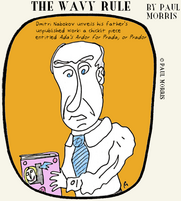
The Wavy Rule, a Daily Comic by Paul Morris: Sole Authorship

_Today’s entry puts me in the mind of John Hodgman’s failed palindromes: “Tow a what? Thaw!” Similarly, egret, neo tickle? Click to enlarge!_
wavyrule_bypaulmorris_nabokov.png
More by Paul Morris: “The Wavy Rule” archive; “Arnjuice,” a wistful, funny webcomic; a smorgasbord at Flickr; and beautifully off-kilter cartoon collections for sale (and free download) at Lulu.

Hugging a Semicolon: National Punctuation Day

NPD-2.png
Paul “The Wavy Rule” Morris writes:
“Hey, it’s National Punctuation Day today!” I exclaimed to a co-worker who had just come back from break involving coffee-drinking and texting on a cellphone, an act that sadly failed to employ any punctuation marks.
“Oh, okay,” he said. “What am I supposed to do now? Hug a semicolon?”
Well, no, National Punctuation Day does not involve hugging semicolons (which are, in any case, notoriously shy punctuation marks). This Day, which has a website devoted to it, has a series of activities that you can do to honor these symbols of ours. Cook a question-mark meatloaf, bake exclamation-point cookies, take a picture of annoying punctuation gaffes, and celebrate the difference that good punctuation-mark use makes.
The benevolent founder of Emdashes (itself a website name that celebrates a punctuation mark), Emily Gordon, who eats, shoots, and leaves, loves and respects punctuation marks–so much so, in fact, that she decided to run a contest to name an unnamed one. (Interroverti, The Qué Mark, and Quiggle were the winners.)
Aldus Manutius, and all the typographical innovators in history, would be proud. Let us celebrate National Punctuation Day by using punctuation marks even more: let’s use semicolons in our text messaging (“The party sounds fun; I should go”), interpuncts on our iPhones, and ellipses in our e-mails (“You didn’t go to the party… Why?”).

Barry Blitt to Duke it Out in Three-Way ASME Final

Congratulations to Barry Blitt, whose Ahmedinejad/Larry Craig cover from October 2007 is “competing”:http://www.mediabistro.com/unbeige/magazines/marc_jacobs_eliot_spitzer_mahmoud_ahmadinejad_battle_for_cover_of_the_year_95340.asp against two worthy efforts: Todd Eberle’s pic of Mark Jacobs for _Interview_, and Henry Leutwyler’s cheeky photo of Eliot Spitzer for _New York_. Good luck, Barry!

Twitter Your Way Through the Festival!

For this year’s New Yorker Festival, we’re going to try a little experiment, and it will work a lot better if some of you join in. We want to have a special Emdashes Twitter dedicated to the New Yorker Festival.
If you are not acquainted with this micro-blogging technique, I recommend that you learn about it at the Twitter website. The essence of it is like writing a blog that consists of text messages. People can post messages of 140 characters or fewer to a blog from their cellphones (and also from a browser). Here’s a look at Jason Kottke’s Twitter.
Our goal is to have people attending events at the Festival contribute spontaneous “tweets,” or messages, and have them appear on a common page accessible to everybody. There’s a minor difficulty that most people will be doing this from a cellphone, and user cellphones have a strong tendency to default to their own Twitters. For users in the United States, the number to dial from your cellphone is 40404.
There is a service called Twemes that makes it easier to aggregate messages from multiple people onto a single Twitter. It’s very clever—users exploit the pound (#) sign to create a kind of tag that they append to the start of each message. So all users have to do is send a tweet as they normally would, but put the string “#nyfest” at the front. If that tag is there, the message will end up on this tweme page.
It’s as simple as that.
Emily’s username is (what else?) Emdashes, and mine is wovenstrap.
So if on Festival weekend, you see Stephen Colbert call David Remnick “papa bear” or witness Clint Eastwood gun down some muggers, Twitter it (after calling 911) by typing #nyfest!

Request to Readers Fluent in Japanese

A Japanese magazine called Courrier Japon printed a photograph that I took of David Remnick during the New Yorker Conference in May. It appears in the October 2008 issue. The article is written by likely Englishman documented Irishman Trevor Butterworth.
I can’t read Japanese. Perhaps someone who can could have a look at the text and give us a very brief indication of its contents? We’d appreciate it!
Update: In a comment, the author himself writes in to explain that it is a Financial Times article in translation. Here is the original, it is well worth a look! It is that rare combination of informational and witty that only Irish journalists laboring for the FT ever attain with regularity. The original photo, by Lorena Ros, is far superior to mine.

The “Mad Men” Files: Introduction

“That story was good enough for The New Yorker. And don’t act like those magazines do everything on merit.”

—Pete Campbell, Mad Men, season 1, episode 5 (“5G”)

As is often the case with really good TV shows, that line only improves with context.
I’m watching Season 1 of Mad Men, enjoying it very much. I take little notes as I watch (“Volkswagen Lemon ad, year?”), minor matters I can look up on Wikipedia and, more to the point, The Complete New Yorker.
Doesn’t it seem likely that Matthew Weiner, the creator of the show, owns a copy of The Complete New Yorker? I bet he’s worn Disc 5 (1957-1964) down to the nub. I expect to do the same.
It’s difficult to think of a show that better lends itself to CNY supplement. Based on a few preliminary searches, the CNY yield on terms like “advertising” for that era is too rich to be covered in a single post, so I’ll add occasional posts over the next few weeks. The ad man really does appear to have been an object of especial interest at that time, and the CNY reflects that. I hope you’ll … tune in.
Here’s a starter, a Dana Fradon cartoon from the October 1, 1960, issue, a commentary on the literary ambitions of the gang at Sterling Cooper (an alternate title for the episode quoted above might have been “All the Sad Young Literary Men”). Enjoy.
fradon.JPG

The Wavy Rule, a Daily Comic by Paul Morris: Horrorshow

The other day on Letterman, Chris Rock called Alaska “The Road Warrior with snow.” Today Paul adds chellovecks and moloko to the vast expanses of Alaska. Click to enlarge!
wavyrule_bypaulmorris_droog.png
More by Paul Morris: “The Wavy Rule” archive; “Arnjuice,” a wistful, funny webcomic; a smorgasbord at Flickr; and beautifully off-kilter cartoon collections for sale (and free download) at Lulu.