
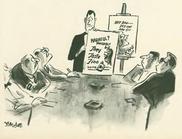
Today’s installment is courtesy of Frank Modell in the February 13, 1960, issue. Shades of the very first episode, in which Don Draper teaches the tobacco executives to reassure their addicted customers. “Smoke your cigarette,” he says. “You still have to get where you’re going.” That’s some evil stuff right there.
Author Archives: Emdashes
Score it Literary Magazine 1, Swedish Chauvinists 0
_Martin Schneider writes:_
As someone with deep roots in the country that produced “Elfriede Jelinek”:http://en.wikipedia.org/wiki/Elfriede_Jelinek, I’m pretty strongly on David Remnick’s side on “this one”:http://www.breitbart.com/article.php?id=D93H89QO0&show_article=1.
The Brothers Grimm and George Herbert Explain It All to You
(Love bade me welcome, yet my soul drew back,
Guilty of dust and sin.)
“You, Cinderella?” she said. “You, all covered with dust and dirt, and you want to go to the festival? You have neither clothes nor shoes, and yet you want to dance!”
(But quick-ey’d Love, observing me grow slack
From my first entrance in,
Drew nearer to me, sweetly questioning
If I lack’d anything.)
However, because Cinderella kept asking, the stepmother finally said, “I have scattered a bowl of lentils into the ashes for you. If you can pick them out again in two hours, then you may go with us.”
(“A guest,” I answer’d, “worthy to be here”;
Love said, “You shall be he.”)
The girl went through the back door into the garden, and called out, “You tame pigeons, you turtledoves, and all you birds beneath the sky, come and help me to gather:
The good ones go into the pot,
The bad ones go into your crop.”
Two white pigeons came in through the kitchen window, and then the turtledoves, and finally all the birds beneath the sky came whirring and swarming in, and lit around the ashes. The pigeons nodded their heads and began to pick, pick, pick, pick. And the others also began to pick, pick, pick, pick. They gathered all the good grains into the bowl. Hardly one hour had passed before they were finished, and they all flew out again.
The girl took the bowl to her stepmother, and was happy, thinking that now she would be allowed to go to the festival with them.
(“I, the unkind, the ungrateful? ah my dear,
I cannot look on thee.”
Love took my hand and smiling did reply,
“Who made the eyes but I?”
But the stepmother said, “No, Cinderella, you have no clothes, and you don’t know how to dance. Everyone would only laugh at you.”
Cinderella began to cry, and then the stepmother said, “You may go if you are able to pick two bowls of lentils out of the ashes for me in one hour,” thinking to herself, “She will never be able to do that.”
The girl went through the back door into the garden, and called out, “You tame pigeons, you turtledoves, and all you birds beneath the sky, come and help me to gather:
The good ones go into the pot,
The bad ones go into your crop.”
(“Truth, Lord, but I have marr’d them; let my shame
Go where it doth deserve.”
Two white pigeons came in through the kitchen window, and then the turtledoves, and finally all the birds beneath the sky came whirring and swarming in, and lit around the ashes. The pigeons nodded their heads and began to pick, pick, pick, pick. And the others also began to pick, pick, pick, pick. They gathered all the good grains into the bowls. Before a half hour had passed they were finished, and they all flew out again.
The girl took the bowls to her stepmother, and was happy, thinking that now she would be allowed to go to the festival with them.
But the stepmother said, “It’s no use. You are not coming with us, for you have no clothes, and you don’t know how to dance. We would be ashamed of you.” With this she turned her back on Cinderella, and hurried away with her two proud daughters.
(“And know you not,” says Love, “who bore the blame?”
“My dear, then I will serve.”)
Now that no one else was at home, Cinderella went to her mother’s grave beneath the hazel tree, and cried out:
Shake and quiver, little tree,
Throw gold and silver down to me.
Then the bird threw a gold and silver dress down to her, and slippers embroidered with silk and silver. She quickly put on the dress and went to the festival.
Her stepsisters and her stepmother did not recognize her. They thought she must be a foreign princess, for she looked so beautiful in the golden dress. They never once thought it was Cinderella, for they thought that she was sitting at home in the dirt, looking for lentils in the ashes.
“You must sit down,” says Love, “and taste my meat.”
So I did sit and eat.
–From “Cinderella,” by Jacob and Wilhelm Grimm, and “Love (III),” by George Herbert
The Wavy Rule, a Daily Comic by Paul Morris: …Something Completely Different
Paul writes about today’s cartoon:
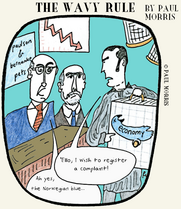
Is it just me, or is the American public not angry enough about this whole bailout? What we need is an “Eric Praline-like”:http://en.wikipedia.org/wiki/Eric_Praline character, high-pitched and indignant, to go before the President, or Congress, or both, and ask what in bleedin’ hell is going on: “Look, it’s people like you what cause unrest.” “A letter to America attributed to John Cleese”:http://blog.tmcnet.com/blog/rich-tehrani/personal/john-cleeses-letter-to-america.html is now considered to be apocryphal, but nevertheless makes interesting reading. As a “Sarvik.com article”:http://www.sarvik.com called “Between Iraq and a Hard Place” has pointed out, “since the bank rescue package will not include assistance for The People, and because society at large will demand assistance for them as well, bigger government or/and higher taxes to stimulate the system through public works are inevitable in one form or another. Increased taxation is the domain of Democrats, and that’s why they will ultimately win the 2008 Presidential election. The Republicans won’t want to confuse their reputation by being forced to create another New deal administration, as it will make it extremely difficult in future to campaign on a platform of conservatism and small government.”
Also, check out Cleese’s “official site!”:http://www.thejohncleese.com/ And click on the cartoon to enlarge it!
More by Paul Morris: “The Wavy Rule” archive; “Arnjuice,” a wistful, funny webcomic; a smorgasbord at Flickr; and beautifully off-kilter cartoon collections for sale (and free download) at Lulu.
Test Your Banned-Books Knowledge
Benjamin Chambers writes:
The American Library Association is celebrating banned books this week. Trust the Brits to come through with élan, by which I mean they’ve created a quiz, about which, more anon. High time, I thought, for Emdashes to create a quiz of its own: which New Yorker authors have been banned most often?
Top of the list would have to be J.D. Salinger, for Catcher in the Rye (which I gather TNY rejected) and of course Vladimir Nabokov, for Lolita. (Check out William Styron’s 1995 account of why Random House refused to publish it.) Who else should be on the list?
Once you finish with our quiz, head on over to the Guardian, and take theirs. First, though, you might want to bone up by learning more about the top 10 books that Americans tried most frequently to remove from library shelves in 2007. From there, you can also learn which were the top 10 most-frequently challenged books of this century, which is almost a two-for-one, really, because all but 3 of those books were also the most-frequently-challenged books of the 1990s. (Do authors no longer want to be banned in Boston?)
The quiz was posted by the Guardian, and it has at least one UK-centric question on it: “Why did a UK exam board remove Carol Ann Duffy’s poem ‘Education for Leisure’ from the GCSE syllabus?”
This is what’s known in common parlance as a rigged game, so I’m going to even the odds—you can find the poem in question below this article covering the hullabaloo. (Note that somebody complained about the poem because of its “description of a goldfish being flushed down the toilet”.) Apparently, Duffy replied to the official stricture with another poem, which left its target feeling “gobsmacked.” Wish poets had that kind of power in this country.
The Wavy Rule, a Daily Comic by Paul Morris: Potato Chip Politics
In today’s comic, Paul considers the tasty, salty angle of the McCain-Obama debate. Click the drawing to enlarge! (And anticipate the munchies.)

More by Paul Morris: “The Wavy Rule” archive; “Arnjuice,” a wistful, funny webcomic; a smorgasbord at Flickr; and beautifully off-kilter cartoon collections for sale (and free download) at Lulu.
Banks, But No Banks

Lines Cribbed in (Supposedly) Early Fall, As I Remove My Favorite Jacket
“It’s fall, dear.”
“I say it’s summer, and I say the hell with it.”
This Will Probably Be My Favorite Sentence on the Internet All Week
“Sassy mice claiming rights beyond their station might appear in any number of second-tier long-running comic strips (see for instance Garfield, 9/8-11/08).”
Friday Bouillabaisse: Noble Nursing, “Sexy Puritans,” the ’64 World’s Fair, Ricky Gervais, Suzanne Vega, Chimamanda Adichie, and a Very Doggy Tilley
We’ve already noted the commendable choice of Alex Ross as one of this year’s MacArthur Fellows; Chimamanda Adichie is also a winner, and I’m so glad. Here’s the MacArthur website’s description of a third accomplished and deserving recipient, Regina Benjamin:
Regina Benjamin is a rural family physician forging an inspiring model of compassionate and effective medical care in one of the most underserved regions of the United States. In 1990, she founded the Bayou La Batre Rural Health Clinic to serve the Gulf Coast fishing community of Bayou La Batre, Alabama, a village of approximately 2,500 residents devastated twice in the past decade by Hurricanes Georges, in 1998, and Katrina, in 2005. Despite scarce resources, Benjamin has painstakingly rebuilt her clinic after each disaster and set up networks to maintain contact with patients scattered across multiple evacuation sites. She has established a family practice that allows her to treat all incoming patients, many of whom are uninsured, and frequently travels by pickup truck to care for the most isolated and immobile in her region.
This immediately brought to mind “Children of the Bayou,” Katherine Boo’s outstanding 2006 piece about Louisiana nurses who travel to help young mothers learn to care for their babies. I find myself recommending it every few months. Boo has a satisfyingly long interview with Matt Dellinger on the New Yorker website; read it, and find the piece. It’ll slay you.
Speaking of noble professions, I was moved to tears by a comment from a social worker about how Suzanne Vega’s song “Luka” helped child advocates do their jobs by raising awareness about abuse and taking a little of the fear out of reporting it. The comment is on Vega’s absolutely terrific essay for the New York Times about writing the song and listeners’ many (and sometimes surprising) reactions. I was also struck by Vega’s description of what having a hit song feels like: “‘Hit’ is a good name for it — a feeling of intense communication with a huge amount of people at the same time. As with a baseball and a bat, a cracking, quick connection. As with drugs, a sudden alteration of reality. You could get used to it.”
I was led to all this by Clive Thompson’s post about Vega’s “Tom’s Diner,” a song close to many hearts, but particularly those graduates of Barnard and Columbia who have also listened to the cathedral bells and thought of a long-lost midnight voice, over sodden fries and (deliciously) gluey gravy. Vega writes stirringly about that song for the Times, too.
I love these shots of futuristic World’s Fair bus shelters left over from the 1964 World’s Fair, from my friend Paul Lukas, who discovered the far-out shelters northwest of Shea Stadium after last night’s thrilling Mets game.
Very funny: Things that upset Ricky Gervais.
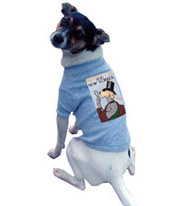
The website Baby New Yorker has some very cute stuff, and is also a natural choice for the New Yorker-minded. The Baby Talk onesie has a New Yorker cartoon feel to it, to be sure, and you’ve got to see the Dog New Yorker Shirt for yourself: “Our Comical Canine Version of the Original Eustace Tilley by Rea Irvin, Cover illustration for The New Yorker, 1925.” A small image is below, but you’ll want to click inside the Baby Talk website to see all the very funny detail. Yes, this is unsolicited endorsement; it’s good for the soul.
I am interviewed.
Meanwhile, Tom Perrotta writes in Slate:
Caribou hunting aside, Sarah Palin represents the state-of-the-art version of a particular type of woman–let’s call her the Sexy Puritan–that’s become a familiar and potent figure in the culture war in recent years.
…
I didn’t think too much about Sexy Puritans as a type until I began looking into the abstinence-only sex-education movement while researching my novel, The Abstinence Teacher. I expected to encounter a lot of stern James Dobson-style scolds warning teenagers about the dangers of premarital sex–and there were a few of those–but what I found over and over again were thoughtful, attractive, downright sexy young women talking about their personal decision to remain pure until marriage. Erika Harold, Miss America of 2003 (the right sure loves beauty queens), is probably the best-known to the wider public, but no abstinence rally is complete without the testimony of a very pretty virgin in her early- to mid-20s. At a Silver Ring Thing event I attended in New Jersey in 2007, a slender young blond woman in tight jeans and a form-fitting T-shirt–she wouldn’t have looked out of place at a frat kegger–bragged about all the college boys who’d tried and failed to talk her into their beds. She reveled in her ability to resist them, to stand alone until she’d found the perfect guy, the fiancé with whom she would soon share a lifetime full of amazing sex. While her explicit message was forceful and empowering–virginity is a form of strength and self-sufficiency–the implicit one was clear as well: Abstinence isn’t just sour grapes for losers, a consolation prize for girls who can’t get a date anyway.
Doesn’t that make you think of those wonderful, ardent, chaste, and slightly self-contradictory Strawberry Queens from Plant City, Florida, the subjects of that terrific New Yorker story by Anne Hull a month or so ago? Here’s a slide show from that piece; Brian Finke did the riveting portraits of the shortcakes and their long gowns.
Next week, know what it is? The New Yorker Festival, the high point of the Emdashes year, in all sincerity (we are, in fact, card-carrying members of The New Sincerity, and also, for crying out loud, The Corduroy Appreciation Club.) For the fourth straight year, we will be attending events, racing to the Starbucks/McDonald’s/Bryant Park/office, and posting our impressions. We’ll even be Twittering. Later, after videos are released of some of the events, we’ll post links to those, too. Gee baby, ain’t I good to you?