
_Pollux writes_:
We continue our “coverage”:http://emdashes.com/2009/04/the-plague-of-our-time-the-ban.php of the odium aimed at the font everyone loves to hate. No, not you, “Take Out the Garbage.”:http://www.dafont.com/take-out-the-garbage.font I mean of course Comic Sans.
Cameron Chapman, on the blog Six Revisions, “writes”:http://sixrevisions.com/graphics-design/comic-sans-the-font-everyone-loves-to-hate/ about why Comic Sans is hated so much, and shows some interesting visual examples of when the font has been used inappropriately. Chapman mentions that Comic Sans has seen wide and inappropriate usage, from a sign for a bone marrow transplant clinic to a grave marker.
Chapman also offers some alternatives to Comic Sans, like “Lexia Readable.”:http://www.k-type.com/?p=520 In the meantime, Comic Sans remains at large. Emdashes has committed an additional 30,000 typographers to address the problem.
Author Archives: Emdashes
The Wavy Rule, a Daily Comic by Pollux: The Minister of Typographic Affairs
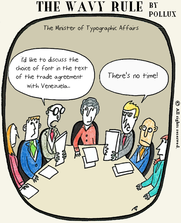
“I have been demanding a Ministry for Typographic Affairs for decades,” graphic designer and typographer Erik Spiekermann “writes”:http://spiekermann.com/en/spanish-impressions/ in his blog. “In vain, obviously.” Well, Mr. Spiekermann, that dream may never come to pass, but I give you a cartoon of a Minister of Typographic Affairs, drawn by a humble Minister of Cartooning Without Portfolio.
Click on the image for a detailed view!
Sempé Fi: Turkey Run
_Pollux writes_:
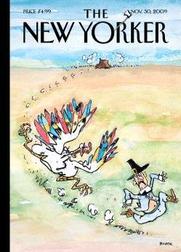
The November 30, 2009 cover of _The New Yorker_ gives us the traditional Thanksgiving images of Pilgrim and Turkey. However, in the hands of an experienced artists like “George Booth”:http://www.bostonphoenix.com/archive/features/99/02/04/GEORGE_BOOTH.html, the relationship between Pilgrim and Turkey is turned upside-down. Booth gives us a “Thanksgiving Skedaddle.”
Booth’s executioner is not the hale and hearty pilgrim he used to be. He cuts a pathetic figure, his shirt flapping in the wind, his belly button exposed. The old pilgrim is skedaddling and skedaddling as fast as he can.
The angry turkey has overpowered him. It displays its colorful feathers in an angry ruffle that dominates the cover. The bird’s cruel talons cut through the November air like corn threshers. They near their target.
It must have been a sudden coup. Perhaps the turkey remained quiet and cooperative until it rested its head on the chopping block, waited until the pilgrim raised his axe, and then -a sudden explosion of anger and rebellion. The pilgrim’s axe still spins in the air.
George Booth creates the illusion of rapid and sudden movement with his combination of narrow, black brushstrokes and wider, colored ones that capture the chaos of angry bird chasing surprised man. Splashes of imperfect spots and lines add to the chaos in this scene. (The word “skedaddle” may in fact derive, according to this “piece”:http://www.worldwidewords.org/weirdwords/ww-ske1.htm by word expert Michael Quinion, from the Scots _skiddle_, meaning to splash water about or spill.)
Instead of a genteel, calm scene of Thanksgiving splendor, Booth gives us humor in a scene in which the Thanksgiving tables are turned. As Emily Coates points out in her “article”:http://www.yaledailynews.com/magazine/magazine-cover/2005/03/04/the-new-kids-at-the-new-yorker/ on _New Yorker_ cartoonists, “chaos typically reigns in a Booth cartoon. Auto body shops, junkyards and shanty interiors establish the ambiance. Cats and dogs hang about. Characters squabble.”
Coates’ article also points out that Booth is part of an older guard of _New Yorker_ cartoonists whose work appears less often in recent years. Nevertheless, Booth’s brush still wields enormous power to amuse and entertain. His work remains funny, effective, and interesting. I give thanks for Booth.
The Wavy Rule, a Daily Comic by Pollux: Under the Sea
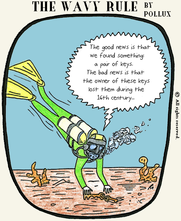
Click on the image for a detailed view!
I Bet He’ll Use His Wish to Improve the Knicks
Martin Schneider writes:
It wouldn’t be right to let Woody Allen’s 74th birthday pass without acknowledgment!
Happy birthday, Woody. May the bon mots keep flowing.
The Wavy Rule, a Daily Comic by Pollux: God Help Us All
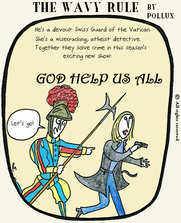
Click on the image for a detailed view!
Lively, Fascinating Interview With David Remnick
…about the future of the printed word, working with Seymour Hersh, Beppe Grillo, the scope of the magazine, and, of course, Dylan. Read it!
The Wavy Rule, a Daily Comic by Pollux: Saving California
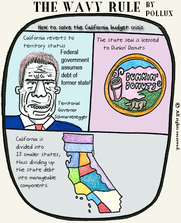
Click on the image for a detailed view!
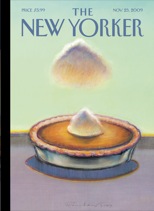
Sempé Fi: Pie and the Sky
_Pollux writes_:
We can’t expect clear skies in late November, but nevertheless we hope to avoid the special kind of rain cloud that hovers over our pumpkin pies. The November 23, 2009 issue of _The New Yorker_, which is “The Food Issue,” features a little cloud hovering above the normally cheery sight of a newly-baked pumpkin pie.
“Wayne Thiebaud’s”:http://en.wikipedia.org/wiki/Wayne_Thiebaud “Pumpkin Cloud” is heavy with rain. Perhaps cheery optimists will hope that the “Pumpkin Cloud” will sprinkle extra whipped cream on the pie, in a sort of Big Rock Candy Mountain kind of fantasy, but I see nothing cheery about the image. Thiebaud’s painting reminds me that we’re never entirely free from worries.
Can we still dig into a pumpkin pie in a carefree manner as we once did? As Phil Gallo “points out”:http://www.zesterdaily.com/media-a-entertainment/281-danger-in-the-kitchen, the November 23 issue of _The New Yorker_ is “likely weighted by the recession — stories about gourmet hamburgers, thousand-dollar meals and Ferran Adria wannabes are certainly gauche these days — but have we reached the point where the joy of eating is gone?”
Depression runs rampant during the holidays. Thiebaud’s cloud is of the emotional kind, a kind of meteorological Sword of Damocles that reminds us that family strife often accompanies Thanksgiving dinners; that political strife still racks the country; that Thanksgiving is followed by the blood-spurting good fun of Black Friday, a frenetic rush for flat-screen TVs and other electronics.
This year, many consumers have foregone the traditional Thanksgiving dinner in order to wait in line outside the department stores and get into the store before anyone else the next morning. And so the pumpkin pie goes cold and uneaten, to be replaced by lifeless electronics and maxed out credit cards.
Thiebaud’s pie is present but where are those who will eat it? Does the pie sit on the edge of a table or of a horizon? This is of course not the first Thiebaud has painted food. Thiebaud gained fame creating still-lifes of all-American foods: pies, cakes, candy, ice creams, hamburgers, hotdogs, and club sandwiches.
Thiebaud’s work “sells well.”:http://oneartworld.com/artists/W/Wayne+Thiebaud.html At his website _Daily Sun Times_, the artist and writer William Theodore Van Doren, who “describes”:http://www.dailysuntimes.net/home/2009/11/22/sunset-sunday-22-november-2009.html Thiebaud’s image as a “luminous and shadowed cream-like cloud hovering over a mound of whipped cream in the middle of a pumpkin pie,” gives a conservative estimate for the value of the original of “Pumpkin Cloud”: $75,000.
Thiebaud’s foods represent nostalgia for a simpler time, when no one worried about calories, cholesterol, and Chinese economic dominance. But what do his paintings mean? What do we make of his rows of gumball machines or lollipops?
I should be careful. As this “article”:http://www.artchive.com/artchive/T/thiebaud.html states:
Thiebaud himself has warned against reading too much into their symbolism. “The symbolic aspect of my work is always confusing to me – it’s never been clear in my mind…. I tend to view the subject matter without trying to be too opaque with respect to its symbolic reference, mostly from the standpoint of problematic attractions – what certain aspects of form offer.”
We should, then, focus on the aspects of form in “Pumpkin Cloud”: the symmetry of cloud and cream, the texture of crust and surface, the horizon and shadow. But that scowl of a cloud isn’t going away.
For the Next Style Issue
Benjamin Chambers writes:
With a few exceptions, The New Yorker has never gone in much for featuring tidbits from its past issues, but here’s one from a short Talk piece by Ian Frazier from the October 10, 1977 issue that should be highlighted in the next Style issue.
Attending a Parsons-New School lecture called “Fashion for the Consumer,” Frazier found “the most interesting part” was the slides shown by Dorothy Waxman of fashions seen on the street. Here’s the punchline:
One of the slides was of a woman stepping off a curb holding a little girl by the hand. “‘Look at this beautiful woman!’ said Dorothy Waxman. ‘Look at the stunning neutral palette of colors she has chosen—the hat just a slightly brighter shade than the jacket. The colors aren’t flashy, but they really come alive. And look at that beautiful little blond girl. What a wonderful accessory!'”