_Benjamin Chambers writes:_
John O’Hara’s one of those writers I’ve always meant to read and haven’t. Last January, The New Yorker did a great podcast featuring a story of his, “Graven Image,” read by E. L. Doctorow, that made me want to read more. A wonderful guide to his “Pal Joey” stories, the basis of a musical even I’ve heard of, has just been made available over at “The John O’Hara Society” blog. Check it out and let me know what you think.
Category Archives: New Yorker
Shirley Jackson’s “Lottery” on Film
I never knew that films had been made of Shirley Jackson’s classic June 26, 1948 story, “The Lottery“. Turns out you can view a classic 1969 short based on the story right now on the blog we saw that…, via the magic of YouTube. (But if you’ve never read the story, do that first!)
The dialogue in the film is a bit wooden (as it is in the story, frankly), and it moves very slowly by today’s standards, but when the climax comes, it’s remarkably shocking even if you know what’s coming. Be sure to unwind with Paul Morris’ Wavy Rule cartoon, in which he gives the story a softer ending.
Literary Notes from All Over: a Digital Edition
Benjamin Chambers writes:
* Anyone else notice that The New Yorker is launching a “digital edition” later this year? You’ll read this edition via the Web, it’ll look just like the magazine, but you’ll get access to it before the print edition arrives in your mailbox or even most newsstands. Current subscribers can get the digital version free for the duration of their subscriptions, as long as they sign up; non-subscribers can get a free, four-issue trial subscription, though after that, it’s $39.95. Looks promising. (Searchable, too.)
* Wouldn’t it be nice if you could collect all of your favorite TNY stories in one place? Thanks to Emily, I found a link on Galleycat about AnthologyBuilder.com, a service that allows you to pick and choose from its list of stories to create your own anthology. Right now, there’s a limit on what you can choose from, but the possibilities are obvious. Perhaps TNY is already figuring out a way to pay its current authors so it can build such a service of its own? If I could create a personal TNY anthology, I’d include some John Cheever, Mary Lavin’s “The Great Wave,” Muriel Spark’s “In the House of the Famous Writer,” and … well, I’m just getting started. I’ll have to work on a list. Which stories would you include?
* Something I didn’t expect to ever see, but found touching: notes from David Foster Wallace’s memorial service, courtesy of Stephen, of the blog Band of Thebes. I quite liked the notes, but there’s something terribly ironic about Wallace’s memorial service being rendered in bursts of shorthand reminiscent of Twitter.
* Dzanc Books, an independent literary publisher (which numbers among its authors TNY poet Terese Svoboda), is holding a Write-a-Thon on November 15th to raise funds for its writers-in-the-schools workshops. Check it out, round up some sponsors for the big day, and when November 15th comes, write your heart out.
He was E-mail Before E-mail was Cool
Benjamin Chambers writes:
Remember when e-mail was new? If you’re like me, probably not as well as you think you do, if John Seabrook’s January 10, 1994 story on Bill Gates, “E-mail from Bill,” is anything to go by.
For instance, Seabrook talks about how odd it was to meet Gates for the first time, after first exchanging a number of e-mails:
As we shook hands, he said, “Hello, I’m Bill Gates,” and emitted a low, vaguely embarrassed chuckle. Is this the sound one E-mailer makes to another when they finally meet in real space? I was aware of a feeling of being discovered.
Doesn’t this seem to be a fairly odd observation under the circumstances—not to mention precious? I have to wonder how in this context e-mailing people before meeting them in person differs from corresponding with them by letter: what had really changed? Hindsight is 20/20 and all that, but Seabrook gets even goofier:
Maybe this is the way lots of people will communicate in the future: meet on the information highway, exchange messages, get to know the lining of each other’s mind, then meet face to face. In each other’s physical presence, they will be able to eliminate a lot of the polite formalities that clutter people’s encounters now, and say what they really mean. If this happens, it will be a good thing about the information highway: electronic communication won’t reduce face-to-face communication; instead, it will focus it.
Still, it’s kind of fun to read such an unabashedly wide-eyed view of the medium from a time when e-mail really was new. It’s like opening a time capsule.
Seabrook followed up his Gates profile with an “In the Mail” piece on pp. 8-9 of the February 7, 1994 issue of TNY. (It doesn’t appear on the TNY website or in the index of The Complete New Yorker.) In it, he summarizes reader response to his article and includes some additional thoughts on what it was like to go from having virtually no e-mail correspondence to an amount of e-mail that must have seemed overwhelming for the time:
“[T]he morning that article appeared on the newsstands, I checked my mailbox and found it stuffed: twenty-nine messages. In the following three weeks, I received three hundred and ninety-six electronic messages from readers, almost all of them strangers. Over that period, I also received eight phone calls about the article, seven letters, and one fax … In my greenness about the information highway, I put my E-mail address in the article, and now I suppose I will be hearing from readers for years.”
I gather Seabrook wasn’t put off by his readers’ responses though, because he helpfully supplied his e-mail address again. I’ll reprint it here, just as a reminder of times (and companies) gone by: 73124,1524@compuserve.com. (Remember when you could put a comma in your e-mail address? Oh, for the days of the open range!)
Seabrook also writes about his changing feelings about receiving so much e-mail: at first he was thrilled, then overwhelmed, and finally more interested in the process than the content: “Now I find myself looking forward more to composing E-mail than to receiving it … Composing E-mail composes me.” Wonder if he still feels that way?
He quotes from a number of readers, who are variously humorous, frivolous, and bemused by the possibilities of the new medium. My favorite:
Real problem with the Information Superhighway is typified by this letter: God only knows how many idiots like me will tie up your time with responses.
Amazing how much things have changed, no?
Literary Notes from All Over
Benjamin Chambers writes:
Boy, the literary news has just been piling up. Here’s a quick taste:
* The Nobel prizes were just handed out, and American poets got skunked—as usual, according to David Orr in the Times. According to Orr, New Yorker poets John Ashbery and Adrienne Rich both shoulda been contendas. (Larissa MacFarquhar did a profile on Ashbery in the November 7, 2005 issue, but no one seems to have done the same for Rich, although D.T. Max did a Talk piece on her refusal of the National Medal of the Arts in 1997.)
* Philip Roth was recently interviewed on NPR about his new novel. I’m not a fan of Roth’s work, but I found Robert McCrum’s long interview with him in The Guardian fairly interesting, particularly the section that talks about the hostile reception his story, “Defender of the Faith,” which appeared in the March 14, 1959 issue of TNY: “For much of the Sixties he was declared a traitor to his people, abused and denounced up and down as worse than anti-Semitic.”
* This week, Yale celebrates the 250th birthday of Noah Webster, author of the eponymous dictionary. Webster, I learned, is the person responsible for separating American English from British English in key ways: “The French version of words like ‘centre’ [also used by the Brits] became ‘center’ and he dropped the British ‘u’ in words like colour’ and the redundant ‘k’ in musick and other words.” Jill Lepore, who wrote a November 6, 2006 essay on Webster for TNY, is a fan: “You cannot look up a dictionary definition today and not stumble across many definitions that were written by Noah Webster.” Happy birthday, Noah.
* In this Kansas City Star profile of novelist and poet Jim Harrison, I found a reference to his September 6, 2004 TNY piece, “A Really Big Lunch.” Concerns a 37-course meal he once had, which took 11 hours to eat. Gotta look that one up … feeling a bit peckish.
* May not be as good for sales as the Oprah Book Club, but Melville’s Moby-Dick may soon become the Massachusetts state (er—commonwealth) novel, if its state House of Representatives has anything to say about it, and apparently it does. The bill proposing the honor for Moby-Dick was filed “at the request of fifth-grade pupils at Egremont Elementary School so they could follow the bill through the legislative process.” However, “those pupils are now in the seventh grade, and the bill still isn’t law. It needs to pass the state Senate and get the signature of Governor Deval Patrick.” While you’re waiting for it to become official, check out John Updike’s May 10, 1982 TNY review of Melville’s career after Moby-Dick came out. Updike reverses quite a few myths about Melville, chiefly that Moby-Dick was not, as is popularly supposed, a financial or critical flop.
* Not sure this qualifies as “news,” but I’d never seen these writing commandments from Henry Miller before. Not sure if they’re really his or not, but they might be worth checking out.
Have fun surfing!
Test Your Banned-Books Knowledge
Benjamin Chambers writes:
The American Library Association is celebrating banned books this week. Trust the Brits to come through with élan, by which I mean they’ve created a quiz, about which, more anon. High time, I thought, for Emdashes to create a quiz of its own: which New Yorker authors have been banned most often?
Top of the list would have to be J.D. Salinger, for Catcher in the Rye (which I gather TNY rejected) and of course Vladimir Nabokov, for Lolita. (Check out William Styron’s 1995 account of why Random House refused to publish it.) Who else should be on the list?
Once you finish with our quiz, head on over to the Guardian, and take theirs. First, though, you might want to bone up by learning more about the top 10 books that Americans tried most frequently to remove from library shelves in 2007. From there, you can also learn which were the top 10 most-frequently challenged books of this century, which is almost a two-for-one, really, because all but 3 of those books were also the most-frequently-challenged books of the 1990s. (Do authors no longer want to be banned in Boston?)
The quiz was posted by the Guardian, and it has at least one UK-centric question on it: “Why did a UK exam board remove Carol Ann Duffy’s poem ‘Education for Leisure’ from the GCSE syllabus?”
This is what’s known in common parlance as a rigged game, so I’m going to even the odds—you can find the poem in question below this article covering the hullabaloo. (Note that somebody complained about the poem because of its “description of a goldfish being flushed down the toilet”.) Apparently, Duffy replied to the official stricture with another poem, which left its target feeling “gobsmacked.” Wish poets had that kind of power in this country.
David Foster Wallace’s Reading List
Last week, I linked to Donald Barthelme’s 81-book syllabus. Now I offer a top-ten list from David Foster Wallace, for those of you who, like Martin and me, are trying to come to grips with his suicide—or trying to learn more about who he was. The list comes courtesy of J. Peder Zane in The New York Observer:
David Foster Wallace’s Top Ten List:
1. The Screwtape Letters, by C.S. Lewis
2. The Stand, by Stephen King
3. Red Dragon, by Thomas Harris
4. The Thin Red Line, by James Jones
5. Fear of Flying, by Erica Jong
6. The Silence of the Lambs, by Thomas Harris
7. Stranger in a Strange Land, by Robert A. Heinlein
8. Fuzz, by Ed McBain
9. Alligator, by Shelley Katz
10. The Sum of All Fears, by Tom Clancy
This list, of course, is considerably more problematic than Barthelme’s. (The Screwtape Letters?!) Or rather, I don’t think it’s problematic at all, but it can be hard, apparently, to know what to make of it, because of Wallace’s heavyweight status, erudition, and lack of meanness. Zane, anyhow, agonizes over whether or not Wallace was serious when he offered this list; he even invites a fan of Wallace’s to comment on it, who also cannot make himself believe that Wallace was just being flip, even though the fan refers to a very different sort of reading list—”stars you steer by”—that Wallace reeled off in a 1996 interview in Salon, with Laura Miller:
Historically the stuff that’s sort of rung my cherries: Socrates’ funeral oration, the poetry of John Donne, the poetry of Richard Crashaw, every once in a while Shakespeare, although not all that often, Keats’ shorter stuff, Schopenhauer, Descartes’ “Meditations on First Philosophy” and “Discourse on Method,” Kant’s “Prolegomena to Any Future Metaphysic,” although the translations are all terrible, William James’ “Varieties of Religious Experience,” Wittgenstein’s “Tractatus,” Joyce’s “Portrait of the Artist as a Young Man,” Hemingway—particularly the ital stuff in “In Our Time,” where you just go oomph!, Flannery O’Connor, Cormac McCarthy, Don DeLillo, A.S. Byatt, Cynthia Ozick—the stories, especially one called “Levitations,” about 25 percent of the time Pynchon. Donald Barthelme, especially a story called “The Balloon,” which is the first story I ever read that made me want to be a writer, Tobias Wolff, Raymond Carver’s best stuff —the really famous stuff. Steinbeck when he’s not beating his drum, 35 percent of Stephen Crane, “Moby-Dick,” “The Great Gatsby.”
There’s a breathtaking gap between those two lists. Personally, I don’t think there’s any question that he was kidding when he submitted his top 10 list to Zane, but it’s always been my impression that part of what Wallace was trying to do in his work was to bridge that gap—to reconcile two incredibly disparate parts of our culture. If you want Socrates’ funeral oration to matter, it can be difficult to accept that The Stand is someone else’s North Star.
I recommend reading Miller’s whole interview with Wallace, in which, among other things, he also talks up his contemporaries. And though I was grateful to Martin for tipping me off to an appreciation of Wallace from New Yorker fiction editor Deborah Treisman, I found Miller’s memorial the best and most touching of all those I’ve read.
Read More Fiction: Tastes Great, and it’s Good for You!
It’s back-to-school time, so it seemed appropriate to link to an 81-book syllabus Donald Barthelme used to give out to his students. (It appears in the margins of a nice 2003 essay by Keith Moffett in The Believer about his experience of tackling the list.)
If that’s too much for you, then I recommend you read Barthelme’s hilarious and thought-provoking story “The School,” which appeared in the June 17, 1974, issue of The New Yorker. In the story, a grade school class keeps adopting living things that then die. Yet there’s enough uplift in the improbable, left-field ending to carry you through the rest of the school year. (Don’t cheat and read the capsule summary on TNY‘s website—it’s a spoiler.)
The story typifies what I love about Barthelme: his ability to explore serious topics with larky wit and surreal turns. Though I find him sometimes obscure, I vastly prefer his lightheartedness and unpredictability to the emotionally detached and/or humorless narrators who appear in contemporary TNY fiction with such regularity these days.
But evidently, reading TNY‘s fiction section is better for you than reading the nonfiction, at least when it comes to your social reasoning skills. Need proof? I quote from Liam Durcan’s Toronto Globe and Mail article from July, which I found courtesy of Jonathan Shipley’s blog, A Writer’s Desk:
In a recent study conducted by University of Toronto psychologists, subjects who read a short story in The New Yorker had higher scores on social reasoning tests than those who had read an essay from the same magazine. The researchers concluded that there was something in the experience of reading fiction that made the subjects more empathetic (or at least take a test more empathetically). The study provided some proof for what has often been intuitively argued: Fiction is, in some very important ways, good for us.
To read the rest of Durcan’s article, go here, but be prepared to fork over $4.95. If that’s too rich for your blood, there’s more detail here.
Political Conventions: A Snapshot From 1968
Benjamin Chambers writes:
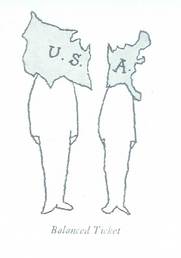
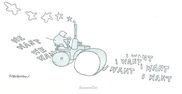
What with the Democratic Convention going on and all, it was highly serendipitous to find a two-page spread of great cartoons entitled “Political Conventions” by James Stevenson in the August 25, 1968 issue of The New Yorker. I couldn’t find them among “Stevenson’s work “:http://www.cartoonbank.com/search_results_category.asp?sitetype=1§ion=all&keyword=james+Stevenson&advanced=0&x=12&y=13featured at the Cartoon Bank, so I’ve uploaded a couple of my favorites below. (For the complete set, I’m afraid you’ll have to reach for the Complete New Yorker.) Stevenson has always been one of my favorite cartoonists; “click here”:http://biography.jrank.org/pages/1693/Stevenson-James-1929.html for a very thorough profile of his artistic career.
While chuckling at Stevenson’s quietly satirical sketches, though, I’ll admit I experienced a bit of cognitive dissonance, since after all, they were published during the infamous 1968 Democratic National Convention.
Here’s the first (click to make it bigger):
And here’s the second one (click on it for a larger version):
So Long to One Great Fiction Editor; Hello Again to Another
One of the great fiction editors of the latter part of the 20th-century, Rust Hills, died this month at 83. Hills made his mark at Esquire; you can read an obituary at The Washington Post. Mention is made of a “wry” piece he wrote about “eating ice cream cones,” which I see originally appeared in The New Yorker in 1968.
Meanwhile, NPR just did a story on William Maxwell, the longtime fiction editor at The New Yorker and accomplished author in his own right, who died in 2000. You can listen in here, or track down John Updike’s eulogy in the Complete New Yorker.