Category Archives: New Yorker

Maryann Burk Carver Responds to the Latest Story About Carver and Lish

At Pinky’s Paperhaus—where Carolyn Kellogg also wondered why there was no byline on “Rough Crossings,” the recent essay in The New Yorker that introduced an exchange between Raymond Carver and Gordon Lish, and preceded Carver’s original draft for “Beginners”—Carver’s first wife, Maryann Burk Carver, posts a series of thoughts about her life and Carver’s, Lish’s editing, Carver’s writing process, and the intersection of all of the above. From her comments:

My seeing this site has made me aware of the extent of the response to the New Yorker piece, and the need perhaps to rebut some of it, much of which I already have done in my memoir. I talk about Ray’s early association with Gordon Lish and the good he did Ray as a publicist for him and his work in New York: The agents he introduced him to, and the other markets, besides Esquire, where he was Fiction Editor and published “Neighbors” and “What Is It?”, aka “Are These Actual Miles?”, (a title change I emphatically disagreed with, as the first reader and “editor” of Ray’s stories for over twenty years).

The question of who wrote the New Yorker intro, should that be haunting you, is still up in the air, but Carol Sklenicka, who writes in to say she’s working on a new biography of Carver, provides a plausible clarification that echoes that of fellow biographer Michael Hemmingson: “I checked with several people in New York, including Gary Fisketjon (Ray’s last editor, who is quoted in the New Yorker article) and was told that David Remnick, the editor-in-chief of The New Yorker, wrote the article. [That was also the understanding of NPR reporter David Gura. —Ed.] But it seems likely that William Stull, who edited the proposed book of stories with Tess Gallagher’s cooperation, provided the template for this unsigned piece.” Sklenicka concludes, sensibly: “The whole story of Carver’s life is complicated, as Kellogg points out, and I’m trying to get all of that into my book. It takes time and care.”

Still, why leave it unsigned? Since when does the modern The New Yorker use “templates” and not bylined writers? It’s too long a piece to be a generic introduction. Oh well, I’m sure there’s a long story we may never know. It didn’t put me off, in any case; I always like reading about complex writer-editor relationships, and I’m always interested in both Carver and Lish. That said, as you can see, it’s a daring decision to perpetuate a mystery among an already conspiracy-mad fan base!

Temporary Outages: Updike, Doctorow, and Boyle

The first installment of a new column on New Yorker fiction, past and present, by writer and editor Benjamin Chambers.
Stories discussed: John Updike’s “Outage,” published January 7, 2008, and “Friends From Philadelphia,” published October 30, 1954; E. L. Doctorow’s “Wakefield,” published January 14, 2008; and T. Coraghessan Boyle’s “Ash Monday,” published January 21, 2008.
To say I’m looking forward to exploring fiction from The New Yorker and sharing my finds with Emdashes readers would be to practice a degree of understatement only the British are really good at, so I’ll just say I’m like a kid in a candy store.
I’ve been having so much fun running through the halls of The Complete New Yorker that I didn’t think I’d start off with recent stories, but here I am, doing just that. When I read the first three stories published in 2008, I found the resonances among them irresistible. (For those of you who haven’t gotten to these yet, there are plot spoilers below.)
Of the three writers I’m reviewing, Updike is the senior man, at least in terms of New Yorker numbers. According to The Complete New Yorker index, which is currently updated through April 2007, Doctorow has had five stories in The New Yorker, beginning in 1997; Boyle has had 17 since 1993. Updike has published 168 stories in The New Yorker over 53 years. (I presume this makes Updike the all-time front-runner in terms of sheer volume, and now that The New Yorker seems to lean on individual contributors a bit less, no one’s likely to catch up to him. While he’s averaged three stories a year, he published nine stories in The New Yorker in 1959, and eight in 1961.)
Considering Updike’s eminence, then, I thought it only appropriate to go back and read “Friends From Philadelphia,” his first story in The New Yorker, published in 1954. “Friends” is about a 15-year-old boy named—surprise!—John, who enlists the help of his neighbors, the Lutzes, to buy wine for him so that his parents can entertain the aforementioned friends. The story’s primary focus is on the kindness of Mr. Lutz, who uses his open-handed generosity to bludgeon the boy with his comparative wealth.
What I found most interesting about the story, however, was that it’s practically a museum of outdated public health policy. Mrs. Lutz smokes like a chimney and allows her teenage daughter to do the same if she wishes (John smokes too, of course); it’s John who is sent by his parents to pick up the wine, though only 15 (he’s foiled when a “new man” at the store requires “written permission” from his parents); Mr. Lutz drives around drunk, protected only by Mrs. Lutz’s mild admonition to “drive carefully”; and Mr. Lutz allows John to drive his new car, though John has little idea how to operate it, as it’s so new that it has “automatic shift, fluid transmission,” and—neat!—turn signals.
“Outage,” Updike’s first New Yorker story this year, is a simpler tale of how a power outage signals (or causes) a temporary interruption in social mores in a suburban New England community. Brad Morris, who works from home while his wife manages a boutique, ventures out after a storm long enough to hook up with a married neighbor he’s seen around at “cocktail parties or zoning-appeals-board meetings.” Well, almost hook up. The power comes back on, and with it, a bit too tidily, their consciences. It won’t do at all, really.
Oddly enough, Doctorow’s “Wakefield” also features a power outage in the opening paragraphs. It’s a largely incidental one, except for its putative effect on the title character’s state of mind—which turns out to be what the story’s really about, because Wakefield, after a spat with his wife, decides to hide out in the attic above the family garage…for a year. Though he has money and credit cards (he’s a lawyer), he sets himself the test of living entirely on what he can scrounge in the garbage while watching jealously over his wife as she deals with the police and the solicitude of neighbors, (eventually) vacations with their daughters, and begins to date again.
The predictable reappearance of a minor character spurs Wakefield’s eventual decision to return to the civilized world, and the story ends with a weak joke. Of the three stories from 2008, this is unquestionably the best written, partly because Wakefield is the most complex character, but that isn’t saying a lot. (Incidentally, don’t miss the podcast of Doctorow reading and discussing John O’Hara’s 1943 story “Graven Image.”)
While Updike and Doctorow’s stories both concern the suspension of normal social rules, Boyle’s story, “Ash Monday,” features thirteen-year-old Dill, who has very personal power outages—moments of inattention, “as if he’d gone outside of himself…another kind of absence that was so usual he hardly noticed it.” Of these three, Boyle’s story—which has the flattest characters and the most exposed machinery—has, surprisingly, the most affecting emotional core.
At one point, Dill asks his mother which church their family belongs to, and eventually observes, “We’re not anything, are we?” It’s the saddest and most deeply felt moment in any of the three stories, because it’s clear he’s talking about much more than what church they belong to: he’s talking about their broken stove, their anonymity, his “piece-of-shit” Camry, and their dead-end, rootless, piece-of-shit lives.
But “Ash Monday” is also the cheapest story of the three—not only do all the characters seem right out of Central Casting (a fault shared, to a degree, with “Outage”), the plotting leaves something to be desired. Dill’s outages of attention are Boyle’s heavy-handed way of trying to make the reader think Dill will be responsible for setting the canyon on fire—oh, didn’t I mention that? Yes, it’s one of those stories, where the curtain lifts, you’ve got a teenage boy standing by a grill with a can of gasoline, the “hot breath” of the Santa Ana winds nosing about the place, and a title that guarantees that baby’s gonna burn, baby, burn.
But as in a cheesy detective story, the true firebug isn’t introduced until the very end; and however much that character hates the setting, the torching is seemingly entirely unmotivated. One wonders why it matters—the point seems to be that it doesn’t. Which is an unrewarding place from which to start or finish a story.
No matter, though; every writer has creative brown-outs like these. We just need to wait a bit, and they’ll get the juice back on.

And Now For a Warm Welcome

Emily and I are very pleased to introduce a new member to the Emdashes team. His name is Benjamin Chambers, and some of you will recall his e-mails on past New Yorker essays and his post comments over the past weeks. We’ve been very impressed by his powers of expression, and we look forward to his sure-to-be-insightful posts.
Benjamin’s column will focus on fiction and will be called The Katharine Wheel, aptly named after The New Yorker‘s first fiction editor, Katharine White. We feel certain that Benjamin will roam wherever his interest takes him, stories appearing in The New Yorker each week, stories from the distant past encountered in The Complete New Yorker, novels by people associated with The New Yorker, and so on. And if he has any diverting comments on any other subject, we hope he’ll feel free to contribute those too!
Benjamin is the editor of The King’s English, a prizewinning online magazine that specializes in novella-length fiction, which you should definitely check out. He received his MFA from Washington University in St. Louis and has had his fiction, poetry, and essays published in numerous journals, including The Iowa Review, ZYZZYVA, MANOA, and the Mississippi Review.
I’ve enjoyed corresponding with him in recent days, and I’m sure his wit, wisdom, and good taste will enhance this humble project. Welcome, Benjamin!
—Martin Schneider

Will the Winners of the Tilley Contest Also Appear in the Magazine?

I dunno, but this post by Len at the Jawbone Radio Show in Cleveland, who’s been notified that one of his entries has been selected as a winner of the Eustace Tilley competition (congratulations!), makes me curious. Len writes: “The art will be published on Monday on the New Yorker.com and there is a slight chance that I may make it into the print edition as well. I’ll be sure to publish more info as soon as I know it.” A little gallery in the print edition would be a treat, but even if the winners’ circle is online-only, it’s been a great contest for all involved. I’m sure Rea Irvin would have been thoroughly amused.
In case you were wondering, or, as the wise Cary Tennis would say, Since You Asked, I only repeat conjectures I hear from outside the magazine and Condé Nast generally, specifically those already reported elsewhere. That is, I ignore most of them, but I make note of the ones I think dedicated readers of The New Yorker will find interesting. As Jean Hagen once said in her corrosive platinum, “What do they think I am, dumb or something?” More to the point, don’t we have enough of a gossip culture as it is?

People Like Winners

That’s why we should be writing about John Edwards now. We had something to learn from the fairly extensive coverage of Rudy Giuliani‘s disastrous campaign, and now we have something to gain from looking back at the results of Edwards’ approach and the details of his inconveniently mellow-harshing story and concerns. I want to hear about what he’ll do next. Don’t discount him just because we love a bullfight.
Does God exist? Tonight Christopher Hitchens and Rabbi Shmuley Boteach are debating it at the 92nd St. Y. I’ll be there. Potential highlights include God, appearing Marshall McLuhan-style, strolling onstage to declare to Hitchens, Boteach, the audience, or some combination of the above, “You know nothing of my work.” (Afterward: While that didn’t happen, exactly, there were certainly insults a-flyin’.)
At least we can be confident that Eustace Tilley exists, as did his creator, Rea Irvin; as Jason Kottke reports, the winners of the Tilley retooling contest have been notified. I’ve been enjoying the discussions on the contest’s various Flickr threads; entrants commune, commiserate, and praise with Threadless-like generosity and swap ideas for drawings that coulda been. Dan Savage has gotten involved, too. This contest has clearly been a hit—what’s next in user-generated interactoolery, do you suppose?
Finally, my carnivorous friend Paul Lukas has updated Joseph Mitchell’s juicy, tender, and well-done ode to the beefsteak (as Paul explains, “The term refers not to a cut of meat but to a raucous all-you-can-eat-and-drink banquet”)—which you can reread in Secret Ingredients: The New Yorker Book of Food and Drink—with a sizzling, bacon-wrapped Times story (with video!) on how we beefsteak now. Sorry, cows of the world (and environment, etc.); I apologize from the bottom of my ostensible soul, and I’m saving you for special occasions these days, but in the list of things that are sacred, I’m going to have to include the occasional indulgence in just this sort of ritual.

Doesn’t This Law & Order Guy Look a Little Like David Remnick?

I know how this sounds, but I was watching a few minutes of that dreadful but hypnotic Taxi TV the other day, and there was a Law & Order promo on; the faces of a bunch of actors flashed by, and I could have sworn one of them was the jazz-appreciating editor himself. Once you really look at the guy (it’s got to be Jeremy Sisto as Detective Cyrus Lupo), it’s a little less doppelganger-y, but there’s something to it.
OK, enough silliness for today! (Here’s Remnick calming down Elizabeth Kolbert after a particularly dire climate-change report.)

This Just In: E.B. White Was Versatile

Yesterday, Bill Christensen of Technovelgy.com reported that the Russians have plans to construct a new space platform and have it in use by the year 2020. According to Christensen, there have been serious proposals for a “earth satellite vehicle program” as far back as the 1940s, but the first use of the term “space platform” may have appeared in E.B. White’s short story “The Morning of the Day They Did It,” published in the February 25, 1950, issue of The New Yorker. Christensen describes the story as “scary,” and, if I’m following my links correctly, elsewhere writes,

Absolutely first-rate story by White makes me think I completely misunderstood Stuart Little. A man who works on a Stratovideo plane in the nascent television industry writes the story of the end of the world. This story is so up-to-date you’ll whimper with fear by the end. Highly recommended.

Mercy! Well, I couldn’t resist an endorsement like that. I busted out The Complete New Yorker to have a look.
I won’t admit to whimpering, but the story is very well turned indeed. It’s got a few dated bits but not too many; Christensen has a point that it holds up well. (Good writing remains good writing.) It reminded me of nothing so much as 2001: A Space Odyssey, which I suppose is unavoidable. (If you’re wondering, Arthur C. Clarke‘s story “The Sentinel” was written a couple of years earlier but seems not to have been published right away.)
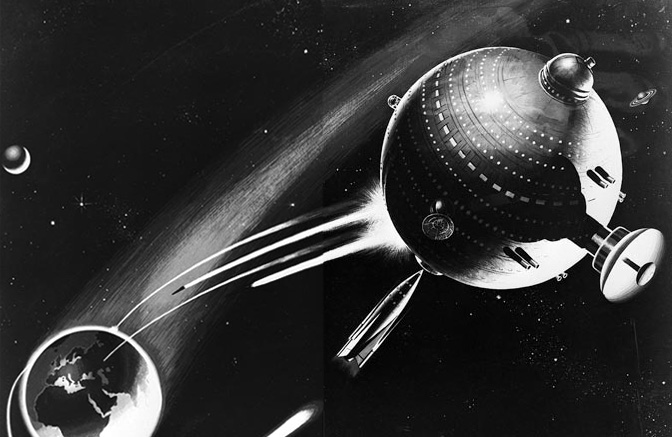
Just to enhance the mood, here’s a 1949 painting of a similar object by legendary fantasist Frank Tinsley:

tinsley49.jpg

The story is full of imaginative touches—the Americans invent a pesticide that accidentally kills off all the birds and the bees (except for the whooping crane, for some reason), and all human beings have to get a special injection every three weeks in order to ward off the poisons now in the food. The story features a TV studio in outer space and a character named Major General Artemus T. Recoil.
And the United States does end up destroying the world, but you know what?
We meant well.
—Martin Schneider

How Much Do They Pay Her If Obama Wins?

In this political season, we note with interest that former New Yorker editor and recent Princess Diana memoirist has signed a deal with Doubleday to write a book about the Clintons. Her last book was called The Diana Chronicles; this one is tentatively titled The Clinton Chronicles. Judging from the title, we may have another Sue Grafton on our hands! (I’d certainly pay to read her Rick James Chronicles or Chuck Norris Chronicles.)
It’ll be interesting to see how this plays out. On the one hand, Brown was uniquely qualified to write a book about Diana, and she really came through on all levels. One doesn’t know if she has the same access to the Clinton story or even to what extent she is a political animal. However, The Diana Chronicles did prove that she has considerable talent in entertainingly synthesizing huge amounts of information on heavily covered (I almost wrote “chronicled”) subjects. And, as I noted in June, she’s already been giving Hillary Clinton a bit of thought.
—Martin Schneider

How to Read The New Yorker: An Illustrated Guide

Check out this gorgeous and useful entry by Heather Powazek Champ at The Magazineer, featuring elegant shots of the New Yorker pages in question. She writes:

A subscription to any weekly magazine is a commitment. If you subscribe to more than one, it’s even more important to ensure you stay on top of your consumption. I’ve developed the following process to ensure a timely yet comprehensive digestion of the beauty and wonder that is The New Yorker. Here’s my 10-step approach to the 7 January 2008 issue. (Read on.)

While I read the complete contents every week, or close to it, I certainly can’t (and don’t!) fault other people for doing less. (OK, I carp from time to time, but that’s only when my patience is really being tested.) This is a magazine, after all! It should be an illuminating diversion, not a chore.

Champ’s advice is similar to what I tell people who ask how to manage the overwhelmingness, as did my friend Stephen the other day (he got a subscription for Christmas). Skim the listings if you see live events in New York and the short movie reviews if you see movies anywhere; read Talk, Shouts, the cartoons if you like cartoons, the reviews of whatever interests you, and a long feature or Profile. I got an email from him just this morning, though, with this update: “actually, i’ve been meaning to write you to tell you that i DEVOURED the latest issue. like, read every article (almost). i’m LOVING it more than i expected.” So as you can see, it’s doable, even for busy actors, waiters, and other professionals!

Also, as I told Stephen, there’s nothing like it for total absorption on the subway, at the post office, in the tub, and on the internet. (Then, after you’ve recycled, you still have the DVD archives if a missed piece is haunting you like the Telltale Heart.) As Champ writes: “If managed correctly, the above process of consumption should take about a week. In fact, that’s what you should aim for lest you become ‘that’ subscriber who’s hopelessly behind.”

Amen to that. Thanks to Steve Heller for the tip!

Breaking: The New Yorker Cartoonists Have a Blog of Their Own

More later since I’m working, but this is very exciting news. Cartoonist and online cartoonist shepherd Mick Stevens will be the blog’s first “captain,” and it’ll rotate every month. Dare we hope that Roz Chast, Bruce Eric Kaplan, Eric Lewis, Drew Dernavich, Liza Donnelly, Gahan Wilson, the already very webby Emily Richards, Ed Koren, Matt Diffee, Harry Bliss, Marisa Acocella Marchetto, Charles Barsotti, Michael Crawford, and dear pal of Emdashes (and blogeuse extraordinaire) Carolita Johnson—not to mention scores more of our favorites—will be among the captains to come?