Three days until the festival! I can feel the electricity building—can you feel it? What was it that one friend of mine told me? Oh, yes, I think it was “EEEEEEEEEE!”
Now, stay in sight of your teachers and guardians, and always use the buddy system! We’re going to cross all intersections as a group. (Traffic be damned.) Remember that “all participants will have a whistle, compass, and map on their person, and are instructed as to the use of these aids should they become lost.” Well, no, not really, but it would be so much more fun. And speaking of the buddy system, we’re adding a few special correspondents (think Kermit in a press hat) to our ranks for the weekend. Stay tuned on their identities.
A few pithy reminders:
Sign up to the Festival’s special texting service! All weekend long (and even beforehand; we’ve been getting about one a day), you’ll receive occasional updates. Just text “NYFEST†to 644444 and you’ll sign up to receive official updates on the New Yorker Festival via text message. Here’s more on that.
Not only are tickets still available to some events, but a small number of tickets for all events will still be available at the Festival headquarters during the weekend. As a reminder, Festival Headquarters is located at Metropolitan Pavilion, 125 West 18th Street (between Sixth and Seventh Avenues).
Even if you don’t get any tickets, that doesn’t mean you have to sit the whole weekend out. You can always go to the Javits Plaza (Eleventh Avenue between 35th & 36th Sts.) on Sunday at 1 pm to see what’s sure to be a scintillating demonstration of parkour with David Belle.
Many authors who are involved in other events throughout the weekend will be signing books all Saturday and Sunday afternoon. Check the festival site for the full list.
Send us any tidbits you want—sightings, encounters, favorite quotes—from the festival all weekend, at letters@emdashes.com. And if you see one of us, by all means flag us down! Both Emily and I look exactly like the icon above. That’s right, just like that. —Martin Schneider
Author Archives: Emdashes
O Caption! My Caption! New Contest Winner David Wood Speaks Out
Our extraordinarily employable intern John Bucher recently sat down with David Wood, whose caption for Alex Gregory’s drawing of a nude briefcase-carrier—“On second thought, it’s more of a sandals dayâ€â€”earned him the blue ribbon in Cartoon Caption Contest #111. Wood, who now teaches English at Northern Michigan University, did his doctorate in Renaissance Studies at Purdue. Like last week’s winner (and the interviewer), David has passed time in the forbidding climes of North America’s extreme northwest.
The winner of last week’s Cartoon Caption Contest was from Alaska—the first in 110 to go to that state. What’s your connection to the place?
I lived up in Fairbanks (a.k.a. Ice Planet Hoth) for some years toward the end of the 20th century, hanging around the University of Alaska Fairbanks, where I picked up my master’s. On the face of this earth, I humbly suggest, and with nothing but love for their creative hearts, that there is nothing more comical than those seriously involved in an MFA program. Harry Shearer (of Best in Show fame) needs to tackle such a thing.
At UAF, there were at least a few kinds of comedy I saw demonstrated brilliantly: the deliberate, piss-in-your-pants sort of funny, and the incidental hilarity that derives from witnessing a dire sense of artistic earnestness. I keep in touch with most of these writers, a number of whom are starting to make waves right now. I left to pursue my doctorate. But if you never truly leave Alaska once you’ve lived there, then it is nigh on impossible to get Fairbanks, a kind of über-Alaska, out of your system; and if Alaska is filled with characters marching to the beat of a different drum, as the saying goes, Fairbanks itself attracts the über-characters. I miss them and Fairbanks dearly.
Okay, “dire sense of artistic earnestness” is too tempting. Change whatever names you need to, but give us an example, will you? Of course, if the earnestness cuts too near the bone, a good pants-pisser will do, too.
Well, I’ll leave their work out of it, then. As for a literal pants-pissing, I recall the time a guy, participating in the reading of another student’s play, drunkenly reeled to the floor of a stage while mid-sentence in front of a crowd of 100 or so. The humor lies in the fact that he had been sitting in a chair and then fallen in a slow-motion sprawl, emitting the faintest of howls as he spread out gradually upon the floor. When he finally got back on his feet, he began to insist belligerently that he had been miscast…
As for earnestness, there was the nature-writer guy who, during a cold snap (lasting a month or so) wore bunny boots (rubbery, white moon-boots that are good to minus-60 degrees or so) and five layers of clothes all day around our 75-degree office. By the end of each day he was just drenched in sweat. After witnessing this guy’s getup for a few weeks, another guy finally looked him in the eye and said: “Congratulations, you live in Alaska. And we live here too, right?”
Your current book manuscript—tentatively titled Very Now: Timing the Subject in English Renaissance Literature—traces the relationship between character emotion and narrative form during that period. Timing, subject, character emotion, narrative form—these all sound applicable to cartoons. What’s your book’s central argument? And is this academic focus a good preparation for cartoon caption-writing?
My academic work involves elucidating the function of time in early modern medical theories and charting the ways that early modern artists like Shakespeare, Sidney, and Milton apply these contemporary views of human health and emotion to their explorations of time in their literary works. Since such representations of time have larger implications involving experimentation with literary structures—why is there a sixteen year gap in the narrative of The Winter’s Tale, after all?—I am basically investigating the embedded relationship between the medical and the literary that these writers take as a given. In short, why did Shakespeare think his characters were going mad and killing one another? More often than not, the answers are different than we, given our own medical paradigm, might assume. And this literature reflects that difference.
Why does this help me write cartoon captions? Your guess is as good as mine.
While on the subject of health: If you were stricken with a mysterious illness, what three books from the English Renaissance would rest beside the recovery bed—your touchstones, as it were? And what three books from the twentieth century?
Touchstone?—a wry As You Like It reference, John. As for the Renaissance, I would need Tottel’s Miscellany, Edmund Spenser’s Faerie Queen, and Shakespeare’s sonnets. As for 20th-century fiction, Graham Swift’s Waterland, Katherine Dunne’s Geek Love, and Raymond Carver’s Where I’m Calling From.
Dismantle your caption for us, the way you might in one of your English classes. What are the most important parts? Why does it work?
At the risk of the old saw that we murder to dissect, I would suggest the following. My caption hints at a past, present, and future for the central character in the cartoon: in other words, the “second thought” in my caption presumes a first. We are to assume he left the house naked a first time, save for his business socks and shoes and, of course, his briefcase. We witness the present and the words he utters to his wife or lady-friend. And we envision a future, in which, still naked and wielding the briefcase, he heads out the door yet again, this time wearing sandals. Situating a character in time in this fashion offers a kind of individuality to him that makes it possible for a reader to identify within him- or herself. Further, we’ve all taken a step out the door and turned back inside due to unforeseen weather or what have you. In this way, the caption is a kind of warped exercise in empathy. But I have to say, I received a hilarious anonymous e-mail from someone the other day who feels that my caption successfully critiques declining public standards of dress for men. So there.
You’re at the university right now—what are you wearing?
As tempting as it might be to say nothing but sandals and a smile, I honestly have to add a rugby shirt and a pair of jeans. Sandals weather doesn’t last too long in Upper Michigan, I’m discovering (much like Fairbanks); you’ve got to make the most of it.
Other Emdashes caption-contest interviews:
- James Montana, winner #109 (“I hate connecting through Roswell.â€)
- Robert Gray, winner #106 (“Have you considered writing this story in the third monkey rather than the first monkey?â€)
- David Kempler, winner #100 (“Don’t tell Noah about the vasectomy.â€)
- David Wilkner, winner #99 (“I’d like to get your arrow count down.â€)
- Richard Hine, winner #98 (“When you’re finished here, Spencer, we’ll need you on the bridge-to-nowhere project.â€)
- Carl Gable, winner #40 (“Hmm. What rhymes with layoffs?â€)
- T.C. Boyle, winner #29 (“And in this section it appears that you have not only alienated voters but actually infected them, too.”)
- Adam Szymkowicz (“Shut up, Bob, everyone knows your parrot’s a clip-on”), winner #27, and cartoonist Drew Dernavich interview each other in three parts: One, Clip-On Parrots and Doppelgangers; Two, Adam and Drew, Pt. Two; Three, Clip-On Parrots’ Revenge
- Evan Butterfield, winner #15 (“Well, it’s a lovely gesture, but I still think we should start seeing other people.”)
- Jan Richardson, winner #8 (“He’s the cutest little thing, and when you get tired of him you just flush him down the toilet.”)
- Roy Futterman, winner #1 (“More important, however, is what I learned about myself.”)
Dear Internet, Thank You For These New Yorker Covers
This is almost as good as the half-buried treasure chest of Pauline Kael reviews we discovered last year. From Weblogsky:
I’m discovering online info about old, out of print “golden age” comic books, including whole issues scanned from rare copies and posted as jpgs. While looking for old favorites, I found Cover Browser, which has a bazillion covers, including quite a few for the comics I was looking for, the American Comics Group’s Adventures Into the Unknown and Forbidden Worlds. Magazine covers including Fantasy and Science Fiction, Mad Magazine, Fate, and The New Yorker.
A little plea—don’t let anything happen to these beautiful archives, o men of law. Please don’t.
I Can’t Wait for Google Ransom Note
Google recently came out with a bunch of improvements to its Book Search.
I went over and typed in “New Yorker” in the search field. The New Yorker, as in the magazine, actually comes up in the results. When you click on it, among the elements on the page is this peculiar image:
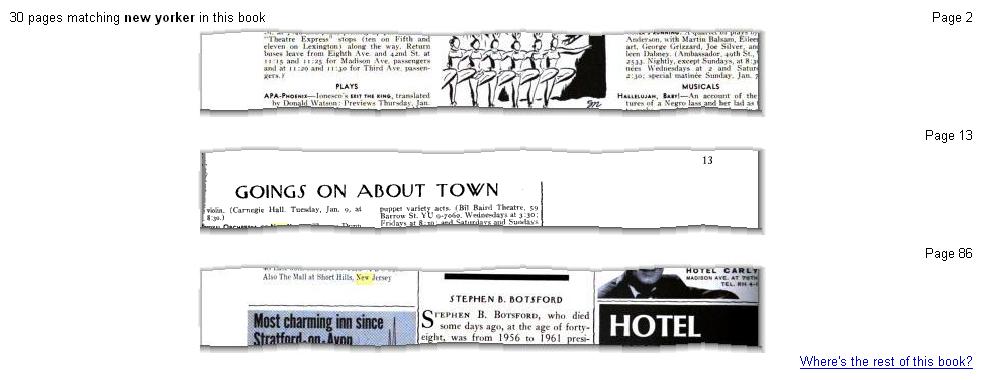
I can’t decide if I find that obscurely chilling (it’s all dismembered!) or an intriguing example of impromptu art.
Or both.
—Martin Schneider
Celebrating Koren, YouTubiness, Muldoon, and More
Congratulations, Edward Koren, on earning the Governor’s Award for Excellence in the Arts! Here’s more. And good news—Bruce Eric Kaplan has a graphic novel out, Edmund and Rosemary Go to Hell, which I would love to see.
Noted earlier, but the magazine is “quietly” building up its YouTube account. Subscribe today; I did! And watch Dan Baum’s New Orleans videos. The musical ones will make you want to dance.
Ted Genoways at VQR notes that Paul Muldoon can be added to the list of non-American poetry editors in America.
ZP at I Hate The New Yorker (a witty title, considering), whom I was delighted to finally meet last week, has views on the Style and Food issues.
In case you missed it yesterday, Garry Kasparov will be a candidate for the 2008 Russian presidential election. Don’t miss David Remnick’s audio interview with Kasparov! I enjoy reading Remnick on Russia—the subject seems so keenly dear to him, which is understandable, since he lived there as the Washington Post‘s correspondent. I wonder if he had the Russia bug before he moved; I seem to remember from Lenin’s Tomb that because his wife’s family was originally from there, it was already an interest, but this could be wrong. I got Russia fever the moment I got on the Aeroflot to Moscow two years ago. (There’s a new jet in town, by the way.) The country seems to become an altered state of mind for some people, a romantic virus, a pair of glasses you can never take off, and I can’t wait to go back there.
And if you see some posts in coming weeks that look kinda grizzled to you, they are! They’re drafts I never published over the past three years, but I wanted to share them with you regardless of “timeliness” (a dubious criterion in this enterprise, don’t you think?). Look for the grizzlies, and don’t play dead or scramble up a tree—embrace them.
The Great Hyphen Extinction
Hyphens are endangered. This is not necessarily bad. Perhaps even The New Yorker will soon shake off a few of its hyphenated habits—just the most antiquated ones. I like hyphens very much myself, and would never advocate their complete extinction! But you know, dear copy dept., that “life-style” and “sound-track” just don’t work anymore, especially in quotations from spangly modern sources. Do they still do “teen-ager”? Yes, it appears they do. Any other hyphenated dinosaurs you can think of? Again, this is not a general railing against “that copy dept. at The New Yorker, why is it stuck in the past?” I like many of its quirks, although, as you know, I take exception to British spellings. (And I’m half-Canadian!) I just think that you can’t talk about the “sound-track” to an Apatow or Cronenberg film, or the “life-style” of Jay-Z, or the “teen-agers” in Kids. Don’t you?
New Yorker Festival Tix Still Available: Dance Party, Iraq Town Hall, and More
From Festival Wire—these nights aren’t sold out, so you may be in luck!
FRIDAY, OCTOBER 5
FICTION NIGHT: READINGS
Karen Russell and Jonathan Lethem
7 P.M. Anthology Film Archives ($16)
THE NEW YORKER TOWN HALL MEETING: IRAQ REVISITED
With Ali Abdul-Amir Allawi, Jon Lee Anderson, David Kilcullen, and Phebe Marr. George Packer, moderator.
7 P.M. Town Hall ($16)
A NEW YORKER DANCE PARTY
Hosted by Sasha Frere-Jones, with special guest d.j. Diplo.
10 P.M. Hiro Ballroom and Lounge ($20)
SATURDAY, OCTOBER 6
WRITERS AND THEIR SUBJECTS
Matthew Bourne and Joan Acocella
1 P.M. Cedar Lake Dance Studios ($25)
PANELS
Casualties of War
With Major L. Tammy Duckworth, Captain (Ret.) Dawn Halfaker, and Colonel John B. Holcomb. Atul Gawande, moderator.
1 P.M. Florence Gould Hall, French Institute Alliance Française ($25)
NEW YORKER TALKS
Sasha Frere-Jones: What IsnÂ’t Hip-Hop?
2 P.M. Ailey Citigroup Theatre, Joan Weill Center for Dance ($25)
EARLY SHIFT
Anna Deavere Smith talks with John Lahr:
A Conversation with Performance
7:30 P.M. Cedar Lake Dance Studios ($35)
Rosanne Cash talks with Hendrik Hertzberg:
A Conversation with Music
7:30 P.M. Highline Ballroom ($35)
Saturday Night Movie: “Encounters at the End of the World”
Followed by a conversation between Werner Herzog and Daniel Zalewski.
7:30 P.M. Ailey Citigroup Theatre, Joan Weill Center for Dance ($25)
SATURDAY NIGHT SPECIAL
David Byrne Presents: How New Yorkers Ride Bikes
David Byrne will host an evening of music, discussion, film, readings, and surprises dedicated to the advancement of bicycling in New York City, including talks and performances by Yves Béhar, the Classic Riders Bicycle Club, Jan Gehl, Buck Henry, Calvin Trillin, Paul Steely White, Jonathan Wood, and the Young@Heart Chorus.
7:30 P.M. Town Hall ($16)
CASUALS
New Yorker Parlor Games with Henry Alford
8 P.M. The New Yorker Cabaret at Festival Headquarters ($25)
LATE SHIFT
Yo La Tengo talk with Ben Greenman:
A Conversation with Music
10 P.M. Brooklyn Lyceum ($35)
John C. Reilly talks with Dana Goodyear
10 P.M. Cedar Lake Dance Studios ($35)
SUNDAY, OCTOBER 7
MASTER CLASSES
Poetry: Robert Hass and Katha Pollitt
10 A.M. Acura Stage at Helen Mills Theatre ($35)
FREE EVENT!
Parkour New York: David Belle talks with Alec Wilkinson
David Belle will discuss, and demonstrate, parkour, the sport he created. Parkour is a system of leaps, vaults, rolls, and landings designed to help a person surmount any obstacles in his path.
1 P.M. Event location to be announced. This event is free and open to the public.
WRITERS AND THEIR SUBJECTS
Rachel Brand, Neal Katyal, and Jeffrey Toobin on the Supreme Court
1 P.M. Florence Gould Hall, French Institute Alliance Française ($25)
TICKETS ON SALE NOW
Tickets are available online at ticketmaster.com, at all outlets in the New York metropolitan area, or by calling 1-877-391-0545. Tickets will also be sold during Festival weekend at Festival Headquarters, located at 125 West 18th Street, and at event doors. All Ticketmaster orders are subject to service charges.
Festival Headquarters will be open on Friday, October 5th, from 3 P.M. to 6 P.M., on Saturday, October 6th, from 9:30 A.M. to 6 P.M., and on Sunday, October 7th, from 9:30 A.M. to 5 P.M.
For more information, go to festival.newyorker.com.
Hey, What’s Wrong With Alaskan Poets? The 49th State Sticks Up For Itself
From the Chronicle of Higher Education blog, two northern retorts to David Remnick’s recent comment on having picked Paul Muldoon to replace Alice Quinn at the poetry editor post: “It’s not just a matter of picking the best poet you can think of. It’s also somebody who would know how to be in touch with an enormous range of poets, and that narrows it down a little bit more. And also somebody who’s not in Alaska.â€
I was looking forward to the first poetic Alaskan defenses against this slur (which is of course no more than humorous hyperbole, but I suppose if I lived in a state of humorous hyperbole, I too would be easily offended), since they were inevitable.
Here are two. Will there be an Alaskan poets’ protest, in the manner of Sparrow, outside the offices till Muldoon relents and publishes “A Moose and a Musket, My Love” (ridiculous joke, I know) in TOTT?
1. Why not in Alaska? I was in Barrow in June (with Auden in my suitcase, as it happens) and my e-mail and web access worked fine at the Top of The World Hotel. The notion that a person writing, or editing, general-interest material needs to be in a particular location sounds a bit Eisenhower.
— Alan Contreras Sep 21, 04:03 PM
2. As an Alaskan, a New Yorker subscriber, and a teacher of poetry, I can testify that all of these are compatible. We regularly communicate with and visit the rest of the planet.
— Judith Moore Sep 21, 09:40 PM
And regardless of what you think about Quinn’s departure from the poetry editorship and Muldoon’s taking up the challenge—there’s been a riot of opinions about it all—I liked this remark from the blogger Baroque in Hackney:
The controversial, sainted novelist John Gardner once wrote (in his book “On Moral Fiction,” I think) words to the effect that if The New Yorker published real, vital fiction even once it would shatter all the fine glass in the ads.* Now, Paul Muldoon has, I know, been published in the magazine and as such must bear an implicit share of responsibility for not shattering the glass (though for all I know he may have shattered it, because I don’t always read the magazine, as it is £3.90 every two weeks in this country, but I do read it sometimes and always check the poetry). But the man has written many, many poems that would be more than capable of shattering it. He has a wonderful quality of play. He will bring a wide-ranging wit, and circle (and district) of poetry contacts, to his editorial practice.
I am entertaining a strong hope that he will smash the Steuben paperweights.** Come on Paul!
*This is unfair, of course; the New Yorker publishes lots of good fiction. I’ve always thought that the magazine’s format is not kind to art – the font is wrong and the paper’s too glossy.
**Also unfair. Steuben is a fine old firm that makes beautiful luxury goods. We have a Steuben apple at my mother’s house which was a christening present to my brother, which is exactly the kind of thing.
Elsewhere, here’s Vulture on James Wood’s unlikely (or possibly likely) first choice for book-review scrutiny, and a very amusing excerpt, in the Guardian, from Latin Love Lessons: Put a Little Ovid in Your Life, by Charlotte Higgins. Trust me, it’s very funny.
Notes on Nudism, in Verse, and We Answer a Baseball Question
In my inbox today, this note from my old friend Sandy McCroskey, who can’t resist shedding his garments when the sun is out (and who can blame him?). I’d pointed out the skin-baring angle in that daughter-marrying hoax, to wit, that hoaxster “[John] Ordover is a science-fiction editor with a prankish history and an interest in urban nudism.”
Yeah, but as noted here, the average age of nudists is, alas, increasing.
Also, I don’t see how some of the people out on the nude beach can let themselves go so badly. (I’m not talking about a little plumpness or inevitable signs of age.)
We just had a book grab, and I was delighted to find uncorrected proofs of the new collection by your former teacher the late lamented Kenneth Koch, On the Edge: Collected Long Poems—because I knew that inside I would find “Ko, or A Season on Earth,” which contains a passage that I’ve always remembered very vividly but have never been able to find online. It begins:
Meanwhile in Kansas there was taking place
A great upheaval. High school girls refused
To wear their clothes to school, and every place
In Kansas male observers were amused
To see the naked girls, who, lacking grace,
Were young, with bodies time had not abused,
And therefore made the wheatfields fresher areas
And streets and barns as well. No matter where he is
A man is cheered to see a naked girl—
Milking a cow, or standing in a streetcar,
Opening a filing cabinet, brushing a curl
Back from her eyes while driving in a neat car
Through Wichita in the summer—like the pearl
Inside the oyster, she makes it a complete car.
We get a diversity of letters at letters@emdashes.com, and here’s another recent one:
For years I’ve seen Ebbetts/Ebbets Field referred to, but there seems to be no agreement on how to spell it. With one “t” or two?
Can you help?
We aim to please. I asked meat aficionado and sports-uniform maven Paul Lukas to guest-edit this reply. Here’s what he says:
Ebbets Field was named after Brooklyn Dodgers owner Charles Ebbets—two bees, one tee.
And there you have it. No question too big or small, folks!
Katha Pollitt and Jeffrey Toobin Read Tonight in NYC
…at the same bookstore, but not the same location. Choose your Barnes & Noble!
Pollitt: Barnes & Noble Astor Place, 7 p.m.; her new book is Learning to Drive: And Other Life Stories (Random House).
Toobin: Barnes & Noble Union Square, 7 p.m.; his new book is The Nine: Inside the Secret World of the Supreme Court (Doubleday). Slate recently did an analysis of some media perspectives on the book so far.
As for me, I’ll be at Katha’s reading; she’s a hilarious reader, and I should know—I’ve been to a dozen of ’em. Come join me! If you didn’t read her Q. and A. with Deboorah Solomon in the Times yesterday, check it out. The rest of her fall book tour schedule is here; she’s traveling throughout the country, so see if she’s got a reading or radio-show appearance near you. James Wolcott had some nice praise for Katha’s new book, Learning to Drive, on his blog yesterday: “To doubters and detractors, I would recommend the bittersweet chapter on the Marxist study group Pollitt attended in the 1990s, whose subtle intrigues and quixotic yearnings would make a wonderful play for a Richard Greenberg or A. R. Gurney.”
As always, the best way to keep up with events we think you’ll want to go to is to subscribe to the Emdashes Google Calendar. It’s free (natch) and we’re adding rashers of new events—New Yorker-related and otherwise excellent happenings—every day. We’ve also made a New Yorker Festival-specific calendar, for those of you following it, in person or in spirit. Got a listing for our calendar? Send it to listings@emdashes.com.